
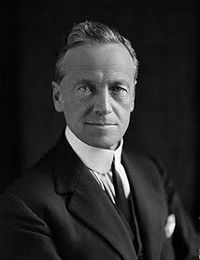
Honorable Walter Edward Guinness (1944)
Walter Edward Guinness, 1st Baron Moyne, DSO & Bar, TD, PC (29 March 1880 – 6 November 1944), was a British Conservative politician, soldier and businessman. He served as the British minister of state in the Middle East until November 1944, when he was assassinated by the Zionist terrorist group Lehi in Cairo. The assassination of Lord Moyne sent shock waves through Palestine and the rest of the world. [1]
He was an advocate of compromise between Arabs and Jews in Palestine and his death hastened the onset of a conflict in Israel-Palestine that continues to this day.
Assassination
In the early afternoon of 6 November 1944, Eliyahu Bet-Zuri and Eliyahu Hakim of the Jewish terrorist group Lehi waited for Moyne near his home in Cairo following a well-planned and much practised plan of action to assassinate Moyne.[67][68]
Moyne arrived in his car with his driver, Lance Corporal Arthur Fuller, his secretary, Dorothy Osmond, and his ADC, Major Andrew Hughes-Onslow. The ADC went to open the front door of the residence and the driver got out to open the door for Moyne. They were suddenly told not to move, as Bet-Zuri emerged and shot Fuller in the chest, causing him to collapse in the driveway and bleed to death in minutes. Hakim then pulled the car door open and shot Moyne three times. The first bullet hit him in the neck on the right side, just above the clavicle, the second penetrated his abdomen, punctured his colon and large intestine, and became embedded to the right of the second lumbar vertebrae, while the third shot, fired after Moyne raised his right hand, ripped across four of his fingers and went in and out of his chest, causing no serious injuries.[69]
Hakim and Bet-Zuri ran out of the yard, jumped on their rented bicycles, and began pedalling down the street away from the scene. Major Hughes-Onslow rushed to the sentry box and raised the alarm. Hearing it, Hakim and Bet-Zuri turned onto a side street. They had very nearly gotten away when an Egyptian motorcycle policeman, El-Amin Mahomed Abdullah, caught up to them. Bet-Zuri fired a volley of warning shots in his direction, which he ignored. Abdullah then dismounted and ordered him to drop his weapon. Bet-Zuri attempted to shoot out the motorcycle's tires but found that his pistol had run out of ammunition, and as he attempted to reload it, Abdullah fired, hitting Bet-Zuri in the chest. Hearing the commotion, Hakim turned back to help Bet-Zuri, and within minutes, another policeman appeared, and the two were placed under arrest.[69]
Meanwhile, Moyne regained consciousness, and in a few minutes, a doctor and ambulance arrived. Moyne was rushed to a British military hospital in Cairo and admitted at 1:40 p.m., in critical condition, having lost a great deal of blood through gross haemorrhaging and suffering from shock. Five minutes later, he was given the first of three blood transfusions, causing his condition to improve. After he complained of a burning sensation down his right leg and an inability to move it, X-rays revealed an injury to his thoracic vertebrae. Later, his right arm also became paralyzed as a result of the neck wound. Doctors were reluctant to operate until his condition improved, but at 5:30, a lumbar puncture revealed a bloodstain, and it was decided to operate. He was given another blood transfusion, and in the operation that followed, surgeons removed the bullet lodged near the second lumbar vertebra and discovered the injuries to the colon and large intestine, while the neck wound and finger wounds were cleaned. Soon after the operation, his condition began to deteriorate, and he died at 8:40 pm, aged 64.[69]
As the principal witness at the trial, Major Hughes-Onslow became a marked man and was sent to Aden and then to Khartoum for his safety. He subsequently said, "No doubt Lord Moyne could have been regarded as a target for political assassination, but the shooting of the chauffeur was pure murder."[70][71]
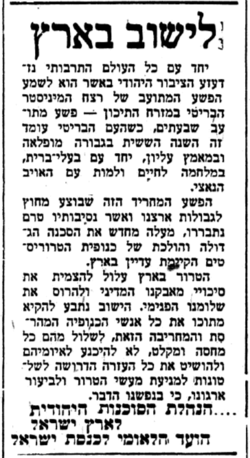
Condemnation of the assassination by official Jewish organizations[66]
Moyne's body was flown home to England and cremated on 17 November at Golders Green Crematorium.[72] His will was proven on 2 December, with his estate valued at £2 million (equivalent to £76,681,040 in 2025).[73][74]
According to a member of the Lehi's three-man executive, Natan Yellin-Mor, the group's founder Ya'ir Stern had considered the possibility of assassinating the British Minister Resident in the Middle East as early as 1941 before Moyne held the position.[75] Moyne's predecessor Richard Casey was deemed unsuitable because he was Australian.[76] When Moyne replaced Casey in 1944, planning for the operation began.
As well as being the highest British official within Lehi's reach, Moyne was regarded as personally responsible for Britain's Palestine policy. In particular, he was regarded as one of the architects of Britain's strict immigration policy, and to have been responsible for the British hand in the Struma disaster,[75] which followed a refusal to grant visas to Palestine for its Jewish refugee passengers, decided during his time as Colonial Secretary.[72] According to Bell, Lord Moyne was believed by the underground to be an Arabist, who had consistently followed an anti-Zionist line.[77]
However, according to Yellin-Mor:[78]
"Really these acts by Lord Moyne were without meaning for us. They were useful only as propaganda, because they allowed us to explain to the people why we had killed him. What was important to us was that he symbolized the British Empire in Cairo. We weren't yet in a position to try to hit Churchill in London, so the logical second best was to hit Lord Moyne in Cairo."
According to Yaakov Banai (Mazal), who served as the commander of the fighting unit of Lehi, there were three purposes in the assassination:[79]
- To show the world that this conflict was not between a government and its citizens as Britain had tried to show but between citizens and a foreign ruler.
- To demonstrate that the conflict was between the Jewish people and British Imperialism.
- To take the "War of Liberation" out of the Land of Israel and the Yishuv. The trial was not planned, but the action had to capture a place in the world press and lead political thoughts.
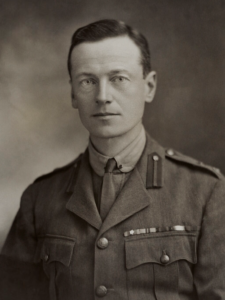
The Stern Gang
By 1941 Lord Moyne had served in various posts which included Kenya and as acting secretary of the Polish Relief Fund. He celebrated Empire Day (24th of May) by speaking on the colonies, protectorates, and mandated territories that the world war had given a new strength and power to Empire Unity
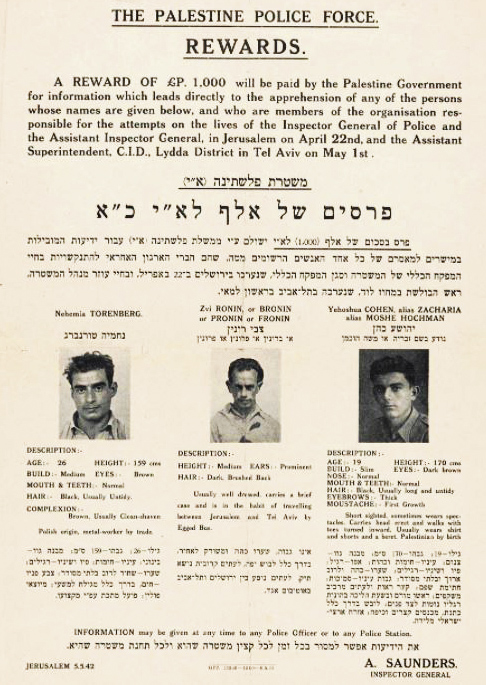
Minister resident in the Middle East
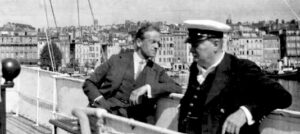
Moyne and Churchill, the two were personal friends.
Lesser men may have been dismayed by the turn of events. However, Lord Moyne remained resolute in his belief in compromise between Jews and Arabs. He dismissed his Egyptian police escort and a police guard that was stationed at his house day and night.
In November 1944, Moyne was assassinated near his office in Cairo by two criminal members of Lehi or the ‘Stern gang’. They were later hanged.
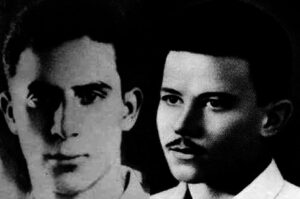
In November 1944 (just three months after the attempt on High Commissioner Mac Michael’s life) two Stern Gang members, Eliahu Hakim and Eliyahu Bet-Zuri waited for Lord Moyne near his Cairo residence when he was shot in the neck, chest and abdomen as he stepped into his automobile in front of his home. His chauffer was killed instantly. Lord Moyne had once survived the gun. This time the overseer of limited Jewish immigration expired in a British military hospital in Cairo -several hours after the event The murderers themselves narrowly escaped lynching at the hands of Egyptian passers-by and they were apprehended soon after.
The aftermath
Although the group had been targeting British Mandate personnel since 1940, Moyne was the first high-profile British official to be killed by them, though several failed attempts had been made to assassinate the British High Commissioner in Palestine, Sir Harold MacMichael. This was therefore the opening shot in the new Lehi campaign.
British prime minister Winston Churchill, who once described himself as a "Zionist,"[84] taking the view that the creation of a Jewish state in Palestine would provide Britain with a more reliable and powerful ally,[78] for the time-being tempered his support for Zionism.[85][86] Moyne had been sent to Cairo because of their long personal and political friendship, and Churchill told the House of Commons:
If our dreams for Zionism are to end in the smoke of assassins' pistols and our labours for its future to produce only a new set of gangsters worthy of Nazi Germany, many like myself will have to reconsider the position we have maintained so consistently and so long in the past. If there is to be any hope of a peaceful and successful future for Zionism, these wicked activities must cease, and those responsible for them must be destroyed root and branch. [...] In Palestine the executive of the Jewish Agency have called upon the Jewish community—and I quote their actual words: 'To cast out the members of this destructive band, deprive them of all refuge and shelter, to resist their threats, and to render all necessary assistance to the authorities in the prevention of terrorist acts, and in the eradication of the terrorist organisation.' These are strong words, but we must wait for these words to be translated into deeds.[87]
Referring to Lord Moyne, he also added, "I can assure the House that the Jews in Palestine have rarely lost a better or more well-informed friend."[88]
[1] https://en.wikipedia.org/wiki/Walter_Guinness,_1st_Baron_Moyne