
Honorable Folke Bernadotte (1948)
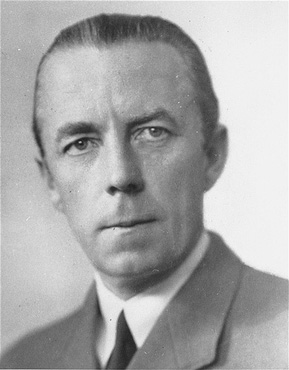
Folke Bernadotte, Count of Wisborg (Swedish: [fɔ̂l.kɛ̂ bæɳaˈdɔtː]; 2 January 1895 – 17 September 1948) was a Swedish nobleman and diplomat. In World War II, he negotiated the release of about 450 Danish Jews and 30,550 non-Jewish prisoners of many nations from the Nazi German Theresienstadt Ghetto.[a] They were released on 14 April 1945.[4][5] In 1945 he received a German surrender offer from Heinrich Himmler, though the offer was ultimately rejected by the allies.
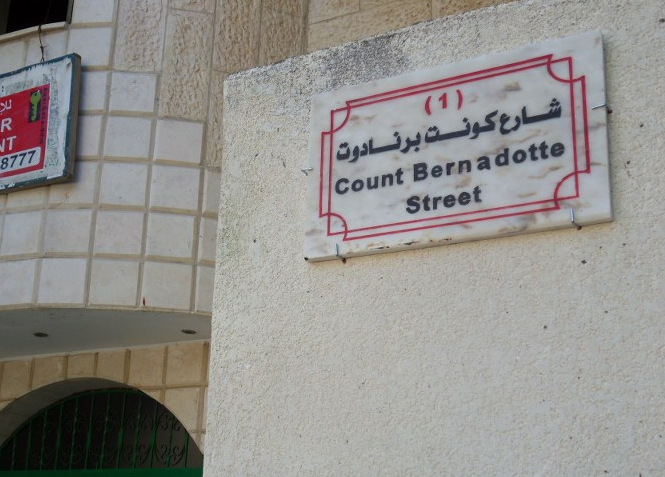
Count Bernadotte street sign in Gaza City, Gaza Strip
After the war, Bernadotte was unanimously chosen to be the United Nations Security Council mediator in the Arab–Israeli conflict of 1947–1948.
He was assassinated in Jerusalem in 1948 by the Zionist terror group Lehi while pursuing his official duties. Upon his death, Ralph Bunche took up his work at the UN, mediating the 1949 Armistice Agreements between Israel and Egypt.
Folke Bernadotte was born in Stockholm into the House of Bernadotte, the Swedish royal family. His father, Prince Oscar Bernadotte, Count of Wisborg (formerly Prince Oscar of Sweden, Duke of Gotland), was the second son of King Oscar II of Sweden; his mother, Ebba Munck af Fulkila, had been a lady-in-waiting to Victoria of Baden, the wife of Crown Prince Gustaf. Oscar had married Ebba without the consent of the King, and so was forced to renounce his Swedish titles; in 1892, he was granted the titles of Prince Bernadotte and Count of Wisborg by his uncle, Adolphe, Grand Duke of Luxembourg.[6][7]
Bernadotte attended school in Stockholm, after which he entered training to become a cavalry officer at the Royal Military Academy. He took the officer's exam in 1915, was commissioned a lieutenant in 1918, and subsequently was promoted to the rank of major.
UN mediator
In 1948, Bernadotte played a central but brief role in the expanding Arab-Israeli conflict, a role which culminated in his assassination.
On November 29, 1947, the United Nations passed Resolution 181 for the Partition of Palestine, endorsing an independent Jewish state. Violence immediately broke out between Jewish and Arab fighters; this first phase of conflict, known as the 1947–1948 Civil War in Mandatory Palestine, lasted until May 14, 1948, when the Zionist leadership proclaimed the independent State of Israel and Britain began the termination of its 27-year control of Palestine. Arab nations bordering Israel immediately joined the battle on the Palestinian Arabs side, marking the commencement of the 1948 Arab–Israeli War. The United Nations Security Council demanded an immediate cease-fire, and the secretary general appointed Bernadotte as "United Nations Mediator in Palestine."[18]
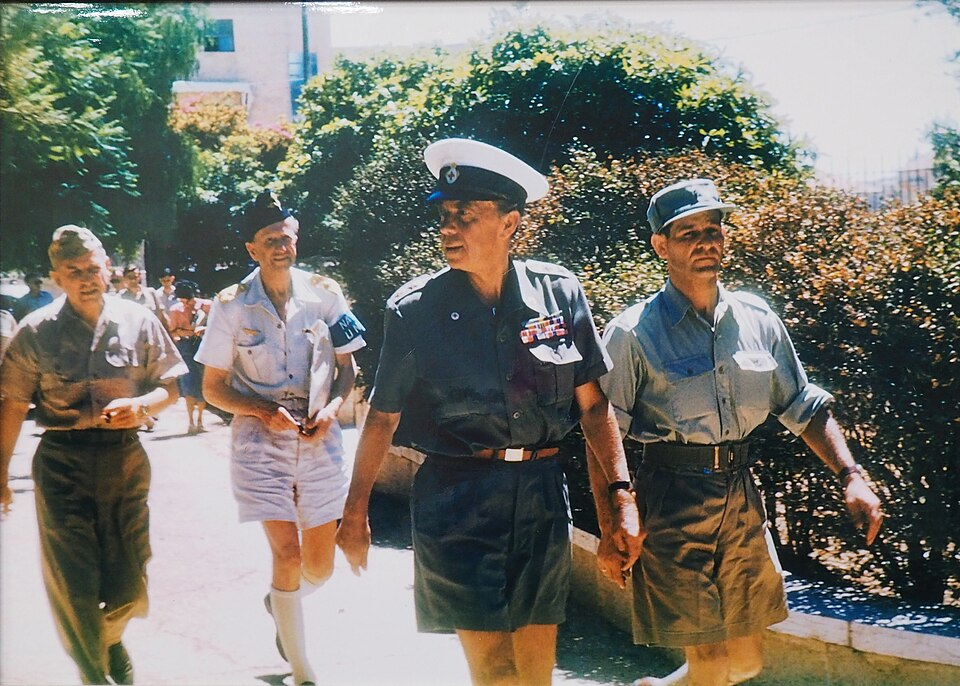
Folke Bernadotte in 1948
It was the first official mediation in the UN's history - Bernadotte's assignment was to effect a cease-fire between the Zionist and Arab forces and then seek a peaceful resolution by proposing partition plans.[19] Bernadotte succeeded in achieving an initial truce, which went into effect on June 11 and lasted until July 8.
Achieving a satisfactory resolution to the conflict was significantly more difficult; Bernadotte wrote that "in putting forward any proposal for the solution of the Palestine problem, one must bear in mind the aspirations of the Jews, the political difficulties and differences of opinion of the Arab leaders, the strategic interests of Great Britain, the financial commitment of the United States and the Soviet Union, the outcome of the war, and finally the authority and prestige of the United Nations."[20][21]
His final report, submitted to the United Nations in September, proposed that the Negev was to become Arab territory and the western Galilee, intended for the Arab state in the partition plan, would be included in the Jewish state.[22] The disposition of the Arab part of Palestine was to be decided by the Arab states in consultation with the Palestinian Arabs, with a recommendation of a merger with Transjordan.[22]
Assassination
_family_grave_2007.jpg)
Prince Oscar Bernadotte's family tomb at the Northern Cemetery in Stockholm where the remains of Folke Bernadotte also are interred
On Friday 17 September 1948, four members of the Zionist paramilitary militant organization Lehi, sometimes referred to in the West as the Stern Gang, dressed in the uniforms of IDF soldiers and attacked Bernadotte's UN convoy as it drove through West Jerusalem, killing him as well as the French officer riding next to him, Colonel André Serot.
Planning and background
The Stern Gang saw Bernadotte as a puppet of the British and the Arabs and therefore a serious threat to the emerging State of Israel.[23]: 239–255 Since a truce was in force, Lehi feared that the Israeli leadership would agree to Bernadotte's peace proposals, which it considered disastrous.[23]: passim [24] The group was unaware the Israeli government had already decided to reject Bernadotte's plan.[3]: 200–201 [25]
The killing was approved by the three-man 'center' of Lehi: Yitzhak Yezernitsky (the future Prime Minister of Israel Yitzhak Shamir), Nathan Friedmann (also called Natan Yellin-Mor) and Yisrael Eldad (also known as Scheib). A fourth leader, Emmanuel Strassberg (Hanegbi) was also suspected by the Israeli Prime Minister David Ben-Gurion of being part of the group that ordered the assassination.[3]: 194 [26][27][28] The assassination was planned by Lehi's Jerusalem operations chief, Yehoshua Zettler.[29]
The attack
In the Katamon quarter, we were held up by a Jewish Army type jeep placed in a road block and filled with men in Jewish Army uniforms. At the same moment, I saw an armed man coming from this jeep. I took little notice of this because I merely thought it was another checkpoint. However, he put a Tommy gun through the open window on my side of the car, and fired point blank at Count Bernadotte and Colonel Serot. I also heard shots fired from other points, and there was considerable confusion. [...]
Colonel Serot fell in the seat in back of me, and I saw at once that he was dead. Count Bernadotte bent forward, and I thought at the time he was trying to get cover. I asked him: 'Are you wounded?' He nodded, and fell back. [...]
When we arrived [at the Hadassah hospital] I carried the Count inside and laid him on the bed [...] I took off the Count's jacket and tore away his shirt and undervest. I saw that he was wounded around the heart and that there was also a considerable quantity of blood on his clothes about it.
When the doctor arrived, I asked if anything could be done, but he replied that it was too late.
— General Åge Lundström, who was in the UN vehicle[30]
A four-man team, consisting of Yehoshua Cohen, Yitzhak Ben-Moshe (Markovitz), Avraham Steinberg, and Meshulam Makover, ambushed Bernadotte's motorcade in Jerusalem's Katamon neighborhood. The team left a Lehi base in a Jeep and set up a makeshift roadblock at Ben Zion Guini Square, off Hapalmach Street, and waited in the jeep. When Bernadotte's motorcade approached, Cohen, Ben-Moshe, and Steinberg got out and approached it, while Makover, the driver, remained in the jeep. Captain Moshe Hillman, the motorcade's Israeli liaison officer, who was sitting in the leading UN vehicle, called out in Hebrew to let them through, but was ignored.
Cohen came up to Bernadotte's sedan and fired through an open window, pumping six shots into Bernadotte's chest, throat and arms and 18 into Colonel André Serot who was seated to his left, killing both.[5] Serot had swapped places in the motorcade to join Bernadotte - they had become friends after Bernadotte was instrumental in saving Serot's wife's life in a German concentration camp.[5] Ben-Moshe and Steinberg shot at the tires of the UN vehicles, while Cohen finished the magazine by firing at the radiator. The driver of the sedan, Colonel Frank M. Begley, got out and tried to grapple with Cohen as he fired his last shots, but was burned in the face by the gun flashes. Ben-Moshe and Steinberg then rushed back and mounted the jeep, which quickly accelerated down a side road, while Cohen ran away from the scene across a roadside field.[29][31][32][33]
All four members of the hit team made it to the religious community of Shaarei Pina, where they hid with local Haredi sympathizers. After a few days in hiding, they fled to Tel Aviv in the back of a furniture truck.[34]
Following the shooting, Bernadotte's car sped to Hadassah Mount Scopus Hospital, despite damage to the radiator; the lead vehicle followed as its tires came apart. At the hospital, Bernadotte was pronounced dead. His body was moved to the YMCA, after which it was taken to Haifa and flown back to Sweden. Bernadotte was granted a state funeral, Abba Eban attended on behalf of Israel. Bernadotte was survived by a widow and two sons, a 12-year-old and a 17-year-old. He was buried in Prince Oscar Bernadotte's family tomb at the Northern Cemetery in Stockholm.[35]
Investigation
The Israel Police, along with the military police and security services, investigated the assassination, but failed to identify any of the participants in the assassination, and the case was eventually closed without any of the participants having been identified. It has been suggested that the reasons for the failure of the investigation were poor coordination between these bodies, which resulted in information that may have assisted the police not being turned over to them, and the lack of proficiency among police officers and investigators in the early days of the Israel Police.[36] The murder case was identified as 148/48 in Israeli police records.[37]
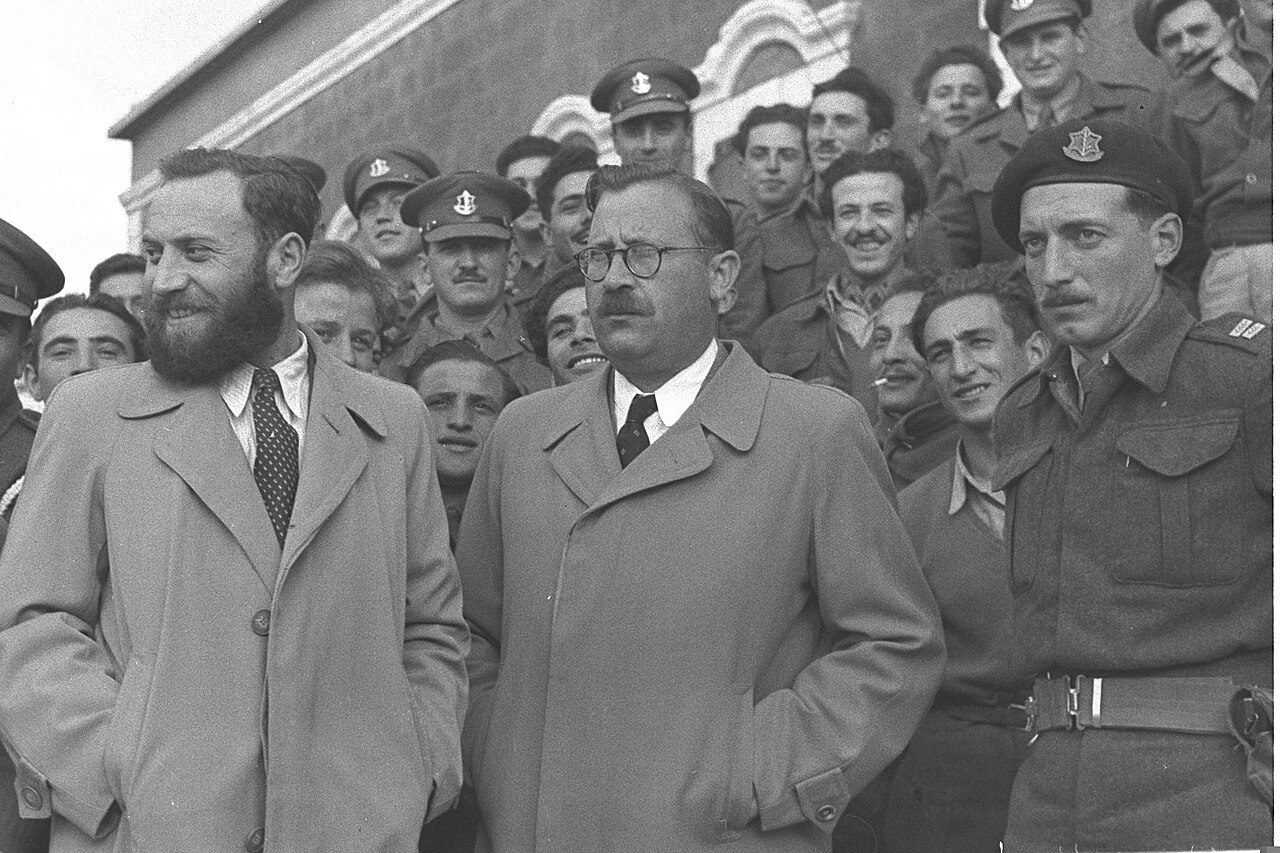
Natan Yellin-Mor (center) and Matityahu Shmueliwitz in front of the Acre prison, after their release in 1949
Lehi leaders initially denied responsibility for the attack.[38] Only later did Lehi take responsibility for the killings in the name of Hazit Hamoledet (the Homeland Front), a name they copied from a war-time Bulgarian resistance group.[d][23]: 252–253
In the wake of universal condemnation of the killing, Israeli Prime Minister David Ben-Gurion moved to shut down the Irgun and Lehi.[40] While the underground organizations had by then mostly been integrated into the IDF, especially after the Altalena Affair, they had retained an independent presence in Jerusalem. With Bernadotte's assassination, the Israeli government lost its last remaining tolerance for them and passed the Ordinance to Prevent Terrorism. Lehi was declared a terrorist organization and many of its members were arrested.[41][42] In addition, an ultimatum was issued to the Irgun to fully integrate into the IDF or be destroyed, and IDF troops surrounded the Irgun camp in Jerusalem. The Irgun accepted the ultimatum, and its fighters subsequently turned over their arms and enlisted in the IDF.[43][44]
Yellin-Mor and another Lehi member, Mattityahu Shmulevitz, were charged with belonging to a terrorist organization. They were found guilty but immediately released and pardoned. Yellin-Mor had meanwhile been elected to the first Knesset.[23]: 261–270 Betty Knut-Lazarus, a Lehi militant, and the granddaughter of composer Alexander Scriabin, was also imprisoned for being allegedly involved in the killing, before being subsequently released.[45]
Years later, Cohen's role was uncovered by David Ben-Gurion's biographer Michael Bar Zohar, while Cohen was working as Ben-Gurion's personal bodyguard. The first public admission of Lehi's role in the killing was made on the anniversary of the assassination in 1977.[46] The statute of limitations for the murder had expired in 1971.[27][3]: 193 In 1988, two years after Cohen's death, Zettler and Makover publicly confessed their role in the assassination and confirmed that Cohen had killed Bernadotte.[37] In the late 1960s, Israeli journalist Baruch Nadel published a book in which he also claimed to have taken part in planning the murder.[47]
The weapon which was used in the assassination (an MP 40, serial number 2581)[37] was lost, and was only found again in 2018 during an inventory check in the Heritage House of the Israel Police [he], when an unidentified box was found to contain an MP 40 machine pistol and the curator, Shlomi Shitrit, decided to identify the history of the weapon. Prior to finding it, it was believed to have been destroyed.