
Digital Financialization by Secrecy
Financialization Tyranny
In our digital age, in our Digital Financialization [1] age the Information Asymmetry is the core foundation of most tyrannies.
Phrases like "knowledge is power" became "information is power" and now reborn as "Information is gold" [2]. If information is the measure of modern power and wealth, then the asymmetry of information accessibility provides a tool for expansion of tyranny, old or new.
To correlate the tyranny to financialization, first we need to study the 1980s innovations of Financialized Capitalism [3] which begot the widespread global Digial Financialization.
Once there are digital networks in place to Financialize the capital, then asymmetric information access is a must to accumulate wealth, and the kind of wealth rooted in tyranny and begets only tyrannies and tyrants abound.
What is Financialization?
- Summarised by Lapavitsas [4] as "profiting without producing"
- Financialized Capitalism [3] is being exploitative by supplying (vast) income to non-laborers
- Financialization describes an economic process by which exchange is facilitated through the intermediation of Financial Instruments
- Rather than focusing on making products or developing new services, many businesses now generate significant profits through financial activities (See Background)
"profiting without producing": guys who know no software or any computing and lead and profit from large software companies under their command! Imagine the heads of radiology department in a large medical facility who know nothing about medicine! And are paid vasts sums of money and shares in this medical business!
"supplying income to non-laborers": multitudes of highly lucrative financial services which thirty years ago did not exist yet today their staff and management make vast sums of money for secretarial or mostly data-entry office activities!
"financial instrument": A financial instrument [6] is a monetary contract between parties. They can be created, traded, modified and settled. They can be cash (currency), evidence of an ownership interest in an entity or a contractual right to receive or deliver in the form of currency (forex); debt (bonds, loans); equity (shares); or derivatives (options, futures, forwards).
Financial Supremacy through Information Asymmetry
- If digital paperwork and signing digital contracts somehow translates to profit and actual money in traditional bank accounts, then if someone(s) control the flow and distribution of information and availability of the digital paperwork and signing digital contracts then a few can amass large wealth, hence the inexorable link between information asymmetry and financial power
- Hedge fund managers, or massive retirement pension companies as examples, in secretive meetings with state and federal officials ,and more frequently these days with actual heads of states discuss secretive measures or new initiatives or simply insider-trading kinds of information exchange which both sides hugely benefit and even profit from and yet the ordinary people intentionally and tyrannically are left out in the dark!
Secrecy in the hands of few
Secrecy -> Information Asymmetry -> Financial Supremacy -> Financialization -> Digital Contracts/Instruments -> Tyranny
---
Background
Rather than focusing on making products or developing new services, many businesses now generate significant profits through financial activities like stock buybacks, complex derivatives, and other monetary instruments. Nothing better shows this long trend, perhaps, than the rise of cryptocurrencies—financial assets whose promise for practical uses is always somehow over the horizon but whose speculative returns can be felt today. [5]
Financialization in the US
Total US Financial Assets as a Percentage of Gross Domestic Product (GDP) Since 1960
This chart tells us that for every $1 there is $4-$5 bogus paper money which has no backing by any asset!
This chart depicts the growth of the financial sector relative to the real economy in the U.S. over time, as measured by the ratio of total financial assets held by U.S. households and businesses to GDP. The increasing ratio over time means the financial sector is growing faster than the real economy, implying that a larger proportion of economic activity is related to the trading and holding of financial assets than the production of goods and services.
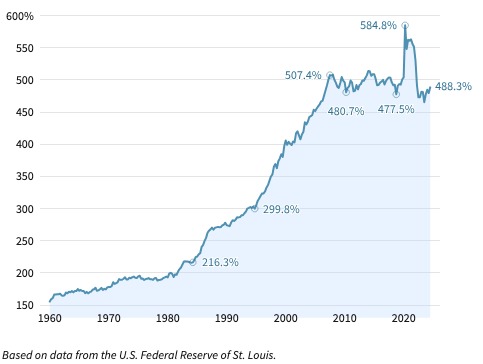
TODO: Code this chart from actual data source.
[1] https://en.wikipedia.org/wiki/Financialization
[2] https://www.forbes.com/councils/forbesfinancecouncil/2020/06/18/information-is-the-new-gold/
[3] https://en.wikipedia.org/wiki/Finance_capitalism
[4] https://www.tandfonline.com/doi/full/10.1080/13604813.2013.853865
[5] https://www.investopedia.com/terms/f/financialization.asp
[6] https://en.wikipedia.org/wiki/Financial_instrument