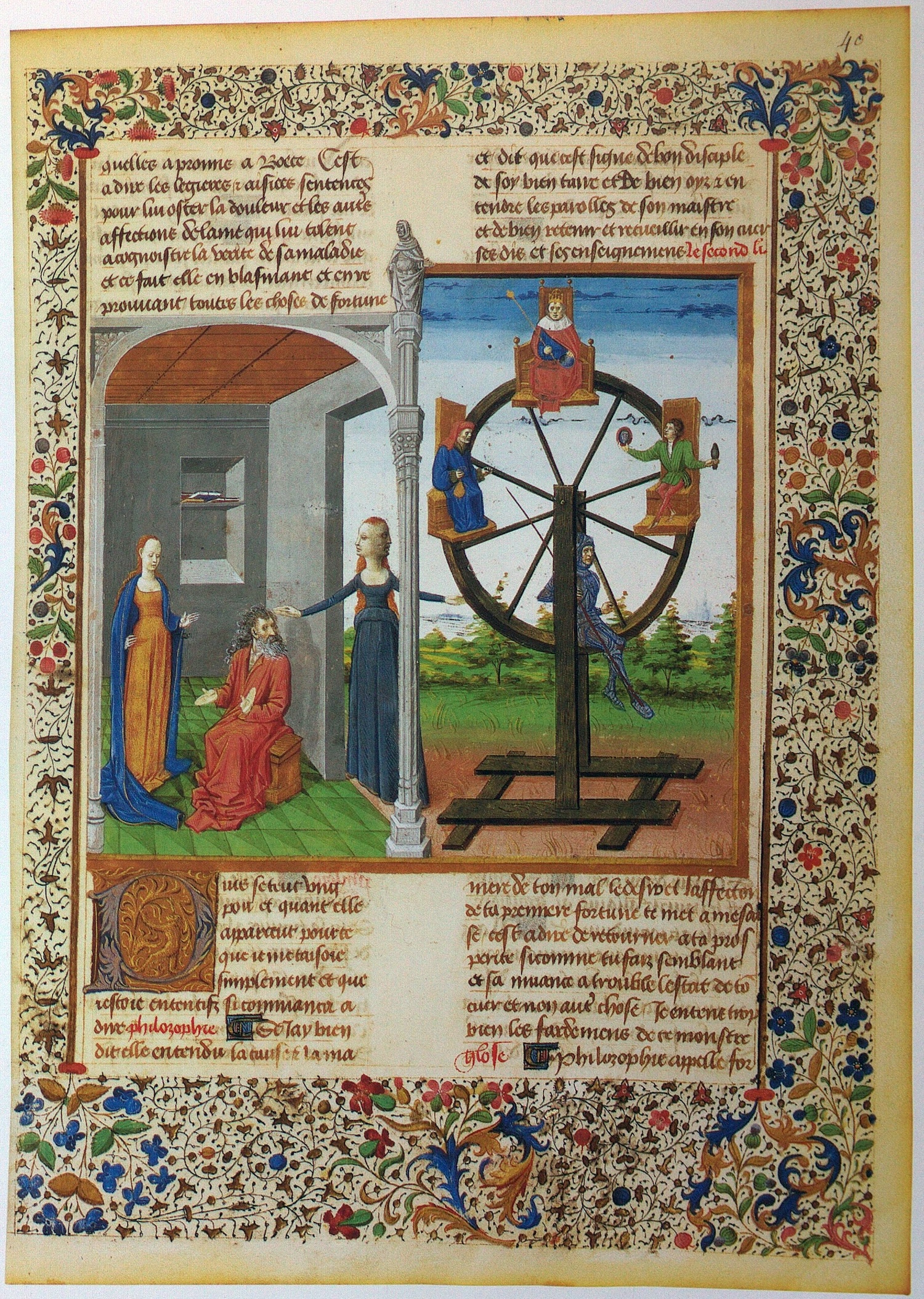
The Lady Philosophy
On the Consolation of Philosophy was written in AD 523 during a one-year imprisonment Boethius served while awaiting trial—and eventual execution—for the alleged crime of treason under the Ostrogothic King Theodoric the Great. Boethius was at the very heights of power in Rome, holding the prestigious office of magister officiorum, and was brought down by treachery. This experience inspired the text, which reflects on how evil can exist in a world governed by God (an example of theodicy), and how happiness is still attainable amidst fickle fortune, while also considering the nature of happiness and God. In 1891, the academic Hugh Fraser Stewart described the work as "by far the most interesting example of prison literature the world has ever seen."

Boethius writes the book as a conversation between himself and a female personification of philosophy, referred to as "Lady Philosophy". Philosophy consoles Boethius by discussing the transitory nature of wealth, fame, and power ("no man can ever truly be secure until he has been forsaken by Fortune"), and the ultimate superiority of things of the mind, which she calls the "one true good". She contends that happiness comes from within, and that virtue is all that one truly has because it is not imperiled by the vicissitudes of fortune.
Boethius engages with the nature of predestination and free will, the problem of evil and the "problem of desert", human nature, virtue, and justice. He speaks about the nature of free will and determinism when he asks whether God knows and sees all, or whether man has free will. On human nature, Boethius says that humans are essentially good, and only when they give in to "wickedness" do they "sink to the level of being an animal." On justice, he says criminals are not to be abused, but rather treated with sympathy and respect, using the analogy of doctor and patient to illustrate the ideal relationship between prosecutor and criminal.