Craniometry
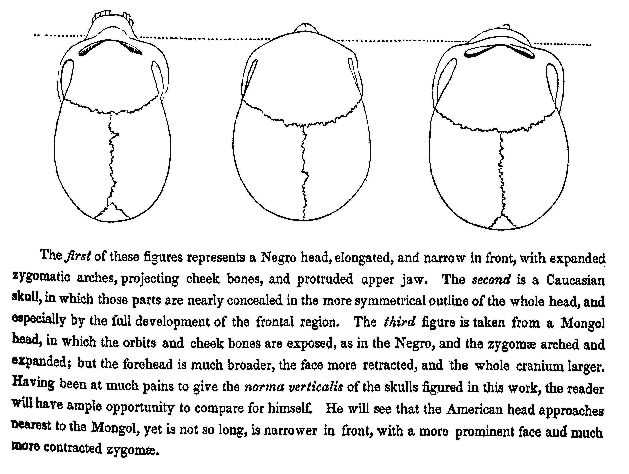
The Mismeasure of Man is a critical analysis of the early works of scientific racism which promoted "the theory of unitary, innate, linearly rankable intelligence"—such as craniometry, the measurement of skull volume and its relation to intellectual faculties. Gould alleged that much of the research was based largely on racial and social prejudices of the researchers rather than their scientific objectivity; that on occasion, researchers such as Samuel George Morton (1799–1851), Louis Agassiz (1807–1873), and Paul Broca (1824–1880), committed the methodological fallacy of allowing their personal a priori expectations to influence their conclusions and analytical reasoning. Gould noted that when Morton switched from using bird seed, which was less reliable, to lead shot to obtain endocranial-volume data, the average skull volumes changed; however, these changes were not uniform across Morton's "racial" groupings. To Gould, it appeared that unconscious bias influenced Morton's initial results.[7] Gould speculated,
Plausible scenarios are easy to construct. Morton, measuring by seed, picks up a threateningly large black skull, fills it lightly and gives it a few desultory shakes. Next, he takes a distressingly small Caucasian skull, shakes hard, and pushes mightily at the foramen magnum with his thumb. It is easily done, without conscious motivation; expectation is a powerful guide to action.[8]
In 1977 Gould conducted his own analysis on some of Morton's endocranial-volume data, and alleged that the original results were based on a priori convictions and a selective use of data. He argued that when biases are accounted for, the original hypothesis—an ascending order of skull volume ranging from Blacks to Mongols to Whites—is unsupported by the data.
The "species" of man: "a Negro head . . . a Caucasian skull . . . a Mongol head", by S. G. Morton (1839)