
The assassination of Walter Edward Guinness - Lord Moyne – 1944
The foundation stone of a building at Trinity College Dublin was laid by the Hon. Grania Guinness of the philanthropic brewing family in February of 1950. Grania named the Institute of Preventative Medicine ‘Moyne’ in memorial to her late father Baron Moyne.
Dublin-born Walter Edward Guinness, later1st knownBaron asMoyne, LordDSO Moyne,& Bar, TD, PC (29 March 1880 – 6 November 1944), was a British Conservative politician, soldier and businessman. He served as the British Secretaryminister forof State for the Colonies and Minister Residentstate in the Middle East,East until November 1944, when he was assassinated by the criminalZionist militantterrorist Zionistgroup group,Lehi Lehi in JerusalemCairo. onThe Novemberassassination 6,of 1944.Lord HisMoyne deathsent wasshock onewaves through Palestine and the rest of the blood-soaked steps on the road to the British withdrawal from their Mandate in Palestine in 1948 and the creation of the state of Israel.world.
He was an advocate of compromise between Arabs and Jews in Palestine and his death hastened the onset of a conflict in Israel-Palestine that continues to this day.
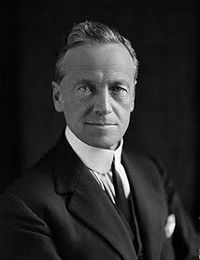
LordAssassination
In the early afternoon of 6 November 1944, Eliyahu Bet-Zuri and PalestineEliyahu
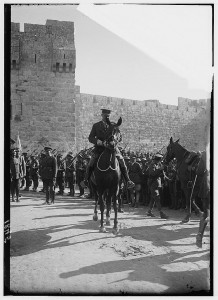
British troops enter Jerusalem in 1917.
British forces had conquered muchHakimmiddleJewish east,terrorist takinggroup itLehi waited for Moyne near his home in Cairo following a well-planned and much practised plan of action to assassinate Moyne.[67][68]
Moyne arrived in his car with his driver, Lance Corporal Arthur Fuller, his secretary, Dorothy Osmond, and his ADC, Major Andrew Hughes-Onslow. The ADC went to open the front door of the residence and the driver got out to open the door for Moyne. They were suddenly told not to move, as Bet-Zuri emerged and shot Fuller in the chest, causing him to collapse in the driveway and bleed to death in minutes. Hakim then pulled the car door open and shot Moyne three times. The first bullet hit him in the neck on the right side, just above the clavicle, the second penetrated his abdomen, punctured his colon and large intestine, and became embedded to the right of the second lumbar vertebrae, while the third shot, fired after Moyne raised his right hand, ripped across four of his fingers and went in and out of his chest, causing no serious injuries.[69]
Hakim and Bet-Zuri ran out of the yard, jumped on their rented bicycles, and began pedalling down the street away from the Ottomanscene. EmpireMajor duringHughes-Onslow rushed to the Firstsentry Worldbox War,and includingraised the newalarm. statesHearing it, Hakim and Bet-Zuri turned onto a side street. They had very nearly gotten away when an Egyptian motorcycle policeman, El-Amin Mahomed Abdullah, caught up to them. Bet-Zuri fired a volley of Iraq,warning Jordanshots in his direction, which he ignored. Abdullah then dismounted and Palestine.ordered him to drop his weapon. Bet-Zuri attempted to shoot out the motorcycle's tires but found that his pistol had run out of ammunition, and as he attempted to reload it, Abdullah fired, hitting Bet-Zuri in the chest. Hearing the commotion, Hakim turned back to help Bet-Zuri, and within minutes, another policeman appeared, and the two were placed under arrest.[69]
TheMeanwhile, mandateMoyne issuedregained byconsciousness, and in a few minutes, a doctor and ambulance arrived. Moyne was rushed to a British military hospital in Cairo and admitted at 1:40 p.m., in critical condition, having lost a great deal of blood through gross haemorrhaging and suffering from shock. Five minutes later, he was given the Leaguefirst of Nationsthree blood transfusions, causing his condition to improve. After he complained of a burning sensation down his right leg and an inability to move it, X-rays revealed an injury to his thoracic vertebrae. Later, his right arm also became paralyzed as a result of the neck wound. Doctors were reluctant to operate until his condition improved, but at 5:30, a lumbar puncture revealed a bloodstain, and it was decided to operate. He was given another blood transfusion, and in the operation that followed, surgeons removed the bullet lodged near the second lumbar vertebra and discovered the injuries to the colon and large intestine, while the neck wound and finger wounds were cleaned. Soon after the Firstoperation, Worldhis Warcondition gavebegan Britainto full administrative control over the region[20]deteriorate, and includedhe provisionsdied forat establishing8:40 apm, homelandaged for the Jews in Palestine (in accordance with the Balfour declaration of 1917) which went into effect in 1923.
However, there was, as yet no rush of eager Jewish volunteers to build up the ‘’national homeland’’; on the contrary, an average of only eight or nine thousand Jewish immigrants a year came to Palestine between 1920 and 1932. Yet from 1933 onwards, however, this changed dramatically, with the Nazis in control in Berlin.64.[21]69]
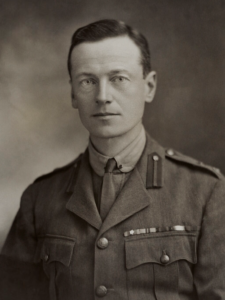
Thethe Arabprincipal population of Palestine, alarmedwitness at the influxtrial, Major Hughes-Onslow became a marked man and was sent to Aden and then to Khartoum for his safety. He subsequently said, "No doubt Lord Moyne could have been regarded as a target for political assassination, but the shooting of the chauffeur was pure murder."[70][71]
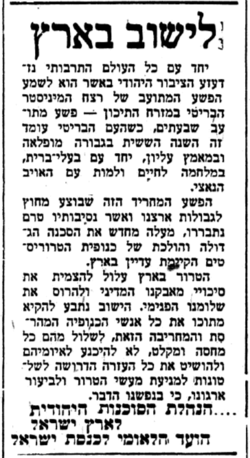
Condemnation of the assassination by official Jewish immigrants,organizations[66]
Moyne's enbody masse,was flown home to England and cremated on 17 November at Golders Green Crematorium.[72] His will was proven on 2 December, with his estate valued at £2 million (equivalent to £76,681,040 in 19362025).[73][74]
According thisto ushereda in three yearsmember of strifethe asLehi's theythree-man triedexecutive, toNatan end British rule while endeavouring to establish Arab independence and an end to Jewish immigration. The British putYellin-Mor, the revoltgroup's downfounder harshly,Ya'ir butStern alsohad decided thereafter to limit Jewish immigration in order to try to prevent further conflict.
Nevertheless,considered the Second World War found the three protagonists, the British, the Arabs, and the Zionists unreconciled. Furthermore, the most militant Zionist organisations now began a campaignpossibility of political violence againstassassinating the British authorities, who, though they had overseen the establishment of Jewish settlement in Palestine, they now viewed as blocking their dream for a Jewish state there.
Yitzhak Shamir, a leading member of Stern gang and later Prime Minister of Israel (and according to Dr. Shavit, the chief planner of the murder of Lord Moyne) noted that the relations between their mandatory authorities and our ‘state within a state’, ‘tended to be schizophrenic at best’.
Meanwhile, the Arabs viewed the Jewish influx as part of a European colonial movement, and the period was marred by violence on all sides. The Irish Examiner, for instance, reported an incident in June of 1939 in which Jews raced through the streets in fast cars like American screen gangsters pouring out a stream of led that killed twelve Arabs, wounded four others and one Jew.
It was this complex, three-sided conflict that Lord Moyne came to preside over in Palestine as resident minister of state in 1942 and British ‘Minister-Resident’Resident in the Middle East 1944.as early as 1941 before Moyne held the position.[75] Moyne's predecessor Richard Casey was deemed unsuitable because he was Australian.[76] When Moyne replaced Casey in 1944, planning for the operation began.
As well as being the highest British official within Lehi's reach, Moyne was regarded as personally responsible for Britain's Palestine policy. In particular, he was regarded as one of the architects of Britain's strict immigration policy, and to have been responsible for the British hand in the Struma disaster,[75] which followed a refusal to grant visas to Palestine for its Jewish refugee passengers, decided during his time as Colonial Secretary.[72] According to Bell, Lord Moyne was believed by the underground to be an Arabist, who had consistently followed an anti-Zionist line.[77]
However, according to Yellin-Mor:[78]
"Really these acts by Lord Moyne were without meaning for us. They were useful only as propaganda, because they allowed us to explain to the people why we had killed him. What was important to us was that he symbolized the British Empire in Cairo. We weren't yet in a position to try to hit Churchill in London, so the logical second best was to hit Lord Moyne in Cairo."
According to Yaakov Banai (Mazal), who served as the commander of the fighting unit of Lehi, there were three purposes in the assassination:[79]
- To show the world that this conflict was not between a government and its citizens as Britain had tried to show but between citizens and a foreign ruler.
- To demonstrate that the conflict was between the Jewish people and British Imperialism.
- To take the "War of Liberation" out of the Land of Israel and the Yishuv. The trial was not planned, but the action had to capture a place in the world press and lead political thoughts.
The Stern Gang
By 1941 Lord Moyne had served in various posts which included Kenya and as acting secretary of the Polish Relief Fund. He celebrated Empire Day (24th of May) by speaking on the colonies, protectorates, and mandated territories that the world war had given a new strength and power to Empire Unity.Unity[26]
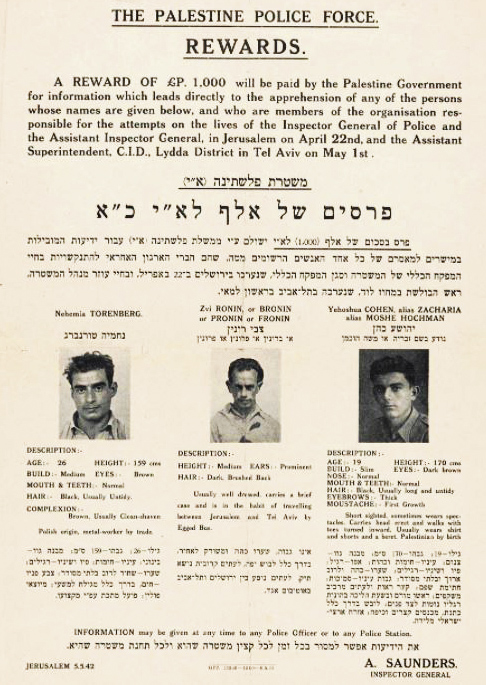
Stern’s followers, the Lehi (Fighters for the Freedom of Israel), also called ‘Stern Gang’, conducted an unrelenting campaign of terror against the British authorities.
The ferocity of their actions was designed to force the British to relinquish control of the Palestine mandate. To implement these objectives, Stern unsuccessfully attempted to establish contacts with German representatives in Istanbul and forge an anti-British alliance with Arab nations[29].
Stern’s movement, which numbered no more than a few hundred, continued to commit acts of terror after he was shot and killed by the British in 1942, In fact, both the Stern Gang and the extremist Zionist group National Military Organisation or ‘Irgun’, rejected the policy of restraint. ‘’Strike the British and Arab murderers, ‘’ one pamphlet declared. ‘’End the passive self-defence! We shall go to the nests of murderers and destroy them’.[31]
Minister resident in the Middle East
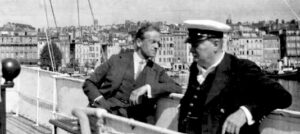
Moyne and Churchill, the two were personal friends.
This was the volatile situation which 63-year-old Lord Moyne inherited in 1944, when he succeeded Mr. G. R Casey as Minister resident in the Middle East, responsibility for an area that stretched from Tripoli to eastern Persia. [32]
This was a period of dramatic upheaval and the time of the notorious ‘saison’ or ‘hunting season’ in Palestine was getting underway, in which Zionist organisations, divided over the correct attitude towards the British authorities in Palestine, came to blows with each other. This brought relationships between the Haganah, the main paramilitary Jewish organisation and Irgun almost to the point of civil war, when the Haganah agreed to collaborate with the British authorities and began to hand over Irgun members to the police.[34]
The situation was further antagonised by the assassination attempts on the High Commissioner, Sir Harold McMichael by Stern’s followers in August of 1944, which reminds the Irish reader of the failed assassination of Lord French, the Lord Lieutenant of Ireland by the IRA in 1919. McMichael’s injuries had not been life threatening. Not so fortunate were two Jewish detectives and a much hated British Sgt. W, who were also shot by Stern in the same month.[35]
Lesser men may have been dismayed by the turn of events. However, Lord Moyne remained resolute in his belief in compromise between Jews and Arabs. He dismissed his Egyptian police escort and a police guard that was stationed at his house day and night.[36]
In November 1944, Moyne was assassinated near his office in Cairo by two criminal members of Lehi or the ‘Stern gang’. They were later hanged.
In November 1944 (just three months after the attempt on High Commissioner Mac Michael’s life) two Stern Gang members, Eliahu Hakim and Eliyahu Bet-Zuri waited for Lord Moyne near his Cairo residence when he was shot in the neck, chest and abdomen as he stepped into his automobile in front of his home. His chauffer was killed instantly. Lord Moyne had once survived the gun. This time the overseer of limited Jewish immigration expired in a British military hospital in Cairo -several hours after the event.[39] The murderers themselves narrowly escaped lynching at the hands of Egyptian passers-by and they were apprehended soon after.[40]
The aftermath
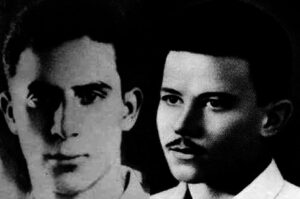
The assassins, Eliahu Hakim and Eliyahu Bet-Zuri
By the next week a forensic examination had established that the pistols wielded by the killers had been used in a string of murders of British police officers by the Stern gang. Nevertheless, the decision had already been made not to concentrate too much on the ‘masters’ of the assassins last in doing so, ‘drastic action …should be directed against the whole Jewish community in Palestine’. Instead, all attention was to be concentrated on the two killers.[41]
The killing was condemned by Jewish leaders and newspapers in Britain and Palestine, but significant damage had been done to the Zionist cause. By a twist of fate, the assassination, preceded by only a few days the scheduled cabinet discussion on the Cabinet Committee recommendation to partition Palestine.
Prime Minister Winston Churchill irritated that ‘Jewish terrorists’ had killed his own personal friend at a time when Churchill had been fighting a lonely struggle on behalf of the Zionist cause. Disappointed, he cancelled the item and it was never revisited by his Cabinet.[42]
[21] Michael Adams What Went Wrong in Palestine? Journal of Palestinian Studies Vol. 18, No. 1, Special Issues: Palestine 1948 (Autumn, 1988) p. 74.