
The assassination of Walter Edward Guinness - Lord Moyne – 1944
The foundation stone of a building at Trinity College Dublin was laid by the Hon. Grania Guinness of the philanthropic brewing family in February of 1950. Grania named the Institute of Preventative Medicine ‘Moyne’ in memorial to her late father Baron Moyne.
Dublin-born Walter Edward Guinness, later known as Lord Moyne, served as British Secretary for State for the Colonies and Minister Resident in the Middle East, until he was assassinated by the criminal militant Zionist group, Lehi in Jerusalem on November 6, 1944. His death was one of the blood-soaked steps on the road to the British withdrawal from their Mandate in Palestine in 1948 and the creation of the state of Israel.
He was an advocate of compromise between Arabs and Jews in Palestine and his death hastened the onset of a conflict in Israel-Palestine that continues to this day.
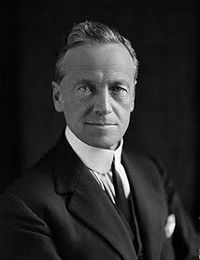
Lord Moyne and Palestine
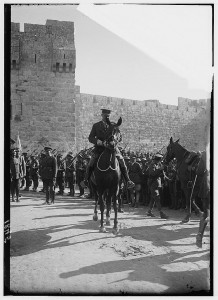
British troops enter Jerusalem in 1917.
British forces had conquered much of the middle east, taking it from the Ottoman Empire during the First World War, including the new states of Iraq, Jordan and Palestine.
The mandate issued by the League of Nations after the First World War gave Britain full administrative control over the region[20] and included provisions for establishing a homeland for the Jews in Palestine (in accordance with the Balfour declaration of 1917) which went into effect in 1923.
However, there was, as yet no rush of eager Jewish volunteers to build up the ‘’national homeland’’; on the contrary, an average of only eight or nine thousand Jewish immigrants a year came to Palestine between 1920 and 1932. Yet from 1933 onwards, however, this changed dramatically, with the Nazis in control in Berlin.[21]
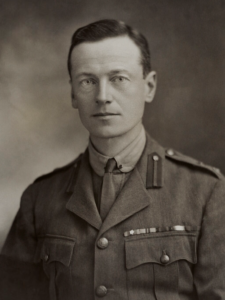
The Arab population of Palestine, alarmed at the influx of Jewish immigrants, revolted en masse, in 1936 and this ushered in three years of strife as they tried to end British rule while endeavouring to establish Arab independence and an end to Jewish immigration. The British put the revolt down harshly, but also decided thereafter to limit Jewish immigration in order to try to prevent further conflict.
Nevertheless, the Second World War found the three protagonists, the British, the Arabs, and the Zionists unreconciled. Furthermore, the most militant Zionist organisations now began a campaign of political violence against the British authorities, who, though they had overseen the establishment of Jewish settlement in Palestine, they now viewed as blocking their dream for a Jewish state there.
Yitzhak Shamir, a leading member of Stern gang and later Prime Minister of Israel (and according to Dr. Shavit, the chief planner of the murder of Lord Moyne) noted that the relations between their mandatory authorities and our ‘state within a state’, ‘tended to be schizophrenic at best’.
Meanwhile, the Arabs viewed the Jewish influx as part of a European colonial movement, and the period was marred by violence on all sides. The Irish Examiner, for instance, reported an incident in June of 1939 in which Jews raced through the streets in fast cars like American screen gangsters pouring out a stream of led that killed twelve Arabs, wounded four others and one Jew.
It was this complex, three-sided conflict that Lord Moyne came to preside over in Palestine as resident minister of state in 1942 and British ‘Minister-Resident’ in the Middle East 1944.
The Stern Gang
By 1941 Lord Moyne had served in various posts which included Kenya and as acting secretary of the Polish Relief Fund. He celebrated Empire Day (24th of May) by speaking on the colonies, protectorates, and mandated territories that the world war had given a new strength and power to Empire Unity.[26]
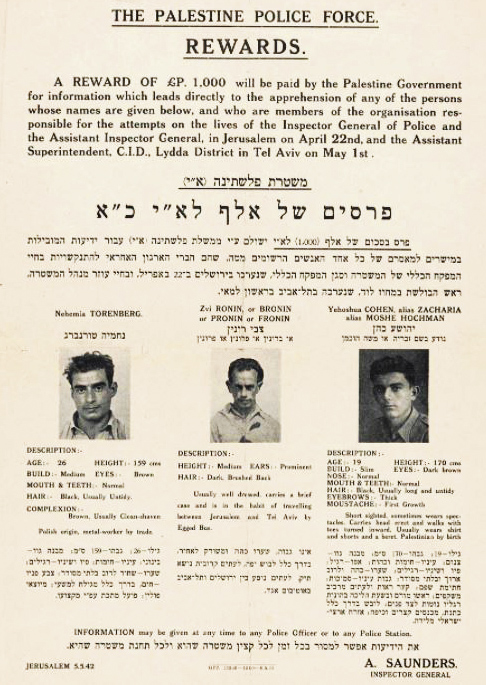
Stern’s followers, the Lehi (Fighters for the Freedom of Israel), also called ‘Stern Gang’, conducted an unrelenting campaign of terror against the British authorities.
The ferocity of their actions was designed to force the British to relinquish control of the Palestine mandate. To implement these objectives, Stern unsuccessfully attempted to establish contacts with German representatives in Istanbul and forge an anti-British alliance with Arab nations[29].
Stern’s movement, which numbered no more than a few hundred, continued to commit acts of terror after he was shot and killed by the British in 1942, In fact, both the Stern Gang and the extremist Zionist group National Military Organisation or ‘Irgun’, rejected the policy of restraint. ‘’Strike the British and Arab murderers, ‘’ one pamphlet declared. ‘’End the passive self-defence! We shall go to the nests of murderers and destroy them’.[31]
Minister resident in the Middle East
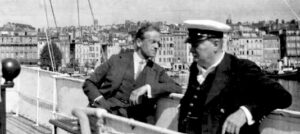
Moyne and Churchill, the two were personal friends.
This was the volatile situation which 63-year-old Lord Moyne inherited in 1944, when he succeeded Mr. G. R Casey as Minister resident in the Middle East, responsibility for an area that stretched from Tripoli to eastern Persia. [32]
This was a period of dramatic upheaval and the time of the notorious ‘saison’ or ‘hunting season’ in Palestine was getting underway, in which Zionist organisations, divided over the correct attitude towards the British authorities in Palestine, came to blows with each other. This brought relationships between the Haganah, the main paramilitary Jewish organisation and Irgun almost to the point of civil war, when the Haganah agreed to collaborate with the British authorities and began to hand over Irgun members to the police.[34]
The situation was further antagonised by the assassination attempts on the High Commissioner, Sir Harold McMichael by Stern’s followers in August of 1944, which reminds the Irish reader of the failed assassination of Lord French, the Lord Lieutenant of Ireland by the IRA in 1919. McMichael’s injuries had not been life threatening. Not so fortunate were two Jewish detectives and a much hated British Sgt. W, who were also shot by Stern in the same month.[35]
Lesser men may have been dismayed by the turn of events. However, Lord Moyne remained resolute in his belief in compromise between Jews and Arabs. He dismissed his Egyptian police escort and a police guard that was stationed at his house day and night.[36]
In November 1944, Moyne was assassinated near his office in Cairo by two criminal members of Lehi or the ‘Stern gang’. They were later hanged.
In November 1944 (just three months after the attempt on High Commissioner Mac Michael’s life) two Stern Gang members, Eliahu Hakim and Eliyahu Bet-Zuri waited for Lord Moyne near his Cairo residence when he was shot in the neck, chest and abdomen as he stepped into his automobile in front of his home. His chauffer was killed instantly. Lord Moyne had once survived the gun. This time the overseer of limited Jewish immigration expired in a British military hospital in Cairo -several hours after the event.[39] The murderers themselves narrowly escaped lynching at the hands of Egyptian passers-by and they were apprehended soon after.[40]
The aftermath
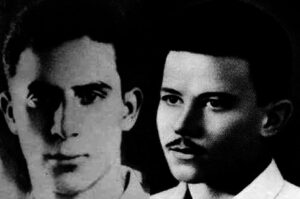
The assassins, Eliahu Hakim and Eliyahu Bet-Zuri
By the next week a forensic examination had established that the pistols wielded by the killers had been used in a string of murders of British police officers by the Stern gang. Nevertheless, the decision had already been made not to concentrate too much on the ‘masters’ of the assassins last in doing so, ‘drastic action …should be directed against the whole Jewish community in Palestine’. Instead, all attention was to be concentrated on the two killers.[41]
The killing was condemned by Jewish leaders and newspapers in Britain and Palestine, but significant damage had been done to the Zionist cause. By a twist of fate, the assassination, preceded by only a few days the scheduled cabinet discussion on the Cabinet Committee recommendation to partition Palestine.
Prime Minister Winston Churchill irritated that ‘Jewish terrorists’ had killed his own personal friend at a time when Churchill had been fighting a lonely struggle on behalf of the Zionist cause. Disappointed, he cancelled the item and it was never revisited by his Cabinet.[42]
[21] Michael Adams What Went Wrong in Palestine? Journal of Palestinian Studies Vol. 18, No. 1, Special Issues: Palestine 1948 (Autumn, 1988) p. 74.