
Lehi
Lehi (Hebrew pronunciation: [ˈleχi]; Hebrew: לח״י, sometimes abbreviated "LHI"), officially the Fighters for the Freedom of Israel (Hebrew: לוחמי חרות ישראל,romanized: Lohamei Herut Israel) and often known pejoratively as the Stern Gang,[20][21][22][23] was a Zionist paramilitary militant organization founded by Avraham ("Yair") Stern in Mandatory Palestine in 1940.[24][25][26] Its avowed aim was to evict the British authorities from Palestine by use of violence, allowing unrestricted immigration of Jews and the formation of a Jewish state. It was initially called the National Military Organization in Israel,[27] upon being founded in August 1940, and considered its actions as necessary for achieving its national aims.[24][28][29]

Lehi split from the Irgun militant group in 1940 in order to continue fighting the British during World War II. It initially sought an alliance with Fascist Italy and Nazi Germany.[30] Believing that Nazi Germany was a lesser enemy of the Jews than Britain, Lehi twice attempted to form an alliance with the Nazis, proposing a Jewish state based on "nationalist and totalitarian principles, and linked to the German Reich by an alliance".[30][31] After Stern's death in 1942, the new leadership of Lehi began to move towards support for Joseph Stalin's Soviet Union[27] and the ideology of National Bolshevism, which was considered an amalgam of both right and left.[32][30] Regarding themselves as "revolutionary Socialists", the new Lehi developed a highly original ideology combining an "almost mystical" belief in Greater Israel with support for the Arab liberation struggle.[27] This sophisticated ideology failed to gain public support and Lehi fared poorly in the first Israeli elections.[33]
In April 1948, Lehi and the Irgun were jointly responsible for the massacre in Deir Yassin of at least 107 Palestinian Arab villagers, including women and children. Lehi assassinated Lord Moyne, British Minister Resident in the Middle East, and made many other attacks on the British in Palestine.[34] On 29 May 1948, the government of Israel, having inducted the group's activist members into the Israel Defense Forces, formally disbanded Lehi, though some of its members carried out one final terrorist act, the assassination of Swedish diplomat Folke Bernadotte some months later,[35] an act condemned by Bernadotte's replacement as mediator, Ralph Bunche.[36] After the assassination, the new Israeli government declared Lehi a terrorist organization, arresting some 200 members and convicting some of the leaders.[37] However, several months later, just before the first Israeli elections in January 1949, the government granted all Lehi prisoners amnesty under a state general order of pardon, and they were released.[37] In 1980, Israel instituted a military decoration, an "award for activity in the struggle for the establishment of Israel", the Lehi ribbon.[38] Former Lehi leader Yitzhak Shamir became Prime Minister of Israel in 1983.
Lehi was created in August 1940 by Avraham Stern.[2] Stern had been a member of the Irgun (Irgun Tsvai Leumi – "National Military Organization") high command. Zeev Jabotinsky, then the Irgun's supreme commander, had decided that diplomacy and working with Britain would best serve the Zionist cause. World War II was in progress, and Britain was fighting Nazi Germany. The Irgun suspended its underground military activities against the British for the duration of the war.
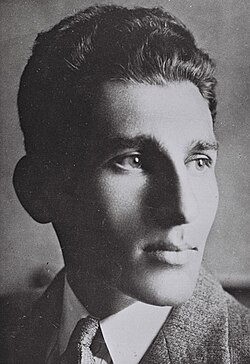
Stern argued that the time for Zionist diplomacy was over and that it was time for an armed struggle against the British. Like other Zionists, he objected to the White Paper of 1939, which restricted both Jewish immigration and Jewish land purchases in Palestine. For Stern, "no difference existed between Hitler and Chamberlain, between Dachau or Buchenwald and sealing the gates of Eretz Israel."[39]
Stern wanted to open Palestine to all Jewish refugees from Europe and considered this to be the most important issue of the day. Britain would not allow this. Therefore, he concluded, the Yishuv (Jews of Palestine) should fight the British rather than support them in the war. When the Irgun made a truce with the British, Stern left the Irgun to form his own group, which he called Irgun Tsvai Leumi B'Yisrael ("National Military Organization in Israel"), later Lohamei Herut Israel ("Fighters for the Freedom of Israel"). In September 1940, the organization was officially named "Lehi", the Hebrew acronym of the latter name.[2]
Stern and his followers believed that dying for the "foreign occupier" who was obstructing the creation of the Jewish State was useless. They differentiated between "enemies of the Jewish people" (the British) and "Jew haters" (the Nazis), believing that the former needed to be defeated and the latter manipulated.[40]
Stern and his followers believed that dying for the "foreign occupier" who was obstructing the creation of the Jewish State was useless. They differentiated between "enemies of the Jewish people" (the British) and "Jew haters" (the Nazis), believing that the former needed to be defeated and the latter manipulated.[40]
In 1940, the idea of the Final Solution was still "unthinkable", and Stern believed that Hitler wanted to make Germany judenrein through emigration, as opposed to extermination.[39][41] In December 1940, Lehi contacted Germany with a proposal to aid German conquest in the Middle East in return for recognition of a Jewish state open to unlimited immigration.[39]
Political racism
According to Yaacov Shavit, professor at the Department of Jewish History, Tel Aviv University, articles in Lehi publications contained references to a Jewish "master race", contrasting the Jews with Arabs who were seen as a "nation of slaves".[56] American journalist Sasha Polakow-Suransky writes that "Lehi was also unabashedly racist towards Arabs. Their publications described Jews as a master race and Arabs as a slave race." Lehi advocated mass expulsion of all Arabs from Palestine and Transjordan,[57] or even their physical annihilation.[58]
Bandits and Assassins
The group was initially unsuccessful. Early attempts to raise funds through criminal activities, including a bank robbery in Tel Aviv in 1940 and another robbery on 9 January 1942 in which Jewish passers-by were killed, brought about the temporary collapse of the group. An attempt to assassinate the head of the British secret police in Lod in which three police personnel were killed, two Jewish and one British, elicited a severe response from the British and Jewish establishments who collaborated against Lehi.[61]
They targeted Jews whom they regarded as traitors, and during the 1948 Arab-Israeli War they joined in operations with the Haganah and Irgun against Arab targets, for example Deir Yassin.
According to a compilation by Nachman Ben-Yehuda, Lehi was responsible for 42 assassinations, more than twice as many as the Irgun and Haganah combined during the same period. Of those Lehi assassinations that Ben-Yehuda classified as political, more than half the victims were Jews.[63]
Goals and ideology
Lehi had three main goals:
- To bring together all those interested in liberation (that is, those willing to join in active fighting against the British).
- To appear before the world as the only active Jewish military organization.
- To take over Eretz Yisrael (the Land of Israel) by armed force.[43]
Lehi believed in its early years that its goals would be achieved by finding a strong international ally that would expel the British from Palestine, in return for Jewish military help; this would require the creation of a broad and organised military force "demonstrating its desire for freedom through military operations."[44]
Lehi also referred to themselves as 'terrorists' and may have been one of the last organizations to do so.[45]
An article titled "Terror" in the Lehi underground newspaper He Khazit (The Front) argued as follows:
Neither Jewish ethics nor Jewish tradition can disqualify terrorism as a means of combat. We are very far from having any moral qualms as far as our national war goes. We have before us the command of the Torah, whose morality surpasses that of any other body of laws in the world: "Ye shall blot them out to the last man."
But first and foremost, terrorism is for us a part of the political battle being conducted under the present circumstances, and it has a great part to play: speaking in a clear voice to the whole world, as well as to our wretched brethren outside this land, it proclaims our war against the occupier.
We are particularly far from this sort of hesitation in regard to an enemy whose moral perversion is admitted by all.[29]
he article described the goals of terror:
Yitzhak Shamir, one of the three leaders of Lehi after Avraham Stern's assassination, argued for the legitimacy of Lehi's actions:
There are those who say that to kill Martin[c] is terrorism, but to attack an army camp is guerrilla warfare and to bomb civilians is professional warfare. But I think it is the same from the moral point of view. Is it better to drop an atomic bomb on a city than to kill a handful of persons? I don't think so. But nobody says that President Truman was a terrorist. All the men we went for individually – Wilkin, Martin, MacMichael and others – were personally interested in succeeding in the fight against us.
So it was more efficient and more moral to go for selected targets. In any case, it was the only way we could operate, because we were so small. For us it was not a question of the professional honour of a soldier, it was the question of an idea, an aim that had to be achieved. We were aiming at a political goal. There are many examples of what we did to be found in the Bible – Gideon and Samson, for instance. This had an influence on our thinking. And we also learned from the history of other peoples who fought for their freedom – the Russian and Irish revolutionaries, Giuseppe Garibaldi and Josip Broz Tito.[46]
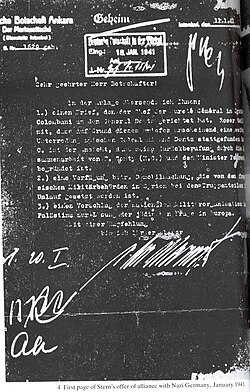
German cover letter from 11 January 1941 attached to a description of an offer for an alliance with Nazi Germany attributed to Lehi.