The Racial Equality Proposal 人種的差別撤廃提案
Failure of the League of Nations
Caption: Child labour in a coal mine, United States, c. 1912
人種的差別撤廃提案:Proposal to abolish racial discrimination
The Racial Equality Proposal (Japanese: 人種的差別撤廃提案; lit. "Proposal to abolish racial discrimination") was an amendment to the Treaty of Versailles that was considered at the 1919 Paris Peace Conference.
Wilson Violation of Democratic Voting
The Racial Equality Proposal (Japanese: 人種的差別撤廃提案; lit. "Proposal to abolish racial discrimination") was an amendment to the Treaty of Versailles that was considered at the 1919 Paris Peace Conference.
Though it was broadly supported, the proposal did not become part of the treaty, largely because of opposition by the United States and the dominions of the British Empire Delegation, namely Australia, Canada and New Zealand.[1]
After the end of seclusion in the 1850s, Japan signed unequal treaties, the so-called Ansei Treaties, but soon came to demand equal status with the Western powers. Correcting that inequality became the most urgent international issue of the Meiji government. In that context, the Japanese delegation to the Paris peace conference proposed the clause in the Covenant of the League of Nations. The first draft was presented to the League of Nations Commission on 13 February as an amendment to Article 21:
The equality of nations being a basic principle of the League of Nations, the High Contracting Parties agree to accord as soon as possible to all alien nationals of states, members of the League, equal and just treatment in every respect making no distinction, either in law or in fact, on account of their race or nationality.
In a speech, the Japanese diplomat Makino Nobuaki stated that during the war men of different races had fought together on the Allied side, leading to say: "A common bond of sympathy and gratitude has been established to an extent never before experienced."[8] The Japanese delegation had not realized the full ramifications of their proposal since its adoption would have challenged aspects of the established norms of the day's Western-dominated international system, which involved the colonial rule over non-white people. The intention of the Japanese was to secure equality of their nationals and the equality for members of the League of Nations,[9] but a universalist meaning and implication of the proposal became attached to it within the delegation, which drove its contentiousness at the conference.[10]
After Makino's speech, Lord Cecil stated that the Japanese proposal was a very controversial one and he suggested that perhaps the matter was so controversial that it should not be discussed at all.[8] Greek Prime Minister Eleftherios Venizelos also suggested that a clause banning religious discrimination should also be removed since that was also a very controversial matter.[8]
Cecil removed all references to clauses that forbade racial and religious discrimination from the text of the peace treaty, but the Japanese made it clear that they would seek to have the clause restored.[8] By then, the clause was beginning to draw widespread public attention. Demonstrations in Japan demanded the end of the "badge of shame" as policies to exclude Japanese immigration in the United States, Canada, Australia, and New Zealand received much attention in the Japanese media.[8]
In the United States, the clause received much negative media coverage on the West Coast.[8]
Makino Nobuaki, the career diplomat who headed the Japanese delegation, then announced at a press conference: "We are not too proud to fight but we are too proud to accept a place of admitted inferiority in dealing with one or more of the associated nations. We want nothing but simple justice."[13] France declared its support for the proposal since the French position had always been that the French language and culture was a "civilizing" force open to all regardless of skin color.[12] British Prime Minister David Lloyd George found himself in an awkward situation since Britain had signed an alliance with Japan in 1902, but he also wanted to hold the British Empire's delegation together.[12] South African Prime Minister General Jan Smuts and Canadian Prime Minister Sir Robert Borden tried to work out a compromise by visiting Makino and Chinda Sutemi and Hughes, serving as mediators.[12] Borden and Smuts were able to arrange a meeting between Makino, Chinda, and Hughes, which ended badly. The Japanese diplomats wrote that Hughes was a vulgar "peasant" who was loud and obnoxious, and Hughes complained that the Japanese had been "beslobbering me with genuflexions and obsequious deference."[12] However, Borden and Smuts were able to persuade Hughes to accept the clause if it was declared that it did not affect immigration.[12] Makino and Chinda then rejected the compromise.[12]
On April 11, 1919, the commission held a final session.[14] Makino stated the Japanese plea for human rights and racial equality.[15] The British representative Robert Cecil spoke for the British Empire and addressed opposition to the proposal.[16] Italian Prime Minister Vittorio Orlando spoke in favor of the statement on human rights.[17] French Senator Léon Bourgeois urged its adoption and stated that it would be impossible to reject the proposal, which embodied "an indisputable principle of justice."[18]
Vote
The proposal received a majority vote on the day,[14] with 11 of the 17 delegates present voted in favor of its amendment to the charter, and no negative vote was taken:
- Japan (2) Yes
- France (2) Yes
- Italy (2) Yes
- Brazil (1) Yes
- China (1) Yes
- Greece (1) Yes
- Serbia (1) Yes
- Czechoslovakia (1) Yes
Total: 11 Yes
- British Empire (2) – Not Registered
- United States (2) – Not Registered
- Portugal (1) – Not Registered
- Romania (1) – Not Registered
- Belgium (2) – Absent[19]
The chairman, Woodrow Wilson, overturned it by saying that although the proposal had been approved by a clear majority, the particular matter had strong opposition manifest itself (despite the lack of any actual votes against the proposal[19]) and that on this issue, a unanimous vote would be required.[20] French delegate Ferdinand Larnaude [la; sv] immediately stated that "a majority had voted for the amendment."[21] Meanwhile, the Japanese delegation wanted the transcript to show that a clear majority had been voted for the amendment.[21]
Aftermath
Cecil felt that British support for the League of Nations was far more important than the clause. The Japanese media fully covered the progress of the conference, which led to the alienation of public opinion towards the US and would foreshadow later, broader conflicts.
In the United States, racial riots resulted from deliberate inaction.[26]
The international mood had changed so dramatically by 1945, that the contentious point of racial equality would be incorporated into that year's United Nations Charter as a fundamental principle of international justice.
Red Summer
The Red Summer was a period in mid-1919 during which white supremacist terrorism and racial riots occurred in more than three dozen cities across the United States, and in one rural county in Arkansas. The term "Red Summer" was coined by civil rights activist and author James Weldon Johnson, who had been employed as a field secretary by the National Association for the Advancement of Colored People (NAACP) since 1916. In 1919, he organized peaceful protests against the racial violence.[1][2]
In most instances, attacks consisted of white-on-black violence. Numerous African Americans fought back, notably in the Chicago and Washington, D.C., race riots, which resulted in 38 and 15 deaths, respectively, along with even more injuries, and extensive property damage in Chicago.[3] Still, the highest number of fatalities occurred in the rural area around Elaine, Arkansas, where an estimated 100–240 black people and five white people were killed—an event now known as the Elaine massacre.
The anti-black riots developed from a variety of post-World War I socio-economic tensions, generally related to the demobilization of both black and white members of the United States Armed Forces following World War I; an economic slump; and increased competition in the job and housing markets between ethnic European Americans and African Americans.[4] The period would also be marked by episodes of labor unrest, wherein certain industrialists employed black people as strikebreakers, further inflaming the resentment of white workers.
The riots and killings were extensively documented by the press, which, along with the federal government, feared socialist and communist influence on the black civil rights movement of the time following the 1917 Bolshevik Revolution in Russia. They also feared foreign anarchists, who had bombed the homes and businesses of prominent figures and government leaders.
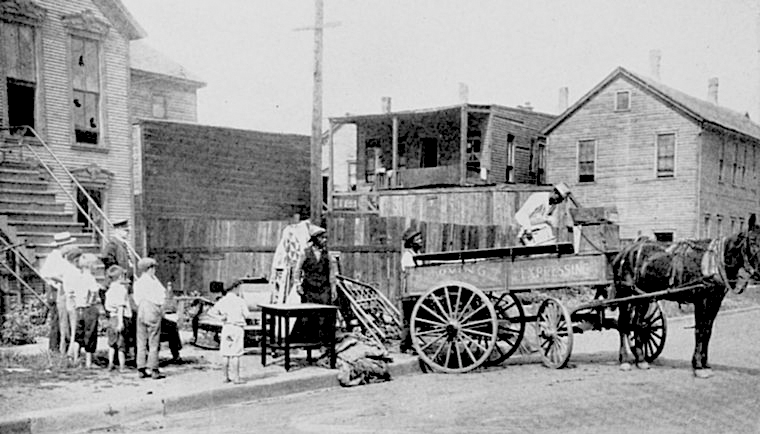
Family leaving damaged home after the Chicago race riot of 1919
Great Migration
With the mobilization of troops for World War I, and with immigration from Europe cut off, the industrial cities of the American Northeast and Midwest experienced severe labor shortages. As a result, northern manufacturers recruited throughout the South, from which an exodus of workers, many black, ensued.[5]
By 1919, an estimated 500,000 African Americans had emigrated from the Southern United States to the industrial cities of the Northeast and Midwest in the first wave of the Great Migration (which continued until 1940).[3] African-American workers filled new positions in expanding industries, such as the railroads, as well as many existing jobs formerly held by whites. In some cities, they were hired as strikebreakers, especially during the strikes of 1917.[5] This increased resentment against blacks among many working-class whites, immigrants, and first-generation Americans.
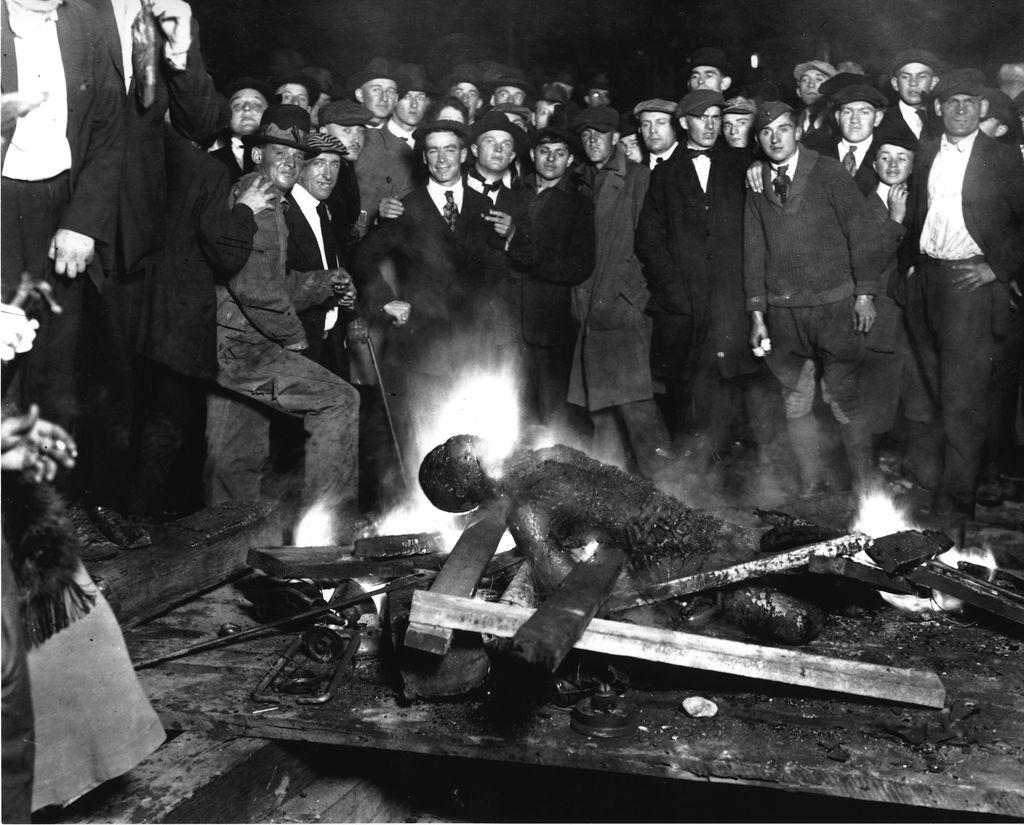
Will Brown, victim of Omaha, Nebraska lynching[31]
Racism and Red Scare
In the summer of 1917, violent racial riots against blacks due to labor tensions broke out in East St. Louis, Illinois, and Houston, Texas.[6] Following the war, rapid demobilization of the military without a plan for absorbing veterans into the job market, and the removal of price controls, led to massive unemployment and inflation that increased competition for jobs. Jobs were very difficult for African Americans to get in the South due to systemic racism and employment segregation.[7]
During the First Red Scare of 1919–20, following the 1917 Russian Revolution, anti-Bolshevik sentiment in the United States quickly followed on the anti-German sentiment arising in the war years. Many politicians and government officials, together with much of the press and the public, feared an imminent attempt to overthrow the U.S. government to create a new regime modeled on that of the Soviets. Authorities viewed with alarm African-Americans' advocacy of racial equality and labor rights, and incidents involving the deaths of whites furthered fears.[4] In a private conversation in March 1919, President Woodrow Wilson said that "the American Negro returning from abroad would be our greatest medium in conveying Bolshevism to America."[8] Other whites expressed a wide range of opinions, some anticipating unsettled times and others seeing no signs of tension.[9]
In the autumn of 1919, following the violence-filled summer, George Edmund Haynes reported on the events as a prelude to an investigation by the U.S. Senate Committee on the Judiciary. He identified 38 separate racial riots against black people in widely scattered cities, in which whites attacked black people.[3] Unlike earlier racial riots against African Americans in U.S. history, the 1919 events were among the first in which black people in number resisted white attacks and fought back.[13] A. Philip Randolph, a civil rights activist and leader of the Brotherhood of Sleeping Car Porters, publicly defended the right of black people to self-defense.[1]
Government activity
During the Chicago racial violence against people of color the press was incorrectly told by Department of Justice officials that the IWW, socialists, and Bolsheviks were "spreading propaganda to breed race hatred".[55] FBI agents filed reports that leftist views were winning converts in the black community. One cited the work of the NAACP "urging the colored people to insist upon equality with white people and to resort to force, if necessary.[50] J. Edgar Hoover, at the start of his career in government, analyzed the riots for the Attorney General. He blamed the July Washington, D.C., riots on "numerous assaults committed by Negroes upon white women".[22] For the October events in Arkansas, he blamed "certain local agitation in a Negro lodge".[22] A more general cause he cited was "propaganda of a radical nature".[22] He charged that socialists were feeding propaganda to black-owned magazines such as The Messenger, which in turn aroused their black readers. He did not note the white perpetrators of violence, whose activities local authorities documented. As chief of the Radical Division within the U.S. Department of Justice, Hoover began an investigation of "negro activities" and targeted Marcus Garvey because he thought his newspaper Negro World preached Bolshevism.[22] He authorized the hiring of black undercover agents to spy on black organizations and publications in Harlem.[55]
On November 17, Attorney General A. Mitchell Palmer reported to Congress on the threat that anarchists and Bolsheviks posed to the government. More than half the report documented radicalism in the black community and the "open defiance" black leaders advocated in response to racial violence and the summer's rioting. It faulted the leadership of the black community for an "ill-governed reaction toward race rioting.… In all discussions of the recent racial riots against blacks there is reflected the note of pride that the Negro has found himself. That he has 'fought back,' that never again will he tamely submit to violence and intimidation."[56] It described "the dangerous spirit of defiance and vengeance at work among the Negro leaders."[56]
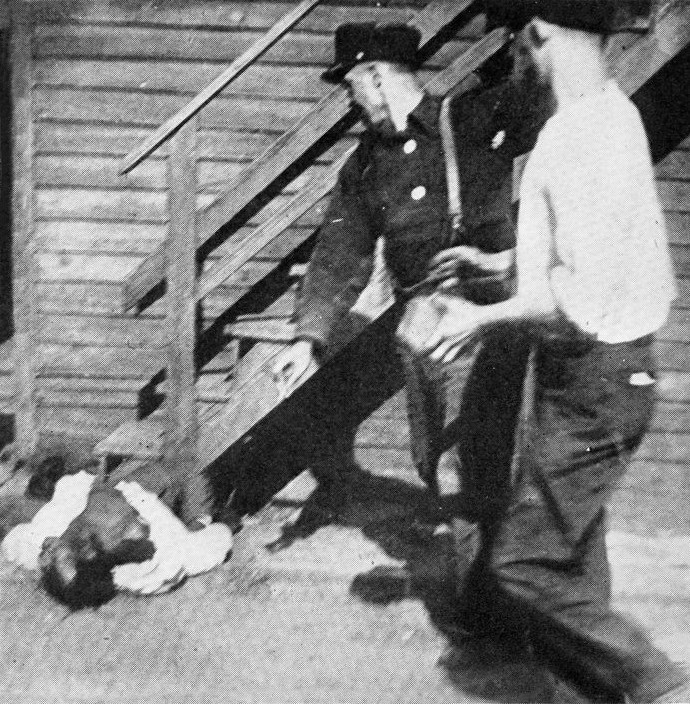
African American being stoned by whites during 1919 Chicago race riot