Solvers
Solving Equations by programming.
Author: Dara O Shayda
Artwork: The Electrofishers were originally Planters who have splintered off and forgotten their past. They currently reside in an Abandoned Level after their original home was destroyed in a Safeguard Attack.
- Preface
- Background
- Sides of Equations
- Manual Operations on the Sides
- Right hand side vs. Left hand side
- Subtract from Sides
- Add to Sides
- Divide both Sides
- Multiply both Sides
- solve[ ]
Preface
This mostly live-code computational Wiki book addresses two audiences:
- STEM high school students to undergraduate college level students
- Programmers' and computer scientists' learning habitat to freely experiment with new concepts in programming languages
On one hand the book is regimented for the absolute newbies with no programming experience, and on the other hand pushes the programmers off the cliff of commercial programming languages for better experiences.
I am borrowing components from the formal language of the Alfred Tarski on modern mathematical logic. I did that to make my language more consistent with a concise paradigm + a terrific economy of the words, while staying away from the fluffy contemporary foo-foo dust publications.
Dara O Shayda
Chief of Software
Computational Classnotes
Republic of Ireland, May 8th 2026
foo-foo dust : A reference to a (non-existent) power or mysterious ingredient or hidden effort that creates desirable results. Results achieved, as if by magic, perhaps by slight-of-hand.
https://www.urbandictionary.com/define.php?term=foo+foo+dust
Background
Basics for setting up equations and extracting solutions.
Terminologies
lhs : Left Hand Side
rhs : Right Hand Side
p = q : an identity
Equational Expression: expr1 = expr2 e.g. expr1 = a*x+b and expr2 = cos[b-c]
copy: when an object is duplicated, byte by byte so to say, into a facsimile.
This definition of copy is the simplest to grasp the concept. In due places, more sophisticated definitions will be produced.
Structure: a structure is that which permitting Similarity to other Similars.
Example: Circular is a structure since it permits similarity to anything that is round.
Example: Red is a structure since it permits similarity to anything that is red.
Example: Numeral is a structure since it permits similarity to anything that is a number.
ff calls a list e.g. {1,2,3} as a structure, or a function e.g. cos[ ] a structure or an algebraic structure e.g. x^2-1.
Symbols
In Free Form Programming Language (ff) the concept of Symbol is more than one:
- Individual alphabet in a language e.g. x in English , ω in Greek
- Composite of individual symbols e.g. dara that while it is the concatenation of four alphabets ff treats it as a single symbol
- Mathematical symbols e.g. ⨂
- Glyph (Unicode) e.g. 🌊 , 💬
- Glyph a raster image (this option is currently unavailable for HTML use)
The mathematical symbols in many cases have particular syntax and semantics in an expression which cannot be altered or ignored.
The mathematical symbol single space or " " is interpreted multiplication in mathematical textbooks. Additionally in ff often " " is assigned the functionality of separator in a list of items.
o be more general ff defines a Symbol as follows:
An atomic or indivisible structure with no discerning programmable components is called a Symbol.
Constants
In Free Form Programming Language (ff) the concept of a Constant is an immutable structure.
Examples : 5, 𝝅 .
Operators
=
+
-
*
/
{}
()
;
""
->
<
>
<=
⋂
⋃
⊕
✕
∂
∈
∉
⊂
→
and
==
value to rhs. What do we mean equal by value? Example: 3 = 6/2 in spite of the fact that lhs and rhs are made from very different expressions but their values are Identical or the same, hence the Identity term.
= : copies stores the rhs into lhs;
// = stores the rhs into lhs;
x1  = 5;

x2 = 2 * x1;

show x2;

// == creates an equations between lsh and rhs;
x3 = (x1 == 5);

show x3;


x4 = (x2 == 10);

show x4;

// lhs and rhs with different variables;
x5 = (x2 == 2*x1);

show x5;

save as equations;Expressions
Algebraic
a*(c-u)
Free Form
solve a*x +b == 0 for x
Words
"I am a word"
Phrases
The highlighted are the phrases
pts = evaluate l2 in the -1 to 3 range at increments of (1/4);
Part of a sentence, have a meaning in and of itself, but often has no procedural meaning alone.
Sentences
pts = evaluate l2 in the -1 to 3 range at increments of (1/4);
FIXME: line cannot be even be used as a subphrase;
l2 := l[v,t,{0,b}];
Sides of Equations
Applying same operations on both sides of =
Manual Operations on the Sides
What: Use ff to duplicate the manual ways handling equations as taught in school teachings. Why: To make sure you understand how to manipulate sides of an equation on your own. How: Simply try to duplicate what the teacher does to solve an equation by working the sides. Time To Complete: 3 hours.

Manully set the lhs and rhs variables to some expressions of choice and then commence, step by step, applying the same arithmetic operations to both sides.
In this example, the equation
x-3 = 17*y +9
is being solved for y namely the equation is transformed to a new equation with y alone on either side as the solution.
lhs = x - 3;
rhs = 17 * y + 9;

lhs = lhs - 9;
rhs = rhs - 9;

lhs = lhs / 17;
rhs = rhs / 17;

show lhs also rhs;

save as sides;
Output
"rhs" → y
© 2012-Present CCN Studios
Creative Commons Attribution-NonCommercial-ShareAlike 4.0
Right hand side vs. Left hand side
What: Different sides to an operator e.g. == Why: Proper treatment of the sides of an operator e.g. == results in much functionality Time To Complete: 3 hours
.left and .right
In Free Form Programming Language (ff) the dot operator, namely the dot on your keyboard, allows for accessing parts of an expression!
For a given equation e.g. eq, in the ff program below, the lhs or x^2-1+y can be accessed by the expression eq.left and a/b+c by the expression eq.right.
eq = (x^2-1+y == a/b+c);

lhs = eq.left;

show lhs;

rhs = eq.right;

show rhs;

save as sides;
Output
"rhs" → a/b + c
The programmer is not required to use a symbol e.g. eq for this . access, as long as using the ( ) operator the results would be the same:
tmp = (x^2-1+y == a/b+c).left;

show tmp;

save as lhsrhs;
Output
⊕
In Free Form Programming Language (ff), the Symbol ⊕ is one of several unassigned operators.
As you can see the . operator works perfectly even if the operator in use is not defined! This is a core language aspect of ff that allows undefined variables as well as undefined functions and undefined operators alike.
eq = (x^2-1+y)  ⊕  (a/b+c);

lhs = eq.left;

show lhs;

rhs = eq.right;

show rhs;

save as sides;
Output
"rhs" → a/b + c
Try different operators.
eq = (x^2-1+y)  <=  (a/b+c);

lhs = eq.left;

show lhs;

rhs = eq.right;

show rhs;

save as sides;
Output
"rhs" → a/b + c
© 2012-Present CCN Studios
Creative Commons Attribution-NonCommercial-ShareAlike 4.0
Subtract from Sides
What: Subtract the same expression from the both sides of == Why: Such side-wise subtraction is an essential computation for solving equations Time to Complete: 3 hours
eq = (x -3 == 17*y + 9);

lhs = eq.left - 9;
rhs = eq.right - 9;

eq2 = (lhs == rhs);

show eq2;

save as sides;
Output
"eq2" → -12 + x == 17*y
Output
"rhs" → y
© 2012-Present CCN Studios
Creative Commons Attribution-NonCommercial-ShareAlike 4.0
Add to Sides
What: Add the same expression to the both sides of == . Why: Such side-wise addition is an essential computation for solving equations. Time to Complete: 3 hours.
eq = (x -3 == 17*y - 9);

lhs = eq.left + 9;
rhs = eq.right + 9;

eq2 = (lhs == rhs);

show eq2;
Output
© 2012-Present CCN Studios
Creative Commons Attribution-NonCommercial-ShareAlike 4.0
Divide both Sides
What: Divide both sides of == by the same expression. Why: Such side-wise division is an essential computation for solving equations. Time to Complete: 3 hours.
eq = (x - 3 == 17*y);

lhs = eq.left / 17;
rhs = eq.right /17;

eq2 = (lhs == rhs);

show eq2;

save as lhsrhs;
Output
© 2012-Present CCN Studios
Creative Commons Attribution-NonCommercial-ShareAlike 4.0
Multiply both Sides
What: Multiply both sides of == by the same expression. Why: Such side-wise multiplication is an essential computation for solving equations. Time to Complete: 4 hours.
eq = (x - 3 == y / 13);

lhs = eq.left * 13;
rhs = eq.right * 13;

eq2 = (lhs == rhs);

show eq2;
Output
"eq2" → 13*(-3 + x) == y
Output
Apply expand[ ] to one side
eq = (x - 3 == y / 13);

lhs = eq.left * 13;
rhs = eq.right * 13;

eq2 = (lhs == rhs);

show eq2;

lhs = expand[eq2.left];
rhs = eq2.right;

eq3 = (lhs == rhs);

show eq3;

save as lhsrhs;
Output
© 2012-Present CCN Studios
Creative Commons Attribution-NonCommercial-ShareAlike 4.0
solve[ ]
solve [ ] function
solve a*x + b = 0
sol =  solve[ a*x + b == 0, {x}];

show sol;

save as solve4;
Output
"sol" → {-(b/a)}
solve a*x +b == 0 for x
sol =  solve a*x +b == 0 for x;

show sol;

save as solve4;
Output
"sol" → {-(b/a)}
instance [ ]
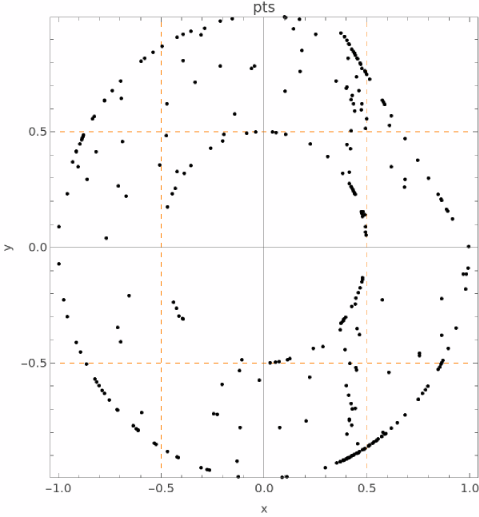
radius=norm[{x,y}];
linear = 3*x+2*y;

pts = instance [linear <= 3 and 0.5<=radius <=1 , 300];

//show pts;
pointplot pts;

save as cropped_anulus;
Ouput