Secrecy as Peoples' Right
Dara O Shayda, CCN
Justice Node Wiki Book (𝛼1.0)
August 17th, 2026
© 2012-Present CCN Studios Creative Commons Attribution-NonCommercial- ShareAlike 4.0 International Public License
- Prelude: The Immutable Secrecy
- Charter of People's Rights to Secrecy
- Who has the right to Secrecy?
- Tyranny by Information Asymmetry
- Digital Financialization by Secrecy
- Subjugation by Secrecy
- Cartelization by Secrecy
- Marginalization by Secrecry
- Attachments and Stuff
Prelude: The Immutable Secrecy
Our university education serves but one purpose namely the certitude. We are so certain that our views on subject matters are so very correct to the point of utter ignorance. For example, we do not realize that which we are force-fed as The Privacy laws, or something or other, are totally manufactured by foreigners in other nations feverishly working to enslave us by eroding our ability to safeguard secrets.
We ignorantly do not discern between the synthetic Privacy and the absolute and immutable Secrecy. We fail to realize that Privacy is a fluid concept that varies per foreign agents' needs and fickle mandates of their masters; while Secrecy is one fixed innate faculty and a concrete construct. Secrecy pervades not only in human individuation and societies but in all other organisms living on this planet!
In general the organism's inability to deploy secrecy regarding its existence opens it up for easy grab as food! Isn't that what is done to us?
We fail to realize that the so-called Privacy Laws are foreign verbiage exogenous to our societies and are manufactured by the very powerful agents of subjugation.
Example: Have you wondered why Google or Apple repeatedly update their binding privacy digital contracts? And incessantly give you a fake-option to opt out when they knowingly understand you cannot opt out. These privacy digital contracts, as we truly see their nature at this point of time, are instruments of subjugation. Ask the thousands of thriving businesses destroyed by both Google and Apple vis-à-vis these or other binding contracts which left their paying customers with impossible options to opt out.
This is a fallacy , this is what is done to you:
A master says to you loud and clear that if you do not do such a task, he will kill you and burn your house down or you have an option to opt out! Which then he will kill you and burn your house down anyway!
You are being talked at, talked down by that master every single time you turn on and use any digital device.
Example:
https://en.wikipedia.org/wiki/CLOUD_Act
The Clarifying Lawful Overseas Use of Data Act or CLOUD Act (H.R. 4943) is a United States federal law enacted in 2018 by the passing of the Consolidated Appropriations Act, 2018, PL 115–141, Division V.
The CLOUD Act primarily amends the Stored Communications Act (SCA) of 1986 to allow federal law enforcement to compel U.S.-based technology companies via warrant or subpoena to provide requested data stored on servers regardless of whether the data are stored in the U.S. or on foreign soil.[1]
Extraterritorial scope
The CLOUD Act allows United States authorities to request data from cloud providers and other covered service providers regardless of where the data is physically stored.[26][27] The act is not limited to companies based in the United States. It applies to "all electronic communication service or remote computing service providers that operate or have a legal presence in the U.S".[28] Courts can require parent companies to provide data held by their subsidiaries.[29]
© 2012-Present CCN Studios Creative Commons Attribution- NonCommercial- ShareAlike 4.0 International Public License
Charter of People's Rights to Secrecy
1. Harboring and safekeeping secrets is the right of all peoples, all individuals.
People with no secrets is no longer a people.
People with no ability to safeguard their secrets is no longer a people.
To prevent peoples' right to safeguard secrets is the ultimate tyranny.
2. The development, deployment and operation of Digital Computational Cryptography systems is the unalienable right of all peoples.
3. Preventing and safeguarding against the state sponsored spying, state developed spyware or foreign state developed commercial spyware is the right all peoples.
4. The digital computationally encrypted communications is the right of all peoples, all individuals.
▢
© 2012-Present CCN Studios Creative Commons Attribution- NonCommercial- ShareAlike 4.0 International Public License
Who has the right to Secrecy?
Privacy vs. Secrecy?
In the Western countries we no longer even dare to utter the word secrets; it is sanitized to a much lesser meaning namely the Privacy.
Rewind: We as the ordinary people in order to remain an identifiable people we need to conceal secrets!
Conspectus
The corporations have the right to keep secrets. [1]
The banks have the right to keep secrets. [2]
The law enforcement has the right to keep secrets. [3]
The military has the right to keep secrets. [4]
The government has the right to keep secrets. [5]
The courts have the right to keep secrets. [6]
Taboo: Yet the ordinary peoples are criminals if express the slightest desire to keep secrets.
The law enforcement has the right to investigate our secrets, by legislated means, in case we are suspected of committing crimes. There is no contradiction here and nothing sinister; this is a diametric human dynamic that can never be dispensed with as you cannot dispense with your heart or your lungs!
A society free of such obverse dynamic is either a utopia or a dystopia. Former inhabited by angels and the latter exclusive domain of ghouls. Human history has never recorded such realms.
At this time it is the ordinary people that are being surveilled, yet our transgressions pale in comparison to those of the elites'!
If we dispense with the right to secrecy, then the super rich and their lofty black budget financed intelligence agencies reign supreme and at a moment's whim swat us like insects! And this is happening at the time of writing these words.
Privacy is meaningless today, manufactured overseas by foreign others who are actively engaged in enslaving us, in a variety of shapes and styles; secrecy, on the other hand, has one and only one meaning and no other meaning!
We are all latent criminals unless super rich or elected government officials!
[1] Organizations, ranging from multi-national for profit corporations to nonprofit charities, keep secrets for competitive advantage, to meet legal requirements, or, in some cases, to conceal nefarious behavior. New products under development, unique manufacturing techniques, or simply lists of customers are types of information protected by trade secret laws.
Research on corporate secrecy has studied the factors supporting secret organizations.[6] In particular, scholars in economics and management have paid attention to the way firms participating in cartels work together to maintain secrecy and conceal their activities from antitrust authorities.[7] The diversity of the participants (in terms of age and size of the firms) influences their ability to coordinate to avoid being detected.
The patent system encourages inventors to publish information in exchange for a limited time monopoly on its use, though patent applications are initially secret. Secret societies use secrecy as a way to attract members by creating a sense of importance.[8]
Shell companies may be used to launder money from criminal activity, to finance terrorism, or to evade taxes. Registers of beneficial ownership aim at fighting corporate secrecy in that sense.[9]
Other laws require organizations to keep certain information secret, such as medical records (HIPAA in the U.S.), or financial reports that are under preparation (to limit insider trading). Europe has particularly strict laws about database privacy.[10]
[2] Banking secrecy,[1][2] alternatively known as financial privacy, banking discretion, or bank safety,[3][4] is a conditional agreement between a bank and its clients that all foregoing activities remain secure, confidential, and private.[5] Most often associated with banking in Switzerland, banking secrecy is prevalent in Luxembourg, Monaco, Hong Kong, Singapore, Ireland, and Lebanon, among other off-shore banking institutions.
Otherwise known as bank–client confidentiality or banker–client privilege,[6][7] the practice was started by Italian merchants during the 1600s near Northern Italy (a region that would become the Italian-speaking region of Switzerland).[8] Geneva bankers established secrecy socially and through civil law in the French-speaking region during the 1700s. Swiss banking secrecy was first codified with the Banking Act of 1934, thus making it a crime to disclose client information to third parties without a client's consent. The law, coupled with a stable Swiss currency and international neutrality, prompted large capital flight to private Swiss accounts.
[3] Surveillance is the systematic observation and monitoring of a person, population, or location, with the purpose of information-gathering, influencing, managing, or directing.[1][2]
It is widely used by governments for a variety of reasons, such as law enforcement, national security, and information awareness. It can also be used as a tactic by persons who are not working on behalf of a government, such as by criminal organizations to plan and commit crimes, and by businesses to gather intelligence on criminals, their competitors, suppliers or customers. Religious organizations charged with detecting heresy and heterodoxy may also carry out surveillance.[3] Various kinds of auditors carry out a form of surveillance.[4]
Surveillance is done in a variety of methods, such as human interaction, postal interception, closed-circuit television (CCTV) cameras, wiretapping, and data mining.
Surveillance can unjustifiably violate people's privacy and is often criticized by civil liberties activists.[5] Democracies may have laws that seek to restrict governmental and private use of surveillance, whereas authoritarian governments seldom have any domestic restrictions. Increasingly, government and intelligence agencies have conducted surveillance by obtaining consumer data through the purchase of online information.[6] Improvements in the technology available to governments have led to mass surveillance and global surveillance.
[4] Military secrecy is the concealing of information about martial affairs that is purposely not made available to the general public and hence to any enemy, in order to gain an advantage or to not reveal a weakness, to avoid embarrassment, or to help in propaganda efforts. Most military secrets are tactical in nature, such as the strengths and weaknesses of weapon systems, tactics, training methods, plans, and the number and location of specific weapons. Some secrets involve information in broader areas, such as secure communications, cryptography, intelligence operations, and cooperation with third parties.[12]
US Government rights in regard to military secrecy were uphold in the landmark legal case of United States v. Reynolds, decided by the Supreme Court in 1953.[13]
[5] Governments often attempt to conceal information from other governments and the public. These state secrets can include weapon designs, military plans, diplomatic negotiation tactics, and secrets obtained illicitly from others ("intelligence"). Most nations have some form of Official Secrets Act (the Espionage Act in the U.S.) and classify material according to the level of protection needed (hence the term "classified information"). An individual needs a security clearance for access and other protection methods, such as keeping documents in a safe, are stipulated.[4]
Few people dispute the desirability of keeping Critical Nuclear Weapon Design Information secret, but many believe government secrecy to be excessive and too often employed for political purposes. Many countries have laws that attempt to limit government secrecy, such as the U.S. Freedom of Information Act and sunshine laws. Government officials sometimes leak information they are supposed to keep secret. (For a recent (2005) example, see Plame affair.)[5]
Secrecy in elections is a growing issue, particularly secrecy of vote counts on computerized vote counting machines. While voting, citizens are acting in a unique sovereign or "owner" capacity (instead of being a subject of the laws, as is true outside of elections) in selecting their government servants. It is argued that secrecy is impermissible as against the public in the area of elections where the government gets all of its power and taxing authority. In any event, permissible secrecy varies significantly with the context involved.
[6] A secret trial is a trial that is not open to the public or generally reported in the news, especially any in-trial proceedings. Generally, no official record of the case or the judge's verdict is made available. Often there is no indictment. Secret trials have been characteristic of many dictatorships in the modern era, but are also used in many democratic nations, with the explanation of being necessary for national security. They are a hotly debated topic in many circles, but are generally accepted in the Western world as they are seen as protecting the "greater good".
In the United Kingdom, one of the most notorious secret courts was the Star Chamber under King Charles I of England in the early 17th century. The abuses of the Star Chamber were one of the rallying points of the opposition that organized around Oliver Cromwell and ultimately resulted in the execution of the deposed king. The term "star chamber" became a generalized term for a court that was accountable to no one (except the chief executive) and was used to suppress political dissent or eliminate the enemies of the regime.
R v Incedal and Rarmoul-Bouhadjar (2014) was to be the first British terrorism trial to be held entirely in secret.[4] However, the Court of Appeal blocked full secrecy.[5]
The FISA Courts of the national intelligence apparatus are by design secret courts and are empowered by the Foreign Intelligence Surveillance Act of 1978 to conduct secret trials and to impose secret punishments. Counsel arguing in the court are also subject to a secrecy order against disclosure of information about any cases in front of the court. Individuals who have been targeted in the court are also subjected to secrecy orders. The court sits ex parte, in the absence of anyone but the judge and the government present at the hearings. That, combined with the minimal number of requests that are rejected by the court, has led experts to characterize it as a rubber stamp; the former National Security Agency analyst Russ Tice called it a "kangaroo court with a rubber stamp".[6]
Although the Great Purges in the Soviet Union under Joseph Stalin are best remembered for the Moscow Trials, show trials in which the court became a parody of justice, most of the victims of the Terror were tried in secret. Mikhail Tukhachevsky and his fellow Red Army officers were tried in secret by a military tribunal, and their executions were announced only after the fact. The presiding judge of the Moscow Trials, Vasili Ulrikh, also presided over large numbers of secret trials, lasting only a few minutes, in which he would quickly speak his way through a pre-formulated charge and verdict.
© 2012-Present CCN Studios Creative Commons Attribution- NonCommercial- ShareAlike 4.0 International Public License
Tyranny by Information Asymmetry
The Achievement of Digital Tyranny
Digital Financialization by Secrecy
Financialization Tyranny
In our digital age, in our Digital Financialized [1] age the Information Asymmetry is the core foundation of most tyrannies.
Phrases like "knowledge is power" became "information is power" and now reborn as "Information is gold" [2]. If information is the measure of modern power and wealth, then the asymmetry of information accessibility provides a tool for expansion of tyranny, old or new.
To correlate the tyranny to financialization, first we need to study the 1980s innovations of Financialized Capitalism [3] which begot the widespread global Digial Financialization.
Once there are digital networks in place to Financialize the capital, then asymmetric information access is a must to accumulate vast wealth with littlest labor, and the kind of wealth rooted in tyranny that exclusively inbreeds and begets tyrannies and tyrants abound.
What is Financialization?
- Summarised by Lapavitsas [4] as "profiting without producing"
- Financialized Capitalism [3] is being exploitative by supplying (vast) income to non-laborers
- Financialization describes an economic process by which exchange is facilitated through the intermediation of Financial Instruments
- Rather than focusing on making products or developing new services, many businesses now generate significant profits through financial activities (See Background)
"profiting without producing": guys who know no software or any computing and lead and profit from large software companies under their command! Imagine the heads of radiology department in a large medical facility who know nothing about medicine! And are paid vasts sums of money and shares in this medical business!
"supplying income to non-laborers": multitudes of highly lucrative financial services which thirty years ago did not exist yet today their staff and management make vast sums of money for secretarial or mostly data-entry office activities!
"financial instrument": A financial instrument [6] is a monetary contract between parties. They can be created, traded, modified and settled. They can be cash (currency), evidence of an ownership interest in an entity or a contractual right to receive or deliver in the form of currency (forex); debt (bonds, loans); equity (shares); or derivatives (options, futures, forwards).
Financial Supremacy through Information Asymmetry
- If digital paperwork and signing digital contracts somehow translates to profit and actual money in traditional bank accounts, then if someone(s) control the flow and distribution of information and availability of the digital paperwork and signing digital contracts then a few can amass large wealth, hence the inexorable link between information asymmetry and financial power
- Hedge fund managers, or massive retirement pension companies as examples, in secretive meetings with state and federal officials ,and more frequently these days with actual heads of states discuss secretive measures or new initiatives or simply insider-trading kinds of information exchange which both sides hugely benefit and even profit from and yet the ordinary people intentionally and tyrannically left out in the dark!
The Secrecy Pipeline in the hands of a few
Secrecy → Information Asymmetry → Financial Supremacy → Financialization → Digital Contracts/Instruments → Tyranny
Take away the Asymmetry and allow for freely accessible information or distributed vast amounts of Secrecy, then the inference to Financial Supremacy becomes quite improbable. In short we, all peoples are doing well!
Background
Rather than focusing on making products or developing new services, many businesses now generate significant profits through financial activities like stock buybacks, complex derivatives, and other monetary instruments. Nothing better shows this long trend, perhaps, than the rise of cryptocurrencies—financial assets whose promise for practical uses is always somehow over the horizon but whose speculative returns can be felt today. [5]
Financialization in the US
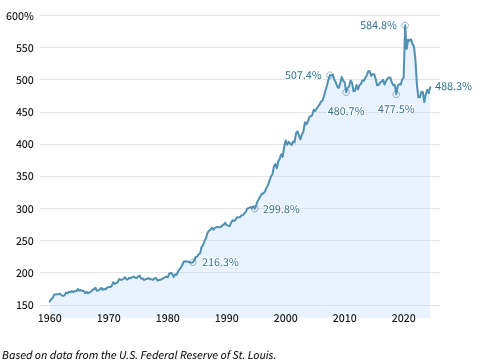
Total US Financial Assets as a Percentage of Gross Domestic Product (GDP) Since 1960
This chart tells us that for every $1 there is $4-$5 bogus paper money which has no backing by any asset, nor by any credit based upon the future GDP!
This chart depicts the growth of the financial sector relative to the real economy in the U.S. over time, as measured by the ratio of total financial assets held by U.S. households and businesses to GDP. The increasing ratio over time means the financial sector is growing faster than the real economy, implying that a larger proportion of economic activity is related to the trading and holding of financial assets than the production of goods and services.
TODO: Code this chart from actual data source.
© 2012-Present CCN Studios Creative Commons Attribution- NonCommercial- ShareAlike 4.0 International Public License
[1] https://en.wikipedia.org/wiki/Financialization
[2] https://www.forbes.com/councils/forbesfinancecouncil/2020/06/18/information-is-the-new-gold/
[3] https://en.wikipedia.org/wiki/Finance_capitalism
[4] https://www.tandfonline.com/doi/full/10.1080/13604813.2013.853865
[5] https://www.investopedia.com/terms/f/financialization.asp
[6] https://en.wikipedia.org/wiki/Financial_instrument
Subjugation by Secrecy
Few countries in the world are able to secretly fly over unsuspecting populated regions, conduct military operations with total immunity and in total secrecy, while the local ordinary people's movements, mobile and internet communications are wide open to prey upon.
Small and large corporations are state sponsored and obscenely financed, outside the scope of local and international laws, to attack, infiltrate your mobile and computer and possibly other digital devices in your home or office to snoop and report on your locations, targets/sources of your communications while turning your devices internal components on and off at the whim of commercial customers.
Files on all your devices are read and copied and archived and pitched to commercial customers!
This is not surveillance, this Secrecy is subjugation.
The people demanding secrecy for their movements, mobile and internet communications; yet that is considered rebellion!
However, secretly snooping and flying over their own ordinary citizens is national security even if across continents!
© 2012-Present CCN Studios Creative Commons Attribution- NonCommercial- ShareAlike 4.0 International Public License
Cartelization by Secrecy
Almost any place ordinary people were instructed to fully disclose all relevant information, the involved organizations kept Secrets from the ordinary people. The sure sign to detect such cartel formations is fantastic accumulation of quick wealth and profits by some unassuming super geniuses.
Research on corporate secrecy has studied the factors supporting secret organizations.[6] In particular, scholars in economics and management have paid attention to the way firms participating in cartels work together to maintain secrecy and conceal their activities from antitrust authorities.
Academic Cartelization
- In large universities, with awesome budgets, haven't you ever wondered who is that useless guy called the Dean? What does he do for his large pay and benefits? He oversees the cartel of all the competing departments; this Dean has large compensation since he maintains the concealment of secrets related to different departments e.g. admission reluctance for certain minorities, lack of academic and scientific integrity to publish more to garner larger and larger endowments and grants! And as we all have seen global sexual abuse of students and faculty. These universities are actually of the form and shape of multiple cartels which by means of Secrecy protect their funding and unnatural selection of students and faculty.
- Ideological Cartels e.g. String Theory, Neo-Darwinism, The Relativists and many more. If you want to get tenure you better join certain cartels and tow the line and while you do shut your mouth!
Publishers Cartelization
- Hollywood studios
- Record Labels USA
- Large book and periodicals publishers:
Case 1: In September 2024, Dr Lucina Uddin [3] , a neuroscience professor at UCLA, filed a class action lawsuit against the world’s largest academic publishers—including Elsevier, Wiley, Springer Nature, Taylor & Francis, and others. The complaint alleges that these publishers operate as an illegal cartel, controlling the terms of academic publishing in a way that is exploitative, anti-competitive, and ultimately harmful to science, scholarship, and society.
At the heart of the lawsuit is a broken system—one that many of us working in research have long experienced but felt powerless to change.
The case argues that publishers collude to enforce three core rules:
- A single submission rule that prevents authors from submitting to multiple journals at once, dramatically slowing down the publication process.
- An unpaid peer review rule, whereby publishers agree not to pay reviewers—ensuring that their billion-dollar profits are built on uncompensated academic labour.
- A gag rule, preventing researchers from sharing their own work while it’s under review, often for months or years.
These practices are not just unfair—they’re systematic. The complaint suggests they are coordinated via a trade body and function to preserve market dominance and suppress reform.
But perhaps the most galling element is how taxpayers pay for the same research three times:
- Once to fund it through public grants.
- Again through free academic labour in writing and peer review.
- And finally, when universities and libraries buy back the published research at exorbitant subscription fees.
In 2023, Elsevier alone made $3.8 billion in revenue, with profit margins higher than most tech giants. And yet, the system depends entirely on the unpaid work of researchers—many of whom are precariously employed or under immense pressure to publish.
The lawsuit doesn’t just seek financial compensation—it asks for structural change. It challenges the legitimacy of publishers setting the rules that benefit themselves while limiting the agency of the very scholars who create and verify knowledge.
This case has huge implications for open access, research equity, and the future of scholarly communication. [1]
Case 2: The Norwegian Competition Authority is imposing fines to the total amount of 545 million NOK on Norway’s four biggest publishing houses and the provider of the database Bokbasen for being in breach of the Competition Act (cartel). These operators have illegally exchanged future book prices and other competitively sensitive information through a subscription to the database Bokbasen.[2]
Industrial Cartelization
- Automobile manufacturing companies: [5]
The Commission's investigation revealed that, for over 15 years, 16 major car manufacturers (including Mercedes, which was not fined) and ACEA entered into anticompetitive agreements and engaged in concerted practices related to the recycling of ELVs.
In particular, the Commission found that the parties colluded on two aspects:
They agreed not to pay car dismantlers for processing ELVs. In particular, they agreed to consider the recycling of ELVs to be a sufficiently profitable business, and therefore not to remunerate car dismantlers for their services (so-called “Zero-Treatment-Cost” strategy). The companies also shared commercially sensitive information on their individual agreements with car dismantlers and coordinated their behaviour towards dismantlers;
They agreed not to promote how much of an ELV can be recycled, recovered and reused and how much recycled material is used in new cars. Their goal was to prevent consumers from considering recycling information when choosing a car, which could lower the pressure on companies to go beyond legal requirements.
- Oil companies
- Construction companies, including tools and technologies: [4]
BRUSSELS, July 20, 2026 (Reuters) - EU antitrust regulators on Monday charged a group of construction chemicals companies and trade associations with taking part in a cartel between 2021 and 2022, putting them at risk of hefty fines.
The European Commission issued the charges via a 'statement of objections' following dawn raids against unnamed companies in several EU countries in 2023.
The Commission, which acts as the EU competition enforcer, said the companies and associations colluded between 2021 and 2022 to increase prices in the supply of chemicals for cement, concrete and mortar, impacting construction costs.
© 2012-Present CCN Studios Creative Commons Attribution- NonCommercial- ShareAlike 4.0 International Public License
[1] https://creativemediapractice.com/academic-publishing-cartel/
[3] https://storage.courtlistener.com/recap/gov.uscourts.nyed.520652/gov.uscourts.nyed.520652.1.0_2.pdf
[5] https://ec.europa.eu/commission/presscorner/api/files/document/print/en/ip_25_881/IP_25_881_EN.pdf
Marginalization by Secrecry
More widespread use of informational asymmetries can be seen within the labor market. The gender gap in remuneration has been widely reported but one key factor that has being instrumental in its continuance has been the purposive hiding of the discrimination. This works through the effectively banning through contractual obligations, or strongly discouraging, workers from discussing their compensation.
Thus women, whose wages consistently remain below those of their male counterparts, are unaware that they personally are being discriminated against due to a lack of comparators. Kulow [1] argues that the only way of eradicating this information asymmetry is to introduce mandatory wage disclosure laws since in Norway, where this was put in place, the gender wage gap narrowed markedly.
© 2012-Present CCN Studios Creative Commons Attribution- NonCommercial- ShareAlike 4.0 International Public License
[1] https://mpra.ub.uni-muenchen.de/53109/1/MPRA_paper_53109.pdf
Attachments and Stuff
[1] The financialization of capitalism Profiting without producing .pdf
[2] https://mpra.ub.uni-muenchen.de/53109/1/MPRA_paper_53109.pdf