Tyranny by Information Asymmetry
The Achievement of Digital Tyranny
- Digital Financialization by Secrecy
- Subjugation by Secrecy
- Cartelization by Secrecy
- Marginalization by Secrecry
Digital Financialization by Secrecy
Financialization Tyranny
In our digital age, in our Digital Financialized [1] age the Information Asymmetry is the core foundation of most tyrannies.
Phrases like "knowledge is power" became "information is power" and now reborn as "Information is gold" [2]. If information is the measure of modern power and wealth, then the asymmetry of information accessibility provides a tool for expansion of tyranny, old or new.
To correlate the tyranny to financialization, first we need to study the 1980s innovations of Financialized Capitalism [3] which begot the widespread global Digial Financialization.
Once there are digital networks in place to Financialize the capital, then asymmetric information access is a must to accumulate vast wealth with littlest labor, and the kind of wealth rooted in tyranny that exclusively inbreeds and begets tyrannies and tyrants abound.
What is Financialization?
- Summarised by Lapavitsas [4] as "profiting without producing"
- Financialized Capitalism [3] is being exploitative by supplying (vast) income to non-laborers
- Financialization describes an economic process by which exchange is facilitated through the intermediation of Financial Instruments
- Rather than focusing on making products or developing new services, many businesses now generate significant profits through financial activities (See Background)
"profiting without producing": guys who know no software or any computing and lead and profit from large software companies under their command! Imagine the heads of radiology department in a large medical facility who know nothing about medicine! And are paid vasts sums of money and shares in this medical business!
"supplying income to non-laborers": multitudes of highly lucrative financial services which thirty years ago did not exist yet today their staff and management make vast sums of money for secretarial or mostly data-entry office activities!
"financial instrument": A financial instrument [6] is a monetary contract between parties. They can be created, traded, modified and settled. They can be cash (currency), evidence of an ownership interest in an entity or a contractual right to receive or deliver in the form of currency (forex); debt (bonds, loans); equity (shares); or derivatives (options, futures, forwards).
Financial Supremacy through Information Asymmetry
- If digital paperwork and signing digital contracts somehow translates to profit and actual money in traditional bank accounts, then if someone(s) control the flow and distribution of information and availability of the digital paperwork and signing digital contracts then a few can amass large wealth, hence the inexorable link between information asymmetry and financial power
- Hedge fund managers, or massive retirement pension companies as examples, in secretive meetings with state and federal officials ,and more frequently these days with actual heads of states discuss secretive measures or new initiatives or simply insider-trading kinds of information exchange which both sides hugely benefit and even profit from and yet the ordinary people intentionally and tyrannically left out in the dark!
The Secrecy Pipeline in the hands of a few
Secrecy → Information Asymmetry → Financial Supremacy → Financialization → Digital Contracts/Instruments → Tyranny
Take away the Asymmetry and allow for freely accessible information or distributed vast amounts of Secrecy, then the inference to Financial Supremacy becomes quite improbable. In short we, all peoples are doing well!
Background
Rather than focusing on making products or developing new services, many businesses now generate significant profits through financial activities like stock buybacks, complex derivatives, and other monetary instruments. Nothing better shows this long trend, perhaps, than the rise of cryptocurrencies—financial assets whose promise for practical uses is always somehow over the horizon but whose speculative returns can be felt today. [5]
Financialization in the US
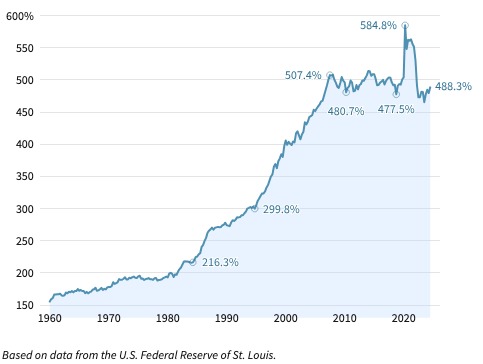
Total US Financial Assets as a Percentage of Gross Domestic Product (GDP) Since 1960
This chart tells us that for every $1 there is $4-$5 bogus paper money which has no backing by any asset, nor by any credit based upon the future GDP!
This chart depicts the growth of the financial sector relative to the real economy in the U.S. over time, as measured by the ratio of total financial assets held by U.S. households and businesses to GDP. The increasing ratio over time means the financial sector is growing faster than the real economy, implying that a larger proportion of economic activity is related to the trading and holding of financial assets than the production of goods and services.
TODO: Code this chart from actual data source.
© 2012-Present CCN Studios Creative Commons Attribution- NonCommercial- ShareAlike 4.0 International Public License
[1] https://en.wikipedia.org/wiki/Financialization
[2] https://www.forbes.com/councils/forbesfinancecouncil/2020/06/18/information-is-the-new-gold/
[3] https://en.wikipedia.org/wiki/Finance_capitalism
[4] https://www.tandfonline.com/doi/full/10.1080/13604813.2013.853865
[5] https://www.investopedia.com/terms/f/financialization.asp
[6] https://en.wikipedia.org/wiki/Financial_instrument
Subjugation by Secrecy
Few countries in the world are able to secretly fly over unsuspecting populated regions, conduct military operations with total immunity and in total secrecy, while the local ordinary people's movements, mobile and internet communications are wide open to prey upon.
Small and large corporations are state sponsored and obscenely financed, outside the scope of local and international laws, to attack, infiltrate your mobile and computer and possibly other digital devices in your home or office to snoop and report on your locations, targets/sources of your communications while turning your devices internal components on and off at the whim of commercial customers.
Files on all your devices are read and copied and archived and pitched to commercial customers!
This is not surveillance, this Secrecy is subjugation.
The people demanding secrecy for their movements, mobile and internet communications; yet that is considered rebellion!
However, secretly snooping and flying over their own ordinary citizens is national security even if across continents!
© 2012-Present CCN Studios Creative Commons Attribution- NonCommercial- ShareAlike 4.0 International Public License
Cartelization by Secrecy
Almost any place ordinary people were instructed to fully disclose all relevant information, the involved organizations kept Secrets from the ordinary people. The sure sign to detect such cartel formations is fantastic accumulation of quick wealth and profits by some unassuming super geniuses.
Research on corporate secrecy has studied the factors supporting secret organizations.[6] In particular, scholars in economics and management have paid attention to the way firms participating in cartels work together to maintain secrecy and conceal their activities from antitrust authorities.
Academic Cartelization
- In large universities, with awesome budgets, haven't you ever wondered who is that useless guy called the Dean? What does he do for his large pay and benefits? He oversees the cartel of all the competing departments; this Dean has large compensation since he maintains the concealment of secrets related to different departments e.g. admission reluctance for certain minorities, lack of academic and scientific integrity to publish more to garner larger and larger endowments and grants! And as we all have seen global sexual abuse of students and faculty. These universities are actually of the form and shape of multiple cartels which by means of Secrecy protect their funding and unnatural selection of students and faculty.
- Ideological Cartels e.g. String Theory, Neo-Darwinism, The Relativists and many more. If you want to get tenure you better join certain cartels and tow the line and while you do shut your mouth!
Publishers Cartelization
- Hollywood studios
- Record Labels USA
- Large book and periodicals publishers:
Case 1: In September 2024, Dr Lucina Uddin [3] , a neuroscience professor at UCLA, filed a class action lawsuit against the world’s largest academic publishers—including Elsevier, Wiley, Springer Nature, Taylor & Francis, and others. The complaint alleges that these publishers operate as an illegal cartel, controlling the terms of academic publishing in a way that is exploitative, anti-competitive, and ultimately harmful to science, scholarship, and society.
At the heart of the lawsuit is a broken system—one that many of us working in research have long experienced but felt powerless to change.
The case argues that publishers collude to enforce three core rules:
- A single submission rule that prevents authors from submitting to multiple journals at once, dramatically slowing down the publication process.
- An unpaid peer review rule, whereby publishers agree not to pay reviewers—ensuring that their billion-dollar profits are built on uncompensated academic labour.
- A gag rule, preventing researchers from sharing their own work while it’s under review, often for months or years.
These practices are not just unfair—they’re systematic. The complaint suggests they are coordinated via a trade body and function to preserve market dominance and suppress reform.
But perhaps the most galling element is how taxpayers pay for the same research three times:
- Once to fund it through public grants.
- Again through free academic labour in writing and peer review.
- And finally, when universities and libraries buy back the published research at exorbitant subscription fees.
In 2023, Elsevier alone made $3.8 billion in revenue, with profit margins higher than most tech giants. And yet, the system depends entirely on the unpaid work of researchers—many of whom are precariously employed or under immense pressure to publish.
The lawsuit doesn’t just seek financial compensation—it asks for structural change. It challenges the legitimacy of publishers setting the rules that benefit themselves while limiting the agency of the very scholars who create and verify knowledge.
This case has huge implications for open access, research equity, and the future of scholarly communication. [1]
Case 2: The Norwegian Competition Authority is imposing fines to the total amount of 545 million NOK on Norway’s four biggest publishing houses and the provider of the database Bokbasen for being in breach of the Competition Act (cartel). These operators have illegally exchanged future book prices and other competitively sensitive information through a subscription to the database Bokbasen.[2]
Industrial Cartelization
- Automobile manufacturing companies: [5]
The Commission's investigation revealed that, for over 15 years, 16 major car manufacturers (including Mercedes, which was not fined) and ACEA entered into anticompetitive agreements and engaged in concerted practices related to the recycling of ELVs.
In particular, the Commission found that the parties colluded on two aspects:
They agreed not to pay car dismantlers for processing ELVs. In particular, they agreed to consider the recycling of ELVs to be a sufficiently profitable business, and therefore not to remunerate car dismantlers for their services (so-called “Zero-Treatment-Cost” strategy). The companies also shared commercially sensitive information on their individual agreements with car dismantlers and coordinated their behaviour towards dismantlers;
They agreed not to promote how much of an ELV can be recycled, recovered and reused and how much recycled material is used in new cars. Their goal was to prevent consumers from considering recycling information when choosing a car, which could lower the pressure on companies to go beyond legal requirements.
- Oil companies
- Construction companies, including tools and technologies: [4]
BRUSSELS, July 20, 2026 (Reuters) - EU antitrust regulators on Monday charged a group of construction chemicals companies and trade associations with taking part in a cartel between 2021 and 2022, putting them at risk of hefty fines.
The European Commission issued the charges via a 'statement of objections' following dawn raids against unnamed companies in several EU countries in 2023.
The Commission, which acts as the EU competition enforcer, said the companies and associations colluded between 2021 and 2022 to increase prices in the supply of chemicals for cement, concrete and mortar, impacting construction costs.
© 2012-Present CCN Studios Creative Commons Attribution- NonCommercial- ShareAlike 4.0 International Public License
[1] https://creativemediapractice.com/academic-publishing-cartel/
[3] https://storage.courtlistener.com/recap/gov.uscourts.nyed.520652/gov.uscourts.nyed.520652.1.0_2.pdf
[5] https://ec.europa.eu/commission/presscorner/api/files/document/print/en/ip_25_881/IP_25_881_EN.pdf
Marginalization by Secrecry
More widespread use of informational asymmetries can be seen within the labor market. The gender gap in remuneration has been widely reported but one key factor that has being instrumental in its continuance has been the purposive hiding of the discrimination. This works through the effectively banning through contractual obligations, or strongly discouraging, workers from discussing their compensation.
Thus women, whose wages consistently remain below those of their male counterparts, are unaware that they personally are being discriminated against due to a lack of comparators. Kulow [1] argues that the only way of eradicating this information asymmetry is to introduce mandatory wage disclosure laws since in Norway, where this was put in place, the gender wage gap narrowed markedly.
© 2012-Present CCN Studios Creative Commons Attribution- NonCommercial- ShareAlike 4.0 International Public License
[1] https://mpra.ub.uni-muenchen.de/53109/1/MPRA_paper_53109.pdf