Margherita Sarfatti: The Jewish mother of Fascism
Margherita Sarfatti Benito Mussolini’s mistress
Haaretz: The Jewish Mother of Fascism
Margherita Sarfatti was known in Italy as Benito Mussolini’s mistress, but she was much more than that. She was his ideological companion, planned the ‘March on Rome’ with him, wrote articles in his name, edited the Fascist Party organ and wrote his first official biography.
ROME – Everyone in Italy wanted to forget the “Duce’s other woman”: the Fascists, because she was Jewish; their opponents, because she was Fascist; and the family, because she became an embarrassing historical burden. As a result, Margherita Sarfatti’s story slipped out of the public awareness, and along with it her central role in Italian fascism and the Duce’s life.
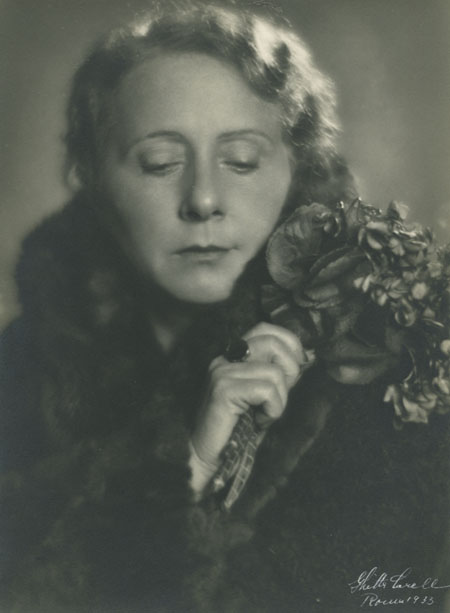
Today, more than 60 years after the Fascist dictator was executed, Sarfatti’s descendants prefer to view her as an intellectual and a patron of the arts, who worked to distanced Italy from the Nazi danger and was forced to flee to Argentina when Benito Mussolini implemented the race laws. They did not hear from her about the 20 years in which she shared Mussolini’s doctrine and bed. Or about the 1,272 letters he wrote her in those years, and which disappeared. No, they are not in her private archive at her home at 18 Via Dei Villini in Rome. At least, that is what her granddaughter, Ippolita Gaetani, who is in charge of the archive, told Haaretz in an exclusive interview. An American cousin, who is also named Margherita Sarfatti, is convinced the letters are in the hands of the Rome cousin.
Many visitors have recently called at the luxurious building in Rome – journalists, researchers, writers (“Italian Night,” by Nicole Fabre, a novel in which Sarfatti is a leading character, was recently published in France). It is a lavish patrician building in ocher, which is a three-minute walk from Villa Torlonia, the Duce’s official residence – three minutes from the villa’s back entrance, it should be noted. “The villa is being renovated,” says a smiling young woman who is working in the courtyard, “but you can visit. Go around to the other side, it’s worth it.”
At the home on the Via Dei Villini in Rome, a gilded bell, a vast black gate, a double wooden door, an elevator in an ornate metal cage, a broad marble staircase. The door is opened by Ippolita Gaetani, a spare, blue-eyed woman of 66, who has a determined, no-nonsense manner. The apartment is spacious, sun-washed, and furnished with classical restraint. The documents and photographs of Grandmother Margherita are housed in one room, in the center of which is the “Holy of Holies”: Sarfatti’s desk. On the wall is a famous portrait of Sarfatti with her daughter Fiammetta, painted by Achille Funi. Next to it are shelves laden with her notebooks and diaries, and a chest with 12 huge drawers.
Before the interview gets under way, the hostess receives a phone call. “I am being interviewed for an Israeli paper,” she apologizes, and adds, “No, no, the ‘good’ paper.” Ippolita Gaetani and her two sisters, Sancia and Margherita, are identified with the Italian left and are quite active on behalf of the Palestinian cause.
Ippolita was 21 when her grandmother died, in 1961, at the age of 81, but never asked her about her past, about her affair with Mussolini or her role in the Fascist movement. And Sarfatti, she says, never volunteered information on the subject. She talked about art, recited Dante, Shakespeare, Edgar Allan Poe and did crosswords in Figaro Litteraire. “After the war there was a deep collective repression, people tried to forget, did not boast about it. There was a kind of self-censorship. People are only now starting to talk about that period, and also about my grandmother,” Gaetani says.
When did you learn about your grandmother’s part in Mussolini’s life and in the Fascist movement in Italy?
“Very late, at the age of 17, 18, and from friends. It was not talked about at home. There was repression in Italy. Everything was imputed to the Germans, all the evils, the race laws, the persecutions. In my home, too, everything was imputed to the Germans. When I grew up and started to read, I understood that f ascism and Nazism are interchangeable. My mother did not think so – she continued to say that fascism was all right until it cozied up to Hitler.
“In my opinion, if the blacks and not the Jews had been persecuted then, many Jews would still be fascists … In fact, it is the same today. Many Jews in Italy are fascists, because fascism is far closer to today’s Israel; they are persecuting the Arabs. If you go to the Rome Ghetto today, you will see that part of the Rome Jewish community is truly fascist, fascist in its mentality, in the head. And the situation in the Middle East complicates matters. They accuse everyone who speaks out against Israel of being anti-Semitic. And in Italian politics they are far closer to the right than to the left.”
Encounter with history
Her mother, Fiammetta, converted to Christianity in 1930 and remained in Italy with her family even after Margherita and her son, Amedeo, went into exile to Argentina following the implementation of the race laws. But Sarfatti feared for the well-being of her daughter and her grandchildren, and after Rome was conquered by the Nazis she made long-distance use of the few connections she still retained from her days of glory in order to ensure that no harm would befall them. Thus Fiammetta found asylum in a hospital, disguised as a nurse; her husband, Livio, who was not Jewish, went into the underground; and their children were sent to Catholic convents. Margherita’s older sister, Nella Errera, did not fare so well. She and her husband, Paolo, who officially denied their Jewishness, were arrested in 1944 by the S.S. and sent to the camp at Fossoli and from there to Auschwitz. They died on the way to the extermination camp.
Did your grandmother talk about the past or feel responsibility for her sister’s death?
“Not with me, not with us, that was taboo at home. She may have had qualms of conscience, but either you commit suicide or you decide to live. People lived with worse things on their conscience. She was actually involved with art – it is not that she harmed or informed on anyone. On the contrary, some historians say that as long as she was by his side, Mussolini did fewer horrible things. She herself did not do anything bad to anyone. That her man was scum – of that there is no doubt.”
The dramatic story of Margherita Sarfatti’s life begins with a tranquil, happy childhood in the ghetto of Venice, where she was born on April 8, 1880, the youngest child of an affluent religious Jewish family, the Grassinis (the father of the Italian writer Natalia Ginzburg was her cousin). The lovely girl with red hair and green eyes and insatiable curiosity was raised in a protected setting and surrounded by love, especially on the part of her grandmother, Dolcetta Levi Nahmias, a “woman of valor,” in the Jewish term, from whom she learned to live in the present and not get caught up in the past.
“Oh, God,” she would mumble every night in a prayer she made up, “make me learn how to be happy and learn how to be grateful for all the good things you have given me.” To be happy, at any price: that was the motto that propelled her throughout her life. At the age of 18, despite her parents’ objections, she married Cesare Sarfatti, a Jewish lawyer and socialist, who was 14 years her senior. The Sarfattis had three children: Roberto, Amedeo and Fiammetta.
However, she found life in Venice too confining, and her husband was also eager for a change. The couple moved to the nerve center of Italy – Milan. There Margherita began to carve herself a place in the intellectual elite and to become active in fields which until then had been male prerogatives: journalism and art. To that end, she opened her salon every Wednesday to the city’s Who’s Who and gained the reputation of an impeccable hostess: beautiful, witty and vivacious. Her home became the center of the artistic avant-garde, the melting pot of Futurism, and later of the Novecento Italiano movement. The leading artists, writers and politicians were regulars in her home.
“A kind of acute sense of smell impelled me toward gifted people,” she wrote in her memoirs, which are really a collection of episodes about her meetings with preeminent world figures, including the inventor Guglielmo Marconi, Pope Pius X, president Franklin Delano Roosevelt, Albert Einstein and many others. Israel Zangwill, whom she calls the “Jewish Dickens,” and Ze’ev Jabotinsky, the Zionist Revisionist leader, were also among her acquaintances.
“She was an educated woman, very attentive to the cultural fashions, a manipulative woman, ambitious and uninhibited, with a singular talent for self-promotion (a talent she showed also after her son died in World War I, appropriating his death as another means of self- promotion),” says the historian Dr. Simona Urso, from the University of Padua, who has written a biography of Sarfatti.
The dramatic pivot of her life – the encounter with history – occurred in 1912, when a young, uncouth and unknown journalist named Benito Mussolini was appointed editor of the socialist journal Avanti, for which Sarfatti wrote art criticism. At 29, he was three years younger than Sarfatti, an ardent socialist from the provinces, a charismatic womanizer with a gift for holding his listeners in thrall with his talk. Sarfatti spotted a “glint of fanaticism” in his eyes and was immediately drawn to the power he projected.
Haaretz: Mussolini’s Jewish Lover Who Crafted Italian Fascism
Margherita Sarfatti wasn’t just the dictator’s most erudite paramour; she was his secret adviser and ideologue. The English version of her memoirs is finally out.
On November 14, 1938, shortly after the Italian Racial Laws were passed, Margherita Sarfatti slipped out of her home near Lake Como, got into her car and asked her chauffeur to drive her to the nearby Swiss border.
Among the few belongings the Jewish socialite and art critic had stuck in her two suitcases were 1,272 letters she had received from Benito Mussolini over their 20-year romantic and ideological relationship — a sort of insurance policy. Sarfatti, 58 at the time, would return to Italy only in 1947 after living in exile in France, Argentina and Uruguay.
In addition to art essays she wrote for local newspapers during her exile, Sarfatti published in 1945, shortly after Mussolini’s death, a series of articles in the Argentine paper Crítica in which she revealed details about her relationship with Il Duce. Scholars believe she waited until he no longer had the chance to harm the family members she had left behind in Rome.
Today, 70 years later, these articles have been published in the English-language book “My Fault: Mussolini As I Knew Him.” Dubbed by Enigma as “the unpublished memoir of Mussolini’s longtime lover,” the book’s 18 chapters come edited and annotated by historian Brian R. Sullivan, whose commentary is informed by three decades of research in Italy, France, Switzerland, Britain and the United States.
Just as the story of the long, intimate relationship between Sarfatti and Mussolini lay forgotten in archives for years until Philip V. Cannistraro and Sullivan published their 1993 work “Il Duce’s Other Woman,” Sarfatti’s memoirs remained abandoned in the shadows of history for decades.
Indeed, Sarfatti wasn’t just one of Mussolini’s hundreds of lovers. The aristocratic, intellectual and ambitious wife of wealthy Zionist lawyer Cesare Sarfatti, and mother of their three children, did not only share her bed with Il Duce. She also helped him forge and implement the fascist idea; she contributed advice — and Sullivan says, money — to help organize the 1922 March on Rome in which Mussolini seized power.
During those 20 years she was his eminence grise and unofficial ambassador, glorifying him in her 1925 biography that was translated into 18 languages.
Il Duce’s many frailties
It was Clara Petacci who has gone down in history as Mussolini’s most famous lover. In April 1945, Italian partisans shot her and Il Duce and hung their bodies upside down in Milan’s Piazzale Loreto. But after their intense 20-year personal and political relationship, Sarfatti was apparently the one who knew him best — maybe even better than his lawful wife, Rachele Guidi.
“Mussolini and Sarfatti had shown each other their souls,” Sullivan writes in the book’s long introduction. “She had listened to his secrets she knew most everything about Mussolini’s hidden weaknesses, his human frailties, his crude behavior, his superstitions, his ignorant misunderstandings about so many scientific and medical matters, and about his syphilis.”
But according to Sullivan, as much as Mussolini feared that Sarfatti would expose details on their sex life, he feared even more that she would reveal other shortcomings — and destroy the demigod image he had worked so hard to create.
Although Sarfatti’s 1955 Italian-language autobiography “Acqua Passata” (“Water Under the Bridge”) does not mention her relationship with Il Duce, her memoirs make up for it. She recounts a raft of personal and political anecdotes, provides quotes from Mussolini and talks about his sex addiction and cocaine use. But she never slides into bedroom gossip.
From her descriptions Mussolini comes across as a brilliant, charismatic statesman — but also an egocentric one ridden by inferiority complexes, fears and superstitions. He was also an unbridled womanizer, not to mention a manipulator who didn’t hesitate in his youth to threaten suicide in a letter to his mother “if she failed to send him some money for food.”
Sarfatti, meanwhile, comes across as a haughty, self-confident woman who often boasts of her good judgment, intuition and wisdom in both political and personal affairs.
Despite the book’s title “My Fault,” chosen by Sarfatti decades ago for the memoirs, she expresses no regret over her relationship with Mussolini, who was responsible for the deaths of her sister and brother-in-law on their way to Auschwitz, the destruction of Italian democracy and the establishment of a dictatorship. On the contrary, Sarfatti evades responsibility, putting all the blame on Mussolini.
Pesky Pact of Steel
Sarfatti maintains that fascism began as a positive idea that was distorted over the years. She claims that even Mussolini underwent a complete change. “After less than a decade in power, Mussolini seemed to me to have become someone else,” she writes. “He began to deny even the right to interior freedom and to subject the very souls of his people to the power of the state.”
As Sarfatti puts it, Mussolini’s alliance with Nazi Germany, which she opposed, was the main cause of his downfall. “But the Duce did not form the Rome–Berlin Axis or the Pact of Steel with the Führer by accident. Mussolini harbored within him a number of defects that attracted him to the Germans of his time. Thus he succumbed to the illness of power, to the madness of the Caesars.”
About one matter, though, she does accept the blame. “I cannot hide behind my work as an art critic. I must accept my responsibilities. I believed in Fascism and fought for it in the beginnings,” she writes.
“Worse, I wrote a book read by many that interpreted the goals of Fascism in a favorable light and proclaimed to the entire world that Mussolini was a hero of historic proportions. That was my fault …. It is my duty to declare that Mussolini fell because of his complete moral bankruptcy.”
Lamenting the failure of her “final, desperate attempt to guide Mussolini,” she adds: “Meanwhile, we discovered that behind the mask of Fascism lay an abyss of corruption, nepotism, favoritism and arbitrary lawlessness.”
Like most Italians, Sarfatti saw Mussolini as the embodiment of the “good tyrant,” adding that she had hoped he would turn out wiser, more level-headed and more just than the leaders produced by the ballot box.
Sullivan lambastes Sarfatti’s attempt to put all the blame on Il Duce. He writes that since it was Sarfatti, more than Mussolini, who crafted the ideological and philosophical basis of fascism between 1913 and 1919, she can’t evade responsibility for what others did based on her views. He adds that the original manuscript contains inaccuracies and spelling mistakes.
In his copious comments and remarks — often more comprehensive than the original text — Sullivan contends that after Sarfatti fled Italy, she agreed with Mussolini not to reveal details about their relationship. In exchange, no harm would befall her family still in Rome, among them her daughter Fiametta, her son-in-law and their three children.
But history lost out, Sullivan concludes, in that the book was not published in the late 1940s. Sarfatti possessed priceless photographs, letters and documents in Mussolini’s own hand.
“At least some of that historically precious material might have become available to scholars over sixty years ago,” Sullivan writes. “Instead, it passed into the possession of Sarfatti’s heirs after her death. They have refused permission to anyone to study those valuable records. Indeed, they have consistently denied their very existence. One can only hope they will have a change of mind.”