# Background
In the weeks before [Queen Victoria's coronation](https://en.wikipedia.org/wiki/Coronation_of_Queen_Victoria "Coronation of Queen Victoria") in 1838, Charles Darwin sought medical advice for his [mysterious physical symptoms](https://en.wikipedia.org/wiki/Charles_Darwin%27s_health "Charles Darwin's health"). He then travelled to Scotland for rest and a "geologising expedition" but also revisited the old haunts of his undergraduate days. On the day of the coronation, 28 June 1838, Darwin was in [Edinburgh](https://en.wikipedia.org/wiki/Edinburgh "Edinburgh"). Two weeks later, he opened a private notebook—*Notebook M*—for philosophical speculation, and, over the next three months, filled it with his ideas about hereditary influences on the psychological aspects of life. Darwin also made his first attempt at autobiography in August 1838.
Darwin fully grasps his conception of [natural selection](https://en.wikipedia.org/wiki/Natural_selection "Natural selection") towards the end of September 1838, after encountering the sixth edition of the *[Essay on Population](https://en.wikipedia.org/wiki/An_Essay_on_the_Principle_of_Population "An Essay on the Principle of Population")* (1826) by [Thomas Malthus](https://en.wikipedia.org/wiki/Thomas_Malthus "Thomas Malthus").[\[8\]](https://en.wikipedia.org/wiki/The_Expression_of_the_Emotions_in_Man_and_Animals#cite_note-Barrett_1980_p-8)[\[10\]](https://en.wikipedia.org/wiki/The_Expression_of_the_Emotions_in_Man_and_Animals#cite_note-10)[\[11\]](https://en.wikipedia.org/wiki/The_Expression_of_the_Emotions_in_Man_and_Animals#cite_note-11) However, Malthus and his essay are strangely unmentioned in *Notebook M*, their acknowledgement delayed till October 1838 in *Notebook N*.
In *Notebook M*, Darwin describes conversations with his father—a successful doctor with a special interest in psychiatric problems—about recurring patterns of behavior in successive generations of his patients' families. [Howard Gruber](https://en.wikipedia.org/wiki/Howard_Gruber "Howard Gruber") comments that these passages suggest genetic aspects to emotions and thought, and there is emphasis on the continuity between sane and insane.
Darwin was concerned about the materialistic drift in his thinking and the suspicions this might arouse in early [Victorian England](https://en.wikipedia.org/wiki/Victorian_England "Victorian England"). At the time, he was mentally preparing for marriage with his cousin [Emma Wedgwood](https://en.wikipedia.org/wiki/Emma_Darwin "Emma Darwin"), who held firm Christian beliefs. On 21 September 1838, *Notebook M* discloses a "confusing" dream where Darwin found himself involved in a public execution; the corpse had come to life and joked about not running away and facing death like a hero.
Darwin assembled the central features of his evolutionary theory while developing an appreciation of human behavior and family life; during this period, he was experiencing some emotional turmoil, largely expressed in physical symptoms.
A detailed discussion of the significance of *Notebook M* can be found in Paul H. Barrett's *Metaphysics, Materialism and the Evolution of Mind – Early Writings of Charles Darwin* (1980).
#### Development of the text in 1866–1872
In its public management, Darwin understood that [his evolutionary theory's](https://en.wikipedia.org/wiki/Darwinism "Darwinism") relevance to human emotional life could provoke an anxious and hostile response.
While preparing the text of *[The Variation of Animals and Plants Under Domestication](https://en.wikipedia.org/wiki/The_Variation_of_Animals_and_Plants_Under_Domestication "The Variation of Animals and Plants Under Domestication")* in 1866, Darwin began to explore topics related to human ancestry, [sexual selection](https://en.wikipedia.org/wiki/Sexual_selection "Sexual selection"), and emotional life. After his initial correspondence with the psychiatrist [James Crichton-Browne](https://en.wikipedia.org/wiki/James_Crichton-Browne "James Crichton-Browne"),[\[14\]](https://en.wikipedia.org/wiki/The_Expression_of_the_Emotions_in_Man_and_Animals#cite_note-14) Darwin set aside his material concerning emotional expression to complete *Descent of Man*, which covered human ancestry and sexual selection. He finished work on *The Descent of Man* on 15 January 1871. Two days later, he began work on *The Expression of the Emotions in Man and Animals* and completed most of the text within four months; progress then slowed because of work required on the sixth (and final) edition of *The Origin of Species* and a hostile review from [St George Jackson Mivart](https://en.wikipedia.org/wiki/St_George_Jackson_Mivart "St George Jackson Mivart"). Darwin finished his work on the proofs on 22 August 1872.
*Expression* brings Darwin's evolutionary theory close to [behavioural science](https://en.wikipedia.org/wiki/Behavioural_sciences "Behavioural sciences"), although several commentators have perceived a spectral [Lamarckism](https://en.wikipedia.org/wiki/Lamarckism "Lamarckism") within its text.
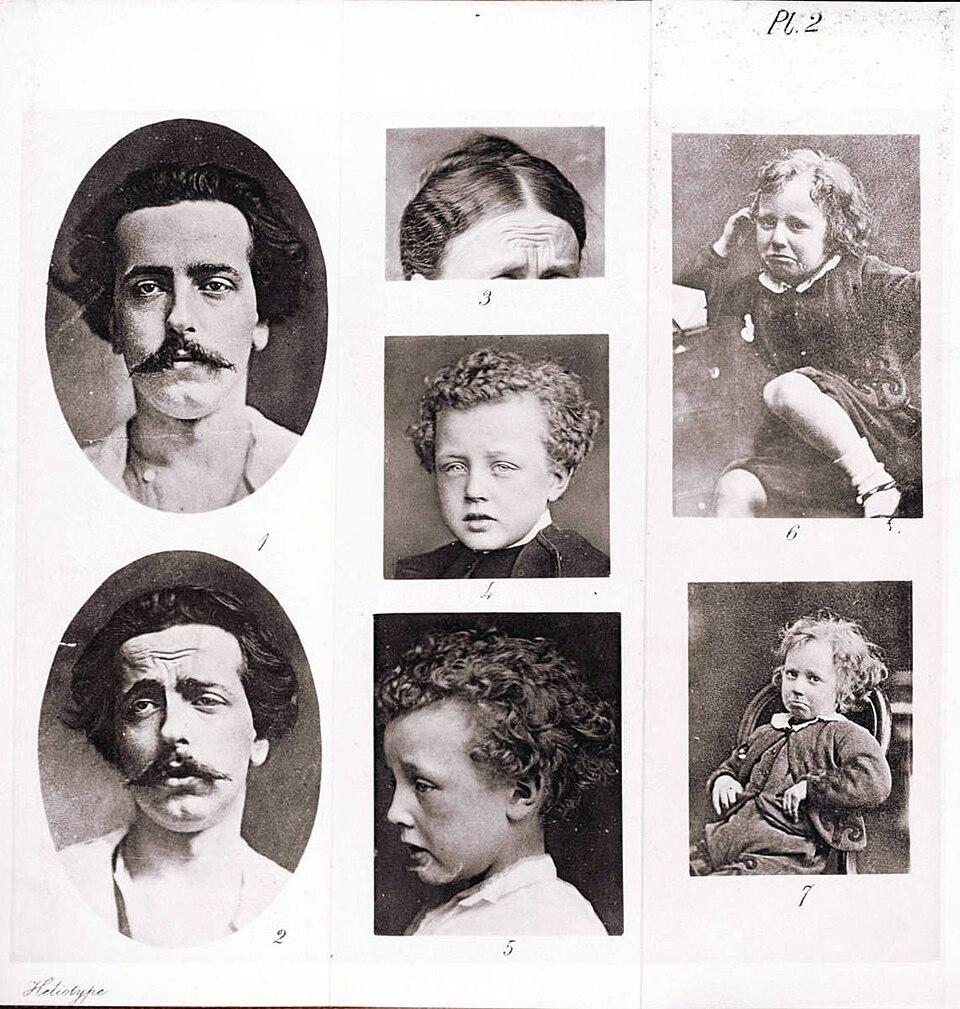
illustration of grief from *The Expression of the Emotions in Man and Animals*
[](https://wiki.compclassnotes.com/uploads/images/gallery/2026-02/plate-depicting-emotions-of-grief-from-charles-darwins-book-the-expression-of-the-emotions.jpg)