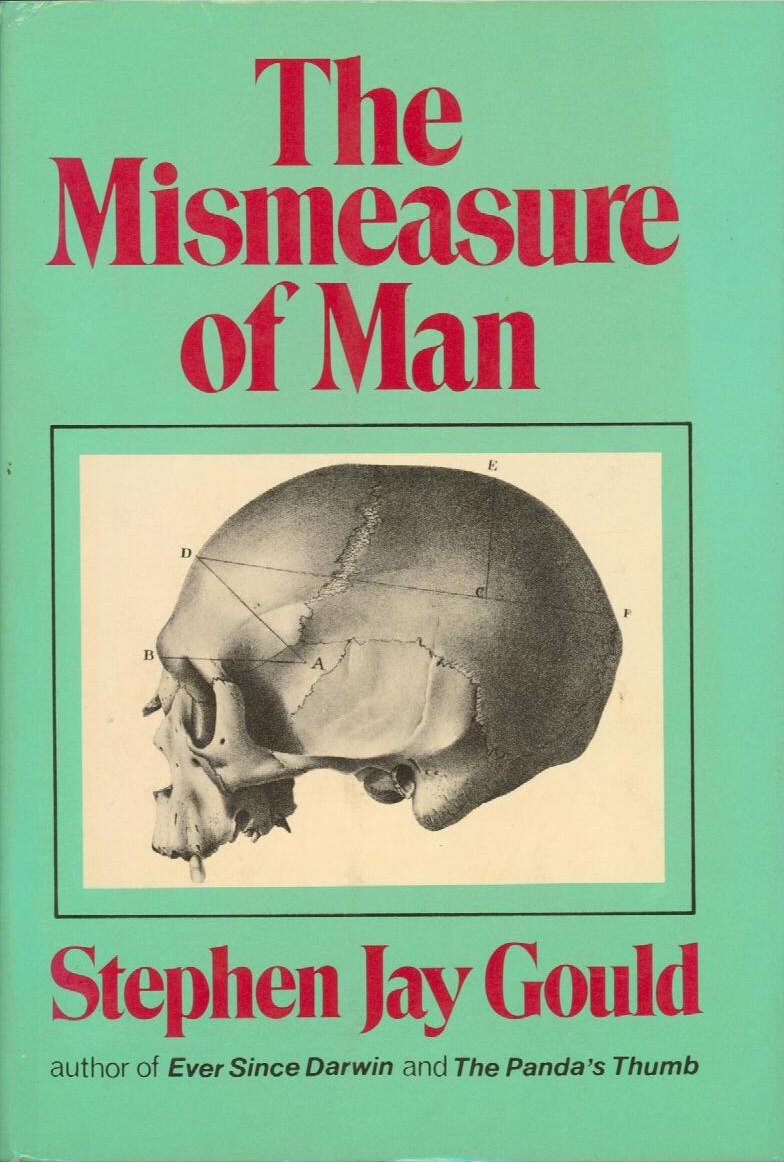
The Mismeasure of Man
The Mismeasure of Man is a critical analysis of the early works of scientific racism which promoted "the theory of unitary, innate, linearly rankable intelligence"—such as craniometry, the measurement of skull volume and its relation to intellectual faculties.
W. W. Norton & Company
ISBN 0-393-01489-4
1981, 1996
- Introduction
- Author
- Craniometry
- Bias and falsification
- IQ, g, statistical correlation, and heritability
Introduction
The Mismeasure of Man is a 1981 book by paleontologist Stephen Jay Gould. The book is both a history and critique of the statistical methods and cultural motivations underlying biological determinism, the belief that "the social and economic differences between human groups—primarily races, classes, and sexes—arise from inherited, inborn distinctions and that society, in this sense, is an accurate reflection of biology".
Gould argues that the primary assumption underlying biological determinism is that "worth can be assigned to individuals and groups by measuring intelligence as a single quantity". Biological determinism is analyzed in discussions of craniometry and psychological testing, the two principal methods used to measure intelligence as a single quantity. According to Gould, these methods possess two deep fallacies. The first fallacy is reification, which is "our tendency to convert abstract concepts into entities". Examples of reification include the intelligence quotient (IQ) and the general intelligence factor (g factor), which have been the cornerstones of much research into human intelligence. The second fallacy is that of "ranking", which is the "propensity for ordering complex variation as a gradual ascending scale".
Author
Stephen Jay Gould (/ɡuːld/; 1941 – 2002) was a professor at Harvard, teaching paleontology, evolutionary biology, and the history of science. An active and prodigious author, Gould's work was frequently cited by colleagues, being both influential and sometimes polarizing. He was also among the best selling authors of popular science, with a broad global readership. As in The Mismeasure of Man, throughout his writings Gould regularly criticized biologically determined explanations for human behavior, as seen in his "Against Sociobiology" (1975) and "The Spandrels of San Marco and the Panglossian Paradigm" (1979).
Craniometry
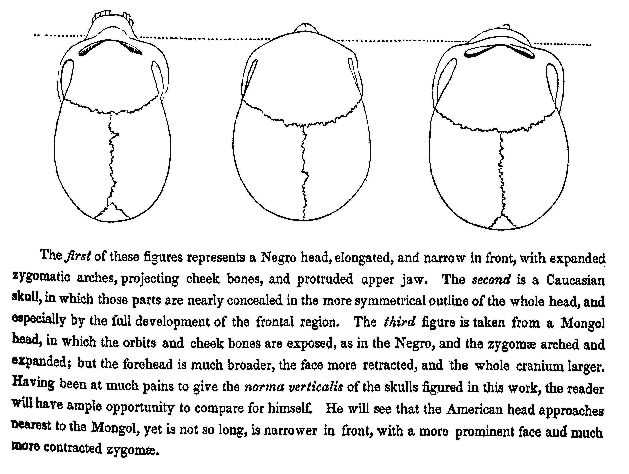
The Mismeasure of Man is a critical analysis of the early works of scientific racism which promoted "the theory of unitary, innate, linearly rankable intelligence"—such as craniometry, the measurement of skull volume and its relation to intellectual faculties. Gould alleged that much of the research was based largely on racial and social prejudices of the researchers rather than their scientific objectivity; that on occasion, researchers such as Samuel George Morton (1799–1851), Louis Agassiz (1807–1873), and Paul Broca (1824–1880), committed the methodological fallacy of allowing their personal a priori expectations to influence their conclusions and analytical reasoning. Gould noted that when Morton switched from using bird seed, which was less reliable, to lead shot to obtain endocranial-volume data, the average skull volumes changed; however, these changes were not uniform across Morton's "racial" groupings. To Gould, it appeared that unconscious bias influenced Morton's initial results.[7] Gould speculated,
Plausible scenarios are easy to construct. Morton, measuring by seed, picks up a threateningly large black skull, fills it lightly and gives it a few desultory shakes. Next, he takes a distressingly small Caucasian skull, shakes hard, and pushes mightily at the foramen magnum with his thumb. It is easily done, without conscious motivation; expectation is a powerful guide to action.[8]
In 1977 Gould conducted his own analysis on some of Morton's endocranial-volume data, and alleged that the original results were based on a priori convictions and a selective use of data. He argued that when biases are accounted for, the original hypothesis—an ascending order of skull volume ranging from Blacks to Mongols to Whites—is unsupported by the data.
The "species" of man: "a Negro head . . . a Caucasian skull . . . a Mongol head", by S. G. Morton (1839)
Bias and falsification
The Mismeasure of Man presents a historical evaluation of the concepts of the intelligence quotient (IQ) and of the general intelligence factor (g factor), which were and are the measures for intelligence used by psychologists. Gould proposed that most psychological studies have been heavily biased, by the belief that the human behavior of a race of people is best explained by genetic heredity. He cites the Burt Affair, about the oft-cited twin studies, by Cyril Burt (1883–1971), wherein Burt claimed that human intelligence is highly heritable
IQ, g, statistical correlation, and heritability
As an evolutionary biologist and historian of science, Gould accepted biological variability (the premise of the transmission of intelligence via genetic heredity), but opposed biological determinism, which posits that genes determine a definitive, unalterable social destiny for each man and each woman in life and society. The Mismeasure of Man is an analysis of statistical correlation, the mathematics applied by psychologists to establish the validity of IQ tests, and the heritability of intelligence. For example, to establish the validity of the proposition that IQ is supported by a general intelligence factor (g factor), the answers to several tests of cognitive ability must positively correlate; thus, for the g factor to be a heritable trait, the IQ-test scores of close-relation respondents must correlate more than the IQ-test scores of distant-relation respondents. However, correlation does not imply causation; for example, Gould said that the measures of the changes, over time, in "my age, the population of México, the price of Swiss cheese, my pet turtle's weight, and the average distance between galaxies" have a high, positive correlation—yet that correlation does not indicate that Gould's age increased because the Mexican population increased. More specifically, a high, positive correlation between the intelligence quotients of a parent and a child can be presumed either as evidence that IQ is genetically inherited, or that IQ is inherited through social and environmental factors. Moreover, because the data from IQ tests can be applied to arguing the logical validity of either proposition—genetic inheritance and environmental inheritance—the psychometric data have no inherent value.
Gould pointed out that if the genetic heritability of IQ were demonstrable within a given racial or ethnic group, it would not explain the causes of IQ differences among the people of a group, or if said IQ differences can be attributed to the environment. For example, the height of a person is genetically determined, but there exist height differences within a given social group that can be attributed to environmental factors (e.g. the quality of nutrition) and to genetic inheritance. The evolutionary biologist Richard Lewontin, a colleague of Gould's, is a proponent of this argument in relation to IQ tests. An example of the intellectual confusion about what heritability is and is not, is the statement: "If all environments were to become equal for everyone, heritability would rise to 100 percent because all remaining differences in IQ would necessarily be genetic in origin", which Gould said is misleading, at best, and false, at worst. First, it is very difficult to conceive of a world wherein every man, woman, and child grew up in the same environment, because their spatial and temporal dispersion upon the planet Earth makes it impossible. Second, were people to grow up in the same environment, not every difference would be genetic in origin because of the randomness of molecular and genetic development. Therefore, heritability is not a measure of phenotypic (physiognomy and physique) differences among racial and ethnic groups, but of differences between genotype and phenotype in a given population.
Furthermore, he dismissed the proposition that an IQ score measures the general intelligence (g factor) of a person, because cognitive ability tests (IQ tests) present different types of questions, and the responses tend to form clusters of intellectual acumen. That is, different questions, and the answers to them, yield different scores—which indicate that an IQ test is a combination method of different examinations of different things. As such, Gould proposed that IQ-test proponents assume the existence of "general intelligence" as a discrete quality within the human mind, and thus they analyze the IQ-test data to produce an IQ number that establishes the definitive general intelligence of each man and of each woman. Hence, Gould dismissed the IQ number as an erroneous artifact of the statistical mathematics applied to the raw IQ-test data, especially because psychometric data can be variously analyzed to produce multiple IQ scores.