illustration of grief from *The Expression of the Emotions in Man and Animals*
[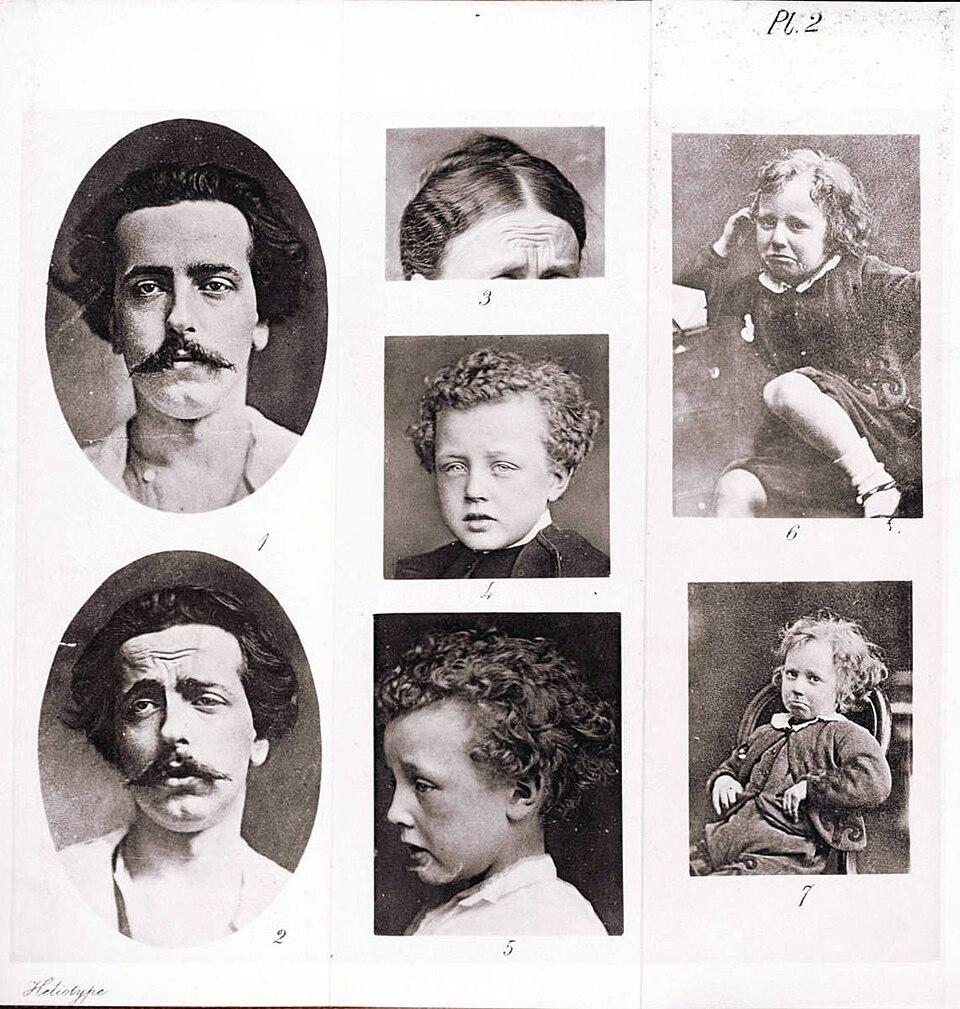](https://wiki.compclassnotes.com/uploads/images/gallery/2026-02/plate-depicting-emotions-of-grief-from-charles-darwins-book-the-expression-of-the-emotions.jpg) # Darwin's sources on emotional expression Darwin attended debates about psychology at the [Plinian Society](https://en.wikipedia.org/wiki/Plinian_Society "Plinian Society") in December 1826 and March 1827 as a medical student at Edinburgh University. These were prompted by the publication of Charles Bell's *Anatomy and Philosophy of Expression* (1824). In his presentations, the [phrenologist](https://en.wikipedia.org/wiki/Edinburgh_Phrenological_Society "Edinburgh Phrenological Society") [William A.F. Browne](https://en.wikipedia.org/wiki/William_A.F._Browne "William A.F. Browne") ridiculed Bell's theological explanations, pointing instead to the similarities of human and animal biology. Both meetings ended in uproar. Darwin revisits these debates 45 years later and refers to Duchenne de Boulogne's *[Mécanisme de la physionomie humaine](https://en.wikipedia.org/wiki/M%C3%A9canisme_de_la_physionomie_humaine "Mécanisme de la physionomie humaine")* (1862) as he shifts the debate from philosophical to scientific discourse and highlights the social value of facial expression over other forms of expression in vocalisations, tears, and posture. Darwin's response to Bell's natural theology is discussed in [Lucy Hartley's](https://en.wikipedia.org/wiki/Lucy_Hartley "Lucy Hartley") *Physiognomy and the Meaning of Expression in Nineteenth Century Culture* (2001).[\[23\]](https://en.wikipedia.org/wiki/The_Expression_of_the_Emotions_in_Man_and_Animals#cite_note-23) In the composition of the book, Darwin drew on a variety of sources: - His questionnaire (circulated in the early months of 1867) concerning emotional expression in different ethnic groups - Anthropological memories from his time on [HMS *Beagle*](https://en.wikipedia.org/wiki/HMS_Beagle "HMS Beagle") - Conversations with livestock breeders and pigeon fanciers - Observations on his infant son [William Erasmus Darwin](https://en.wikipedia.org/wiki/William_Erasmus_Darwin "William Erasmus Darwin") (*A Biographical Sketch of an Infant*, published in 1877 in the philosophical journal *Mind*), on his family's dogs and cats, and on the orangutans at [London Zoo](https://en.wikipedia.org/wiki/London_Zoo "London Zoo") - Simple psychology experiments with members of his family concerning the recognition of emotional expression - The neurological insights of Duchenne de Boulogne, a physician at the [Salpêtrière asylum](https://en.wikipedia.org/wiki/Salp%C3%AAtri%C3%A8re "Salpêtrière") in Paris - Hundreds of photographs of actors, [babies](https://en.wikipedia.org/wiki/Babies "Babies"), and children, including photographs by [Oscar Rejlander](https://en.wikipedia.org/wiki/Oscar_Rejlander "Oscar Rejlander") - Descriptions of psychiatric patients in [West Riding Pauper Lunatic Asylum](https://en.wikipedia.org/wiki/Stanley_Royd_Hospital "Stanley Royd Hospital") in [Wakefield](https://en.wikipedia.org/wiki/Wakefield "Wakefield") As a result of his domestic psychology experiments, Darwin reduced the number of commonly observed emotions from Duchenne's calculation of more than sixty [facial expressions](https://en.wikipedia.org/wiki/Facial_expression "Facial expression") to six "core" expressions: anger, fear, surprise, disgust, happiness, and sadness. Darwin corresponded with James Crichton-Browne, the son of the phrenologist [William A. F. Browne](https://en.wikipedia.org/wiki/William_A._F._Browne "William A. F. Browne") and now the distinguished medical director of West Riding Pauper Lunatic Asylum. At the time, Crichton-Browne was editing *The West Riding Lunatic Asylum Medical Reports*. Recognising the significance of Crichton-Browne's contributions, Darwin suggested to him that *Expression* "ought to be called by Darwin *and* Browne?" Darwin also drew on his personal experience of the symptoms of bereavement and studied the text of [Henry Maudsley's](https://en.wikipedia.org/wiki/Henry_Maudsley "Henry Maudsley") 1870 [Goulstonian Lectures](https://en.wikipedia.org/wiki/Goulstonian_Lecture "Goulstonian Lecture") on *Body And Mind*. Darwin considered other approaches to the study of emotions, such as their depiction in the arts—as discussed by the actor [Henry Siddons](https://en.wikipedia.org/wiki/Henry_Siddons "Henry Siddons") in his *Practical Illustrations of Rhetorical Gesture and Action* (1807) and by the anatomist [Robert Knox](https://en.wikipedia.org/wiki/Robert_Knox_(surgeon) "Robert Knox (surgeon)") in his *Manual of Artistic Anatomy* (1852)—but abandoned these approaches as unreliable. It is noteworthy that only a few sections in *Expression* touch on emotional deception. # Structure *Expression* opens with three chapters (1–3) entitled "General Principles of Expression", where Darwin introduces three principles: 1. "The principle of serviceable associated Habits" – describes how initially voluntary actions constitute complex expressions of emotion by association of habit. 2. "The principle of Antithesis" – explains how opposite mental states induce directly opposing movements. 3. "The principle of actions due to the constitution of the Nervous System, independently from the first of the Will, and independently to a certain extent of Habit*" –* discusses the interplay between physiological reactions (e.g., sweating, muscle trembling, blushing) and emotional experiences. In the following chapters (4–6), Darwin presents his findings on modes of emotional expression peculiar to particular species, including humans. Chapters 7–8 contain Darwin's observations on "low spirits" ([anxiety](https://en.wikipedia.org/wiki/Anxiety "Anxiety"), grief, dejection, and [despair](https://en.wikipedia.org/wiki/Despair_(emotion) "Despair (emotion)")) and "high spirits" (joy, love, tender feelings, and devotion). Darwin claims that high spirits, exemplified by joy, find their purest expression in laughter. Subsequent chapters (9–13) discuss various emotions and their expression. In his discussion of the emotion "disgust", Darwin notes its close links to the sense of smell and conjectures an association with offensive odours. In chapter 13 (which highlights the emotional states of self-attention, shame, shyness, modesty, and blushing), Darwin describes blushing as "the most peculiar and the most human of all expressions". Darwin closes the book with chapter 14, where he summarises his central argument, demonstrating how human emotions link mental states with bodily movement. He argues that these expressions are genetically determined and derive from purposeful actions observed in animals. He comments on the book's implications, proposing a single origin for the entire human species, with universal human expressions. Darwin emphasises the social value of expression, especially the [emotional communication](https://en.wikipedia.org/wiki/Attachment_theory "Attachment theory") between mother and child.