The Dream of the Celt
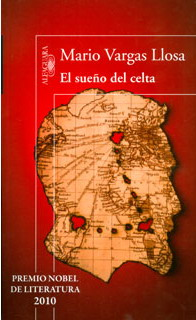
Spanish: El sueño del celta) is a novel by Peruvian writer and 2010 Nobel laureate in literature Mario Vargas Llosa.
Theme and structure
The Dream of the Celt combines elements of the historical novel with those of the journalistic chronicle; the main human and historical themes explored are those relating to the colonial subjugation and enslavement (via a process of systematic terror and torture) of the native inhabitants of the Congo Basin and the Peruvian Amazon during the latter part of the 19th and early part of the 20th century. The novel naturally and purposefully invites comparison with Joseph Conrad's Heart of Darkness (the direct appearance of Conrad in the novel leaves little doubt in this regard).[8][5]
It is within this larger context that the complex and ultimately tragic story of British consul Roger Casement unfolds. The most notable events of this vita being his exposure to and his first-hand accounts of the systematic tortures inflicted on the native inhabitants of the Congo and Peru by European commercial concerns; his attainment of a British knighthood for these same humanitarian endeavors; his subsequent transformation into a radical fighter for Irish independence, collaboration with the German military, and participation in the Easter Rising; his arrest, prosecution, and conviction for treason by the British; the late revelations of a submerged history of pederastic activities as per his own secret diaries; his execution by hanging.[9][10]
The story is told in alternating chapters, with the odd chapters detailing the last three months of Casement's life (in 1916), and the even chapters encompassing the protagonist's experiences up to that time; the latter are themselves divided into three parts, each one named after a specific colonial geography and reality to which Casement was exposed: "Congo," "Amazonia," "Ireland." Ultimately, odd and even chapters converge on a final structural and dramatic point, which is also the final point (and, in a sense, purpose) of Casement's life.
Texture of Experience
I (Lucia) went to see the obelisk that stands on Banna Strand, Kerry. This monument marks the landing place from a German submarine on Good Friday 1916 of the Irish patriot Sir Roger Casement. In the runup to the Easter rising, seeking German help, Casement had been in Germany raising a battalion of Irish volunteers from prisoners of war. As well as Casement, the Germans sent 20,000 guns on a ship flying false Norwegian colours; they were never landed.
I had heard of Sir Roger Casement as a martyr to the Irish cause and fight for freedom. I did not know anything else about him. I love to read book reviews and came across the book ‘The Dream of the Celt’ written no less by Mario Vargas Llosa. This was another layer of interest. Why would a Peruvian Nobel Prize Recipient write about an Irish freedom fighter (so to speak). And then I understood. Sir Roger Casement exposed the rapacious practices of the Force Publique in the Belgian Congo and of rubber barons in the Peruvian Amazon.
Like a biography on the grand scale, it attempts to cover all episodes of his life, from his Protestant childhood in Ulster, to youth as a clerk for a Liverpool shipping line, to his early years in the Congo, working from 1884 for Stanley, in the Congo and on other extensions of the Belgian King Leopold II's barbaric project to annex the region, and on to his period as British consul, during which he began investigations into slave labour and other atrocities by the Belgian Force Publique. These were published in his Congo report of 1904. Commissioned by the Foreign Office as a response to increasing public outrage in Britain, it won Casement a knighthood.
Then, on, on, to Amazonia, for similar investigations into the company of Julio C Arana and the Putumayo rubber planters. This 1912 report, like its Congolese predecessor, is a foundational document of human rights. The final phase of Casement's life, as reported in The Dream of the Celt, concerns his global activities on behalf of the cause of Irish nationalism.
In some respects, Casement was one of the realists among Republican leaders (in part, he came to Ireland in 1916 to try to stop the rising, rightly believing it would not succeed without more German aid than he believed to be coming). In other ways, he was among the most romantic of them, as witnessed by his early poem "The Dream of the Celt", which gives Vargas Llosa his title; in other ways still, he was not romantic enough, failing to see the lasting symbolic power of martyred nationalists.
The deeper Casement got into Irish politics, the more rash he became, ignoring warnings that his sometime homosexual consort, Eivind Adler Christensen, had betrayed him to the British; probably Christensen was a British plant from the start.
Seduced by these old tricks, Casement probably would still have hanged even without the discovery of the so-called "Black Diaries", which appear to document his sexual activity over many years in different countries. Controversy still hovers over the diaries' veracity, but most now seem to accept the findings of a detailed forensic examination in 2002, which concluded that they are genuine.
With or without the hand of the British authorities, Casement was doomed. It seems there was something in him that wanted to be discovered. Casement's naivety is a key theme in this novel, and it dates from early in his professional life. On becoming British consul in Boma, Casement deeply regretted his involvement with Stanley and Leopold. As Vargas Llosa writes: "For the rest of his life, Roger lamented – he said it again now, in 1902, in his fever, dedicating his first eight years in Africa to working, like a pawn in a game of chess, on the building of the Congo Free State."
The narrative is framed with an account of Casement's imprisonment in Pentonville awaiting his appeal; the novel moves back and forth from the ‘current’ imprisonment to what lead to that imprisonment.
Thoughts
One of the questions I ponder - ‘is evil a result of nature or nurture?’ It is the ongoing question that many philosophers ponder. And when I read ‘The Dream of the Celt’, the book provided one perspective on that age old question.
Sir Roger Casement had it all (so to say). He was honoured by his government with a Knighthood for Foreign Office work. He held prestigious positions as a diplomat, yet when he observed and wrote about the abuses of the native peoples of Amazonia and of Congo, he recognized those abject abuses for what they are: Evil perpetuated by those in power.
Why did so many others ignore or accept such abuse towards other human beings? Why did they inflict such abuse on others?
Why do so few people take a stand against such abuse?
About 60 years later we see the next great humanitarian who was changed by the abuses he saw in Bolivia – the same circumstances played out. Che Lynch Guevara (yes, he has Irish heritage) saw similar abuses of people in Bolivia when he travelled as a young man.
That experience, plus the abuses by the CIA in Guatemala, changed the course of his life.
And today we see the same events occur – with as much cruelty yet more intensively as we, on our mobile phones and TVs – in Sudan, and in Palestine. And it is the same response – most people do nothing a few people speak out.
Look at the relentless harassment that Francesca Albanese, the UN The Special Rapporteur on the Occupied Palestinian Territories. There are many voices speaking out, and yet our governments do nothing.
I recall that Nelson Mandela who finally, after 19 years in Robin Island, obtained his freedom, commented that
"We know too well that our freedom is incomplete without the freedom of the Palestinians."
What cost did he pay before he got his freedom and that of the South African people?
As Malcolm X said,
“And until the American Negro lets the white man know that we are really ready and willing to pay the price that is necessary for freedom, our people will always be walking around here, second-class citizens or what you call 20th-century slaves... The price of freedom is death.
People have summarized that powerful statement as ‘Freedom is not Free.’
There is a huge cost that people of conscience pay for their own freedom and their fight for other people's freedom.
Now, many Irish people are speaking out against genocide and the apartheid regime that has killed almost 100,000 people. And yet, the UN and no government have done anything to stop it.
To return to my question. I believe that people are either born with a natural propensity towards compassion and empathy towards others in general and those who are less fortunate, or they are not. Yet, nurture, our environment, can influence that. We have free will and we can choose to be human or inhuman. And we can see, quite clearly in many countries, what their governments and people have chosen.
Copyrights & Attachments
Under the Derivative Work Law, the English translation of the book The Dream of the Celt, for non-profit, educational and editorial use, is held under the copyright by Computational Classnotes of Republic of Ireland.
Under the Fair Use Act, CCN Wiki Books has uploaded the book The Dream of the Celt, for non-profit, educational and editorial use, since file has already, for quite a few years made available for general access by all on Internet.
Audiobook
https://soundcloud.com/justice-node-ccn/the_dream_of_celt1-20260618-1