Miniatures of Boethius teaching and in prison from a 1385 Italian manuscript
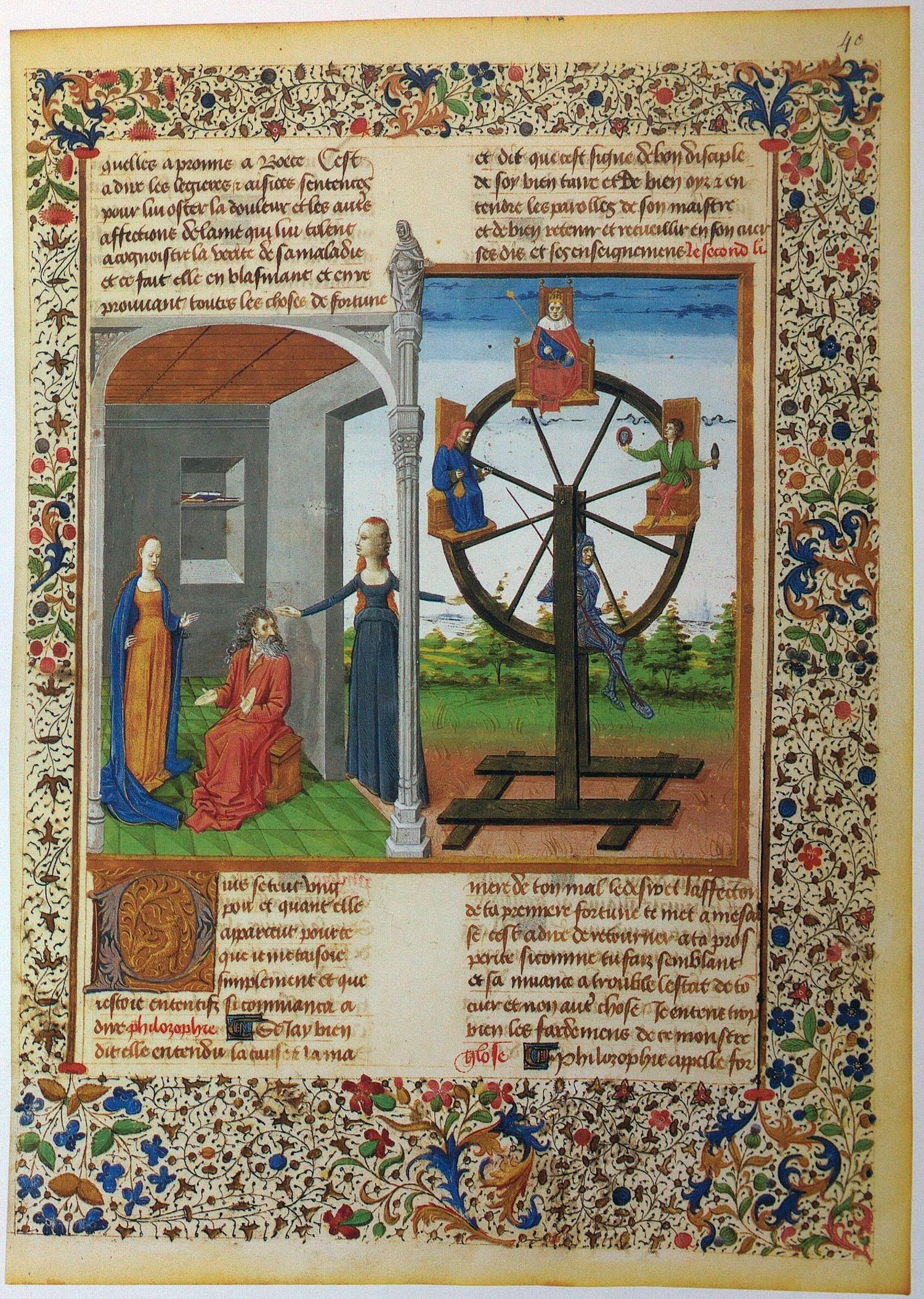
Boethius writes the book as a conversation between himself and a **female personification of philosophy,** referred to as "Lady Philosophy". Philosophy consoles Boethius by discussing the transitory nature of wealth, fame, and power ("no man can ever truly be secure until he has been forsaken by Fortune"), and the ultimate superiority of things of the mind, which she calls the "one true good". She contends that happiness comes from within, and that virtue is all that one truly has because it is not imperiled by the vicissitudes of fortune. Boethius engages with the nature of [predestination](https://en.wikipedia.org/wiki/Predestination "Predestination") and [free will](https://en.wikipedia.org/wiki/Free_will "Free will"), the [problem of evil](https://en.wikipedia.org/wiki/Problem_of_evil "Problem of evil") and the "problem of desert", [human nature](https://en.wikipedia.org/wiki/Human_nature "Human nature"), [virtue](https://en.wikipedia.org/wiki/Virtue "Virtue"), and [justice](https://en.wikipedia.org/wiki/Justice "Justice"). He speaks about the nature of free will and [determinism](https://en.wikipedia.org/wiki/Determinism "Determinism") when he asks whether God knows and sees all, or whether man has free will. On human nature, Boethius says that humans are essentially good, and only when they give in to "wickedness" do they "sink to the level of being an animal." On justice, he says criminals are not to be abused, but rather treated with sympathy and respect, using the analogy of doctor and patient to illustrate the ideal relationship between prosecutor and criminal.A page of a medieval French translation of Boethius’ „[Consolation of Philosophy](https://en.wikipedia.org/wiki/The_Consolation_of_Philosophy "en:The Consolation of Philosophy")“ in the manuscript Paris, Bibliothèque nationale de France, Fr. 809, fol. 40r. The miniature shows Boethius (left) with Philosophia (the personification of philosophy); on the right side of the picture the [Wheel of Fortune](https://en.wikipedia.org/wiki/Rota_Fortunae "en:Rota Fortunae").
[](https://wiki.compclassnotes.com/uploads/images/gallery/2026-02/boethius-consolatio-philosophiae-french.jpg) # Interpretation In the *Consolation*, Boethius answered religious questions without reference to Christianity, relying solely on natural philosophy and the Classical [Greek](https://en.wikipedia.org/wiki/Greek_philosophy "Greek philosophy") tradition. He believed in the correspondence between faith and reason. The truths found in Christianity would be no different from the truths found in philosophy.[\[6\]](https://en.wikipedia.org/wiki/On_the_Consolation_of_Philosophy#cite_note-6) In the words of Henry Chadwick, "If the *Consolation* contains nothing distinctively Christian, it is also relevant that it contains nothing specifically pagan either...\[it\] is a work written by a Platonist who is also a Christian."[\[7\]](https://en.wikipedia.org/wiki/On_the_Consolation_of_Philosophy#cite_note-7) Boethius repeats the [Macrobius](https://en.wikipedia.org/wiki/Macrobius "Macrobius") model of the Earth in the center of a spherical cosmos. The philosophical message of the book fits well with the religious piety of the Middle Ages. Boethius encouraged readers not to pursue worldly goods such as money and power, but to seek internalized virtues. Evil had a purpose, to provide a lesson to help change for good; while suffering from evil was seen as virtuous. Because God ruled the universe through Love, prayer to God and the application of Love would lead to true happiness.[\[9\]](https://en.wikipedia.org/wiki/On_the_Consolation_of_Philosophy#cite_note-Beck-9) The Middle Ages, with their vivid sense of an overruling fate, found in Boethius an interpretation of life closely akin to the spirit of Christianity. The *Consolation* stands, by its note of fatalism and its affinities with the Christian doctrine of humility, midway between the pagan philosophy of [Seneca the Younger](https://en.wikipedia.org/wiki/Seneca_the_Younger "Seneca the Younger") and the later Christian philosophy of consolation represented by [Thomas à Kempis](https://en.wikipedia.org/wiki/Thomas_%C3%A0_Kempis "Thomas à Kempis").[\[10\]](https://en.wikipedia.org/wiki/On_the_Consolation_of_Philosophy#cite_note-Cambridge-10) The book is heavily influenced by [Plato](https://en.wikipedia.org/wiki/Plato "Plato") and his [dialogues](https://en.wikipedia.org/wiki/Socratic_dialogue "Socratic dialogue") (as was Boethius himself).[\[10\]](https://en.wikipedia.org/wiki/On_the_Consolation_of_Philosophy#cite_note-Cambridge-10) Its popularity can in part be explained by its [Neoplatonic](https://en.wikipedia.org/wiki/Neoplatonic "Neoplatonic") and Christian ethical messages, although current scholarly research is still far from clear exactly why and how the work became so vastly popular in the Middle Ages. # Influence From the [Carolingian](https://en.wikipedia.org/wiki/Carolingian "Carolingian") epoch[\[12\]](https://en.wikipedia.org/wiki/On_the_Consolation_of_Philosophy#cite_note-12) to the end of the Middle Ages and beyond, *The Consolation of Philosophy* was one of the most popular and influential philosophical works, read by statesmen, poets, historians, philosophers, and theologians. It is through Boethius that much of the thought of the Classical period was made available to the Western Medieval world. It has often been said Boethius was the "[last of the Romans](https://en.wikipedia.org/wiki/Last_of_the_Romans "Last of the Romans") and the first of the [Scholastics](https://en.wikipedia.org/wiki/Scholasticism "Scholasticism")". Translations into the [vernacular](https://en.wikipedia.org/wiki/Vernacular "Vernacular") were done by famous notables, including [King Alfred](https://en.wikipedia.org/wiki/Alfred_the_Great "Alfred the Great") ([Old English](https://en.wikipedia.org/wiki/Old_English_language "Old English language")), [Jean de Meun](https://en.wikipedia.org/wiki/Jean_de_Meun "Jean de Meun") ([Old French](https://en.wikipedia.org/wiki/Old_French "Old French")), [Geoffrey Chaucer](https://en.wikipedia.org/wiki/Geoffrey_Chaucer "Geoffrey Chaucer") ([Middle English](https://en.wikipedia.org/wiki/Middle_English "Middle English")), [Queen Elizabeth I](https://en.wikipedia.org/wiki/Elizabeth_I "Elizabeth I") ([Early Modern English](https://en.wikipedia.org/wiki/Early_Modern_English "Early Modern English")), [Richard Graham, 1st Viscount Preston](https://en.wikipedia.org/wiki/Richard_Graham,_1st_Viscount_Preston "Richard Graham, 1st Viscount Preston") (English, 1695–1696), and [Notker Labeo](https://en.wikipedia.org/wiki/Notker_Labeo "Notker Labeo") ([Old High German](https://en.wikipedia.org/wiki/Old_High_German "Old High German")).[\[13\]](https://en.wikipedia.org/wiki/On_the_Consolation_of_Philosophy#cite_note-13)[\[14\]](https://en.wikipedia.org/wiki/On_the_Consolation_of_Philosophy#cite_note-14)[\[15\]](https://en.wikipedia.org/wiki/On_the_Consolation_of_Philosophy#cite_note-15)[\[16\]](https://en.wikipedia.org/wiki/On_the_Consolation_of_Philosophy#cite_note-16)[\[17\]](https://en.wikipedia.org/wiki/On_the_Consolation_of_Philosophy#cite_note-17) Other English translators include George Colville (1556), Henry Rosher (H. J.) James (1897), Walter John (W. J.) Sedgefield (1899), and Richard H. Green (1962). Boethius's *Consolation of Philosophy* was translated into Italian by Alberto della Piagentina (1332), Anselmo Tanso (Milan, 1520), [Lodovico Domenichi](https://en.wikipedia.org/wiki/Lodovico_Domenichi "Lodovico Domenichi") (Florence, 1550), [Benedetto Varchi](https://en.wikipedia.org/wiki/Benedetto_Varchi) (Florence, 1551), [Cosimo Bartoli](https://en.wikipedia.org/wiki/Cosimo_Bartoli "Cosimo Bartoli") (Florence, 1551) and [Tommaso Tamburini](https://en.wikipedia.org/wiki/Tommaso_Tamburini "Tommaso Tamburini") (Palermo, 1657). Found within the *Consolation* are themes that have echoed throughout the Western canon: the female figure of wisdom that informs Dante, the ascent through the layered universe that is shared with Milton, the reconciliation of opposing forces that find their way into Chaucer in *[The Knight's Tale](https://en.wikipedia.org/wiki/The_Knight%27s_Tale "The Knight's Tale")*, and the Wheel of Fortune so popular throughout the Middle Ages. Citations from it occur frequently in [Dante](https://en.wikipedia.org/wiki/Dante_Alighieri "Dante Alighieri")'s *[Divina Commedia](https://en.wikipedia.org/wiki/Divine_Comedy "Divine Comedy")*. Of Boethius, Dante remarked: "The blessed soul who exposes the deceptive world to anyone who gives ear to him."[\[18\]](https://en.wikipedia.org/wiki/On_the_Consolation_of_Philosophy#cite_note-18) Boethian influence can be found nearly everywhere in [Geoffrey Chaucer](https://en.wikipedia.org/wiki/Geoffrey_Chaucer "Geoffrey Chaucer")'s poetry, e.g. in *[Troilus and Criseyde](https://en.wikipedia.org/wiki/Troilus_and_Criseyde "Troilus and Criseyde")*, *[The Knight's Tale](https://en.wikipedia.org/wiki/The_Knight%27s_Tale "The Knight's Tale")*, *[The Clerk's Tale](https://en.wikipedia.org/wiki/The_Clerk%27s_Tale "The Clerk's Tale")*, *[The Franklin's Tale](https://en.wikipedia.org/wiki/The_Franklin%27s_Tale "The Franklin's Tale")*, *[The Parson's Tale](https://en.wikipedia.org/wiki/The_Parson%27s_Tale "The Parson's Tale")* and *[The Tale of Melibee](https://en.wikipedia.org/wiki/The_Tale_of_Melibee "The Tale of Melibee")*, in the character of Lady Nature in *[The Parliament of Fowls](https://en.wikipedia.org/wiki/The_Parliament_of_Fowls "The Parliament of Fowls")* and some of the shorter poems, such as *Truth*, *The Former Age* and *Lak of Stedfastnesse*. Chaucer translated the work in his *[Boece](https://en.wikipedia.org/wiki/Boece_(Chaucer) "Boece (Chaucer)")*. The Italian composer [Luigi Dallapiccola](https://en.wikipedia.org/wiki/Luigi_Dallapiccola "Luigi Dallapiccola") used some of the text in his choral work *[Canti di prigionia](https://en.wikipedia.org/wiki/Canti_di_prigionia "Canti di prigionia")* (1938). The Australian composer [Peter Sculthorpe](https://en.wikipedia.org/wiki/Peter_Sculthorpe "Peter Sculthorpe") quoted parts of it in his opera or music theatre work *[Rites of Passage](https://en.wikipedia.org/wiki/Rites_of_Passage_(Sculthorpe) "Rites of Passage (Sculthorpe)")* (1972–73), which was commissioned for the opening of the [Sydney Opera House](https://en.wikipedia.org/wiki/Sydney_Opera_House "Sydney Opera House") but was not ready in time. [Tom Shippey](https://en.wikipedia.org/wiki/Tom_Shippey "Tom Shippey") in *[The Road to Middle-earth](https://en.wikipedia.org/wiki/The_Road_to_Middle-earth "The Road to Middle-earth")* says how "Boethian" much of the treatment of evil is in [Tolkien](https://en.wikipedia.org/wiki/J._R._R._Tolkien "J. R. R. Tolkien")'s *[The Lord of the Rings](https://en.wikipedia.org/wiki/The_Lord_of_the_Rings "The Lord of the Rings")*. Shippey says that Tolkien knew well the translation of Boethius that was made by King Alfred and he quotes some "Boethian" remarks from [Frodo](https://en.wikipedia.org/wiki/Frodo "Frodo"), [Treebeard](https://en.wikipedia.org/wiki/Treebeard "Treebeard"), and [Elrond](https://en.wikipedia.org/wiki/Elrond "Elrond"). Boethius and *Consolatio Philosophiae* are cited frequently by the main character Ignatius J. Reilly in the [Pulitzer Prize](https://en.wikipedia.org/wiki/Pulitzer_Prize "Pulitzer Prize")-winning *[A Confederacy of Dunces](https://en.wikipedia.org/wiki/A_Confederacy_of_Dunces "A Confederacy of Dunces")* (1980). It is a [prosimetrical](https://en.wikipedia.org/wiki/Prosimetrum "Prosimetrum") text, meaning that it is written in alternating sections of [prose](https://en.wikipedia.org/wiki/Prose "Prose") and metered [verse](https://en.wikipedia.org/wiki/Meter_(poetry) "Meter (poetry)"). In the course of the text, Boethius displays a virtuosic command of the forms of [Latin poetry](https://en.wikipedia.org/wiki/Latin_poetry "Latin poetry"). It is classified as a [Menippean satire](https://en.wikipedia.org/wiki/Menippean_satire "Menippean satire"), a fusion of [allegorical](https://en.wikipedia.org/wiki/Allegory "Allegory") tale, [platonic dialogue](https://en.wikipedia.org/wiki/Platonic_dialogue "Platonic dialogue"), and lyrical poetry. Edward Gibbon described the work as "a golden volume not unworthy of the leisure of [Plato](https://en.wikipedia.org/wiki/Plato "Plato") or [Tully](https://en.wikipedia.org/wiki/Cicero "Cicero")."[\[20\]](https://en.wikipedia.org/wiki/On_the_Consolation_of_Philosophy#cite_note-20) In the 20th century, there were close to four hundred manuscripts still surviving, a testament to its popularity. [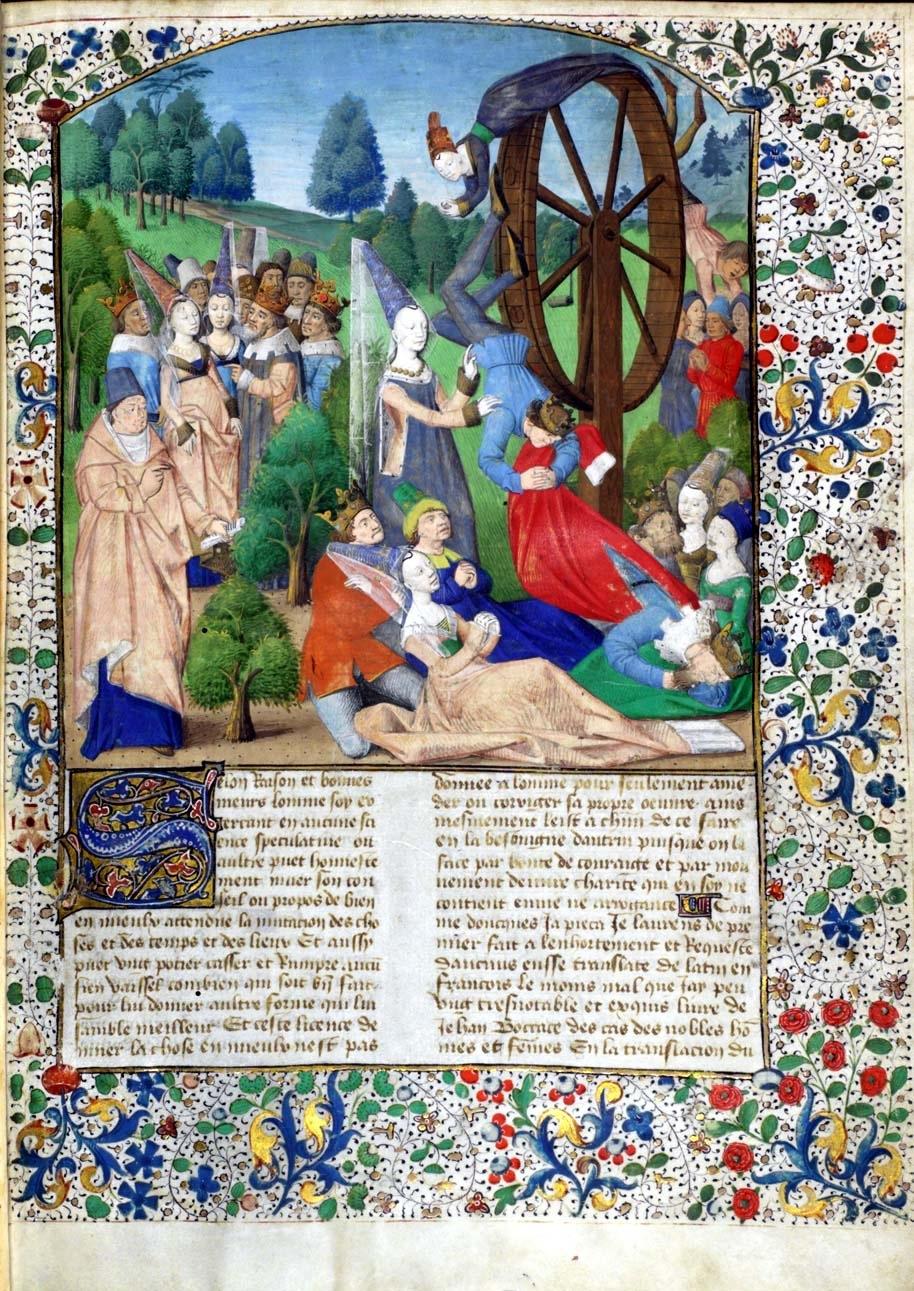](https://wiki.compclassnotes.com/uploads/images/gallery/2026-02/fortune-wheel-15c-french.jpg)