# Jewish–Zionist Terrorism and the Establishment of Israel

**Thesis**

**NAVAL POSTGRADUATE SCHOOL**

**Author: John Louis Peeke**

**Thesis Advisor: John W. Amos**

**Date: December 1977**

**Cover art by Shintaro Kago (駕籠 真太郎 )**

# Introduction

<p class="callout danger">Public Notice by Justice Node: This thesis written under the academic advisory of US Naval Postgraduate School is a grand expose of the Israeli terror groups, now a WIKI Book that shall serve as definitive fully attested and witnessed evidence for the soon coming legal actions in the Western criminal courts of laws against the Israeli and Zionist terror groups. This thesis and the supplementary research documents are also in place to serve the Western Jewish communities in search of truth and justice in these horrid times.</p>

#### Thesis

**NAVAL POSTGRADUATE SCHOOL**

**Author: John Louis Peeke**

**Thesis Advisor: John W. Amos**

**Date: December 1977**

##### Abstract

<span style="color:rgb(0,0,0);">Terrorist bombings of public buildings, attacks on public officials, hijackings and assassinations of political leaders are not new phenonmena in Middle East politics. In recent history, incidents initiated by the Palestine Liberation Organization and its various components have captured headlines around the world. As recently as World War II, however, another terrorist war was fought over the same territory and for the same purposes–the creation of a Palestinian state. This time, though, the terrorists were Jewish. This paper looks at the activities of the Jewish “terror” organizations in their quest for a Jewish state. Through three chronological, more or less parallel tracks, the paper will deal with the formation of the military and paramilitary groups, their organization, leadership philosophy and actions which eventually forced Great Britain to yield to Zionist demands for a Jewish state in Palestine.</span>

# Who is Who

The Terror actors in the theater of creation of Israel.

External references for the thesis.

# Lehi

**Lehi** (Hebrew pronunciation: [\[ˈleχi\]](https://en.wikipedia.org/wiki/Help:IPA/Hebrew "Help:IPA/Hebrew"); [Hebrew](https://en.wikipedia.org/wiki/Hebrew_language "Hebrew language"): לח״י, sometimes abbreviated "LHI"), officially the **Fighters for the Freedom of Israel** (Hebrew: לוחמי חרות ישראל,romanized: *Lohamei Herut Israel*) and often known pejoratively as the **Stern Gang**,[<sup><span class="editor-theme-superscript">\[20\]</span></sup>](https://en.wikipedia.org/wiki/Lehi_(militant_group)#cite_note-Blumberg_1998._Pp._106-22)[<sup><span class="editor-theme-superscript">\[21\]</span></sup>](https://en.wikipedia.org/wiki/Lehi_(militant_group)#cite_note-Lozowick_2003._Pp._78-23)[<sup><span class="editor-theme-superscript">\[22\]</span></sup>](https://en.wikipedia.org/wiki/Lehi_(militant_group)#cite_note-Shindler_2005._Pp._218-24)[<sup><span class="editor-theme-superscript">\[23\]</span></sup>](https://en.wikipedia.org/wiki/Lehi_(militant_group)#cite_note-Cesarani_2010._Pp._1-25) was a [Zionist](https://en.wikipedia.org/wiki/Zionism "Zionism") [paramilitary](https://en.wikipedia.org/wiki/Paramilitary "Paramilitary") [militant](https://en.wikipedia.org/wiki/Militant "Militant") organization founded by [Avraham ("Yair") Stern](https://en.wikipedia.org/wiki/Avraham_Stern "Avraham Stern") in [Mandatory Palestine](https://en.wikipedia.org/wiki/Mandatory_Palestine "Mandatory Palestine") in 1940.[<sup><span class="editor-theme-superscript">\[24\]</span></sup>](https://en.wikipedia.org/wiki/Lehi_(militant_group)#cite_note-:0-26)[<sup><span class="editor-theme-superscript">\[25\]</span></sup>](https://en.wikipedia.org/wiki/Lehi_(militant_group)#cite_note-27)[<sup><span class="editor-theme-superscript">\[26\]</span></sup>](https://en.wikipedia.org/wiki/Lehi_(militant_group)#cite_note-28) Its avowed aim was to evict the British authorities from Palestine by use of violence, allowing unrestricted [immigration](https://en.wikipedia.org/wiki/Aliyah "Aliyah") of [Jews](https://en.wikipedia.org/wiki/Jews "Jews") and the formation of a Jewish state. It was initially called the **National Military Organization in Israel**,[<sup><span class="editor-theme-superscript">\[27\]</span></sup>](https://en.wikipedia.org/wiki/Lehi_(militant_group)#cite_note-Walter_Laqueur_1972._Pp._377-29) upon being founded in August 1940, and considered its actions as necessary for achieving its national aims.[<sup><span class="editor-theme-superscript">\[24\]</span></sup>](https://en.wikipedia.org/wiki/Lehi_(militant_group)#cite_note-:0-26)[<sup><span class="editor-theme-superscript">\[28\]</span></sup>](https://en.wikipedia.org/wiki/Lehi_(militant_group)#cite_note-30)[<sup><span class="editor-theme-superscript">\[29\]</span></sup>](https://en.wikipedia.org/wiki/Lehi_(militant_group)#cite_note-khazit-31)

[![image.png](https://wiki.compclassnotes.com/uploads/images/gallery/2026-09/scaled-1680-/hmIimage.png)](https://wiki.compclassnotes.com/uploads/images/gallery/2026-09/hmIimage.png)

Lehi split from the [Irgun](https://en.wikipedia.org/wiki/Irgun "Irgun") militant group in 1940 in order to continue fighting the [British](https://en.wikipedia.org/wiki/United_Kingdom "United Kingdom") during [World War II](https://en.wikipedia.org/wiki/World_War_II "World War II"). It initially sought an alliance with [Fascist Italy](https://en.wikipedia.org/wiki/Kingdom_of_Italy#Fascist_regime_(1922%E2%80%931943) "Kingdom of Italy") and [Nazi Germany](https://en.wikipedia.org/wiki/Nazi_Germany "Nazi Germany").[<sup><span class="editor-theme-superscript">\[30\]</span></sup>](https://en.wikipedia.org/wiki/Lehi_(militant_group)#cite_note-Sasson_Sofer_2007._Pp._254-32) Believing that Nazi Germany was a lesser enemy of the Jews than Britain, Lehi twice attempted to form an alliance with the Nazis, proposing a Jewish state based on "nationalist and totalitarian principles, and linked to the German Reich by an alliance".[<sup><span class="editor-theme-superscript">\[30\]</span></sup>](https://en.wikipedia.org/wiki/Lehi_(militant_group)#cite_note-Sasson_Sofer_2007._Pp._254-32)[<sup><span class="editor-theme-superscript">\[31\]</span></sup>](https://en.wikipedia.org/wiki/Lehi_(militant_group)#cite_note-33) After Stern's death in 1942, the new leadership of Lehi began to move towards support for [Joseph Stalin](https://en.wikipedia.org/wiki/Joseph_Stalin "Joseph Stalin")'s [Soviet Union](https://en.wikipedia.org/wiki/Soviet_Union "Soviet Union")[<sup><span class="editor-theme-superscript">\[27\]</span></sup>](https://en.wikipedia.org/wiki/Lehi_(militant_group)#cite_note-Walter_Laqueur_1972._Pp._377-29) and the ideology of [National Bolshevism](https://en.wikipedia.org/wiki/National_Bolshevism "National Bolshevism"), which was considered an amalgam of both right and left.[<sup><span class="editor-theme-superscript">\[32\]</span></sup>](https://en.wikipedia.org/wiki/Lehi_(militant_group)#cite_note-Robert_S._Wistrich_1995._Pp._88-34)[<sup><span class="editor-theme-superscript">\[30\]</span></sup>](https://en.wikipedia.org/wiki/Lehi_(militant_group)#cite_note-Sasson_Sofer_2007._Pp._254-32) Regarding themselves as "revolutionary Socialists", the new Lehi developed a highly original ideology combining an "almost mystical" belief in [Greater Israel](https://en.wikipedia.org/wiki/Greater_Israel "Greater Israel") with support for the Arab liberation struggle.[<sup><span class="editor-theme-superscript">\[27\]</span></sup>](https://en.wikipedia.org/wiki/Lehi_(militant_group)#cite_note-Walter_Laqueur_1972._Pp._377-29) This sophisticated ideology failed to gain public support and Lehi fared poorly in the [first Israeli elections](https://en.wikipedia.org/wiki/1949_Israeli_Constituent_Assembly_election "1949 Israeli Constituent Assembly election").[<sup><span class="editor-theme-superscript">\[33\]</span></sup>](https://en.wikipedia.org/wiki/Lehi_(militant_group)#cite_note-35)

In April 1948, Lehi and the Irgun were jointly responsible for the [massacre in Deir Yassin](https://en.wikipedia.org/wiki/Deir_Yassin_massacre "Deir Yassin massacre") of at least 107 Palestinian Arab villagers, including women and children. Lehi assassinated [Lord Moyne](https://en.wikipedia.org/wiki/Walter_Guinness,_1st_Baron_Moyne#Assassination "Walter Guinness, 1st Baron Moyne"), British Minister Resident in the Middle East, and made many other attacks on the British in Palestine.[<sup><span class="editor-theme-superscript">\[34\]</span></sup>](https://en.wikipedia.org/wiki/Lehi_(militant_group)#cite_note-36) On 29 May 1948, the government of Israel, having inducted the group's activist members into the [Israel Defense Forces](https://en.wikipedia.org/wiki/Israel_Defense_Forces "Israel Defense Forces"), formally disbanded Lehi, though some of its members carried out one final terrorist act, the assassination of Swedish diplomat [Folke Bernadotte](https://en.wikipedia.org/wiki/Folke_Bernadotte "Folke Bernadotte") some months later,[<sup><span class="editor-theme-superscript">\[35\]</span></sup>](https://en.wikipedia.org/wiki/Lehi_(militant_group)#cite_note-37) an act condemned by Bernadotte's replacement as mediator, [Ralph Bunche](https://en.wikipedia.org/wiki/Ralph_Bunche "Ralph Bunche").[<sup><span class="editor-theme-superscript">\[36\]</span></sup>](https://en.wikipedia.org/wiki/Lehi_(militant_group)#cite_note-38) After the assassination, the new Israeli government declared Lehi a terrorist organization, arresting some 200 members and convicting some of the leaders.[<sup><span class="editor-theme-superscript">\[37\]</span></sup>](https://en.wikipedia.org/wiki/Lehi_(militant_group)#cite_note-APAP-39) However, several months later, just before the first Israeli elections in January 1949, the government granted all Lehi prisoners amnesty under a state general order of pardon, and they were released.[<sup><span class="editor-theme-superscript">\[37\]</span></sup>](https://en.wikipedia.org/wiki/Lehi_(militant_group)#cite_note-APAP-39) In 1980, Israel instituted a military decoration, an "award for activity in the struggle for the establishment of Israel", the [Lehi ribbon](https://en.wikipedia.org/wiki/Israeli_military_decorations#Service_ribbons "Israeli military decorations").[<sup><span class="editor-theme-superscript">\[38\]</span></sup>](https://en.wikipedia.org/wiki/Lehi_(militant_group)#cite_note-lehiribbon-40) Former Lehi leader [Yitzhak Shamir](https://en.wikipedia.org/wiki/Yitzhak_Shamir "Yitzhak Shamir") became [Prime Minister of Israel](https://en.wikipedia.org/wiki/Prime_Minister_of_Israel "Prime Minister of Israel") in 1983.

Lehi was created in August 1940 by [Avraham Stern](https://en.wikipedia.org/wiki/Avraham_Stern "Avraham Stern").[<sup><span class="editor-theme-superscript">\[2\]</span></sup>](https://en.wikipedia.org/wiki/Lehi_(militant_group)#cite_note-Nachman_Ben-Yehuda_1995._Pp._322-2) Stern had been a member of the [Irgun](https://en.wikipedia.org/wiki/Irgun "Irgun") (*Irgun Tsvai Leumi* – "National Military Organization") high command. [Zeev Jabotinsky](https://en.wikipedia.org/wiki/Zeev_Jabotinsky "Zeev Jabotinsky"), then the Irgun's supreme commander, had decided that diplomacy and working with Britain would best serve the Zionist cause. [World War II](https://en.wikipedia.org/wiki/World_War_II "World War II") was in progress, and Britain was fighting [Nazi Germany](https://en.wikipedia.org/wiki/Nazi_Germany "Nazi Germany"). The Irgun suspended its underground military activities against the British for the duration of the war.

[![image.png](https://wiki.compclassnotes.com/uploads/images/gallery/2026-09/scaled-1680-/a1himage.png)](https://wiki.compclassnotes.com/uploads/images/gallery/2026-09/a1himage.png)
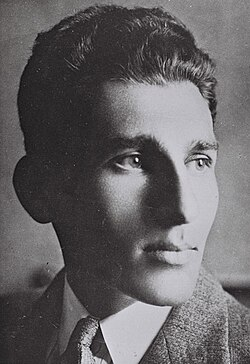
[Avraham Stern](https://en.wikipedia.org/wiki/Avraham_Stern)

Stern argued that the time for Zionist diplomacy was over and that it was time for an armed struggle against the British. Like other Zionists, he objected to the [White Paper of 1939](https://en.wikipedia.org/wiki/White_Paper_of_1939 "White Paper of 1939"), which restricted both Jewish immigration and Jewish land purchases in Palestine. For Stern, "no difference existed between [Hitler](https://en.wikipedia.org/wiki/Adolf_Hitler "Adolf Hitler") and [Chamberlain](https://en.wikipedia.org/wiki/Neville_Chamberlain "Neville Chamberlain"), between [Dachau](https://en.wikipedia.org/wiki/Dachau_concentration_camp "Dachau concentration camp") or [Buchenwald](https://en.wikipedia.org/wiki/Buchenwald_concentration_camp "Buchenwald concentration camp") and sealing the gates of Eretz Israel."[<sup><span class="editor-theme-superscript">\[39\]</span></sup>](https://en.wikipedia.org/wiki/Lehi_(militant_group)#cite_note-Shindler_1995-41)

Stern wanted to open Palestine to all Jewish refugees from Europe and considered this to be the most important issue of the day. Britain would not allow this. Therefore, he concluded, the [*Yishuv*](https://en.wikipedia.org/wiki/Yishuv "Yishuv") (Jews of Palestine) should fight the British rather than support them in the war. When the Irgun made a truce with the British, Stern left the Irgun to form his own group, which he called *Irgun Tsvai Leumi B'Yisrael* ("National Military Organization in Israel"), later *Lohamei Herut Israel* ("Fighters for the Freedom of Israel"). In September 1940, the organization was officially named "Lehi", the Hebrew [acronym](https://en.wikipedia.org/wiki/Acronym "Acronym") of the latter name.[<sup><span class="editor-theme-superscript">\[2\]</span></sup>](https://en.wikipedia.org/wiki/Lehi_(militant_group)#cite_note-Nachman_Ben-Yehuda_1995._Pp._322-2)

Stern and his followers believed that dying for the "foreign occupier" who was obstructing the creation of the Jewish State was useless. They differentiated between "enemies of the Jewish people" (the British) and "Jew haters" (the [Nazis](https://en.wikipedia.org/wiki/Nazism "Nazism")), believing that the former needed to be defeated and the latter manipulated.[<sup><span class="editor-theme-superscript">\[40\]</span></sup>](https://en.wikipedia.org/wiki/Lehi_(militant_group)#cite_note-Bauer-42)

Stern and his followers believed that dying for the "foreign occupier" who was obstructing the creation of the Jewish State was useless. They differentiated between "enemies of the Jewish people" (the British) and "Jew haters" (the [Nazis](https://en.wikipedia.org/wiki/Nazism "Nazism")), believing that the former needed to be defeated and the latter manipulated.[<sup><span class="editor-theme-superscript">\[40\]</span></sup>](https://en.wikipedia.org/wiki/Lehi_(militant_group)#cite_note-Bauer-42)

In 1940, the idea of the [Final Solution](https://en.wikipedia.org/wiki/Final_Solution "Final Solution") was still "unthinkable", and Stern believed that Hitler wanted to make Germany [*judenrein*](https://en.wikipedia.org/wiki/Judenrein "Judenrein") through emigration, as opposed to extermination.[<sup><span class="editor-theme-superscript">\[39\]</span></sup>](https://en.wikipedia.org/wiki/Lehi_(militant_group)#cite_note-Shindler_1995-41)[<sup><span class="editor-theme-superscript">\[41\]</span></sup>](https://en.wikipedia.org/wiki/Lehi_(militant_group)#cite_note-43) In December 1940, Lehi contacted Germany with a proposal to aid German conquest in the Middle East in return for recognition of a Jewish state open to unlimited immigration.[<sup><span class="editor-theme-superscript">\[39\]</span></sup>](https://en.wikipedia.org/wiki/Lehi_(militant_group)#cite_note-Shindler_1995-41)

#### Political racism

According to [Yaacov Shavit](https://en.wikipedia.org/wiki/Yaacov_Shavit "Yaacov Shavit"), professor at the Department of Jewish History, [Tel Aviv University](https://en.wikipedia.org/wiki/Tel_Aviv_University "Tel Aviv University"), articles in Lehi publications contained references to a Jewish "master race", contrasting the Jews with Arabs who were seen as a "nation of slaves".[<sup><span class="editor-theme-superscript">\[56\]</span></sup>](https://en.wikipedia.org/wiki/Lehi_(militant_group)#cite_note-Jabotinsky-59) American journalist [Sasha Polakow-Suransky](https://en.wikipedia.org/wiki/Sasha_Polakow-Suransky "Sasha Polakow-Suransky") writes that "Lehi was also unabashedly racist towards Arabs. Their publications described Jews as a master race and Arabs as a slave race." Lehi advocated mass expulsion of all Arabs from [Palestine](https://en.wikipedia.org/wiki/Palestine_(region) "Palestine (region)") and [Transjordan](https://en.wikipedia.org/wiki/Transjordan_(region) "Transjordan (region)"),[<sup><span class="editor-theme-superscript">\[57\]</span></sup>](https://en.wikipedia.org/wiki/Lehi_(militant_group)#cite_note-60) or even their physical annihilation.[<sup><span class="editor-theme-superscript">\[58\]</span></sup>](https://en.wikipedia.org/wiki/Lehi_(militant_group)#cite_note-61)

#### Bandits and Assassins 

> The group was initially unsuccessful. Early attempts to raise funds through criminal activities, including a bank robbery in Tel Aviv in 1940 and another robbery on 9 January 1942 in which Jewish passers-by were killed, brought about the temporary collapse of the group. An attempt to assassinate the head of the British secret police in [Lod](https://en.wikipedia.org/wiki/Lod "Lod") in which three police personnel were killed, two Jewish and one British, elicited a severe response from the British and Jewish establishments who collaborated against Lehi.[<sup><span class="editor-theme-superscript">\[61\]</span></sup>](https://en.wikipedia.org/wiki/Lehi_(militant_group)#cite_note-Weinberg_2003,_p._109-64)

They targeted Jews whom they regarded as traitors, and during the 1948 Arab-Israeli War they joined in operations with the [Haganah](https://en.wikipedia.org/wiki/Haganah "Haganah") and [Irgun](https://en.wikipedia.org/wiki/Irgun "Irgun") against Arab targets, for example [Deir Yassin](https://en.wikipedia.org/wiki/Deir_Yassin "Deir Yassin").

> According to a compilation by Nachman Ben-Yehuda, Lehi was responsible for 42 assassinations, more than twice as many as the Irgun and Haganah combined during the same period. Of those Lehi assassinations that Ben-Yehuda classified as political, more than half the victims were Jews.[<sup><span class="editor-theme-superscript">\[63\]</span></sup>](https://en.wikipedia.org/wiki/Lehi_(militant_group)#cite_note-66)

#### Goals and ideology

Lehi had three main goals:

- To bring together all those interested in liberation (that is, those willing to join in active fighting against the British).
- To appear before the world as the only active Jewish military organization.
- To take over [*Eretz Yisrael*](https://en.wikipedia.org/wiki/Eretz_Yisrael "Eretz Yisrael") (the Land of Israel) by armed force.[<sup><span class="editor-theme-superscript">\[43\]</span></sup>](https://en.wikipedia.org/wiki/Lehi_(militant_group)#cite_note-45)

Lehi believed in its early years that its goals would be achieved by finding a strong international ally that would expel the British from Palestine, in return for Jewish military help; this would require the creation of a broad and organised military force "demonstrating its desire for freedom through military operations."[<sup><span class="editor-theme-superscript">\[44\]</span></sup>](https://en.wikipedia.org/wiki/Lehi_(militant_group)#cite_note-Weinberg_2003,_p._107-46)

Lehi also referred to themselves as 'terrorists' and may have been one of the last organizations to do so.[<sup><span class="editor-theme-superscript">\[45\]</span></sup>](https://en.wikipedia.org/wiki/Lehi_(militant_group)#cite_note-calderwalton-47)

An article titled "Terror" in the Lehi underground newspaper *He Khazit* (*The Front*) argued as follows:

> Neither Jewish ethics nor Jewish tradition can disqualify [terrorism](https://en.wikipedia.org/wiki/Terrorism "Terrorism") as a means of combat. We are very far from having any moral qualms as far as our national war goes. We have before us the command of the [Torah](https://en.wikipedia.org/wiki/Torah "Torah"), whose morality surpasses that of any other body of laws in the world: "Ye shall blot them out to the last man."
> 
> But first and foremost, terrorism is for us a part of the political battle being conducted under the present circumstances, and it has a great part to play: speaking in a clear voice to the whole world, as well as to our wretched brethren outside this land, it proclaims our war against the occupier.
> 
> We are particularly far from this sort of hesitation in regard to an enemy whose moral perversion is admitted by all.[<sup><span class="editor-theme-superscript">\[29\]</span></sup>](https://en.wikipedia.org/wiki/Lehi_(militant_group)#cite_note-khazit-31)

he article described the goals of terror:

> - It demonstrates ... against the true terrorist who hides behind his piles of papers and the laws he has legislated.
> - It is not directed against people, it is directed against representatives. Therefore it is effective.
> - If it also shakes the [*Yishuv*](https://en.wikipedia.org/wiki/Yishuv "Yishuv") from their complacency, good and well.[<sup><span class="editor-theme-superscript">\[29\]</span></sup>](https://en.wikipedia.org/wiki/Lehi_(militant_group)#cite_note-khazit-31)

[Yitzhak Shamir](https://en.wikipedia.org/wiki/Yitzhak_Shamir "Yitzhak Shamir"), one of the three leaders of Lehi after Avraham Stern's assassination, argued for the legitimacy of Lehi's actions:

> There are those who say that to kill Martin[<sup><span class="editor-theme-superscript">\[c\]</span></sup>](https://en.wikipedia.org/wiki/Lehi_(militant_group)#cite_note-48) is terrorism, but to attack an army camp is guerrilla warfare and to bomb civilians is professional warfare. But I think it is the same from the moral point of view. Is it better to drop an atomic bomb on a city than to kill a handful of persons? I don't think so. But nobody says that President Truman was a terrorist. All the men we went for individually – Wilkin, Martin, [MacMichael](https://en.wikipedia.org/wiki/Harold_MacMichael "Harold MacMichael") and others – were personally interested in succeeding in the fight against us.
> 
> So it was more efficient and more moral to go for selected targets. In any case, it was the only way we could operate, because we were so small. For us it was not a question of the professional honour of a soldier, it was the question of an idea, an aim that had to be achieved. We were aiming at a political goal. There are many examples of what we did to be found in the [Bible](https://en.wikipedia.org/wiki/Bible "Bible") – [Gideon](https://en.wikipedia.org/wiki/Gideon "Gideon") and [Samson](https://en.wikipedia.org/wiki/Samson "Samson"), for instance. This had an influence on our thinking. And we also learned from the history of other peoples who fought for their freedom – the Russian and Irish revolutionaries, [Giuseppe Garibaldi](https://en.wikipedia.org/wiki/Giuseppe_Garibaldi "Giuseppe Garibaldi") and [Josip Broz Tito](https://en.wikipedia.org/wiki/Josip_Broz_Tito "Josip Broz Tito").[<sup><span class="editor-theme-superscript">\[46\]</span></sup>](https://en.wikipedia.org/wiki/Lehi_(militant_group)#cite_note-49)

#### Activities and operations during World War II

[![image.png](https://wiki.compclassnotes.com/uploads/images/gallery/2026-09/scaled-1680-/YZVimage.png)](https://wiki.compclassnotes.com/uploads/images/gallery/2026-09/YZVimage.png)
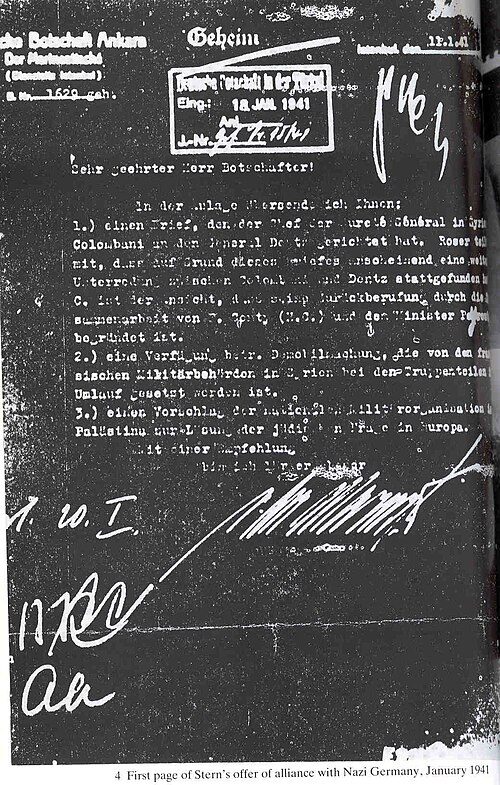
German cover letter from 11 January 1941 attached to a description of an offer for an alliance with [Nazi Germany](https://en.wikipedia.org/wiki/Nazi_Germany "Nazi Germany") attributed to Lehi.

Late in 1940, Lehi, having identified a common interest between the intentions of the new German order and Jewish national aspirations, proposed forming an alliance in World War II with [Nazi Germany](https://en.wikipedia.org/wiki/Nazi_Germany "Nazi Germany").[<sup><span class="editor-theme-superscript">\[30\]</span></sup>](https://en.wikipedia.org/wiki/Lehi_(militant_group)#cite_note-Sasson_Sofer_2007._Pp._254-32) The organization offered cooperation in the following terms: Lehi would rebel against the British, while Germany would recognize an independent Jewish state in Palestine/Eretz Israel, and all Jews leaving their homes in Europe, by their own will or because of government injunctions, could enter Palestine with no restriction of numbers.[<sup><span class="editor-theme-superscript">\[40\]</span></sup>](https://en.wikipedia.org/wiki/Lehi_(militant_group)#cite_note-Bauer-42) Late in 1940, Lehi representative Naftali Lubenchik[<sup><span class="editor-theme-superscript">\[73\]</span></sup>](https://en.wikipedia.org/wiki/Lehi_(militant_group)#cite_note-76) went to [Beirut](https://en.wikipedia.org/wiki/Beirut "Beirut") to meet German official [Werner Otto von Hentig](https://en.wikipedia.org/wiki/Werner_Otto_von_Hentig "Werner Otto von Hentig"). The Lehi documents outlined that its rule would be authoritarian and indicated similarities between the organization and Nazis.[<sup><span class="editor-theme-superscript">\[40\]</span></sup>](https://en.wikipedia.org/wiki/Lehi_(militant_group)#cite_note-Bauer-42) [Israel Eldad](https://en.wikipedia.org/wiki/Israel_Eldad "Israel Eldad"), one of the leading members of Lehi, wrote about Hitler "it is not Hitler who is the hater of the kingdom of Israel and the return to Zion, it is not Hitler who subjects us to the cruel fate of falling a second and a third time into Hitler's hands, but the British."[<sup><span class="editor-theme-superscript">\[74\]</span></sup>](https://en.wikipedia.org/wiki/Lehi_(militant_group)#cite_note-77)

Stern also proposed recruiting 40,000 Jews from occupied Europe to invade Palestine with German support to oust the British.[<sup><span class="editor-theme-superscript">\[30\]</span></sup>](https://en.wikipedia.org/wiki/Lehi_(militant_group)#cite_note-Sasson_Sofer_2007._Pp._254-32) On 11 January 1941, Vice Admiral Ralf von der Marwitz, the German naval [attaché](https://en.wikipedia.org/wiki/Attach%C3%A9 "Attaché") in [Turkey](https://en.wikipedia.org/wiki/Turkey "Turkey"), filed a report (the "Ankara document") conveying an offer by Lehi to "actively take part in the war on Germany's side" in return for German support for "the establishment of the historic Jewish state on a national and totalitarian basis, bound by a treaty with the German Reich."[<sup><span class="editor-theme-superscript">\[67\]</span></sup>](https://en.wikipedia.org/wiki/Lehi_(militant_group)#cite_note-Heller-70)[<sup><span class="editor-theme-superscript">\[75\]</span></sup>](https://en.wikipedia.org/wiki/Lehi_(militant_group)#cite_note-78)[<sup><span class="editor-theme-superscript">\[76\]</span></sup>](https://en.wikipedia.org/wiki/Lehi_(militant_group)#cite_note-79)

According to Yellin-Mor:

> Lubenchik did not take along any written memorandum for the German representatives. Had there been a need for one, he would have formulated it on the spot, since he was familiar with the episode of the Italian "intermediary" and with the numerous drafts connected with it. Apparently one of von Hentig's secretaries noted down the essence of the proposal in his own words.[<sup><span class="editor-theme-superscript">\[77\]</span></sup>](https://en.wikipedia.org/wiki/Lehi_(militant_group)#cite_note-80)

According to Joseph Heller, "The memorandum arising from their conversation is an entirely authentic document, on which the stamp of the 'IZL in Israel' is clearly embossed."[<sup><span class="editor-theme-superscript">\[78\]</span></sup>](https://en.wikipedia.org/wiki/Lehi_(militant_group)#cite_note-81) Von der Marwitz delivered the offer, classified as secret, to the German Ambassador in Turkey and on 21 January 1941 it was sent to Berlin. There was never any response.[<sup><span class="editor-theme-superscript">\[79\]</span></sup>](https://en.wikipedia.org/wiki/Lehi_(militant_group)#cite_note-82) A second attempt to contact the Nazis was made at the end of 1941, but it was even less successful.[<sup><span class="editor-theme-superscript">\[80\]</span></sup>](https://en.wikipedia.org/wiki/Lehi_(militant_group)#cite_note-83) The emissary Yellin-Mor was arrested in Syria before he could carry out his mission.[<sup><span class="editor-theme-superscript">\[81\]</span></sup>](https://en.wikipedia.org/wiki/Lehi_(militant_group)#cite_note-84)

This proposed alliance with Nazi Germany cost Lehi and Stern much support.[<sup><span class="editor-theme-superscript">\[82\]</span></sup>](https://en.wikipedia.org/wiki/Lehi_(militant_group)#cite_note-85) The Stern Gang also had links with, and support from, the [Vichy France](https://en.wikipedia.org/wiki/Vichy_France "Vichy France") [Sûreté](https://en.wikipedia.org/wiki/S%C3%BBret%C3%A9 "Sûreté")'s Lebanese offices.[<sup><span class="editor-theme-superscript">\[83\]</span></sup>](https://en.wikipedia.org/wiki/Lehi_(militant_group)#cite_note-86) Even as the full scale of Nazi atrocities became more evident in 1943, Lehi refused to accept Hitler as the main foe (as opposed to Great Britain).[<sup><span class="editor-theme-superscript">\[84\]</span></sup>](https://en.wikipedia.org/wiki/Lehi_(militant_group)#cite_note-The_Stern_Gang_p._114-87)

In 1942, a Lehi member named Efraim Zetler was kidnapped and interrogated by the Haganah.[<sup><span class="editor-theme-superscript">\[85\]</span></sup>](https://en.wikipedia.org/wiki/Lehi_(militant_group)#cite_note-88) According to transcripts released by Israel's state archives in 2023, during the interrogations, Zetler said that Nazi Germany was not the "enemy of the Jews" and ready to receive assistance from them, stating:

> "We will communicate with any military power ready to help with the establishment of the [Kingdom of Israel](https://en.wikipedia.org/wiki/Kingdom_of_Israel_(united_monarchy) "Kingdom of Israel (united monarchy)"), even if it's Germany. The only condition is that we get weapons, so we can rebel against the English. If Germany agrees to help us fight enemy number 1, the English, we'll team up with it. It’s not an enemy of the Jews in Israel."[<sup><span class="editor-theme-superscript">\[86\]</span></sup>](https://en.wikipedia.org/wiki/Lehi_(militant_group)#cite_note-mee-89)

### Assassination of Lord Moyne

Further information: [Walter Guinness, 1st Baron Moyne § Assassination](https://en.wikipedia.org/wiki/Walter_Guinness,_1st_Baron_Moyne#Assassination "Walter Guinness, 1st Baron Moyne")

On 6 November 1944, Lehi assassinated [Lord Moyne](https://en.wikipedia.org/wiki/Walter_Guinness,_1st_Baron_Moyne "Walter Guinness, 1st Baron Moyne"), the British Minister Resident in the Middle East, in [Cairo](https://en.wikipedia.org/wiki/Cairo "Cairo"). Moyne was the highest ranking British official in the region. Yitzhak Shamir claimed later that Moyne was assassinated because of his support for a Middle Eastern Arab Federation and anti-Semitic lectures in which Arabs were held to be racially superior to Jews.[<sup><span class="editor-theme-superscript">\[87\]</span></sup>](https://en.wikipedia.org/wiki/Lehi_(militant_group)#cite_note-90) The assassination rocked the British government, and outraged [Winston Churchill](https://en.wikipedia.org/wiki/Winston_Churchill "Winston Churchill"), the British [Prime Minister](https://en.wikipedia.org/wiki/Prime_Minister "Prime Minister"). The two assassins, [Eliyahu Bet-Zuri](https://en.wikipedia.org/wiki/Eliyahu_Bet-Zuri "Eliyahu Bet-Zuri") and [Eliyahu Hakim](https://en.wikipedia.org/wiki/Eliyahu_Hakim "Eliyahu Hakim") were captured and used their trial as a platform to make public their political propaganda. They were both found guilty and executed. In 1975, their bodies were returned to Israel, with Egypt exchanging them for 20 Arab prisoners, and given a state funeral.[<sup><span class="editor-theme-superscript">\[88\]</span></sup>](https://en.wikipedia.org/wiki/Lehi_(militant_group)#cite_note-91)[<sup><span class="editor-theme-superscript">\[89\]</span></sup>](https://en.wikipedia.org/wiki/Lehi_(militant_group)#cite_note-92) In 1982, postage stamps were issued for 20 [Olei Hagardom](https://en.wikipedia.org/wiki/Olei_Hagardom "Olei Hagardom"), including Bet-Zouri and Hakim, in a souvenir sheet called "Martyrs of the struggle for Israel's independence."[<sup><span class="editor-theme-superscript">\[90\]</span></sup>](https://en.wikipedia.org/wiki/Lehi_(militant_group)#cite_note-93)[<sup><span class="editor-theme-superscript">\[91\]</span></sup>](https://en.wikipedia.org/wiki/Lehi_(militant_group)#cite_note-94)

After Moyne's assassination, a member of Lehi who was arrested shortly after named Rafael Sawovsky told interrogators that an assassination plan against Churchill was proposed by Lehi members, according to MI5 files released by [The National Archives](https://en.wikipedia.org/wiki/The_National_Archives_(United_Kingdom) "The National Archives (United Kingdom)") in 2011.[<sup><span class="editor-theme-superscript">\[92\]</span></sup>](https://en.wikipedia.org/wiki/Lehi_(militant_group)#cite_note-95)

#### Post war terrorist campaign and insurgency

As a group that never had more than a few hundred members, Lehi relied on audacious but small-scale operations to drive its message home. They adopted the tactics of groups such as the [Socialist Revolutionaries](https://en.wikipedia.org/wiki/Socialist_Revolutionaries "Socialist Revolutionaries") and the [Combat Organization of the Polish Socialist Party](https://en.wikipedia.org/wiki/Combat_Organization_of_the_Polish_Socialist_Party "Combat Organization of the Polish Socialist Party") in Czarist Russia,[<sup><span class="editor-theme-superscript">\[93\]</span></sup>](https://en.wikipedia.org/wiki/Lehi_(militant_group)#cite_note-96) and the [Irish Republican Army](https://en.wikipedia.org/wiki/Irish_Republican_Army "Irish Republican Army"). To this end, Lehi conducted small-scale operations such as individual assassinations of British officials (notable targets included [Lord Moyne](https://en.wikipedia.org/wiki/Walter_Guinness,_1st_Baron_Moyne "Walter Guinness, 1st Baron Moyne"), [CID](https://en.wikipedia.org/wiki/Criminal_Investigation_Department "Criminal Investigation Department") detectives, and Jewish "collaborators"), and random shootings against soldiers and police officers.[<sup><span class="editor-theme-superscript">\[94\]</span></sup>](https://en.wikipedia.org/wiki/Lehi_(militant_group)#cite_note-Bell-97) Another strategy, adopted in 1946, was to send bombs in the mail to British politicians. Other actions included sabotaging infrastructure targets: bridges, [railroads](https://en.wikipedia.org/wiki/Railroad "Railroad"), telephone and telegraph lines, and [oil](https://en.wikipedia.org/wiki/Petroleum "Petroleum") refineries, as well as the use of vehicle bombs against British military, police, and administrative targets. Lehi financed its operations from private donations, [extortion](https://en.wikipedia.org/wiki/Extortion "Extortion"), and [bank robbery](https://en.wikipedia.org/wiki/Bank_robbery "Bank robbery"). Its campaign of violence lasted from 1944 to 1948. Initially conducted together with the Irgun, it included a six-month suspension to avoid being targeted by the [Haganah](https://en.wikipedia.org/wiki/Haganah "Haganah") during the [Hunting Season](https://en.wikipedia.org/wiki/The_Hunting_Season "The Hunting Season"), and later operated jointly with the Haganah and Irgun under the [Jewish Resistance Movement](https://en.wikipedia.org/wiki/Jewish_Resistance_Movement "Jewish Resistance Movement"). After the Jewish Resistance Movement was dissolved, it operated independently as part of the general [Jewish insurgency in Palestine](https://en.wikipedia.org/wiki/Jewish_insurgency_in_Palestine "Jewish insurgency in Palestine").<sup><span class="editor-theme-superscript">\[</span></sup>[*<sup>*citation needed*</sup>*](https://en.wikipedia.org/wiki/Wikipedia:Citation_needed "Wikipedia:Citation needed")<sup><span class="editor-theme-superscript">\]</span></sup>

#### Tel Aviv car park raid

On 25 April 1946, a Lehi unit attacked a car park in [Tel Aviv](https://en.wikipedia.org/wiki/Tel_Aviv "Tel Aviv") occupied by the British [6th Airborne Division](https://en.wikipedia.org/wiki/6th_Airborne_Division_(United_Kingdom) "6th Airborne Division (United Kingdom)"). Under a barrage of heavy covering fire, Lehi fighters broke into the car park, shot soldiers they encountered at close range, stole rifles from arms racks, laid mines to cover the retreat, and withdrew. Seven soldiers were killed in the attack, which caused widespread outrage among the British security forces in Palestine. It resulted in retaliatory anti-Jewish violence by British troops and a punitive curfew imposed on Tel Aviv's roads and the closure of places of entertainment in the city by the British Army.[<sup><span class="editor-theme-superscript">\[94\]</span></sup>](https://en.wikipedia.org/wiki/Lehi_(militant_group)#cite_note-Bell-97)

#### British police station in Haifa

See also: [Lehi bombing of Haifa police station](https://en.wikipedia.org/wiki/Lehi_bombing_of_Haifa_police_station "Lehi bombing of Haifa police station")

On 12 January 1947, Lehi members drove a truckload of explosives into a British police station in [Haifa](https://en.wikipedia.org/wiki/Haifa "Haifa"), killing four and injuring 140, in what has been called 'the world's first true truck bomb'.[<sup><span class="editor-theme-superscript">\[95\]</span></sup>](https://en.wikipedia.org/wiki/Lehi_(militant_group)#cite_note-98)

### Operations in Europe

[![](https://thumb.wikimedia.org/wikipedia/commons/thumb/9/9d/Martin_Bayles.jpg/120px-Martin_Bayles.jpg?utm_source=en.wikipedia.org&utm_campaign=parser&utm_content=thumbnail)](https://en.wikipedia.org/wiki/File:Martin_Bayles.jpg)

Betty Knouth, Tel Aviv, 24 August 1948

Following the bombing of the British embassy in Rome, in October 1946, a series of operations against targets in the United Kingdom were launched. On 7 March 1947, Lehi's only successful operation in Britain was carried out when a Lehi bomb severely damaged the British Colonial Club, a [London](https://en.wikipedia.org/wiki/London "London") recreational facility for soldiers and students from Britain's colonies in Africa and the West Indies.[<sup><span class="editor-theme-superscript">\[96\]</span></sup>](https://en.wikipedia.org/wiki/Lehi_(militant_group)#cite_note-99) On 15 April 1947 a bomb consisting of twenty-four sticks of explosives was planted in the Colonial Office, [Whitehall](https://en.wikipedia.org/wiki/Whitehall "Whitehall"). It failed to explode due to a fault in the timer. Five weeks later, on 22 May, five alleged Lehi members were arrested in Paris with bomb making material including explosives of the same type as found in London. On 2 June, two Lehi members, Betty Knouth and Yaakov Levstein, were arrested crossing from [Belgium](https://en.wikipedia.org/wiki/Belgium "Belgium") to [France](https://en.wikipedia.org/wiki/France "France"). Envelopes addressed to British officials, with detonators, batteries and a time fuse were found in one of Knouth's suitcases. The British Security Services identified Knouth as the person who planted the bomb in the Colonial Office. Shortly after their arrest, 21 letter bombs addressed to senior British figures were intercepted. The letters had been posted in Italy. The intended recipients included [Bevin](https://en.wikipedia.org/wiki/Ernest_Bevin "Ernest Bevin"), [Attlee](https://en.wikipedia.org/wiki/Clement_Attlee "Clement Attlee"), [Churchill](https://en.wikipedia.org/wiki/Winston_Churchill "Winston Churchill") and [Eden](https://en.wikipedia.org/wiki/Anthony_Eden "Anthony Eden").[<sup><span class="editor-theme-superscript">\[97\]</span></sup>](https://en.wikipedia.org/wiki/Lehi_(militant_group)#cite_note-100) Eden carried a letter bomb in his suitcase for a whole day, thinking it was a Whitehall pamphlet that he would read later in the day. He only realized it was a bomb after being warned by the police, who were informed by MI5.[<sup><span class="editor-theme-superscript">\[98\]</span></sup>](https://en.wikipedia.org/wiki/Lehi_(militant_group)#cite_note-101)

Knouth was also known as Gilberte/Elizabeth Lazarus. Levstein was travelling as Jacob Elias; his fingerprints connected him to the deaths of several Palestine Policemen as well as an attempt on the life of the British High Commissioner. In September 1947, a Belgian court sentenced Knouth to one year in prison and Levstein to eight months in prison for illegally transporting explosives with intent to commit a felony.[<sup><span class="editor-theme-superscript">\[99\]</span></sup>](https://en.wikipedia.org/wiki/Lehi_(militant_group)#cite_note-102) In 1973, [Margaret Truman](https://en.wikipedia.org/wiki/Margaret_Truman "Margaret Truman") wrote that letter bombs were also posted to her father, U.S. President [Harry S. Truman](https://en.wikipedia.org/wiki/Harry_S._Truman "Harry S. Truman"), in 1947.[<sup><span class="editor-theme-superscript">\[100\]</span></sup>](https://en.wikipedia.org/wiki/Lehi_(militant_group)#cite_note-BenYehuda-103) Former Lehi leader Yellin-Mor admitted that letter bombs had been sent to British targets but denied that any had been sent to Truman.[<sup><span class="editor-theme-superscript">\[100\]</span></sup>](https://en.wikipedia.org/wiki/Lehi_(militant_group)#cite_note-BenYehuda-103)[<sup><span class="editor-theme-superscript">\[101\]</span></sup>](https://en.wikipedia.org/wiki/Lehi_(militant_group)#cite_note-104)

#### Death threat against Hugh Trevor-Roper

Shortly after the 1947 publication of *The Last Days of Hitler*, Lehi issued a death threat against the author, [Hugh Trevor-Roper](https://en.wikipedia.org/wiki/Hugh_Trevor-Roper "Hugh Trevor-Roper"), for his portrayal of Hitler, feeling that Trevor-Roper had attempted to exonerate the German populace from responsibility.[<sup><span class="editor-theme-superscript">\[104\]</span></sup>](https://en.wikipedia.org/wiki/Lehi_(militant_group)#cite_note-107)

#### Cairo-Haifa train bombings

Main article: [Cairo–Haifa train bombings 1948](https://en.wikipedia.org/wiki/Cairo%E2%80%93Haifa_train_bombings_1948 "Cairo–Haifa train bombings 1948")

During the lead-up to the [1948 Arab–Israeli War](https://en.wikipedia.org/wiki/1948_Arab%E2%80%93Israeli_War "1948 Arab–Israeli War"), Lehi [mined the Cairo–Haifa train](https://en.wikipedia.org/wiki/Cairo%E2%80%93Haifa_train_bombings_1948 "Cairo–Haifa train bombings 1948") several times. On 29 February 1948, Lehi mined the train north of [Rehovot](https://en.wikipedia.org/wiki/Rehovot "Rehovot"), killing 28 British soldiers and wounding 35. On 31 March, Lehi mined the train near [Binyamina](https://en.wikipedia.org/wiki/Binyamina "Binyamina"), killing 40 civilians and wounding 60.

#### Attempted Nablus terror attack

[Shlomo Sand](https://en.wikipedia.org/wiki/Shlomo_Sand "Shlomo Sand") writes that as a method of applying pressure on Arab villagers to abandon their settlements, Lehi planned a terror attack on [Nablus](https://en.wikipedia.org/wiki/Nablus "Nablus") and its Arab city headquarters; Lehi fighter Elisha Ibzov (Avraham Cohen) was captured with a truck filled with explosives on his way to the city. Lehi fighters in return abducted four adult villagers and youth from al-Sheikh Muwannis with no connection to Ibzov's capture and threatened to kill them. As rumours spread that they were already murdered, panic set out in the villagers and the settlement became increasingly abandoned, despite the eventual release of the hostages[<sup><span class="editor-theme-superscript">\[105\]</span></sup>](https://en.wikipedia.org/wiki/Lehi_(militant_group)#cite_note-108)

### Deir Yassin massacre

Main article: [Deir Yassin massacre](https://en.wikipedia.org/wiki/Deir_Yassin_massacre "Deir Yassin massacre")

One of the most widely known acts of Lehi was the attack on the Palestinian-Arab village of [Deir Yassin](https://en.wikipedia.org/wiki/Deir_Yassin "Deir Yassin").

In the months before the British evacuation from Palestine, the [Arab League](https://en.wikipedia.org/wiki/Arab_League "Arab League")-sponsored [Arab Liberation Army](https://en.wikipedia.org/wiki/Arab_Liberation_Army "Arab Liberation Army") (ALA) occupied several strategic points along the road between [Jerusalem](https://en.wikipedia.org/wiki/Jerusalem "Jerusalem") and [Tel Aviv](https://en.wikipedia.org/wiki/Tel_Aviv "Tel Aviv"), cutting off supplies to the Jewish part of Jerusalem. One of these points was Deir Yassin. By March 1948, the road was cut off and Jewish Jerusalem was under siege. The Haganah launched [Operation Nachshon](https://en.wikipedia.org/wiki/Operation_Nachshon "Operation Nachshon") to break the siege.

On 6 April, the Haganah attacked [al-Qastal](https://en.wikipedia.org/wiki/Al_Qastal,_Jerusalem "Al Qastal, Jerusalem"), a village two kilometres north of Deir Yassin, also overlooking the Jerusalem-Tel Aviv road.[<sup><span class="editor-theme-superscript">\[106\]</span></sup>](https://en.wikipedia.org/wiki/Lehi_(militant_group)#cite_note-Silver1984p91-109)

Then on 9 April 1948, about 120 Lehi and Irgun fighters, acting in cooperation with the Haganah, attacked and captured Deir Yassin. The attack was at night, the fighting was confused, and many civilian inhabitants of the village were killed.[<sup><span class="editor-theme-superscript">\[107\]</span></sup>](https://en.wikipedia.org/wiki/Lehi_(militant_group)#cite_note-110) This action had great consequences for the war, and remains a cause célèbre for Palestinians ever since.

Exactly what happened has never been established clearly. The Arab League reported a great massacre: 254 killed, with rape and lurid mutilations. Israeli investigations claimed the actual number of dead was between 100 and 120, and there were no mass rapes, but most of the dead were civilians and admitted some were killed deliberately. Lehi and Irgun both denied an organized massacre. Accounts by Lehi veterans such as Ezra Yakhin note that many of the attackers were killed or wounded, assert that Arabs fired from every building and that Iraqi and Syrian soldiers were among the dead, and even that some Arab fighters dressed as women.[<sup><span class="editor-theme-superscript">\[108\]</span></sup>](https://en.wikipedia.org/wiki/Lehi_(militant_group)#cite_note-yakhin_261%E2%80%93272-111)

However, Jewish authorities, including Haganah, the Chief Rabbinate, the Jewish Agency, and [David Ben-Gurion](https://en.wikipedia.org/wiki/David_Ben-Gurion "David Ben-Gurion"), also condemned the attack, lending credence to the charge of massacre.[<sup><span class="editor-theme-superscript">\[109\]</span></sup>](https://en.wikipedia.org/wiki/Lehi_(militant_group)#cite_note-112) The Jewish Agency even sent a letter of condemnation, apology, and condolence to King [Abdullah I of Jordan](https://en.wikipedia.org/wiki/Abdullah_I_of_Jordan "Abdullah I of Jordan").[<sup><span class="editor-theme-superscript">\[110\]</span></sup>](https://en.wikipedia.org/wiki/Lehi_(militant_group)#cite_note-113)

[![](https://thumb.wikimedia.org/wikipedia/commons/thumb/5/51/PikiWiki_Israel_1105_Israel_Defense_Forces_%D7%97%D7%99%D7%99%D7%9C%D7%95%D7%AA_%D7%9C%D7%97%D7%99.jpg/250px-PikiWiki_Israel_1105_Israel_Defense_Forces_%D7%97%D7%99%D7%99%D7%9C%D7%95%D7%AA_%D7%9C%D7%97%D7%99.jpg?utm_source=en.wikipedia.org&utm_campaign=parser&utm_content=thumbnail)](https://en.wikipedia.org/wiki/File:PikiWiki_Israel_1105_Israel_Defense_Forces_%D7%97%D7%99%D7%99%D7%9C%D7%95%D7%AA_%D7%9C%D7%97%D7%99.jpg)

Female Lehi fighters in 1948

Both the Arab reports and Jewish responses had hidden motives: the Arab leaders wanted to encourage Palestinian Arabs to fight rather than surrender, to discredit the Zionists with international opinion, and to increase popular support in their countries for an invasion of Palestine. The Jewish leaders wanted to discredit Irgun and Lehi.

Ironically, the Arab reports backfired in one respect: frightened Palestinian Arabs did not surrender, but did not fight either – [they fled](https://en.wikipedia.org/wiki/1948_Palestinian_expulsion_and_flight "1948 Palestinian expulsion and flight"), allowing Israel to gain much territory with little fighting and also without absorbing many Arabs.[<sup><span class="editor-theme-superscript">\[111\]</span></sup>](https://en.wikipedia.org/wiki/Lehi_(militant_group)#cite_note-114)

Lehi similarly interpreted events at Deir Yassin as turning the tide of war in favour of the Jews. Lehi leader [Israel Eldad](https://en.wikipedia.org/wiki/Israel_Eldad "Israel Eldad") later wrote in his memoirs from the underground period that "without Deir Yassin the State of Israel could never have been established".[<sup><span class="editor-theme-superscript">\[112\]</span></sup>](https://en.wikipedia.org/wiki/Lehi_(militant_group)#cite_note-eldad_334-335-115)[<sup><span class="editor-theme-superscript">\[113\]</span></sup>](https://en.wikipedia.org/wiki/Lehi_(militant_group)#cite_note-116)

The Deir Yassin story did not much sway international opinion.<sup><span class="editor-theme-superscript">\[</span></sup>[*<sup>*citation needed*</sup>*](https://en.wikipedia.org/wiki/Wikipedia:Citation_needed "Wikipedia:Citation needed")<sup><span class="editor-theme-superscript">\]</span></sup> It did increase, not only support but pressure on Arab governments to intervene. Abdullah of Jordan was now compelled to join the invasion of Palestine after [Israel's declaration of independence](https://en.wikipedia.org/wiki/Declaration_of_Independence_(Israel) "Declaration of Independence (Israel)") on 14 May.<sup><span class="editor-theme-superscript">\[</span></sup>[*<sup>*citation needed*</sup>*](https://en.wikipedia.org/wiki/Wikipedia:Citation_needed "Wikipedia:Citation needed")<sup><span class="editor-theme-superscript">\]</span></sup>

### Assassination of Count Folke Bernadotte

[![](https://thumb.wikimedia.org/wikipedia/commons/thumb/d/d7/Folke-Bernadotte.jpg/250px-Folke-Bernadotte.jpg?utm_source=en.wikipedia.org&utm_campaign=parser&utm_content=thumbnail)](https://en.wikipedia.org/wiki/File:Folke-Bernadotte.jpg)

UN mediator Count [Folke Bernadotte](https://en.wikipedia.org/wiki/Folke_Bernadotte "Folke Bernadotte") was assassinated by *Lehi* in [Jerusalem](https://en.wikipedia.org/wiki/Jerusalem "Jerusalem") in 1948.

Further information: [Folke Bernadotte § Assassination](https://en.wikipedia.org/wiki/Folke_Bernadotte#Assassination "Folke Bernadotte")

Although Lehi had stopped operating nationally after May 1948, the group continued to function in Jerusalem. On 17 September 1948, Lehi assassinated UN mediator Count [Folke Bernadotte](https://en.wikipedia.org/wiki/Folke_Bernadotte "Folke Bernadotte"). The assassination was directed by [Yehoshua Zettler](https://en.wikipedia.org/wiki/Yehoshua_Zettler "Yehoshua Zettler") and carried out by a four-man team led by Meshulam Makover. The fatal shots were fired by [Yehoshua Cohen](https://en.wikipedia.org/wiki/Yehoshua_Cohen "Yehoshua Cohen"). The [Security Council](https://en.wikipedia.org/wiki/United_Nations_Security_Council "United Nations Security Council") described the assassination as a "cowardly act which appears to have been committed by a criminal group of terrorists".[<sup><span class="editor-theme-superscript">\[114\]</span></sup>](https://en.wikipedia.org/wiki/Lehi_(militant_group)#cite_note-117)

Three days after the assassination, the Israeli government passed the Ordinance to Prevent Terrorism and declared Lehi to be a terrorist organization.[<sup><span class="editor-theme-superscript">\[115\]</span></sup>](https://en.wikipedia.org/wiki/Lehi_(militant_group)#cite_note-Sprinzak45-118)[<sup><span class="editor-theme-superscript">\[116\]</span></sup>](https://en.wikipedia.org/wiki/Lehi_(militant_group)#cite_note-119) Many Lehi members were arrested, including leaders [Nathan Yellin-Mor](https://en.wikipedia.org/wiki/Nathan_Yellin-Mor "Nathan Yellin-Mor") and Matityahu Shmulevitz who were arrested on 29 September.[<sup><span class="editor-theme-superscript">\[115\]</span></sup>](https://en.wikipedia.org/wiki/Lehi_(militant_group)#cite_note-Sprinzak45-118) Eldad and Shamir managed to escape arrest.[<sup><span class="editor-theme-superscript">\[115\]</span></sup>](https://en.wikipedia.org/wiki/Lehi_(militant_group)#cite_note-Sprinzak45-118) Yellin-Mor and Schmulevitz were charged with leadership of a terrorist organization and on 10 February 1949 were sentenced to 8 years and 5 years imprisonment, respectively.[<sup><span class="editor-theme-superscript">\[117\]</span></sup>](https://en.wikipedia.org/wiki/Lehi_(militant_group)#cite_note-Sprinzak47-120)[<sup><span class="editor-theme-superscript">\[118\]</span></sup>](https://en.wikipedia.org/wiki/Lehi_(militant_group)#cite_note-121)[<sup><span class="editor-theme-superscript">\[119\]</span></sup>](https://en.wikipedia.org/wiki/Lehi_(militant_group)#cite_note-PPost-122) However the State (Temporary) Council soon announced a general amnesty for Lehi members and they were released.[<sup><span class="editor-theme-superscript">\[117\]</span></sup>](https://en.wikipedia.org/wiki/Lehi_(militant_group)#cite_note-Sprinzak47-120)[<sup><span class="editor-theme-superscript">\[120\]</span></sup>](https://en.wikipedia.org/wiki/Lehi_(militant_group)#cite_note-123)

#### The Lehi trial and the Fighters' Party

[![](https://thumb.wikimedia.org/wikipedia/commons/thumb/3/37/LehiTerroristDesignation.jpg/250px-LehiTerroristDesignation.jpg?utm_source=en.wikipedia.org&utm_campaign=parser&utm_content=thumbnail)](https://en.wikipedia.org/wiki/File:LehiTerroristDesignation.jpg)

Declaration of Lehi as a terrorist organization, September 20, 1948[<sup><span class="editor-theme-superscript">\[121\]</span></sup>](https://en.wikipedia.org/wiki/Lehi_(militant_group)#cite_note-124)

Between 5 December 1948 and 25 January 1949, Yellin-Mor and Shmuelevitz were tried in a military court on terrorism charges.[<sup><span class="editor-theme-superscript">\[122\]</span></sup>](https://en.wikipedia.org/wiki/Lehi_(militant_group)#cite_note-Heller261-125) The prosecution accused them of the murder of Bernadotte, though they were not specifically charged with it.[<sup><span class="editor-theme-superscript">\[122\]</span></sup>](https://en.wikipedia.org/wiki/Lehi_(militant_group)#cite_note-Heller261-125) Senior officers of the IDF, including [Yisrael Galili](https://en.wikipedia.org/wiki/Yisrael_Galili "Yisrael Galili") and [David Shaltiel](https://en.wikipedia.org/wiki/David_Shaltiel "David Shaltiel"), told the court that Lehi had hindered, rather than assisted the fight against the British and the Arabs.[<sup><span class="editor-theme-superscript">\[122\]</span></sup>](https://en.wikipedia.org/wiki/Lehi_(militant_group)#cite_note-Heller261-125)

While the trial was in progress, some of the Lehi leadership founded a USSR-leaning political party called the [Fighters' List](https://en.wikipedia.org/wiki/Fighters'_List "Fighters' List") with Yellin-Mor as its leader.[<sup><span class="editor-theme-superscript">\[123\]</span></sup>](https://en.wikipedia.org/wiki/Lehi_(militant_group)#cite_note-Heller265-126) The party took part in the [elections in January 1949](https://en.wikipedia.org/wiki/1949_Israeli_legislative_election "1949 Israeli legislative election") with Yellin-Mor and Shmuelevitz heading the list.[<sup><span class="editor-theme-superscript">\[123\]</span></sup>](https://en.wikipedia.org/wiki/Lehi_(militant_group)#cite_note-Heller265-126) The trial verdict was handed down on 10 February, soon after the Fighters' List had won one seat with only 1.2% of the vote.[<sup><span class="editor-theme-superscript">\[123\]</span></sup>](https://en.wikipedia.org/wiki/Lehi_(militant_group)#cite_note-Heller265-126) Yellin-Mor was sentenced to 8 years and Shmuelevitz to 5 years imprisonment, but the court agreed to remit the sentences if the prisoners agreed to a list of conditions.[<sup><span class="editor-theme-superscript">\[123\]</span></sup>](https://en.wikipedia.org/wiki/Lehi_(militant_group)#cite_note-Heller265-126) The Provisional State Council then authorised their pardon.[<sup><span class="editor-theme-superscript">\[123\]</span></sup>](https://en.wikipedia.org/wiki/Lehi_(militant_group)#cite_note-Heller265-126) The party disbanded after several years and did not contest the [1951 elections](https://en.wikipedia.org/wiki/1951_Israeli_legislative_election "1951 Israeli legislative election").[<sup><span class="editor-theme-superscript">\[124\]</span></sup>](https://en.wikipedia.org/wiki/Lehi_(militant_group)#cite_note-Heller279-127)

In 1956, some Lehi veterans established the [Semitic Action](https://en.wikipedia.org/wiki/Semitic_Action "Semitic Action") movement, which sought the creation of a regional federation encompassing Israel and its Arab neighbours[<sup><span class="editor-theme-superscript">\[49\]</span></sup>](https://en.wikipedia.org/wiki/Lehi_(militant_group)#cite_note-tikkun-52)[<sup><span class="editor-theme-superscript">\[50\]</span></sup>](https://en.wikipedia.org/wiki/Lehi_(militant_group)#cite_note-enc-53) on the basis of an anti-colonialist alliance with other indigenous inhabitants of the Middle East.[<sup><span class="editor-theme-superscript">\[51\]</span></sup>](https://en.wikipedia.org/wiki/Lehi_(militant_group)#cite_note-dispersion-54)

Not all Lehi alumni gave up [political violence](https://en.wikipedia.org/wiki/Political_violence "Political violence") after independence: former members were involved in the activities of the [Kingdom of Israel](https://en.wikipedia.org/wiki/Kingdom_of_Israel_(group) "Kingdom of Israel (group)") militant group, the 1957 assassination of [Rudolf Kastner](https://en.wikipedia.org/wiki/Rudolf_Kastner "Rudolf Kastner"), and likely the 1952 attempted assassination of [David-Zvi Pinkas](https://en.wikipedia.org/wiki/David-Zvi_Pinkas "David-Zvi Pinkas").[<sup><span class="editor-theme-superscript">\[125\]</span></sup>](https://en.wikipedia.org/wiki/Lehi_(militant_group)#cite_note-baram-128)[<sup><span class="editor-theme-superscript">\[126\]</span></sup>](https://en.wikipedia.org/wiki/Lehi_(militant_group)#cite_note-time-129)[<sup><span class="editor-theme-superscript">\[127\]</span></sup>](https://en.wikipedia.org/wiki/Lehi_(militant_group)#cite_note-segev-130)[<sup><span class="editor-theme-superscript">\[128\]</span></sup>](https://en.wikipedia.org/wiki/Lehi_(militant_group)#cite_note-131)

#### Publications

Lehi produced a range of publications containing unabashedly racist literature referring to Jews as a "master race" and Arabs as a "slave race".[<sup><span class="editor-theme-superscript">\[56\]</span></sup>](https://en.wikipedia.org/wiki/Lehi_(militant_group)#cite_note-Jabotinsky-59)[<sup><span class="editor-theme-superscript">\[129\]</span></sup>](https://en.wikipedia.org/wiki/Lehi_(militant_group)#cite_note-Suransky-132) Prominent publications included [*Hamaas*](https://en.wikipedia.org/wiki/Hamaas "Hamaas") (Ahe Action), a weekly publication,[<sup><span class="editor-theme-superscript">\[130\]</span></sup>](https://en.wikipedia.org/wiki/Lehi_(militant_group)#cite_note-133) as well as the monthly *HaKhazit* (The Front),[<sup><span class="editor-theme-superscript">\[29\]</span></sup>](https://en.wikipedia.org/wiki/Lehi_(militant_group)#cite_note-khazit-31) daily *Mivrak* (Telegram), an

\[1\] [https://en.wikipedia.org/wiki/Lehi\_(militant\_group)](https://en.wikipedia.org/wiki/Lehi_(militant_group))

# Peel Commission

The **Peel Commission**, formally known as the **Palestine Royal Commission**, was a British [Royal Commission](https://en.wikipedia.org/wiki/Royal_Commission "Royal Commission") of Inquiry, headed by [Lord Peel](https://en.wikipedia.org/wiki/William_Wellesley_Peel,_1st_Earl_Peel "William Wellesley Peel, 1st Earl Peel"), appointed in 1936 to investigate the causes of [conflict](https://en.wikipedia.org/wiki/Intercommunal_conflict_in_Mandatory_Palestine "Intercommunal conflict in Mandatory Palestine") in [Mandatory Palestine](https://en.wikipedia.org/wiki/Mandatory_Palestine "Mandatory Palestine"), which was administered by the [United Kingdom](https://en.wikipedia.org/wiki/United_Kingdom "United Kingdom"), following a six-month-long [Arab general strike](https://en.wikipedia.org/wiki/Arab_general_strike_(Mandatory_Palestine) "Arab general strike (Mandatory Palestine)").

On 7 July 1937, the commission published a report that, for the first time, stated that the [League of Nations](https://en.wikipedia.org/wiki/League_of_Nations "League of Nations") [Mandate](https://en.wikipedia.org/wiki/Mandate_for_Palestine "Mandate for Palestine") had become unworkable and recommended partition.[<sup><span class="editor-theme-superscript">\[1\]</span></sup>](https://en.wikipedia.org/wiki/Peel_Commission#cite_note-avalon-1) The British cabinet endorsed the Partition plan in principle but requested more information.[<sup><span class="editor-theme-superscript">\[2\]</span></sup>](https://en.wikipedia.org/wiki/Peel_Commission#cite_note-Mandated_Landscape-2) Following the publication, in 1938 the [Woodhead Commission](https://en.wikipedia.org/wiki/Woodhead_Commission "Woodhead Commission") was appointed to examine it in detail and recommend an actual partition plan.

The Arab leadership opposed the partition plan.[<sup><span class="editor-theme-superscript">\[3\]</span></sup>](https://en.wikipedia.org/wiki/Peel_Commission#cite_note-3) The [Arab Higher Committee](https://en.wikipedia.org/wiki/Arab_Higher_Committee "Arab Higher Committee") opposed the idea of a Jewish state[<sup><span class="editor-theme-superscript">\[4\]</span></sup>](https://en.wikipedia.org/wiki/Peel_Commission#cite_note-Podeh-4) and called for an independent state of Palestine, "with protection of all legitimate Jewish and other minority rights and safeguarding of reasonable British interests".[<sup><span class="editor-theme-superscript">\[5\]</span></sup>](https://en.wikipedia.org/wiki/Peel_Commission#cite_note-Bose2009-5) They also demanded cessation of all Jewish immigration and land purchase.[<sup><span class="editor-theme-superscript">\[4\]</span></sup>](https://en.wikipedia.org/wiki/Peel_Commission#cite_note-Podeh-4) They argued that the creation of a Jewish state and lack of independent Palestine was a betrayal of the word given by Britain.[<sup><span class="editor-theme-superscript">\[2\]</span></sup>](https://en.wikipedia.org/wiki/Peel_Commission#cite_note-Mandated_Landscape-2)[<sup><span class="editor-theme-superscript">\[6\]</span></sup>](https://en.wikipedia.org/wiki/Peel_Commission#cite_note-jstor25642368-6)

The Zionist leadership was bitterly divided over the plan.[<sup><span class="editor-theme-superscript">\[4\]</span></sup>](https://en.wikipedia.org/wiki/Peel_Commission#cite_note-Podeh-4) In a resolution adopted at the 1937 Zionist Congress, the delegates rejected the specific partition plan. Yet the principle of partition is generally thought to have been "accepted" or "not rejected outright" by any major faction: the delegates empowered the leadership to pursue future negotiations.[<sup><span class="editor-theme-superscript">\[4\]</span></sup>](https://en.wikipedia.org/wiki/Peel_Commission#cite_note-Podeh-4)[<sup><span class="editor-theme-superscript">\[7\]</span></sup>](https://en.wikipedia.org/wiki/Peel_Commission#cite_note-7)[<sup><span class="editor-theme-superscript">\[8\]</span></sup>](https://en.wikipedia.org/wiki/Peel_Commission#cite_note-8)[<sup><span class="editor-theme-superscript">\[9\]</span></sup>](https://en.wikipedia.org/wiki/Peel_Commission#cite_note-9) The [Jewish Agency](https://en.wikipedia.org/wiki/Jewish_Agency "Jewish Agency") Council later attached a request that a conference be convened to explore a peaceful settlement in terms of an undivided Palestine.[<sup><span class="editor-theme-superscript">\[4\]</span></sup>](https://en.wikipedia.org/wiki/Peel_Commission#cite_note-Podeh-4) According to [Benny Morris](https://en.wikipedia.org/wiki/Benny_Morris "Benny Morris"), [Ben-Gurion](https://en.wikipedia.org/wiki/David_Ben-Gurion "David Ben-Gurion") and [Weizmann](https://en.wikipedia.org/wiki/Chaim_Weizmann "Chaim Weizmann") saw it "as a stepping stone to some further expansion and the eventual takeover of the whole of Palestine".[<sup><span class="editor-theme-superscript">\[4\]</span></sup>](https://en.wikipedia.org/wiki/Peel_Commission#cite_note-Podeh-4)[<sup><span class="editor-theme-superscript">\[10\]</span></sup>](https://en.wikipedia.org/wiki/Peel_Commission#cite_note-MorrisBGW-10)

<iframe height="800" id="bkmrk--8" src="https://wiki.compclassnotes.com/attachments/16?open=true" width="600"></iframe>

#### History

With the collapse of the [Ottoman Empire](https://en.wikipedia.org/wiki/Ottoman_Empire "Ottoman Empire") at the end of World War I, The United Kingdom was given a [mandate](https://en.wikipedia.org/wiki/League_of_Nations_mandate "League of Nations mandate") by the [League of Nations](https://en.wikipedia.org/wiki/League_of_Nations "League of Nations") to [administer](https://en.wikipedia.org/wiki/Mandate_for_Palestine "Mandate for Palestine") the region known as Palestine. The mandate continued in force until the United Kingdom withdrew from it in 1948.&lt;sup class="mw-ref reference" data-mw="{"name":"ref","attrs":{},"body":{"id":"mw-reference-text-cite\_note-11"}}" id="bkmrk-%5B11%5D"&gt;[\[11\]](https://en.wikipedia.org/wiki/Peel_Commission#cite_note-11) The solution led to other problems, however, as the British sought to honor the [Balfour Declaration](https://en.wikipedia.org/wiki/Balfour_Declaration "Balfour Declaration") while protecting the rights of the prior inhabitants of the territory. The British government investigated numerous possibilities for the region, including [partition](https://en.wikipedia.org/wiki/Mandatory_Palestine#Partition_proposals "Mandatory Palestine").

The commission was established at a time of increased violence; serious [clashes between Arabs and Jews broke out in 1936](https://en.wikipedia.org/wiki/1936%E2%80%9339_Arab_revolt_in_Palestine "1936–39 Arab revolt in Palestine") and were to last three years. On 11 November 1936, the commission arrived in Palestine to investigate the reasons behind the uprising. The commission was charged with determining the cause of the riots, and judging the grievances of both sides. [Chaim Weizmann](https://en.wikipedia.org/wiki/Chaim_Weizmann "Chaim Weizmann") made a speech on behalf of the Jews. On 25 November 1936, testifying before the Peel Commission, Weizmann said that there are in Europe 6,000,000 Jews ... "for whom the world is divided into places where they cannot live and places where they cannot enter."&lt;sup class="mw-ref reference" data-mw="{"name":"ref","attrs":{"name":"Weizmann1983p102"}}" id="bkmrk-%5B12%5D"&gt;[\[12\]](https://en.wikipedia.org/wiki/Peel_Commission#cite_note-Weizmann1983p102-12)

The [Mufti](https://en.wikipedia.org/wiki/Mufti "Mufti") of Jerusalem, Hajj [Amin al-Husseini](https://en.wikipedia.org/wiki/Amin_al-Husseini "Amin al-Husseini"), testified in front of the commission, opposing any partition of Arab lands with the Jews. He demanded full cessation of Jewish immigration. Although the Arabs continued to boycott the Commission officially, there was a sense of urgency to respond to Weizmann's appeal to restore calm. The former Mayor of Jerusalem [Ragheb Bey al-Nashashibi](https://en.wikipedia.org/wiki/Raghib_al-Nashashibi "Raghib al-Nashashibi")—who was the Mufti's rival in the internal Palestinian arena, was thus sent to explain the Arab perspective through unofficial channels.<sup><span class="editor-theme-superscript">\[</span></sup>[*<sup>*citation needed*</sup>*](https://en.wikipedia.org/wiki/Wikipedia:Citation_needed "Wikipedia:Citation needed")<sup><span class="editor-theme-superscript">\]</span></sup>

In 1981 it was disclosed that the [Jewish Agency Executive](https://en.wikipedia.org/wiki/Jewish_Agency "Jewish Agency") Political Department had installed microphones in the room in which the commission was meeting and Ben Gurion was able to read transcripts of evidence held in camera.&lt;sup class="mw-ref reference" data-mw="{"name":"ref","attrs":{},"body":{"id":"mw-reference-text-cite\_note-13"}}" id="bkmrk-%5B13%5D"&gt;[\[13\]](https://en.wikipedia.org/wiki/Peel_Commission#cite_note-13)

\[1\] [https://en.wikipedia.org/wiki/Peel\_Commission](https://en.wikipedia.org/wiki/Peel_Commission)

# Mandate For Palestine

The **Mandate for Palestine** was a [League of Nations mandate](https://en.wikipedia.org/wiki/League_of_Nations_mandate "League of Nations mandate") for [British](https://en.wikipedia.org/wiki/British_Empire "British Empire") administration of the territories of [Palestine](https://en.wikipedia.org/wiki/Mandatory_Palestine "Mandatory Palestine") and [Transjordan](https://en.wikipedia.org/wiki/Emirate_of_Transjordan "Emirate of Transjordan") – which had been [part of](https://en.wikipedia.org/wiki/Ottoman_Syria "Ottoman Syria") the [Ottoman Empire](https://en.wikipedia.org/wiki/Ottoman_Empire "Ottoman Empire") for four centuries – following the defeat of the Ottoman Empire in [World War I](https://en.wikipedia.org/wiki/World_War_I "World War I"). Under the mandate, Britain assumed obligations both to the inhabitants of Palestine and to the establishment of a Jewish national home, as set out in the British government's 1917 Balfour Declaration.[<sup><span class="editor-theme-superscript">\[2\]</span></sup>](https://en.wikipedia.org/wiki/Mandate_for_Palestine#cite_note-:1-6) The mandate was assigned to Britain by the [San Remo conference](https://en.wikipedia.org/wiki/San_Remo_conference "San Remo conference") in April 1920, after France's concession in the [1918 Clemenceau–Lloyd George Agreement](https://en.wikipedia.org/wiki/1918_Clemenceau%E2%80%93Lloyd_George_Agreement_(Middle_East) "1918 Clemenceau–Lloyd George Agreement (Middle East)") of the previously agreed "international administration" of Palestine under the [Sykes–Picot Agreement](https://en.wikipedia.org/wiki/Sykes%E2%80%93Picot_Agreement "Sykes–Picot Agreement"). Transjordan was added to the mandate after [the Arab Kingdom in Damascus](https://en.wikipedia.org/wiki/Arab_Kingdom_of_Syria "Arab Kingdom of Syria") was toppled by the French in the [Franco-Syrian War](https://en.wikipedia.org/wiki/Franco-Syrian_War "Franco-Syrian War"). Civil administration began in Palestine and Transjordan in July 1920 and April 1921, respectively, and the mandate was in force from 29 September 1923 to 15 May 1948 and to 25 May 1946 respectively.

The mandate document was based on Article 22 of the [Covenant of the League of Nations](https://en.wikipedia.org/wiki/Covenant_of_the_League_of_Nations "Covenant of the League of Nations") of 28 June 1919 and the [Supreme Council of the Principal Allied Powers](https://en.wikipedia.org/wiki/Allies_of_World_War_I "Allies of World War I")' San Remo Resolution of 25 April 1920. The mandatory power's objective was to administer the territories as a trust until they were "able to stand alone", taking into account the wishes and interests of their inhabitants. However, it was not itself a sovereign authority over the territory, and could not unilaterally transfer sovereignty to itself or independently establish territorial title.[<sup><span class="editor-theme-superscript">\[3\]</span></sup>](https://en.wikipedia.org/wiki/Mandate_for_Palestine#cite_note-7) The border between Palestine and Transjordan was agreed in the final mandate document, and the approximate northern border with the French [Mandate for Syria and the Lebanon](https://en.wikipedia.org/wiki/Mandate_for_Syria_and_the_Lebanon "Mandate for Syria and the Lebanon") was agreed in the [Paulet–Newcombe Agreement](https://en.wikipedia.org/wiki/Paulet%E2%80%93Newcombe_Agreement "Paulet–Newcombe Agreement") of 23 December 1920.

UN Library: https://digitallibrary.un.org/record/829707?v=pdf

<iframe height="600" id="bkmrk--8" src="https://wiki.compclassnotes.com/attachments/17?open=true" width="600"></iframe>

# British White Paper of 1939

#### British White Paper of 1939

In the statement on Palestine, issued on 9 November, 1938, His Majesty's Government announced their intention to invite representatives of the Arabs of Palestine, of certain neighboring countries and of the Jewish Agency to confer with them in London regarding future policy. It was their sincere hope that, as a result of full, free and frank discussions, some understanding might be reached. Conferences recently took place with Arab and Jewish delegations, lasting for a period of several weeks, and served the purpose of a complete exchange of views between British Ministers and the Arab and Jewish representatives. In the light of the discussions as well as of the situation in Palestine and of the Reports of the Royal Commission and the Partition Commission, certain proposals were formulated by His Majesty's Government and were laid before the Arab and Jewish Delegations as the basis of an agreed settlement. Neither the Arab nor the Jewish delegation felt able to accept these proposals, and the conferences therefore did not result in an agreement. Accordingly His Majesty's Government are free to formulate their own policy, and after careful consideration they have decided to adhere generally to the proposals which were finally submitted to and discussed with the Arab and Jewish delegations.

The [Mandate for Palestine](https://avalon.law.yale.edu/20th_century/palmanda.asp), the terms of which were confirmed by the Council of the League of Nations in 1922, has governed the policy of successive British Governments for nearly 20 years. It embodies the [Balfour Declaration](https://avalon.law.yale.edu/20th_century/balfour.asp) and imposes on the Mandatory four main obligations. These obligations are set out in [Article 2](https://avalon.law.yale.edu/20th_century/palmanda.asp#art2), [6](https://avalon.law.yale.edu/20th_century/palmanda.asp#art6) and [13](https://avalon.law.yale.edu/20th_century/palmanda.asp#art13) of the Mandate. There is no dispute regarding the interpretation of one of these obligations, that touching the protection of and access to the Holy Places and religious building or sites. The other three main obligations are generally as follows:

To place the country under such political, administrative and economic conditions as will secure the establishment in Palestine of a national home for the Jewish People. To facilitate Jewish immigration under suitable conditions, and to encourage, in cooperation with the Jewish Agency, close settlement by Jews on the Land.

To safeguard the civil and religious rights of all inhabitants of Palestine irrespective of race and religion, and, whilst facilitating Jewish immigration and settlement, to ensure that the rights and position of other sections of the population are not prejudiced.

To place the country under such political, administrative and economic conditions as will secure the development of self governing institutions.

The Royal Commission and previous commissions of Enquiry have drawn attention to the ambiguity of certain expressions in the Mandate, such as the expression `a national home for the Jewish people', and they have found in this ambiguity and the resulting uncertainty as to the objectives of policy a fundamental cause of unrest and hostility between Arabs and Jews. His Majesty's Government are convinced that in the interests of the peace and well being of the whole people of Palestine a clear definition of policy and objectives is essential. The proposal of partition recommended by the Royal Commission would have afforded such clarity, but the establishment of self supporting independent Arab and Jewish States within Palestine has been found to be impracticable. It has therefore been necessary for His Majesty's Government to devise an alternative policy which will, consistent with their obligations to Arabs and Jews, meet the needs of the situation in Palestine. Their views and proposals are set forth below under three heads, Section I, "The Constitution", Section II. Immigration and Section III. Land.

#### Section I. "The Constitution"

It has been urged that the expression "a national home for the Jewish people" offered a prospect that Palestine might in due course become a Jewish State or Commonwealth. His Majesty's Government do not wish to contest the view, which was expressed by the Royal Commission, that the Zionist leaders at the time of the issue of the Balfour Declaration recognised that an ultimate Jewish State was not precluded by the terms of the Declaration. But, with the Royal Commission, His Majesty's Government believe that the framers of the [Mandate](https://avalon.law.yale.edu/20th_century/palmanda.asp) in which the [Balfour Declaration](https://avalon.law.yale.edu/20th_century/balfour.asp) was embodied could not have intended that Palestine should be converted into a Jewish State against the will of the Arab population of the country. That Palestine was not to be converted into a Jewish State might be held to be implied in the passage from the [Command Paper of 1922](https://avalon.law.yale.edu/20th_century/brwh1922.asp) which reads as follows

"Unauthorized statements have been made to the effect that the purpose in view is to create a wholly Jewish Palestine. Phrases have been used such as that `Palestine is to become as Jewish as England is English.' His Majesty's Government regard any such expectation as impracticable and have no such aim in view. Nor have they at any time contemplated .... the disappearance or the subordination of the Arabic population, language or culture in Palestine. They would draw attention to the fact that the terms of the (Balfour) Declaration referred to do not contemplate that Palestine as a whole should be converted into a Jewish National Home, but that such a Home should be founded IN PALESTINE."

But this statement has not removed doubts, and His Majesty's Government therefore now declare unequivocally that it is not part of their policy that Palestine should become a Jewish State. They would indeed regard it as contrary to their obligations to the Arabs under the Mandate, as well as to the assurances which have been given to the Arab people in the past, that the Arab population of Palestine should be made the subjects of a Jewish State against their will.

The nature of the Jewish National Home in Palestine was further described in the [Command Paper of 1922](https://avalon.law.yale.edu/20th_century/brwh1922.asp) as follows

"During the last two or three generations the Jews have recreated in Palestine a community now numbering 80,000, of whom about one fourth are farmers or workers upon the land. This community has its own political organs; an elected assembly for the direction of its domestic concerns; elected councils in the towns; and an organisation for the control of its schools. It has its elected Chief Rabbinate and Rabbinical Council for the direction of its religious affairs. Its business is conducted in Hebrew as a vernacular language, and a Hebrew press serves its needs. It has its distinctive intellectual life and displays considerable economic activity. This community, then, with its town and country population, its political, religious and social organisations, its own language, its own customs, its own life, has in fact `national' characteristics. When it is asked what is meant by the development of the Jewish National Home in Palestine, it may be answered that it is not the imposition of a Jewish nationality upon the inhabitants of Palestine as a whole, but the further development of the existing Jewish community, with the assistance of Jews in other parts of the world, in order that it may become a centre in which the Jewish people as a whole may take, on grounds of religion and race, an interest and pride. But in order that this community should have the best prospect of free development and provide a full opportunity for the Jewish people to display its capacities, it is essential that it should know that it is in Palestine as of right and not on sufferance. That is the reason why it is necessary that the existence of a Jewish National Home in Palestine should be internationally guaranteed, and that it should be formally recognised to rest upon ancient historic connection."

His Majesty's Government adhere to this intepretation of the [(Balfour) Declaration of 1917](https://avalon.law.yale.edu/20th_century/balfour.asp) and regard it as an authoritative and comprehensive description of the character of the Jewish National Home in Palestine. It envisaged the further development of the existing Jewish community with the assistance of Jews in other parts of the world. Evidence that His Majesty's Government have been carrying out their obligation in this respect is to be found in the facts that, since the statement of 1922 was published, more than 300,000 Jews have immigrated to Palestine, and that the population of the National Home has risen to some 450,000, or approaching a third of the entire population of the country. Nor has the Jewish community failed to take full advantage of the opportunities given to it. The growth of the Jewish National Home and its acheivements in many fields are a remarkable constructive effort which must command the admiration of the world and must be, in particular, a source of pride to the Jewish people.

In the recent discussions the Arab delegations have repeated the contention that Palestine was included within the area in which Sir Henry McMahon, on behalf of the British Government, in October, 1915, undertook to recognise and support Arab independence. The validity of this claim, based on the terms of the correspondence which passed between Sir Henry McMahon and the Sharif of Mecca, was thoroughly and carefully investigated by the British and Arab representatives during the recent conferences in London. Their report, which has been published, states that both the Arab and the British representatives endeavoured to understand the point of view of the other party but that they were unable to reach agreement upon an interpretation of the correspondence. There is no need to summarize here the arguments presented by each side. His Majesty's Government regret the misunderstandings which have arisen as regards some of the phrases used. For their part they can only adhere, for the reasons given by their representatives in the Report, to the view that the whole of Palestine west of Jordan was excluded from Sir Henry McMahon's pledge, and they therefore cannot agree that the McMahon correspondence forms a just basis for the claim that Palestine should be converted into an Arab State.

His Majesty's Government are charged as the Mandatory authority "to secure the development of self governing institutions" in Palestine. Apart from this specific obligation, they would regard it as contrary to the whole spirit of the Mandate system that the population of Palestine should remain forever under Mandatory tutelage. It is proper that the people of the country should as early as possible enjoy the rights of self-government which are exercised by the people of neighbouring countries. His Majesty's Government are unable at present to foresee the exact constitutional forms which government in Palestine will eventually take, but their objective is self government, and they desire to see established ultimately an independent Palestine State. It should be a State in which the two peoples in Palestine, Arabs and Jews, share authority in government in such a way that the essential interests of each are shared.

The establishment of an independent State and the complete relinquishmnet of Mandatory control in Palestine would require such relations between the Arabs and the Jews as would make good government possible. Moreover, the growth of self governing institutions in Palestine, as in other countries, must be an evolutionary process. A transitional period will be required before independence is achieved, throughout which ultimate responsibility for the Government of the country will be retained by His Majesty's Government as the Mandatory authority, while the people of the country are taking an increasing share in the Government, and understanding and cooperation amongst them are growing. It will be the constant endeavour of His Majesty's Government to promote good relations between the Arabs and the Jews.

In the light of these considerations His Majesty's Government make the following declaration of their intentions regarding the future government of Palestine:

The objective of His Majesty's Government is the establishment within 10 years of an independent Palestine State in such treaty relations with the United Kingdom as will provide satisfactorily for the commercial and strategic requirements of both countries in the future. The proposal for the establishment of the independent State would involve consultation with the Council of the League of Nations with a view to the termination of the [Mandate](https://avalon.law.yale.edu/20th_century/palmanda.asp).

The independent State should be one in which Arabs and Jews share government in such a way as to ensure that the essential interests of each community are safeguarded.

The establishment of the independent State will be preceded by a transitional period throughout which His Majesty's Government will retain responsibility for the country. During the transitional period the people of Palestine will be given an increasing part in the government of their country. Both sections of the population will have an opportunity to participate in the machinery of government, and the process will be carried on whether or not they both avail themselves of it.

As soon as peace and order have been sufficiently restored in Palestine steps will be taken to carry out this policy of giving the people of Palestine an increasing part in the government of their country, the objective being to place Palestinians in charge of all the Departments of Government, with the assistance of British advisers and subject to the control of the High Commissioner. Arab and Jewish representatives will be invited to serve as heads of Departments approximately in proportion to their respective populations. The number of Palestinians in charge of Departments will be increased as circumstances permit until all heads of Departments are Palestinians, exercising the administrative and advisory functions which are presently performed by British officials. When that stage is reached consideration will be given to the question of converting the Executive Council into a Council of Ministers with a consequential change in the status and functions of the Palestinian heads of Departments.

His Majesty's Government make no proposals at this stage regarding the establishment of an elective legislature. Nevertheless they would regard this as an appropriate constitutional development, and, should public opinion in Palestine hereafter show itself in favour of such a development, they will be prepared, provided that local conditions permit, to establish the necessary machinery.

At the end of five years from the restoration of peace and order, an appropriate body representative of the people of Palestine and of His Majesty's Government will be set up to review the working of the constitutional arrangements during the transitional period and to consider and make recommendations regarding the constitution of the independent Palestine State.

His Majesty's Government will require to be satisfied that in the treaty contemplated by sub-paragraph (6) adequate provision has been made for:

the security of, and freedom of access to the Holy Places, and protection of the interests and property of the various religious bodies.

the protection of the different communities in Palestine in accordance with the obligations of His Majesty's Government to both Arabs and Jews and for the special position in Palestine of the Jewish NationalHome.

such requirements to meet the strategic situation as may be regarded as necessary by His Majesty's Government in the light of the circumstances then existing. His Majesty's Government will also require to be satisfied that the interests of certain foreign countries in Palestine, for the preservation of which they are at present responsible, are adequately safeguarded.

His Majesty's Government will do everything in their power to create conditions which will enable the independent Palestine State to come into being within 10 years. If, at the end of 10 years, it appears to His Majesty's Government that, contrary to their hope, circumstances require the postponement of the establishment of the independent State, they will consult with representatives of the people of Palestine, the Council of the League of Nations and the neighbouring Arab States before deciding on such a postponement. If His Majesty's Government come to the conclusion that postponement is unavoidable, they will invite the co-operation of these parties in framing plans for the future with a view to achieving the desired objective at the earliest possible date.

During the transitional period steps will be taken to increase the powers and responsibilities of municipal corporations and local councils.

#### Section II. Immigration

Under [Article 6 of the Mandate](https://avalon.law.yale.edu/20th_century/palmanda.asp#art6), the Administration of Palestine, "while ensuring that the rights and position of other sections of the population are not prejudiced," is required to "facilitate Jewish immigration under suitable conditions." Beyond this, the extent to which Jewish immigration into Palestine is to be permitted is nowhere defined in the Mandate. But in the [Command Paper of 1922](https://avalon.law.yale.edu/20th_century/brwh1922.asp) it was laid down that for the fulfilment of the policy of establishing a Jewish National Home:

"it is necessary that the Jewish commun ity in Palestine should be able to increase its numbers by immigration. This immigration cannot be so great in volume as to exceed whatever may be the economic capacity of the country at the time to absorb new arrivals. It is essential to ensure that the immigrants should not be a burden upon the people of Palestine as a whole, and that they should not deprive any section of the present population of their employment."

In practice, from that date onwards until recent times, the economic absorptive capacity of the country has been treated as the sole limiting factor, and in the letter which Mr. Ramsay MacDonald, as Prime Minister, sent to Dr. Weizmann in February 1931 it was laid down as a matter of policy that economic absorptive capacity was the sole criterion. This interpretation has been supported by resolutions of the Permanent Mandates Commissioner. But His Majesty's Government do not read either the Statement of Policy of 1922 or the letter of 1931 as implying that the [Mandate](https://avalon.law.yale.edu/20th_century/palmanda.asp) requires them, for all time and in all circumstances, to facilitate the immigration of Jews into Palestine subject only to consideration of the country's economic absorptive capacity. Nor do they find anything in the Mandate or in subsequent Statements of Policy to support the view that the establishment of a Jewish National Home in Palestine cannot be effected unless immigration is allowed to continue indefinitely. If immigration has an adverse effect on the economic position in the country, it should clearly be restricted; and equally, if it has a seriously damaging effect on the political position in the country, that is a factor that should not be ignored. Although it is not difficult to contend that the large number of Jewish immigrants who have been admitted so far have been absrobed economically, the fear of the Arabs that this influx will continue indefinitely until the Jewish population is in a position to dominate them has produced consequences which are extremely grave for Jews and Arabs alike and for the peace and prosperity of Palestine. The lamentable disturbances of the past three years are only the latest and most sustained manifestation of this intense Arab apprehension. The methods employed by Arab terrorists against fellow Arabs and Jews alike must receive unqualified condemnation. But it cannot be denied that fear of indefinite Jewish immigration is widespread amongst the Arab population and that this fear has made possible disturbances which have given a serious setback to economic progress, depleted the Palestine exchequer, rendered life and property insecure, and produced a bitterness between the Arab and Jewish populations which is deplorable between citizens of the same country. If in these circumstances immigration is continued up to the economic absorptive capacity of the country, regardless of all other considerations, a fatal enmity between the two peoples will be perpetuated, and the situation in Palestine may become a permanent source of friction amongst all peoples in the Near and Middle East. His Majesty's Government cannot take the view that either their obligations under the Mandate, or considerations of common sense and justice, require that they should ignore these circumstances in framing immigration policy.

In the view of the Royal Commission the association of the policy of the Balfour Declaration with the Mandate system implied the belief that Arab hostility to the former would sooner or later be overcome. It has been the hope of British Governments ever since the [Balfour Declaration](https://avalon.law.yale.edu/20th_century/balfour.asp) was issued that in time the Arab population, recognizing the advantages to be derived from Jewish settlement and development in Palestine, would become reconciled to the further growth of the Jewish National Home. This hope has not been fulfilled. The alternatives before His Majesty's Government are either (i) to seek to expand the Jewish National Home indefinitely by immigration, against the strongly expressed will of the Arab people of the country; or (ii) to permit further expansion of the Jewish National Home by immigration only if the Arabs are prepared to acquiesce in it. The former policy means rule by force. Apart from other considerations, such a policy seems to His Majesty's Government to be contrary to the whole spirit of [Article 22 of the Covenant of the League of Nations](https://avalon.law.yale.edu/20th_century/leagcov.asp#art22), as well as to their specific obligations to the Arabs in the Palestine Mandate. Moreover, the relations between the Arabs and the Jews in Palestine must be based sooner or later on mutual tolerance and goodwill; the peace, security and progress of the Jewish National Home itself requires this. Therefore His Majesty's Government, after earnest consideration, and taking into account the extent to which the growth of the Jewish National Home has been facilitated over the last twenty years, have decided that the time has come to adopt in principle the second of the alternatives referred to above.

It has been urged that all further Jewish immigration into Palestine should be stopped forthwith. His Majesty's Government cannot accept such a proposal. It would damage the whole of the financial and economic system of Palestine and thus effect adversely the interests of Arabs and Jews alike. Moreover, in the view of His Majesty's Government, abruptly to stop further immigration would be unjust to the Jewish National Home. But, above all, His Majesty's Government are conscious of the present unhappy plight of large numbers of Jews who seek refuge from certain European countries, and they believe that Palestine can and should make a further contribution to the solution of this pressing world problem. In all these circumstances, they believe that they will be acting consistently with their Mandatory obligations to both Arabs and Jews, and in the manner best calculated to serve the interests of the whole people of Palestine, by adopting the following proposals regarding immigration:

Jewish immigration during the next five years will be at a rate which, if economic absorptive capacity permits, will bring the Jewish population up to approximately one third of the total population of the country. Taking into account the expected natural increase of the Arab and Jewish populations, and the number of illegal Jewish immigrants now in the country, this would allow of the admission, as from the beginning of April this year, of some 75,000 immigrants over the next five years. These immigrants would, subject to the criterion of economic absorptive capacity, be admitted as follows:

For each of the next five years a quota of 10,000 Jewish immigrants will be allowed on the understanding that a shortage one year may be added to the quotas for subsequent years, within the five year period, if economic absorptive capacity permits.

In addition, as a contribution towards the solution of the Jewish refugee problem, 25,000 refugees will be admitted as soon as the High Commissioner is satisfied that adequate provision for their maintenance is ensured, special consideration being given to refugee children anddependents.

The existing machinery for ascertaining economic absorptive capacity will be retained, and the High Commissioner will have the ultimate responsibility for deciding the limits of economic capacity. Before each periodic decision is taken, Jewish and Arab representatives will be consulted.

After the period of five years, no further Jewish immigration will be permitted unless the Arabs of Palestine are prepared to acquiesce in it.

His Majesty's Government are determined to check illegal immigration, and further preventive measures are being adopted. The numbers of any Jewish illegal immigrants who, despite these measures, may succeed in coming into the country and cannot be deported will be deducted from the yearly quotas.

His Majesty's Government are satisfied that, when the immigration over five years which is now contemplated has taken place, they will not be justified in facilitating, nor will they be under any obligation to facilitate, the further development of the Jewish National Home by immigration regardless of the wishes of the Arab population.

#### Section III. Land

The Administration of Palestine is required, under [Article 6 of the Mandate](https://avalon.law.yale.edu/20th_century/palmanda.asp#art6), "while ensuring that the rights and position of other sections of the population are not prejudiced," to encourage "close settlement by Jews on the land," and no restriction has been imposed hitherto on the transfer of land from Arabs to Jews. The Reports of several expert Commissions have indictaed that, owing to the natural growth of the Arab population and the steady sale in recent years of Arab land to Jews, there is now in certain areas no room for further transfers of Arab land, whilst in some other areas such transfers of land must be restricted if Arab cultivators are to maintain their existing standard of life and a considerable landless Arab population is not soon to be created. In these circumstances, the High Commissioner will be given general powers to prohibit and regulate transfers of land. These powers will date from the publication of this statement of policy and the High Commissioner will retain them throughout the transitional period.

The policy of the Government will be directed towards the development of the land and the improvement, where possible, of methods of cultivation. In the light of such development it will be open to the High Commissioner, should he be satisfied that the "rights and position" of the Arab population will be duly preserved, to review and modify any orders passed relating to the prohibition or restriction of the transfer of land.

In framing these proposals His Majesty's Government have sincerely endeavoured to act in strict accordance with their obligations under the Mandate to both the Arabs and the Jews. The vagueness of the phrases employed in some instances to describe these obligations has led to controversy and has made the task of interpretation difficult. His Majesty's Government cannot hope to satisfy the partisans of one party or the other in such controversy as the Mandate has aroused. Their purpose is to be just as between the two people in Palestine whose destinies in that country have been affected by the great events of recent years, and who, since they live side by side, must learn to practice mutual tolerance, goodwill and co operation. In looking to the future, His Majesty's Government are not blind to the fact that some events of the past make the task of creating these relations difficult; but they are encouraged by the knowledge that as many times and in many places in Palestine during recent years the Arab and Jewish inhabitants have lived in friendship together. Each community has much to contribute to the welfare of their common land, and each must earnestly desire peace in which to assist in increasing the well being of the whole people of the country. The responsibility which falls on them, no less than upon His Majesty's Government, to co operate together to ensure peace is all the more solemn because their country is revered by many millions of Moslems, Jews and Christians throughout the world who pray for peace in Palestine and for the happiness of her people.

\[1\] [https://avalon.law.yale.edu/20th\_century/brwh1939.asp](https://avalon.law.yale.edu/20th_century/brwh1939.asp)

# Aliyah Bet

***Aliyah Bet*** ([Hebrew](https://en.wikipedia.org/wiki/Hebrew_language "Hebrew language"): עלייה ב׳, "[Aliyah](https://en.wikipedia.org/wiki/Aliyah "Aliyah") 'B'" – [bet](https://en.wikipedia.org/wiki/Bet_(letter) "Bet (letter)") being the second letter of the [Hebrew alphabet](https://en.wikipedia.org/wiki/Hebrew_alphabet)) was the code name given to illegal immigration to [Mandatory Palestine](https://en.wikipedia.org/wiki/Mandatory_Palestine "Mandatory Palestine") from 1920 to 1948 by [Jews](https://en.wikipedia.org/wiki/Jews "Jews"), mostly from Europe. In the 1930s and 1940s, many were [refugees](https://en.wikipedia.org/wiki/Jews_escaping_from_German-occupied_Europe "Jews escaping from German-occupied Europe") escaping from [Nazi Germany](https://en.wikipedia.org/wiki/Nazi_Germany "Nazi Germany") or other Nazi-controlled countries.[<sup><span class="editor-theme-superscript">\[1\]</span></sup>](https://en.wikipedia.org/wiki/Aliyah_Bet#cite_note-Aliyah-Bet-1)[<sup><span class="editor-theme-superscript">\[2\]</span></sup>](https://en.wikipedia.org/wiki/Aliyah_Bet#cite_note-2) In the postwar years, they included [Holocaust survivors](https://en.wikipedia.org/wiki/Holocaust_survivors "Holocaust survivors").[<sup><span class="editor-theme-superscript">\[1\]</span></sup>](https://en.wikipedia.org/wiki/Aliyah_Bet#cite_note-Aliyah-Bet-1)[<sup><span class="editor-theme-superscript">\[3\]</span></sup>](https://en.wikipedia.org/wiki/Aliyah_Bet#cite_note-Aftermath-3)[<sup><span class="editor-theme-superscript">\[4\]</span></sup>](https://en.wikipedia.org/wiki/Aliyah_Bet#cite_note-4) The later immigration to Palestine[<sup><span class="editor-theme-superscript">\[1\]</span></sup>](https://en.wikipedia.org/wiki/Aliyah_Bet#cite_note-Aliyah-Bet-1) violated restrictions laid out in the British [White Paper of 1939](https://en.wikipedia.org/wiki/White_Paper_of_1939 "White Paper of 1939"), but nonetheless the numbers dramatically increased between 1939 and 1948.[<sup><span class="editor-theme-superscript">\[3\]</span></sup>](https://en.wikipedia.org/wiki/Aliyah_Bet#cite_note-Aftermath-3) With the [establishment of the State of Israel](https://en.wikipedia.org/wiki/Establishment_of_the_State_of_Israel "Establishment of the State of Israel") in May 1948, Jewish displaced persons and refugees from Europe began streaming into the new state in the midst of the [1948 Palestine war](https://en.wikipedia.org/wiki/1948_Palestine_war "1948 Palestine war").[<sup><span class="editor-theme-superscript">\[3\]</span></sup>](https://en.wikipedia.org/wiki/Aliyah_Bet#cite_note-Aftermath-3)

In modern-day [Israel](https://en.wikipedia.org/wiki/Israel "Israel"), it has also been called by the Hebrew term ***Ha'apala*** (Hebrew: הַעְפָּלָה, "Ascension"). Those who underwent Ha'apala are known as ***Ma'apilim**.* The *Aliyah Bet* is distinguished from the *Aliyah Aleph* ("Aliyah 'A'", [Aleph](https://en.wikipedia.org/wiki/Aleph_(Hebrew) "Aleph (Hebrew)") being the first letter of the Hebrew alphabet), which refers to the limited Jewish immigration permitted by British authorities during the same period. The name *Aliya B* is also shortened for *Aliya Bilti Legalit* (Hebrew: עלייה בלתי־לגאלית,lit. 'illegal immigration').

[![image.png](https://wiki.compclassnotes.com/uploads/images/gallery/2026-09/scaled-1680-/4Wiimage.png)](https://wiki.compclassnotes.com/uploads/images/gallery/2026-09/4Wiimage.png)
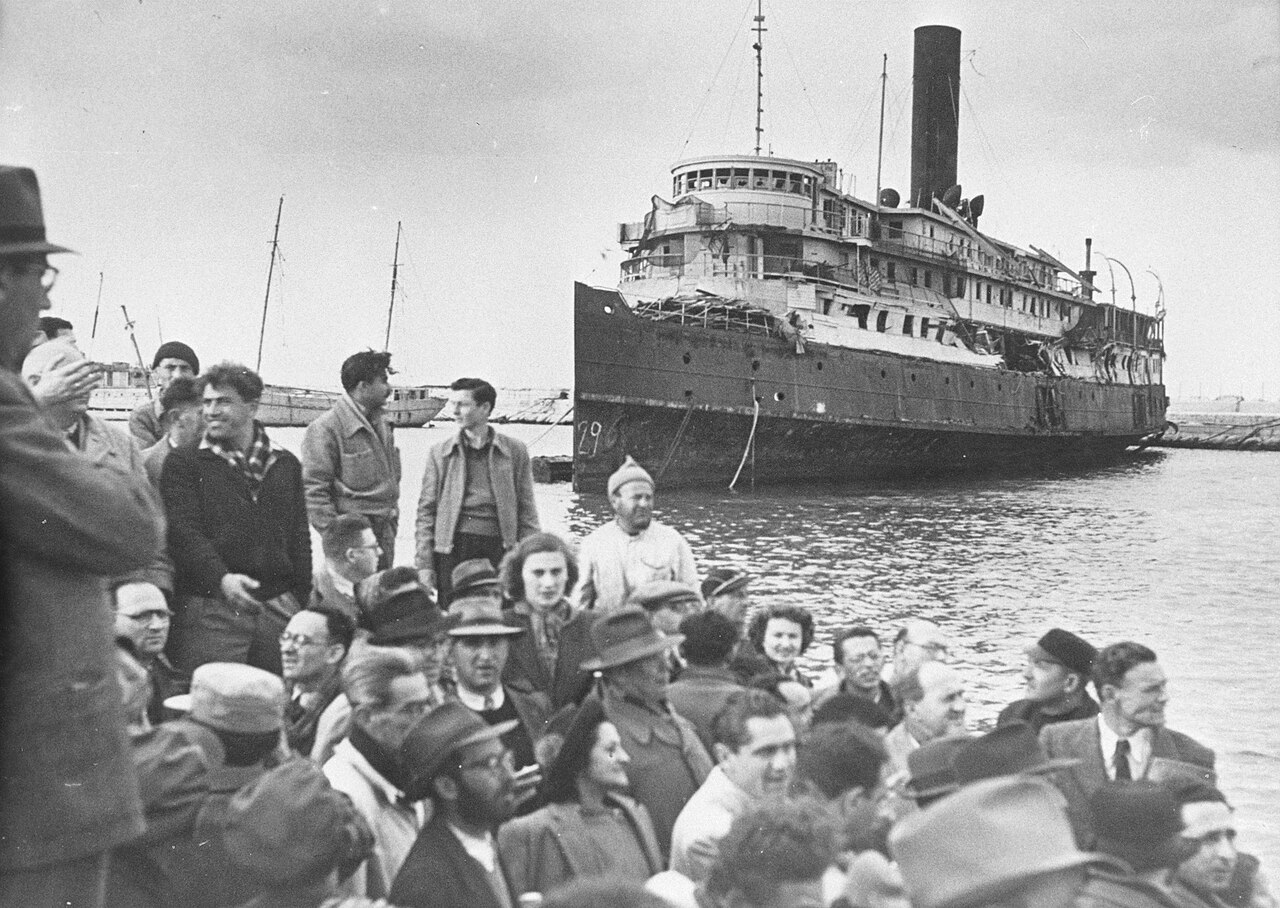
The Palmach, Immigration to Israel

#### History

Over 100,000 people attempted to illegally enter Mandatory Palestine. There were 142 voyages by 120 ships. Over half were stopped by the British patrols. The [Royal Navy](https://en.wikipedia.org/wiki/Royal_Navy "Royal Navy") had eight ships on station in Palestine, and additional ships were tasked with tracking suspicious vessels heading for Palestine. Most of the intercepted immigrants were sent to [internment camps](https://en.wikipedia.org/wiki/Cyprus_internment_camps "Cyprus internment camps") in [Cyprus](https://en.wikipedia.org/wiki/Cyprus "Cyprus"): (Karaolos near [Famagusta](https://en.wikipedia.org/wiki/Famagusta "Famagusta"), [Nicosia](https://en.wikipedia.org/wiki/Nicosia "Nicosia"), [Dhekelia](https://en.wikipedia.org/wiki/Dhekelia_Cantonment "Dhekelia Cantonment"), and [Xylotymbou](https://en.wikipedia.org/wiki/Xylotymbou "Xylotymbou"). Some were sent to the [Atlit detention camp](https://en.wikipedia.org/wiki/Atlit_detainee_camp "Atlit detainee camp") in Palestine, and some to [Mauritius](https://en.wikipedia.org/wiki/Mauritius "Mauritius"). The British held as many as 50,000 people in these camps (see [Jews in British camps on Cyprus](https://en.wikipedia.org/wiki/Jews_in_British_camps_on_Cyprus "Jews in British camps on Cyprus")). Over 1,600 drowned at sea. Only a few thousand actually entered Palestine.

The pivotal event in *Ha'apala* program was the [*Exodus*](https://en.wikipedia.org/wiki/SS_Exodus "SS Exodus") incident in 1947. *Exodus* was intercepted and boarded by a [Royal Navy](https://en.wikipedia.org/wiki/Royal_Navy "Royal Navy") patrol. Despite significant resistance, passengers from *Exodus* were forcibly returned to Europe, and eventually put in camps in Germany. This was publicized, to the great embarrassment of the British government.

One account of Aliyah Bet is given by journalist [I. F. Stone](https://en.wikipedia.org/wiki/I._F._Stone "I. F. Stone") in his 1946 book [*Underground to Palestine*](https://en.wikipedia.org/wiki/Underground_to_Palestine "Underground to Palestine")*,* a first-person account of traveling from Europe with displaced persons attempting to reach the Jewish homeland.[<sup><span class="editor-theme-superscript">\[7\]</span></sup>](https://en.wikipedia.org/wiki/Aliyah_Bet#cite_note-7)

More than 300 volunteers, most of them American World War II veterans, including [Murray Greenfield](https://en.wikipedia.org/wiki/Murray_Greenfield) (of the ship [*HaTikva*](https://en.wikipedia.org/wiki/HaTikva_(ship) "HaTikva (ship)")), volunteered to sail ten ships ("The Jews' Secret Fleet") from the United States to Europe to load 35,000 survivors of the Holocaust (half of the illegal immigrants to Palestine), only to be deported to detention camps on Cyprus.

#### Before World War II

- n 1934, the first attempt to bring in a large number of illegal immigrants by sea happened when some 350 Jews sailed on the *Vallos*, a chartered ship, without the permission of the [Jewish Agency](https://en.wikipedia.org/wiki/Jewish_Agency "Jewish Agency"), who feared illegal immigration would cause the British to restrict legal immigration. She arrived off the coast of Palestine on 25 August, and the passengers disembarked with the help of the [Haganah](https://en.wikipedia.org/wiki/Haganah "Haganah"), which received special permission to assist them.
- On 29 July 1939, the *Colorado*, flying under the Panamanian flag and carrying 378 Jewish refugees from Europe was intercepted by the British; the illegal immigrants were arrested and taken into Haifa.[<sup><span class="editor-theme-superscript">\[8\]</span></sup>](https://en.wikipedia.org/wiki/Aliyah_Bet#cite_note-FRUS1096-8)
- On 19 August, the *Aghios Nicolaus*, a Greek owned ship, transferred 840 immigrants to smaller vessels off the coast and sent them to shore.[<sup><span class="editor-theme-superscript">\[8\]</span></sup>](https://en.wikipedia.org/wiki/Aliyah_Bet#cite_note-FRUS1096-8)
- On 23 August, the *Parita*, carrying some 700 refugees on board, was deliberately beached at Tel Aviv by the passengers, the captain and crew having fled in a small boat.[<sup><span class="editor-theme-superscript">\[8\]</span></sup>](https://en.wikipedia.org/wiki/Aliyah_Bet#cite_note-FRUS1096-8)

[![image.png](https://wiki.compclassnotes.com/uploads/images/gallery/2026-09/scaled-1680-/I0vimage.png)](https://wiki.compclassnotes.com/uploads/images/gallery/2026-09/I0vimage.png)
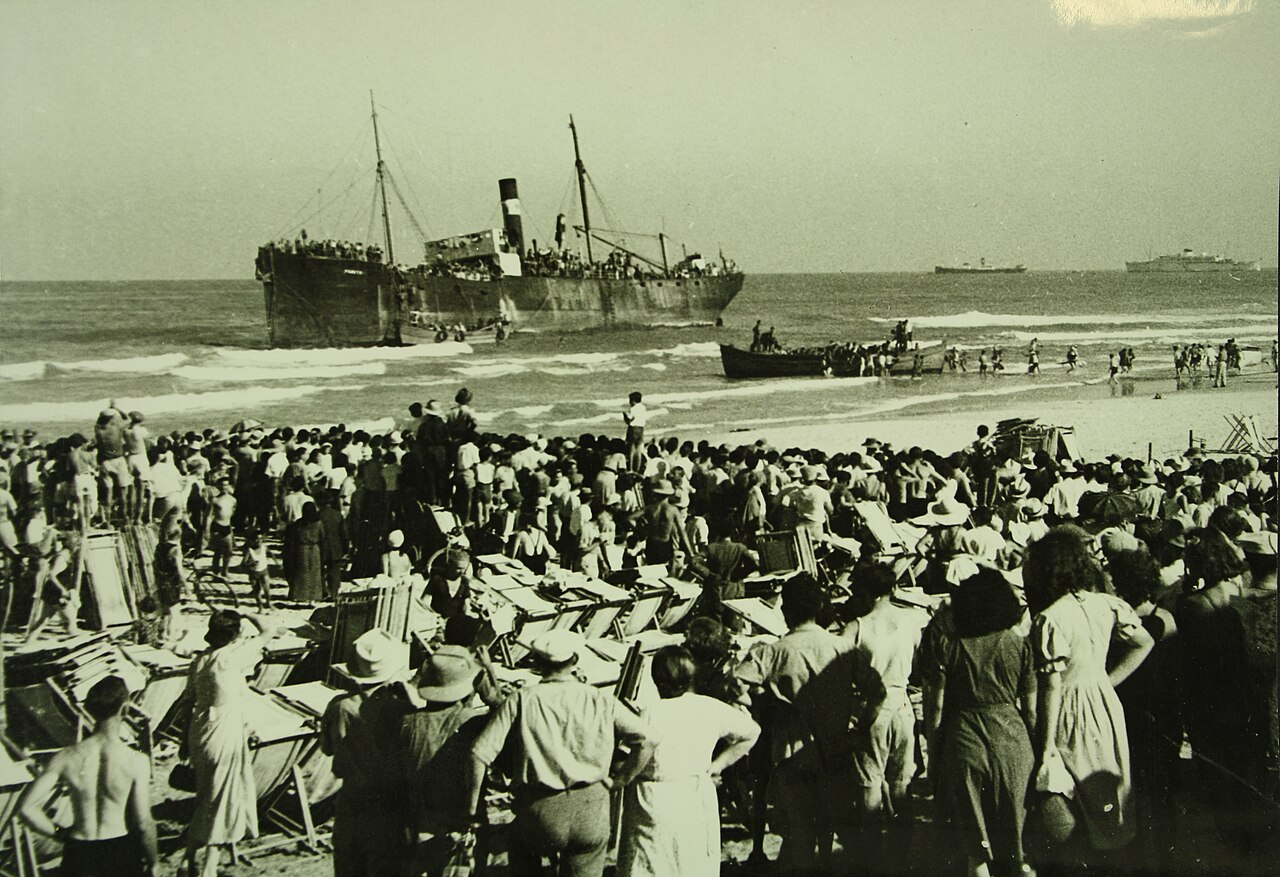
SS *Parita* aground off Tel Aviv, August 1939

[![image.png](https://wiki.compclassnotes.com/uploads/images/gallery/2026-09/scaled-1680-/oQjimage.png)](https://wiki.compclassnotes.com/uploads/images/gallery/2026-09/oQjimage.png)
SS *Patria* sinking in Haifa port

#### During World War II

- On 2 September, the *Tiger Hill*, a 1,499-ton ship built in 1887, was intercepted and fired on by [Royal Navy](https://en.wikipedia.org/wiki/Royal_Navy "Royal Navy") gunboats off [Tel Aviv](https://en.wikipedia.org/wiki/Tel_Aviv "Tel Aviv"), killing two passengers (Dr Robert Schneider and Zvi Binder); the ship HMCS *Belleville* beached on the shore with 1,205 immigrants on board; the *Tiger Hill* had sailed from [Constanţa](https://en.wikipedia.org/wiki/Constan%C5%A3a "Constanţa"), Romania, on 3 August 1939, with about 750 immigrants on board and had taken on board the passengers from the *Frossoula*, another illegal immigrant ship that was marooned in [Lebanon](https://en.wikipedia.org/wiki/Lebanon "Lebanon").[<sup><span class="editor-theme-superscript">\[8\]</span></sup>](https://en.wikipedia.org/wiki/Aliyah_Bet#cite_note-FRUS1096-8)[<sup><span class="editor-theme-superscript">\[9\]</span></sup>](https://en.wikipedia.org/wiki/Aliyah_Bet#cite_note-Holmes-9)[<sup><span class="editor-theme-superscript">\[10\]</span></sup>](https://en.wikipedia.org/wiki/Aliyah_Bet#cite_note-10)[<sup><span class="editor-theme-superscript">\[11\]</span></sup>](https://en.wikipedia.org/wiki/Aliyah_Bet#cite_note-Ziedenberg-11)
- On 16 September, the *Rudnitchan* transferred 364 Jewish refugees into five lifeboats outside the territorial waters of the Mandate and sent them ashore as illegal immigrants.[<sup><span class="editor-theme-superscript">\[8\]</span></sup>](https://en.wikipedia.org/wiki/Aliyah_Bet#cite_note-FRUS1096-8)
- On 19 September, the *Noemi Julia*, sailing from Sulina in Romania with 1,130 Jewish refugees from Europe on board was intercepted in the Mediterranean by a British warship and forced to Haifa port; fearing that they would be sent back, the illegal immigrants engaged in passive resistance; the British authorities brought them ashore and held them in a detention camp; they were released a month later.[<sup><span class="editor-theme-superscript">\[8\]</span></sup>](https://en.wikipedia.org/wiki/Aliyah_Bet#cite_note-FRUS1096-8)[<sup><span class="editor-theme-superscript">\[11\]</span></sup>](https://en.wikipedia.org/wiki/Aliyah_Bet#cite_note-Ziedenberg-11)
- On 24–25 November 1939, a large group of immigrants traveled by train from [Vienna](https://en.wikipedia.org/wiki/Vienna "Vienna") to [Bratislava](https://en.wikipedia.org/wiki/Bratislava "Bratislava") and about 2 weeks later sailed from there on the riverboat *Uranus* down the [Danube](https://en.wikipedia.org/wiki/Danube "Danube"). At the [Romanian](https://en.wikipedia.org/wiki/Romania "Romania") border, the three smaller riverboats to which they had been transferred on December 14 on entering [Yugoslavia](https://en.wikipedia.org/wiki/Yugoslavia "Yugoslavia") were intercepted and the immigrants were forced to disembark at the old fortress town of [Kladovo](https://en.wikipedia.org/wiki/Kladovo "Kladovo").[<sup><span class="editor-theme-superscript">\[12\]</span></sup>](https://en.wikipedia.org/wiki/Aliyah_Bet#cite_note-12) About 1,100 refugees were stranded there and came to be known as the [Kladovo-Sabac Group](https://en.wikipedia.org/wiki/Kladovo_transport "Kladovo transport"). In May 1941, they were still in Yugoslavia, where 915 of them were caught and eventually killed by the invading Nazis. The 800 men were shot by Nazi soldiers in a farmer's field at Zasavica; after the war, the remains of the men were re-interred in a mass grave in the Belgrade Sephardi Cemetery. The women and children were imprisoned in the Sajmiste concentration camp where they perished from hunger, disease, exposure to the bitter cold winter weather, or gassed to death in a mobile gas truck.
- On 18 May 1940 the old Italian paddle steamer *Pencho* sailed from [Bratislava](https://en.wikipedia.org/wiki/Bratislava "Bratislava"), with 514 passengers, mostly [Betar](https://en.wikipedia.org/wiki/Betar "Betar") members. The *Pencho* sailed down the [Danube](https://en.wikipedia.org/wiki/Danube "Danube") to the [Black Sea](https://en.wikipedia.org/wiki/Black_Sea "Black Sea") and into the [Aegean Sea](https://en.wikipedia.org/wiki/Aegean_Sea "Aegean Sea"). On 9 October, her engines failed and she was wrecked off [Mytilene](https://en.wikipedia.org/wiki/Mytilene "Mytilene"), in the Italian-ruled [Dodecanese](https://en.wikipedia.org/wiki/Dodecanese "Dodecanese") Islands. The Italians rescued the passengers and took them to [Rhodes](https://en.wikipedia.org/wiki/Rhodes "Rhodes"). All but two were then placed in an internment camp at [Ferramonti di Tarsia](https://en.wikipedia.org/wiki/Ferramonti_di_Tarsia "Ferramonti di Tarsia") in southern Italy. They were held there until [Allied](https://en.wikipedia.org/wiki/Allies_of_World_War_II "Allies of World War II") forces liberated the area in September 1943.[<sup><span class="editor-theme-superscript">\[13\]</span></sup>](https://en.wikipedia.org/wiki/Aliyah_Bet#cite_note-Pentcho-13)
- In October 1940, a large group of refugees were allowed to leave Vienna. The exodus was organized by Berthold Storfer, a Jewish businessman who worked under [Adolf Eichmann](https://en.wikipedia.org/wiki/Adolf_Eichmann "Adolf Eichmann"). They took four river boats, *Uranus*, *Schönbrunn*, *Helios*, and *Melk*, down the Danube to Romania, where the *Uranus* passengers, about 1,000, boarded the [*Pacific*](https://en.wikipedia.org/wiki/Patria_disaster#Background "Patria disaster"), and sailed on 11 October 1940. They arrived at [Haifa](https://en.wikipedia.org/wiki/Haifa "Haifa") on 1 November, followed by the [*Milos*](https://en.wikipedia.org/wiki/SS_Milos_(1878)?action=edit&redlink=1 "SS Milos (1878) (page does not exist)") a few days later. The British transferred all the immigrants to the French liner [SS *Patria*](https://en.wikipedia.org/wiki/SS_Patria_(1913) "SS Patria (1913)") to take them for internment to Mauritius. To stop the *Patria* from sailing, the [Haganah](https://en.wikipedia.org/wiki/Haganah "Haganah") [smuggled a bomb aboard](https://en.wikipedia.org/wiki/Patria_disaster "Patria disaster"). The explosion holed her side, capsizing her and killing around 260 people. The British, by order of [Winston Churchill](https://en.wikipedia.org/wiki/Winston_Churchill "Winston Churchill"), allowed the survivors to remain in Palestine.[<sup><span class="editor-theme-superscript">\[14\]</span></sup>](https://en.wikipedia.org/wiki/Aliyah_Bet#cite_note-:0-14)
- In December 1940 the *Salvador*, a small [Bulgarian](https://en.wikipedia.org/wiki/Bulgaria "Bulgaria") schooner formerly named *Tsar Krum*, left [Burgas](https://en.wikipedia.org/wiki/Burgas "Burgas") with 327 refugees. On December 12 the *Salvador* was wrecked in a violent storm in the [Sea of Marmara](https://en.wikipedia.org/wiki/Sea_of_Marmara "Sea of Marmara"), near [Istanbul](https://en.wikipedia.org/wiki/Istanbul "Istanbul"). 223 persons, including 66 children, lost their lives. The survivors were taken to Istanbul. 125 survivors were deported back to Bulgaria, and the remaining 70 left on the *Darien* (No. 66).[<sup><span class="editor-theme-superscript">\[15\]</span></sup>](https://en.wikipedia.org/wiki/Aliyah_Bet#cite_note-15)
- On 11 December 1941, the [*Struma*](https://en.wikipedia.org/wiki/MV_Struma "MV Struma") sailed from [Constanţa](https://en.wikipedia.org/wiki/Constan%C5%A3a "Constanţa") carrying between 760 and 790 refugees. Three days later she reached Istanbul, where Turkey detained her and her passengers for 10 weeks. On 23 February 1942, Turkish authorities towed her back into the Black Sea and cast her adrift. Early the next day the [*Shch-213*](https://en.wikipedia.org/wiki/Soviet_submarine_Shch-213 "Soviet submarine Shch-213") [torpedoed and sank her](https://en.wikipedia.org/wiki/Struma_disaster "Struma disaster"). Between 767 and 791 people were killed, and there was only one survivor.[<sup><span class="editor-theme-superscript">\[16\]</span></sup>](https://en.wikipedia.org/wiki/Aliyah_Bet#cite_note-16)
- On 20 September 1942, the *Europa* sailed from Romania with 21 passengers. She was wrecked in the [Bosphorus](https://en.wikipedia.org/wiki/Bosphorus "Bosphorus").
- On 21 April 1944, the *Belasitza* sailed from Romania with 273 passengers including 120 children, who went from Istanbul to Palestine by sealed train.
- On 5 August 1944, *Bulbul*, [*Mefküre*](https://en.wikipedia.org/wiki/MV_Mefk%C3%BCre "MV Mefküre") and *Morino* sailed from Constanţa carrying about 1,000 refugees between them. In the night the [Soviet submarine](https://en.wikipedia.org/wiki/Shchuka-class_submarine "Shchuka-class submarine") [*Shch-215*](https://en.wikipedia.org/wiki/Soviet_submarine_Shch-215 "Soviet submarine Shch-215") sank *Mefküre* by torpedo and shellfire, and then machine-gunned survivors in the water.[<sup><span class="editor-theme-superscript">\[17\]</span></sup>](https://en.wikipedia.org/wiki/Aliyah_Bet#cite_note-17) Between 289 and 394 refugees plus seven crew were aboard *Mefküre*; only the crew and five refugees survived. *Bulbul* rescued the few survivors and took them to Turkey.[<sup><span class="editor-theme-superscript">\[1</span></sup>](https://en.wikipedia.org/wiki/Aliyah_Bet#cite_note-18)

[![image.png](https://wiki.compclassnotes.com/uploads/images/gallery/2026-09/scaled-1680-/CQaimage.png)](https://wiki.compclassnotes.com/uploads/images/gallery/2026-09/CQaimage.png)
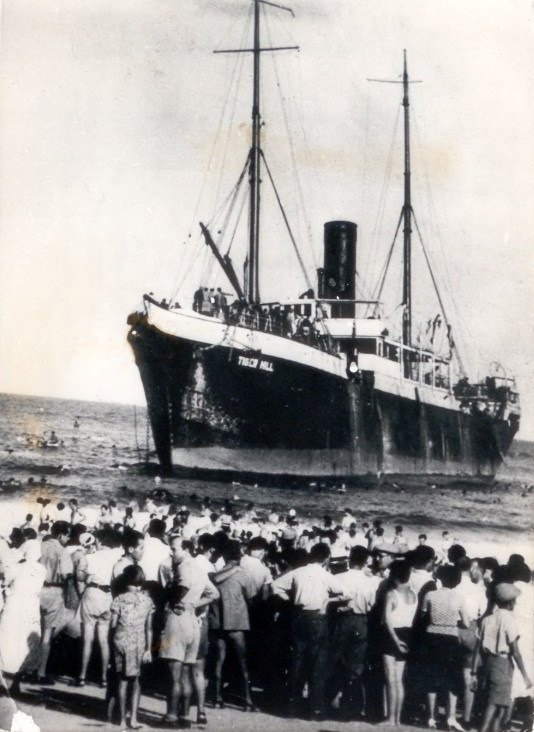
SS *Tiger Hill* aground off Haifa, September 1, 1939

# Yishuv

The **Yishuv** ([Hebrew](https://en.wikipedia.org/wiki/Hebrew_language "Hebrew language"): ישוב,[lit.](https://en.wikipedia.org/wiki/Literal_translation "Literal translation") 'settlement'), **HaYishuv Ha'ivri** ([Hebrew](https://en.wikipedia.org/wiki/Hebrew_language "Hebrew language"): הישוב העברי,[lit.](https://en.wikipedia.org/wiki/Literal_translation "Literal translation") 'the [Hebrew](https://en.wikipedia.org/wiki/Hebrews#Use_in_Zionism "Hebrews") settlement'), or **HaYishuv HaYehudi Be'Eretz Yisra'el** (lit. 'the Jewish Settlement in the Land of Israel') was the community of [Jews](https://en.wikipedia.org/wiki/Jews "Jews") residing in [Palestine](https://en.wikipedia.org/wiki/Palestine_(region) "Palestine (region)") prior to the establishment of the [State of Israel](https://en.wikipedia.org/wiki/State_of_Israel "State of Israel") in 1948. The Yishuv was also referred to as the [Palestinian Jewish](https://en.wikipedia.org/wiki/Palestinian_Jews "Palestinian Jews") community.[<sup><span class="editor-theme-superscript">\[1\]</span></sup>](https://en.wikipedia.org/wiki/Yishuv#cite_note-1) The term Yishuv came into use in the 1880s, when there were about 25,000 Jews living in that region, and continued to be used until 1948, by which time there were some 630,000 Jews there.[<sup><span class="editor-theme-superscript">\[2\]</span></sup>](https://en.wikipedia.org/wiki/Yishuv#cite_note-2) The term is still in use to denote the pre-1948 Jewish residents in Palestine, corresponding to the southern part of [Ottoman Syria](https://en.wikipedia.org/wiki/Ottoman_Syria "Ottoman Syria") until 1918, [OETA South](https://en.wikipedia.org/wiki/Occupied_Enemy_Territory_Administration "Occupied Enemy Territory Administration") in 1917–1920, and [Mandatory Palestine](https://en.wikipedia.org/wiki/Mandatory_Palestine "Mandatory Palestine") in 1920–1948.[<sup><span class="editor-theme-superscript">\[3\]</span></sup>](https://en.wikipedia.org/wiki/Yishuv#cite_note-3)

A distinction is sometimes drawn between the [*Old Yishuv*](https://en.wikipedia.org/wiki/Old_Yishuv "Old Yishuv") and the [*New Yishuv*](https://en.wikipedia.org/wiki/Yishuv#New_Yishuv). 'Old Yishuv' refers to all the Jews living in Palestine before the first [Zionist](https://en.wikipedia.org/wiki/Zionist_movement "Zionist movement") immigration wave ([*aliyah*](https://en.wikipedia.org/wiki/Aliyah "Aliyah")) of 1882, and to their descendants until 1948. The Old Yishuv residents were religious Jews, living mainly in [Jerusalem](https://en.wikipedia.org/wiki/Jerusalem "Jerusalem"), [Safed](https://en.wikipedia.org/wiki/Safed "Safed"), [Tiberias](https://en.wikipedia.org/wiki/Tiberias "Tiberias"), and [Hebron](https://en.wikipedia.org/wiki/Hebron "Hebron"). There were smaller communities in [Jaffa](https://en.wikipedia.org/wiki/Jaffa "Jaffa"), [Haifa](https://en.wikipedia.org/wiki/Haifa "Haifa"), [Peki'in](https://en.wikipedia.org/wiki/Peki'in "Peki'in"), [Acre](https://en.wikipedia.org/wiki/Acre,_Israel "Acre, Israel"), [Nablus](https://en.wikipedia.org/wiki/Nablus "Nablus"), [Shfaram](https://en.wikipedia.org/wiki/Shfaram "Shfaram"), and until 1799[<sup><span class="editor-theme-superscript">\[4\]</span></sup>](https://en.wikipedia.org/wiki/Yishuv#cite_note-benayahu-4) in [Gaza](https://en.wikipedia.org/wiki/Gaza_City "Gaza City"). In the final centuries before modern Zionism,<sup><span class="editor-theme-superscript">\[</span></sup>[*<sup>*clarification needed*</sup>*](https://en.wikipedia.org/wiki/Wikipedia:Please_clarify "Wikipedia:Please clarify")<sup><span class="editor-theme-superscript">\]</span></sup> a large part of the Old Yishuv spent their time studying the [Torah](https://en.wikipedia.org/wiki/Torah "Torah") and lived off charity ([halukka](https://en.wikipedia.org/wiki/Halukka "Halukka")), donated by Jews in the [diaspora](https://en.wikipedia.org/wiki/Jewish_diaspora "Jewish diaspora").[<sup><span class="editor-theme-superscript">\[5\]</span></sup>](https://en.wikipedia.org/wiki/Yishuv#cite_note-5)<sup><span class="editor-theme-superscript">\[</span></sup>[*<sup>*clarification needed*</sup>*](https://en.wikipedia.org/wiki/Wikipedia:Please_clarify "Wikipedia:Please clarify")<sup><span class="editor-theme-superscript">\]</span></sup>

The term 'New Yishuv' refers to those who adopted a new approach, based on economic independence and various national ideologies, rather than strictly religious reasons for settling in the "Holy Land".<sup><span class="editor-theme-superscript">\[</span></sup>[*<sup>*citation needed*</sup>*](https://en.wikipedia.org/wiki/Wikipedia:Citation_needed "Wikipedia:Citation needed")<sup><span class="editor-theme-superscript">\]</span></sup> The precursors began building homes outside the [Old City](https://en.wikipedia.org/wiki/Old_City_(Jerusalem) "Old City (Jerusalem)") walls of Jerusalem in the 1860s, followed soon after by the founders of the [moshava](https://en.wikipedia.org/wiki/Moshava "Moshava") of [Petah Tikva](https://en.wikipedia.org/wiki/Petah_Tikva "Petah Tikva"), with growth in full swing during the [First Aliyah](https://en.wikipedia.org/wiki/First_Aliyah "First Aliyah") of 1882, followed by the founding of neighbourhoods and villages until the establishment of the State of Israel in 1948.

#### Ottoman rule 

The Old Yishuv were the Jewish communities of southern [Ottoman Syria](https://en.wikipedia.org/wiki/Ottoman_Syria "Ottoman Syria") in the [Ottoman Empire](https://en.wikipedia.org/wiki/Ottoman_Empire "Ottoman Empire"),[<sup><span class="editor-theme-superscript">\[6\]</span></sup>](https://en.wikipedia.org/wiki/Yishuv#cite_note-6) up to the onset of Zionist [aliyah](https://en.wikipedia.org/wiki/Aliyah "Aliyah") and the consolidation of the New Yishuv by the end of World War I in 1918 and the establishment of the British [Mandate for Palestine](https://en.wikipedia.org/wiki/Mandate_for_Palestine "Mandate for Palestine"). The Old Yishuv had continuously resided in Palestine and was largely made up of [ultra-Orthodox Jews](https://en.wikipedia.org/wiki/Ultra-Orthodox_Jews "Ultra-Orthodox Jews") dependent on external donations ([Halukka](https://en.wikipedia.org/wiki/Halukka "Halukka")) for living, as opposed to the later Zionist aliyah and the New Yishuv, who were more socialist-leaning and secular, emphasizing labor and self-sufficiency.<sup><span class="editor-theme-superscript">\[</span></sup>[*<sup>*citation needed*</sup>*](https://en.wikipedia.org/wiki/Wikipedia:Citation_needed "Wikipedia:Citation needed")<sup><span class="editor-theme-superscript">\]</span></sup>

The Old Yishuv developed after a period of severe decline in Jewish communities of the Southern [Levant](https://en.wikipedia.org/wiki/Levant "Levant") during the [early Middle Ages](https://en.wikipedia.org/wiki/Early_Middle_Ages "Early Middle Ages"), and was composed of three clusters. The oldest group consisted of the [Ladino](https://en.wikipedia.org/wiki/Judaeo-Spanish "Judaeo-Spanish")-speaking [Sephardic Jewish](https://en.wikipedia.org/wiki/Sephardic_Jew "Sephardic Jew") communities in [Galilee](https://en.wikipedia.org/wiki/Galilee "Galilee") and the [Judeo-Arabic](https://en.wikipedia.org/wiki/Judeo-Arabic "Judeo-Arabic") speaking [Musta'arabi Jews](https://en.wikipedia.org/wiki/Musta'arabi_Jews "Musta'arabi Jews") who settled in Eretz Yisrael in the Ottoman and late [Mamluk period](https://en.wikipedia.org/wiki/Mamluk_Sultanate_(Cairo) "Mamluk Sultanate (Cairo)"). A second group was composed of [Ashkenazi](https://en.wikipedia.org/wiki/Ashkenazi "Ashkenazi") and [Hasidic](https://en.wikipedia.org/wiki/Hasidic "Hasidic") Jews who had emigrated from Europe in the 18th and early 19th centuries. A third wave was constituted by Yishuv members who arrived in the late 19th century.[<sup><span class="editor-theme-superscript">\[7\]</span></sup>](https://en.wikipedia.org/wiki/Yishuv#cite_note-7) The Old Yishuv was thus generally divided into two independent communities – the [Sephardi Jews](https://en.wikipedia.org/wiki/Sephardi_Jews "Sephardi Jews") (including Musta'arabim), mainly constituting the remains of Jewish communities of [Galilee](https://en.wikipedia.org/wiki/Galilee "Galilee") and the [Four Holy Cities](https://en.wikipedia.org/wiki/Four_Holy_Cities "Four Holy Cities") of Judaism, which had flourished in the 16th and 17th centuries; and the [Ashkenazi Jews](https://en.wikipedia.org/wiki/Ashkenazi_Jews "Ashkenazi Jews"), whose immigration from Europe was primarily since the 18th century.[<sup><span class="editor-theme-superscript">\[8\]</span></sup>](https://en.wikipedia.org/wiki/Yishuv#cite_note-Bloch-8)

The *Old Yishuv* term was coined by members of the 'New Yishuv' in the late 19th century to distinguish themselves from the economically dependent and generally earlier Jewish communities, who mainly resided in the four holy cities, and unlike the New Yishuv, had not embraced land ownership and agriculture. Apart from the Old Yishuv centres in the four holy cities of Judaism, namely [Jerusalem](https://en.wikipedia.org/wiki/Jerusalem "Jerusalem"), [Hebron](https://en.wikipedia.org/wiki/Hebron "Hebron"), [Tiberias](https://en.wikipedia.org/wiki/Tiberias "Tiberias") and [Safed](https://en.wikipedia.org/wiki/Safed "Safed"), smaller communities also existed in [Jaffa](https://en.wikipedia.org/wiki/Jaffa "Jaffa"), [Haifa](https://en.wikipedia.org/wiki/Haifa "Haifa"), [Peki'in](https://en.wikipedia.org/wiki/Peki'in "Peki'in"), [Acre](https://en.wikipedia.org/wiki/Acre,_Israel "Acre, Israel"), [Nablus](https://en.wikipedia.org/wiki/Nablus "Nablus") and [Shfaram](https://en.wikipedia.org/wiki/Shfaram "Shfaram"). [Petah Tikva](https://en.wikipedia.org/wiki/Petah_Tikva "Petah Tikva"), although established in 1878 by the Old Yishuv, nevertheless was also supported by the arriving Zionists. [Rishon LeZion](https://en.wikipedia.org/wiki/Rishon_LeZion "Rishon LeZion"), the first settlement founded by the [Hovevei Zion](https://en.wikipedia.org/wiki/Hovevei_Zion "Hovevei Zion") in 1882, could be considered the true beginning of the *New Yishuv*.[<sup><span class="editor-theme-superscript">\[9\]</span></sup>](https://en.wikipedia.org/wiki/Yishuv#cite_note-9)

[![image.png](https://wiki.compclassnotes.com/uploads/images/gallery/2026-09/scaled-1680-/tYfimage.png)](https://wiki.compclassnotes.com/uploads/images/gallery/2026-09/tYfimage.png)
[Jewish](https://en.wikipedia.org/wiki/Jews "Jews") community in the [Mutasarrifate of Jerusalem](https://en.wikipedia.org/wiki/Mutasarrifate_of_Jerusalem "Mutasarrifate of Jerusalem") under [Ottoman](https://en.wikipedia.org/wiki/Ottoman_Empire "Ottoman Empire") rule, 1895

#### Beginning of modern Aliyah (New Yishuv)

The Ottoman government was not supportive of the new settlers from the First and Second Aliyah, as the Ottoman government officially restricted Jewish immigration. The Yishuv relied on money from abroad to support their settlements.

In 1908, the Zionist Organization founded the [Palestine Office](https://en.wikipedia.org/wiki/Palestine_Office?action=edit&redlink=1 "Palestine Office (page does not exist)") \[[he](https://he.wikipedia.org/wiki/%D7%94%D7%9E%D7%A9%D7%A8%D7%93%20%D7%94%D7%90%D7%A8%D7%A6%D7%99%D7%A9%D7%A8%D7%90%D7%9C%D7%99 "he:המשרד הארצישראלי")\], under [Arthur Ruppin](https://en.wikipedia.org/wiki/Arthur_Ruppin "Arthur Ruppin"), for land acquisition, agricultural settlement and training,[<sup><span class="editor-theme-superscript">\[10\]</span></sup>](https://en.wikipedia.org/wiki/Yishuv#cite_note-10) and later for urban expansion. The first Hebrew high schools were opened in Palestine as well as the [Technion](https://en.wikipedia.org/wiki/Technion "Technion"), the first institution for higher learning. [Hashomer](https://en.wikipedia.org/wiki/Hashomer "Hashomer"), a Zionist self-defence group, was created to protect the Jewish settlements. Labor organizations were created along with health and cultural services, all later coordinated by the [Jewish National Council](https://en.wikipedia.org/wiki/Jewish_National_Council "Jewish National Council"). By 1914, the old Yishuv was a minority, and the New Yishuv began to express itself and its [Zionist](https://en.wikipedia.org/wiki/Zionism "Zionism") goals.

The [First Aliyah](https://en.wikipedia.org/wiki/First_Aliyah "First Aliyah") was the very beginning of the creation of the New Yishuv. More than 25,000 Jews immigrated to Palestine. The immigrants were inspired by the notion of creating a national home for Jews. Most of the Jewish immigrants came from Russia, escaping the [pogroms](https://en.wikipedia.org/wiki/Pogrom "Pogrom"), while some arrived from Yemen. Many of the immigrants were affiliated with [Hovevei Zion](https://en.wikipedia.org/wiki/Hovevei_Zion "Hovevei Zion"). Hovevei Zion purchased land from Arabs and other Ottoman subjects and created various settlements such as [Yesud HaMa'ala](https://en.wikipedia.org/wiki/Yesud_HaMa'ala "Yesud HaMa'ala"), [Rosh Pinna](https://en.wikipedia.org/wiki/Rosh_Pinna "Rosh Pinna"), [Gedera](https://en.wikipedia.org/wiki/Gedera "Gedera"), [Rishon LeZion](https://en.wikipedia.org/wiki/Rishon_LeZion "Rishon LeZion"), [Nes Tziona](https://en.wikipedia.org/wiki/Nes_Tziona "Nes Tziona") and [Rechovot](https://en.wikipedia.org/wiki/Rechovot "Rechovot"). These agricultural settlements were supported by philanthropists from abroad, chiefly [Edmond James de Rothschild](https://en.wikipedia.org/wiki/Edmond_James_de_Rothschild "Edmond James de Rothschild"). and [Alphonse James de Rothschild](https://en.wikipedia.org/wiki/Alphonse_James_de_Rothschild "Alphonse James de Rothschild").[<sup><span class="editor-theme-superscript">\[11\]</span></sup>](https://en.wikipedia.org/wiki/Yishuv#cite_note-11)

[Eliezer Ben-Yehuda](https://en.wikipedia.org/wiki/Eliezer_Ben-Yehuda "Eliezer Ben-Yehuda") also immigrated during the first Aliyah. Ben-Yehuda took it upon himself to revive the Hebrew language, and along with [Nissim Bechar](https://en.wikipedia.org/wiki/Nissim_Bechar?action=edit&redlink=1 "Nissim Bechar (page does not exist)") started a school for teaching Hebrew, later on founding the first Hebrew newspaper.

During the Second Aliyah, between 1903 and 1914, there were 35,000 new immigrants, primarily from the [Russian Empire](https://en.wikipedia.org/wiki/Russian_Empire "Russian Empire").

During [World War I](https://en.wikipedia.org/wiki/World_War_I "World War I"), the conditions for the Jews in the Ottoman Empire worsened. All those Jews who were of an enemy nationality were exiled and others were drafted into the Ottoman army. Many of those exiled fled to [Egypt](https://en.wikipedia.org/wiki/Egypt "Egypt") and the [United States](https://en.wikipedia.org/wiki/United_States "United States"). Those who remained in the Ottoman ruled Palestine faced hard economic times. There was disagreement whether to support the British or the Turks. A clandestine group, [Nili](https://en.wikipedia.org/wiki/Nili "Nili"), was established to pass information to the British in the hope of defeating the Ottomans and ending their rule over Palestine. The purpose and members of the Nili were discovered. All involved were executed by the Ottomans except its founder, [Aaron Aaronsohn](https://en.wikipedia.org/wiki/Aaron_Aaronsohn "Aaron Aaronsohn"), who escaped to Egypt. During World War I, the Jewish population in Palestine diminished by a third due to deportations, immigration, economic trouble and disease. In 1915, the [British Army](https://en.wikipedia.org/wiki/British_Army "British Army") recruited Yishuv Jews who had been exiled to Egypt into the Zion Mule Corps, which provided logistical support during the [Gallipoli campaign](https://en.wikipedia.org/wiki/Gallipoli_campaign "Gallipoli campaign"). Subsequently, the British established the [Jewish Legion](https://en.wikipedia.org/wiki/Jewish_Legion "Jewish Legion"), which participated in the British conquest of Ottoman Syria (including Palestine), leading to the Turkish surrender. The Jewish Legion's soldiers were predominantly diaspora Jews, but after British forces entered Palestine, a battalion of local Jews was recruited, which carried out support roles and guarded prisoners.

#### Paramilitary forces

See [Bar-Giora](https://en.wikipedia.org/wiki/Bar-Giora_(organisation) "Bar-Giora (organisation)"), [Hamagen](https://en.wikipedia.org/wiki/Hamagen "Hamagen"), Hanoter, and [Hashomer](https://en.wikipedia.org/wiki/Hashomer "Hashomer").

#### During the British Mandate

[World War I](https://en.wikipedia.org/wiki/World_War_I) saw the [dissolution of the Ottoman Empire](https://en.wikipedia.org/wiki/Dissolution_of_the_Ottoman_Empire "Dissolution of the Ottoman Empire") and the division of its territory. The [Sykes–Picot Agreement](https://en.wikipedia.org/wiki/Sykes%E2%80%93Picot_Agreement "Sykes–Picot Agreement") led to a division of Ottoman territory between British and French rule, and the [McMahon–Hussein correspondence](https://en.wikipedia.org/wiki/McMahon%E2%80%93Hussein_correspondence "McMahon–Hussein correspondence") "ambiguously omitted" the region of Palestine from what was promised to become an Arab state to the Hashemite sharif.[<sup><span class="editor-theme-superscript">\[12\]</span></sup>](https://en.wikipedia.org/wiki/Yishuv#cite_note-12) The British then worked to follow through on the [Balfour Declaration](https://en.wikipedia.org/wiki/Balfour_Declaration "Balfour Declaration") of 1917, that announced British support for the [Zionist](https://en.wikipedia.org/wiki/Zionism "Zionism") aspiration to establish "a national home for the Jewish people" in Palestine.[<sup><span class="editor-theme-superscript">\[13\]</span></sup>](https://en.wikipedia.org/wiki/Yishuv#cite_note-13)[<sup><span class="editor-theme-superscript">\[14\]</span></sup>](https://en.wikipedia.org/wiki/Yishuv#cite_note-:3-14) The Jewish population was variously estimated at less than 10% of the [population of Palestine](https://en.wikipedia.org/wiki/Demographic_history_of_Palestine_(region) "Demographic history of Palestine (region)") before the beginning of [British Mandatory rule](https://en.wikipedia.org/wiki/Mandatory_Palestine "Mandatory Palestine") (1920–1948)[<sup><span class="editor-theme-superscript">\[14\]</span></sup>](https://en.wikipedia.org/wiki/Yishuv#cite_note-:3-14) to slightly more at the beginning.[<sup><span class="editor-theme-superscript">\[15\]</span></sup>](https://en.wikipedia.org/wiki/Yishuv#cite_note-15)

Under British rule Jewish immigration, the majority from Europe, led to the rapid growth of the Yishuv. It referred to this immigration in Hebrew as [aliyah](https://en.wikipedia.org/wiki/Aliyah "Aliyah"), meaning "going up", giving it an ideological and religious connotation unlike immigration to other places.[<sup><span class="editor-theme-superscript">\[16\]</span></sup>](https://en.wikipedia.org/wiki/Yishuv#cite_note-16) Additional [Jewish land purchases in Palestine](https://en.wikipedia.org/wiki/Jewish_land_purchase_in_Palestine "Jewish land purchase in Palestine") enabled the establishment of more farming communities known as [*moshavim*](https://en.wikipedia.org/wiki/Moshav "Moshav") and [*kibbutzim*](https://en.wikipedia.org/wiki/Kibbutz "Kibbutz"). The [League of Nations](https://en.wikipedia.org/wiki/League_of_Nations "League of Nations") codified support for the eventual "establishment in Palestine of a national home for the Jewish people" into the [foundational document](https://en.wikipedia.org/wiki/Mandate_for_Palestine "Mandate for Palestine") of the British Mandate in Palestine, thereby facilitating what detractors later regarded not as aliyah, or the flight of refugees from Nazi and Fascist atrocities,[<sup><span class="editor-theme-superscript">\[17\]</span></sup>](https://en.wikipedia.org/wiki/Yishuv#cite_note-17) but as the Zionist colonization of Palestine.[<sup><span class="editor-theme-superscript">\[14\]</span></sup>](https://en.wikipedia.org/wiki/Yishuv#cite_note-:3-14)[<sup><span class="editor-theme-superscript">\[18\]</span></sup>](https://en.wikipedia.org/wiki/Yishuv#cite_note-18)[<sup><span class="editor-theme-superscript">\[19\]</span></sup>](https://en.wikipedia.org/wiki/Yishuv#cite_note-:0-19)<sup><span class="editor-theme-superscript">: xx </span></sup> The Yishuv had a level of international recognition that the [Arab Higher Committee](https://en.wikipedia.org/wiki/Arab_Higher_Committee "Arab Higher Committee"), the governing body of the Arab majority in Mandatory Palestine did not have. At times the British referred to the Arabs only as "non-Jewish communities".[<sup><span class="editor-theme-superscript">\[19\]</span></sup>](https://en.wikipedia.org/wiki/Yishuv#cite_note-:0-19)

#### Parliamentary representation and self-government

A department of the [World Zionist Organization](https://en.wikipedia.org/wiki/World_Zionist_Organization "World Zionist Organization") became the [Jewish Agency for Palestine](https://en.wikipedia.org/wiki/Jewish_Agency_for_Israel#Jewish_Agency_for_Palestine_1929%E2%80%931948 "Jewish Agency for Israel"), and later the [Jewish Agency for Israel](https://en.wikipedia.org/wiki/Jewish_Agency_for_Israel "Jewish Agency for Israel"). The agency and representative bodies were set up to enable self government.[<sup><span class="editor-theme-superscript">\[20\]</span></sup>](https://en.wikipedia.org/wiki/Yishuv#cite_note-20) The Assembly of Representatives was the elected parliamentary assembly of the Jewish community in [Mandatory Palestine](https://en.wikipedia.org/wiki/Mandatory_Palestine "Mandatory Palestine"). It was established on 19 April 1920,[<sup><span class="editor-theme-superscript">\[21\]</span></sup>](https://en.wikipedia.org/wiki/Yishuv#cite_note-21) and functioned until 13 February 1949, the day before the [first Knesset](https://en.wikipedia.org/wiki/1949_Israeli_legislative_election "1949 Israeli legislative election"), elected on 25 January, was sworn in. The Assembly met once a year to elect the executive body, the Jewish National Council,[<sup><span class="editor-theme-superscript">\[22\]</span></sup>](https://en.wikipedia.org/wiki/Yishuv#cite_note-K-22) which was responsible for education, local government, welfare, security and defense.[<sup><span class="editor-theme-superscript">\[23\]</span></sup>](https://en.wikipedia.org/wiki/Yishuv#cite_note-23) It also voted on the budgets proposed by the Jewish National Council and the Rabbinical Council.[<sup><span class="editor-theme-superscript">\[22\]</span></sup>](https://en.wikipedia.org/wiki/Yishuv#cite_note-K-22) The [Jewish National Council](https://en.wikipedia.org/wiki/Jewish_National_Council "Jewish National Council") (ועד לאומי *Va'ad Le'umi*) was also known as the General Council of the Jewish Community of Palestine.[<sup><span class="editor-theme-superscript">\[24\]</span></sup>](https://en.wikipedia.org/wiki/Yishuv#cite_note-24)

Yishuv governing institutions were recognized by the British government and created a [quasi state](https://en.wikipedia.org/wiki/Quasi-state "Quasi-state") as well as a structure of self-governing institutions that legitimately represented the Jewish population.[<sup><span class="editor-theme-superscript">\[19\]</span></sup>](https://en.wikipedia.org/wiki/Yishuv#cite_note-:0-19)[<sup><span class="editor-theme-superscript">\[25\]</span></sup>](https://en.wikipedia.org/wiki/Yishuv#cite_note-:2-25) It was "recognized as a public body for the purpose of advising and cooperating with the Administration of Palestine", and it was entitled to diplomatic representation in the League of Nations [Permanent Mandates Commission](https://en.wikipedia.org/wiki/Permanent_Mandates_Commission "Permanent Mandates Commission") in Geneva, as well as in London and elsewhere.[<sup><span class="editor-theme-superscript">\[19\]</span></sup>](https://en.wikipedia.org/wiki/Yishuv#cite_note-:0-19) These were given quasi-official diplomatic status by Britain and the [League of Nations](https://en.wikipedia.org/wiki/League_of_Nations "League of Nations"), giving the Yishuv's governing bodies international legitimacy.[<sup><span class="editor-theme-superscript">\[19\]</span></sup>](https://en.wikipedia.org/wiki/Yishuv#cite_note-:0-19)<sup><span class="editor-theme-superscript">: 45 </span></sup>

#### Paramilitary forces

Main articles: [Haganah](https://en.wikipedia.org/wiki/Haganah "Haganah"), [Irgun](https://en.wikipedia.org/wiki/Irgun "Irgun"), and [Lehi (group)](https://en.wikipedia.org/wiki/Lehi_(group) "Lehi (group)")

See also: [Zionist political violence](https://en.wikipedia.org/wiki/Zionist_political_violence "Zionist political violence")

The most notable Jewish paramilitaries in the [British Mandate of Palestine](https://en.wikipedia.org/wiki/Mandatory_Palestine "Mandatory Palestine") were the [Haganah](https://en.wikipedia.org/wiki/Haganah "Haganah"), the [Irgun](https://en.wikipedia.org/wiki/Irgun "Irgun") and [Lehi](https://en.wikipedia.org/wiki/Lehi_(group) "Lehi (group)"). In October 1945, during the [Jewish insurgency in Mandatory Palestine](https://en.wikipedia.org/wiki/Jewish_insurgency_in_Mandatory_Palestine "Jewish insurgency in Mandatory Palestine"), those organizations joined to form the [Jewish Resistance Movement](https://en.wikipedia.org/wiki/Jewish_Resistance_Movement "Jewish Resistance Movement"). It was established by the [Jewish Agency](https://en.wikipedia.org/wiki/Jewish_Agency "Jewish Agency") and activated for some ten months, until August, 1946.[<sup><span class="editor-theme-superscript">\[26\]</span></sup>](https://en.wikipedia.org/wiki/Yishuv#cite_note-Agency-26) The alliance coordinated acts of sabotage and attacks against British authorities.

\[1\] [https://en.wikipedia.org/wiki/Yishuv](https://en.wikipedia.org/wiki/Yishuv)

# Biltmore Conference

The **Biltmore Conference**, also known by its resolution as the **Biltmore Program**, was a fundamental departure from traditional [Zionist](https://en.wikipedia.org/wiki/Zionist "Zionist") policy, prompted by the [White Paper of 1939](https://en.wikipedia.org/wiki/White_Paper_of_1939 "White Paper of 1939") and the ongoing [Holocaust](https://en.wikipedia.org/wiki/Holocaust "Holocaust"),[<sup><span class="editor-theme-superscript">\[1\]</span></sup>](https://en.wikipedia.org/wiki/Biltmore_Conference#cite_note-ajcarchives.org-1) that sought "that Palestine be established as a **Jewish Commonwealth**."[<sup><span class="editor-theme-superscript">\[2\]</span></sup>](https://en.wikipedia.org/wiki/Biltmore_Conference#cite_note-2) The meeting was held in [New York City](https://en.wikipedia.org/wiki/New_York_City "New York City"), at the prestigious [Biltmore Hotel](https://en.wikipedia.org/wiki/New_York_Biltmore_Hotel "New York Biltmore Hotel"), from May 6 to May 11, 1942, with 600 delegates and Zionist leaders from 18 countries attending.[<sup><span class="editor-theme-superscript">\[3\]</span></sup>](https://en.wikipedia.org/wiki/Biltmore_Conference#cite_note-3)

This marked the first time that Zionist leaders called for the establishment of a Jewish state.[<sup><span class="editor-theme-superscript">\[4\]</span></sup>](https://en.wikipedia.org/wiki/Biltmore_Conference#cite_note-4) The program has been described by a number of historians as "a virtual [coup d’état](https://en.wikipedia.org/wiki/Coup_d%E2%80%99etat "Coup d’etat")" within Zionism since the movement's more moderate leaders were replaced by leaders with more aggressive goals.[<sup><span class="editor-theme-superscript">\[5\]</span></sup>](https://en.wikipedia.org/wiki/Biltmore_Conference#cite_note-Gelvin2014-5)

#### History

Prior to this Extraordinary Zionist Conference at the Biltmore, official Zionism had steadfastly refused to formulate the ultimate aim of the movement but preferred to concentrate on the practical task of building the [Jewish National Home](https://en.wikipedia.org/wiki/Jewish_National_Home "Jewish National Home"). The Biltmore Program became the official Zionist stand on the ultimate aim of the movement.[<sup><span class="editor-theme-superscript">\[1\]</span></sup>](https://en.wikipedia.org/wiki/Biltmore_Conference#cite_note-ajcarchives.org-1) According to Ben-Gurion, the "first and essential" stage of the program was the immigration of two million additional Jews to Palestine. In 1944, a [One Million Plan](https://en.wikipedia.org/wiki/One_Million_Plan "One Million Plan") would become the official policy of the Zionist leadership.[<sup><span class="editor-theme-superscript">\[6\]</span></sup>](https://en.wikipedia.org/wiki/Biltmore_Conference#cite_note-6) There was no reference to the Arab population prevailing in [Mandatory Palestine](https://en.wikipedia.org/wiki/Mandatory_Palestine "Mandatory Palestine"), which, according to [Anita Shapira](https://en.wikipedia.org/wiki/Anita_Shapira "Anita Shapira"), marked a transition to the view that conflict was inevitable between the Arabs and Jews and could only be resolved by the sword.[<sup><span class="editor-theme-superscript">\[7\]</span></sup>](https://en.wikipedia.org/wiki/Biltmore_Conference#cite_note-7)

The major shift at Biltmore was prompted by intense common opposition to the British [White Paper of 1939](https://en.wikipedia.org/wiki/White_Paper_of_1939 "White Paper of 1939"), which interpreted the terms of the Mandate in a way that would freeze "the Jewish community to a permanent minority status", and the negative situation during the war. The shift was prompted also by the realization that America would play a larger part in fulfillment of Zionist designs after the war.[<sup><span class="editor-theme-superscript">\[8\]</span></sup>](https://en.wikipedia.org/wiki/Biltmore_Conference#cite_note-8)

Official Zionism’s firm unequivocal stand did not please everyone, however. The pro-British [Chaim Weizmann](https://en.wikipedia.org/wiki/Chaim_Weizmann "Chaim Weizmann") had bristled at it. Also, binationalists such as [Henrietta Szold](https://en.wikipedia.org/wiki/Henrietta_Szold "Henrietta Szold") and [Judah L. Magnes](https://en.wikipedia.org/wiki/Judah_L._Magnes "Judah L. Magnes") rejected the stand and broke off to establish their own party, [Ichud](https://en.wikipedia.org/wiki/Ihud "Ihud") ("Unification"), which advocated an Arab–Jewish federation. Opposition to the Biltmore Program also led to the founding of the anti-Zionist [American Council for Judaism](https://en.wikipedia.org/wiki/American_Council_for_Judaism "American Council for Judaism").[<sup><span class="editor-theme-superscript">\[9\]</span></sup>](https://en.wikipedia.org/wiki/Biltmore_Conference#cite_note-9)

Various Zionist organizations were represented in the American Emergency Committee of Zionist Affairs, which called an "Extraordinary Zionist Conference" as a substitute for the full (22nd) Zionist Congress, which had been cancelled because of [World War II](https://en.wikipedia.org/wiki/World_War_II "World War II"). Attendees included [Chaim Weizmann](https://en.wikipedia.org/wiki/Chaim_Weizmann "Chaim Weizmann"), as President of the [Zionist Organization](https://en.wikipedia.org/wiki/Zionist_Organization "Zionist Organization"); [David Ben-Gurion](https://en.wikipedia.org/wiki/David_Ben-Gurion "David Ben-Gurion"), as Chairman of the [Jewish Agency](https://en.wikipedia.org/wiki/Jewish_Agency "Jewish Agency") Executive; and [Nahum Goldmann](https://en.wikipedia.org/wiki/Nahum_Goldmann "Nahum Goldmann"), as a member of the Executive of the [Zionist Organization of America](https://en.wikipedia.org/wiki/Zionist_Organization_of_America "Zionist Organization of America").[<sup><span class="editor-theme-superscript">\[10\]</span></sup>](https://en.wikipedia.org/wiki/Biltmore_Conference#cite_note-Mideast_Web-10) The four main organisations of American Jewry represented were the Zionist Organization of America, [Hadassah](https://en.wikipedia.org/wiki/Hadassah_Women's_Zionist_Organization_of_America "Hadassah Women's Zionist Organization of America"), [Mizrahi](https://en.wikipedia.org/wiki/Religious_Zionists_of_America "Religious Zionists of America"), and [Poale Zion](https://en.wikipedia.org/wiki/Poale_Zion "Poale Zion").<sup><span class="editor-theme-superscript">\[</span></sup>[*<sup>*citation needed*</sup>*](https://en.wikipedia.org/wiki/Wikipedia:Citation_needed "Wikipedia:Citation needed")<sup><span class="editor-theme-superscript">\]</span></sup> Among the American organizers was Reform Rabbi [Abba Hillel Silver](https://en.wikipedia.org/wiki/Abba_Hillel_Silver "Abba Hillel Silver").

#### Declaration 

The joint statement issued at the end of the session was known as the Biltmore Program. It asked for unrestricted [Jewish](https://en.wikipedia.org/wiki/Jew "Jew") immigration to [Palestine](https://en.wikipedia.org/wiki/Palestine_(region) "Palestine (region)"). Here is the full text of the program:

1. *American Zionists assembled in this Extraordinary Conference reaffirm their unequivocal devotion to the cause of democratic freedom and international justice to which the people of the United States, allied with the* [*other United Nations*](https://en.wikipedia.org/wiki/Atlantic_Charter "Atlantic Charter")*, have dedicated themselves, and give expression to their faith in the ultimate victory of humanity and justice over lawlessness and brute force.*
2. *This Conference offers a message of hope and encouragement to their fellow Jews in the Ghettos and concentration camps of Hitler-dominated Europe and prays that their hour of liberation may not be far distant.*
3. *The Conference sends its warmest greetings to the Jewish Agency Executive in Jerusalem, to the Va`ad Leumi, and to the whole Yishuv in Palestine, and expresses its profound admiration for their steadfastness and achievements in the face of peril and great difficulties ...*
4. *In our generation, and in particular in the course of the past twenty years, the Jewish people have awakened and transformed their ancient homeland; from 50,000 at the end of the last war their numbers have increased to more than 500,000. They have made the waste places to bear fruit and the desert to blossom. Their pioneering achievements in agriculture and in industry, embodying new patterns of cooperative endeavour, have written a notable page in the history of colonization.*
5. *In the new values thus created, their Arab neighbours in Palestine have shared. The Jewish people in its own work of national redemption welcomes the economic, agricultural and national development of the Arab peoples and states. The Conference reaffirms the stand previously adopted at Congresses of the World Zionist Organization, expressing the readiness and the desire of the Jewish people for full cooperation with their Arab neighbours.*
6. *The Conference calls for the fulfillment of the original purpose of the Balfour Declaration and the Mandate which recognizing the historical connection of the Jewish people with Palestine' was to afford them the opportunity, as stated by President Wilson, to found there a Jewish Commonwealth. The Conference affirms its unalterable rejection of the White Paper of May 1939 and denies its moral or legal validity. The White Paper seeks to limit, and in fact to nullify Jewish rights to immigration and settlement in Palestine, and, as stated by Mr. Winston Churchill in the House of Commons in May 1939, constitutes `a breach and repudiation of the Balfour Declaration'. The policy of the White Paper is cruel and indefensible in its denial of sanctuary to Jews fleeing from Nazi persecution; and at a time when Palestine has become a focal point in the war front of the United Nations, and Palestine Jewry must provide all available manpower for farm and factory and camp, it is in direct conflict with the interests of the allied war effort.*
7. *In the struggle against the forces of aggression and tyranny, of which Jews were the earliest victims, and which now menace the Jewish National Home, recognition must be given to the right of the Jews of Palestine to play their full part in the war effort and in the defence of their country, through a Jewish military force fighting under its own flag and under the high command of the United Nations.*
8. *The Conference declares that the new world order that will follow victory cannot be established on foundations of peace, justice and equality, unless the problem of Jewish homelessness is finally solved. The Conference urges that the gates of Palestine be opened; that the Jewish Agency be vested with control of immigration into Palestine and with the necessary authority for upbuilding the country, including the development of its unoccupied and uncultivated lands; and that Palestine be established as a Jewish Commonwealth integrated in the structure of the new democratic world.*

*Then and only then will the age old wrong to the Jewish people be righted.*[<sup><span class="editor-theme-superscript">\[11\]</span></sup>](https://en.wikipedia.org/wiki/Biltmore_Conference#cite_note-11)[<sup><span class="editor-theme-superscript">\[12\]</span></sup>](https://en.wikipedia.org/wiki/Biltmore_Conference#cite_note-12)[<sup><span class="editor-theme-superscript">\[13\]</span></sup>](https://en.wikipedia.org/wiki/Biltmore_Conference#cite_note-13)

After approval by the [Zionist General Council](https://en.wikipedia.org/wiki/Zionist_General_Council "Zionist General Council") in Palestine, the Biltmore Program was adopted as the platform of the World Zionist Organization.

\[1\] [https://en.wikipedia.org/wiki/Biltmore\_Conference](https://en.wikipedia.org/wiki/Biltmore_Conference)

# Churchill White Paper

The **Churchill White Paper** of 3 June 1922 (sometimes referred to as "British Policy in Palestine") was drafted at the request of [Winston Churchill](https://en.wikipedia.org/wiki/Winston_Churchill "Winston Churchill"), then [Secretary of State for the Colonies](https://en.wikipedia.org/wiki/Secretary_of_State_for_the_Colonies "Secretary of State for the Colonies"), partly in response to the 1921 [Jaffa Riots](https://en.wikipedia.org/wiki/Jaffa_riots_(May_1921) "Jaffa riots (May 1921)"). The official name of the document was **Palestine: Correspondence with the Palestine Arab Delegation and the Zionist Organisation**. The [white paper](https://en.wikipedia.org/wiki/White_paper "White paper") was made up of nine documents and "Churchill's memorandum" was an enclosure to document number 5.[<sup><span class="editor-theme-superscript">\[1\]</span></sup>](https://en.wikipedia.org/wiki/Churchill_White_Paper#cite_note-1) While maintaining Britain's commitment to the [Balfour Declaration](https://en.wikipedia.org/wiki/Balfour_Declaration "Balfour Declaration") and its promise of a [Jewish national home](https://en.wikipedia.org/wiki/Homeland_for_the_Jewish_people "Homeland for the Jewish people") in [Mandatory Palestine](https://en.wikipedia.org/wiki/Mandatory_Palestine "Mandatory Palestine"), the paper emphasized that the establishment of a national home would not impose a Jewish nationality on the [Arab](https://en.wikipedia.org/wiki/Arabs "Arabs") inhabitants of Palestine. To reduce tensions between the Arabs and Jews in Palestine the paper called for a limitation of [Jewish immigration](https://en.wikipedia.org/wiki/Third_Aliyah "Third Aliyah") to the economic capacity of the country to absorb new arrivals. This limitation was considered a great setback to many in the [Zionist](https://en.wikipedia.org/wiki/Zionist "Zionist") movement, though it acknowledged that the Jews should be able to increase their numbers through immigration rather than sufferance.

#### British White Paper of June 1922 \[2\]

The Secretary of State for the Colonies has given renewed consideration to the existing political situation in Palestine, with a very earnest desire to arrive at a settlement of the outstanding questions which have given rise to uncertainty and unrest among certain sections of the population. After consultation with the High Commissioner for Palestine \[Sir Herbert Samuel\] the following statement has been drawn up. It summarizes the essential parts of the correspondence that has already taken place between the Secretary of State and a delegation from the Moslem Christian Society of Palestine, which has been for some time in England, and it states the further conclusions which have since been reached.

The tension which has prevailed from time to time in Palestine is mainly due to apprehensions, which are entertained both by sections of the Arab and by sections of the Jewish population. These apprehensions, so far as the Arabs are concerned are partly based upon exaggerated interpretations of the meaning of the [\[Balfour\] Declaration](https://avalon.law.yale.edu/20th_century/balfour.asp) favouring the establishment of a Jewish National Home in Palestine, made on behalf of His Majesty's Government on 2nd November, 1917.

Unauthorized statements have been made to the effect that the purpose in view is to create a wholly Jewish Palestine. Phrases have been used such as that Palestine is to become "as Jewish as England is English." His Majesty's Government regard any such expectation as impracticable and have no such aim in view. Nor have they at any time contemplated, as appears to be feared by the Arab deegation, the disappearance or the subordination of the Arabic population, language, or culture in Palestine. They would draw attention to the fact that the terms of the Declaration referred to do not contemplate that Palestine as a whole should be converted into a Jewish National Home, but that such a Home should be founded `in Palestine.' In this connection it has been observed with satisfaction that at a meeting of the Zionist Congress, the supreme governing body of the Zionist Organization, held at Carlsbad in September, 1921, a resolution was passed expressing as the official statement of Zionist aims "the determination of the Jewish people to live with the Arab people on terms of unity and mutual respect, and together with them to make the common home into a flourishing community, the upbuilding of which may assure to each of its peoples an undisturbed national development."

It is also necessary to point out that the Zionist Commission in Palestine, now termed the Palestine Zionist Executive, has not desired to possess, and does not possess, any share in the general administration of the country. Nor does the special position assigned to the Zionist Organization in Article IV of the Draft Mandate for Palestine imply any such functions. That special position relates to the measures to be taken in Palestine affecting the Jewish population, and contemplates that the organization may assist in the general development of the country, but does not entitle it to share in any degree in its government.

Further, it is contemplated that the status of all citizens of Palestine in the eyes of the law shall be Palestinian, and it has never been intended that they, or any section of them, should possess any other juridical status. So far as the Jewish population of Palestine are concerned it appears that some among them are apprehensive that His Majesty's Government may depart from the policy embodied in the [Declaration of 1917](https://avalon.law.yale.edu/20th_century/balfour.asp). It is necessary, therefore, once more to affirm that these fears are unfounded, and that that Declaration, re affirmed by the Conference of the Principle Allied Powers at San Remo and again in the Treaty of Sevres, is not susceptible of change.

During the last two or three generations the Jews have recreated in Palestine a community, now numbering 80,000, of whom about one fourth are farmers or workers upon the land. This community has its own political organs; an elected assembly for the direction of its domestic concerns; elected councils in the towns; and an organization for the control of its schools. It has its elected Chief Rabbinate and Rabbinical Council for the direction of its religious affairs. Its business is conducted in Hebrew as a vernacular language, and a Hebrew Press serves its needs. It has its distinctive intellectual life and displays considerable economic activity. This community, then, with its town and country population, its political, religious, and social organizations, its own language, its own customs, its own life, has in fact "national" characteristics. When it is asked what is meant by the development of the Jewish National Home in Palestine, it may be answered that it is not the imposition of a Jewish nationality upon the inhabitants of Palestine as a whole, but the further development of the existing Jewish community, with the assistance of Jews in other parts of the world, in order that it may become a centre in which the Jewish people as a whole may take, on grounds of religion and race, an interest and a pride. But in order that this community should have the best prospect of free development and provide a full opportunity for the Jewish people to display its capacities, it is essential that it should know that it is in Palestine as of right and not on the sufferance. That is the reason why it is necessary that the existence of a Jewish National Home in Palestine should be internationally guaranteed, and that it should be formally recognized to rest upon ancient historic connection.

This, then, is the interpretation which His Majesty's Government place upon the [Declaration of 1917](https://avalon.law.yale.edu/20th_century/balfour.asp), and, so understood, the Secretary of State is of opinion that it does not contain or imply anything which need cause either alarm to the Arab population of Palestine or disappointment to the Jews.

For the fulfilment of this policy it is necessary that the Jewish community in Palestine should be able to increase its numbers by immigration. This immigration cannot be so great in volume as to exceed whatever may be the economic capacity of the country at the time to absorb new arrivals. It is essential to ensure that the immigrants should not be a burden upon the people of Palestine as a whole, and that they should not deprive any section of the present population of their employment. Hitherto the immigration has fulfilled these conditions. The number of immigrants since the British occupation has been about 25,000.

It is necessary also to ensure that persons who are politically undesirable be excluded from Palestine, and every precaution has been and will be taken by the Administration to that end.

It is intended that a special committee should be established in Palestine, consisting entirely of members of the new Legislative Council elected by the people, to confer with the administration upon matters relating to the regulation of immigration. Should any difference of opinion arise between this committee and the Administration, the matter will be referred to His Majesty's Government, who will give it special consideration. In addition, under Article 81 of the draft Palestine Order in Council, any religious community or considerable section of the population of Palestine will have a general right to appeal, through the High Commissioner and the Secretary of State, to the League of Nations on any matter on which they may consider that the terms of the Mandate are not being fulfilled by the Government of Palestine.

With reference to the Constitution which it is now intended to establish in Palestine, the draft of which has already been published, it is desirable to make certain points clear. In the first place, it is not the case, as has been represented by the Arab Delegation, that during the war His Majesty's Government gave an undertaking that an independent national government should be at once established in Palestine. This representation mainly rests upon a letter dated the 24th October, 1915, from Sir Henry McMahon, then His Majesty's High Commissioner in Egypt, to the Sharif of Mecca, now King Hussein of the Kingdom of the Hejaz. That letter is quoted as conveying the promise to the Sherif of Mecca to recognise and support the independence of the Arabs within the territories proposed by him. But this promise was given subject to a reservation made in the same letter, which excluded from its scope, among other territories, the portions of Syria lying to the west of the District of Damascus. This reservation has always been regarded by His Majesty's Government as covering the vilayet of Beirut and the independent Sanjak of Jerusalem. The whole of Palestine west of the Jordan was thus excluded from Sir. Henry McMahon's pledge.

Nevertheless, it is the intention of His Majesty's overnment to foster the establishment of a full measure of self government in Palestine. But they are of the opinion that, in the special circumstances of that country, this should be accomplished by gradual stages and not suddenly. The first step was taken when, on the institution of a Civil Administration, the nominated Advisory Council, which now exists, was established. It was stated at the time by the High Commissioner that this was the first step in the development of self governing institutions, and it is now proposed to take a second step by the establishment of a Legislative Council containing a large proportion of members elected on a wide franchise. It was proposed in the published draft that three of the members of this Council should be non official persons nominated by the High Commissioner, but representations having been made in opposition to this provision, based on cogent considerations, the Secretary of State is prepared to omit it. The legislative Council would then consist of the High Commissioner as President and twelve elected and ten official members. The Secretary of State is of the opinion that before a further measure of self government is extended to Palestine and the Assembly placed in control over the Executive, it would be wise to allow some time to elapse. During this period the institutions of the country will have become well established; its financial credit will be based on firm foundations, and the Palestinian officials will have been enabled to gain experience of sound methods of government. After a few years the situation will be again reviewed, and if the experience of the working of the constitution now to be established so warranted, a larger share of authority would then be extended to the elected representatives of the people.

The Secretary of State would point out that already the present administration has transferred to a Supreme Council elected by the Moslem community of Palestine the entire control of Moslem Religious endowments (Waqfs), and of the Moslem religious Courts. To this Council the Administration has also voluntarily restored considerable revenues derived from ancient endowments which have been sequestrated by the Turkish Government. The Education Department is also advised by a committee representative of all sections of the population, and the Department of Commerce and Industry has the benefit of the co operation of the Chambers of Commerce which have been established in the principal centres. It is the intention of the Administration to associate in an increased degree similar representative committees with the various Deparments of the Government.

The Secretary of State believes that a policy upon these lines, coupled with the maintenance of the fullest religious liberty in Palestine and with scrupulous regard for the rights of each community with reference to its Holy Places, cannot but commend itself to the various sections of the population, and that upon this basis may be built up that a spirit of cooperation upon which the future progress and prosperity of the Holy Land must largely depend.

\[1\] [https://en.wikipedia.org/wiki/Churchill\_White\_Paper](https://en.wikipedia.org/wiki/Churchill_White_Paper)

\[2\] [https://avalon.law.yale.edu/20th\_century/brwh1922.asp](https://avalon.law.yale.edu/20th_century/brwh1922.asp)

# Altalena affair

The ***Altalena*** **Affair** was a violent confrontation that took place in June 1948 between the newly created [Israel Defense Forces](https://en.wikipedia.org/wiki/Israel_Defense_Forces "Israel Defense Forces") and the [Irgun](https://en.wikipedia.org/wiki/Irgun "Irgun") (also known as Etzel), one of the Jewish paramilitary groups that were in the process of merging to form the IDF. The confrontation involved a cargo ship, the *Altalena*, captained by ex-US Navy lieutenant Monroe Fein and led by senior Etzel commander [Eliyahu Lankin](https://en.wikipedia.org/wiki/Eliyahu_Lankin "Eliyahu Lankin"), which had been loaded with weapons and fighters by the independent Irgun, but arrived during the murky period of the Irgun's absorption into the IDF. Nineteen Israelis (three IDF soldiers and sixteen Irgun members) were killed in the confrontation. The incident brought the newfound Israel to the brink of civil war.[<sup><span class="editor-theme-superscript">\[1\]</span></sup>](https://en.wikipedia.org/wiki/Altalena_affair#cite_note-murdered-1)[<sup><span class="editor-theme-superscript">\[2\]</span></sup>](https://en.wikipedia.org/wiki/Altalena_affair#cite_note-underwater-2)

[![image.png](https://wiki.compclassnotes.com/uploads/images/gallery/2026-09/scaled-1680-/mMrimage.png)](https://wiki.compclassnotes.com/uploads/images/gallery/2026-09/mMrimage.png)
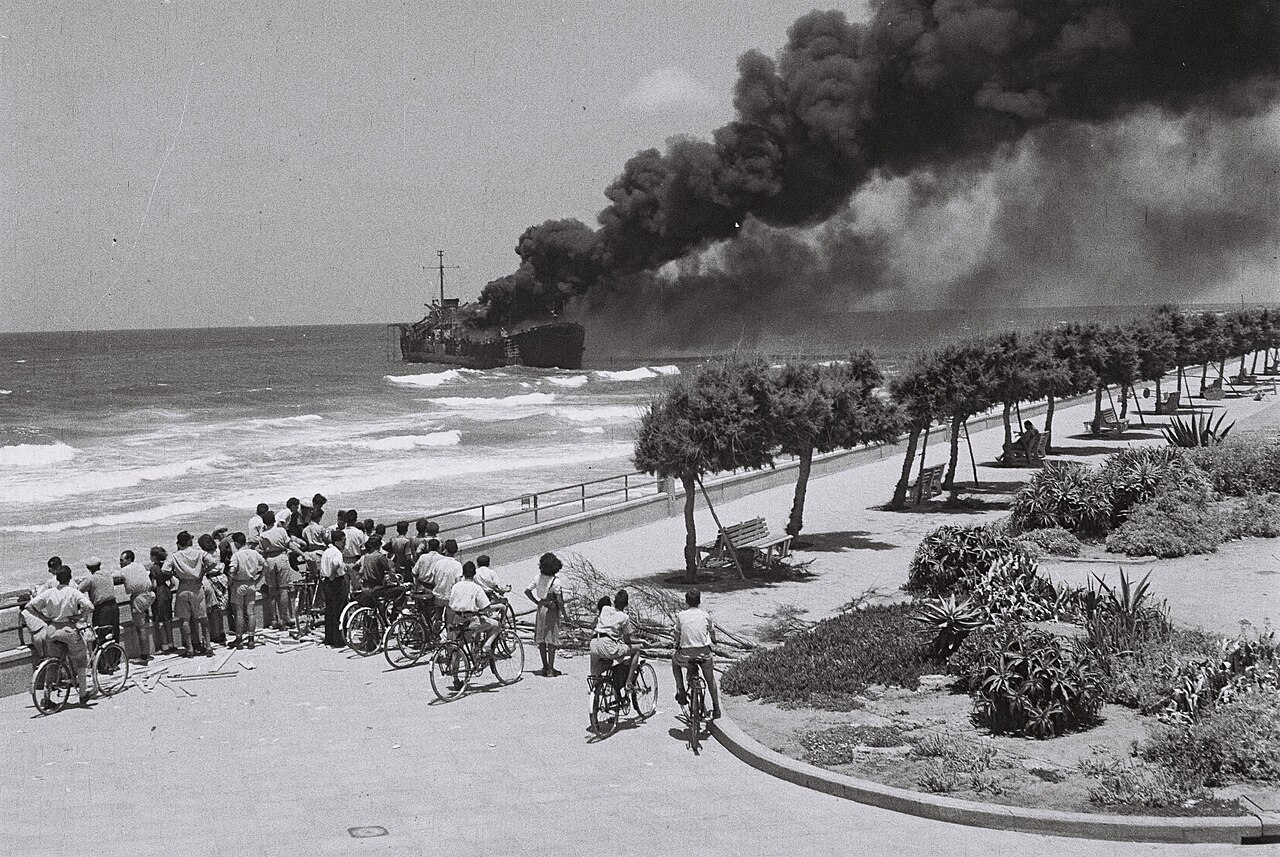
June 1948. The ship [Altalena](https://commons.wikimedia.org/w/index.php?title=Altalena&action=edit&redlink=1 "Altalena (page does not exist)") on fire after being shelled near Tel-Aviv. Altalena was a ship of the right wing zionist organisation “Irgun”, which tried to give weapons to the fighters of Irgun in Israel. The Israeli government refused the existence of weapons furnitures without the control of IDF, and fought against the boat.

#### History

As the [British Mandate for Palestine](https://en.wikipedia.org/wiki/Mandate_for_Palestine "Mandate for Palestine") was coming to an end, and following the United Nations General Assembly vote recommending the [Partition Plan for Mandatory Palestine](https://en.wikipedia.org/wiki/United_Nations_Partition_Plan_for_Palestine "United Nations Partition Plan for Palestine"), which took place on 29 November 1947, Jewish leaders [proclaimed the establishment](https://en.wikipedia.org/wiki/Declaration_of_Independence_(Israel) "Declaration of Independence (Israel)") of the [State of Israel](https://en.wikipedia.org/wiki/Israel "Israel") on May 14, 1948. The declaration of independence was followed by the establishment of a [provisional government](https://en.wikipedia.org/wiki/Provisional_government_of_Israel "Provisional government of Israel") and the [Israel Defense Forces](https://en.wikipedia.org/wiki/Israel_Defense_Forces "Israel Defense Forces") (IDF). The process of absorbing all military organizations into the IDF proved complicated, and several paramilitary groups continued to be active outside the IDF. One of the largest groups, the [Irgun](https://en.wikipedia.org/wiki/Irgun "Irgun"), planned to ship weapons and fighters to the newly formed state. The plans included a ship renamed *Altalena* (a *nom de plume* of Zionist leader [Ze'ev Jabotinsky](https://en.wikipedia.org/wiki/Ze'ev_Jabotinsky "Ze'ev Jabotinsky")) and a target date for the ship's arrival from Europe was set to mid-May 1948. The *Altalena*, former [landing ship tank](https://en.wikipedia.org/wiki/Landing_ship_tank "Landing ship tank") USS *LST-138*,[<sup><span class="editor-theme-superscript">\[3\]</span></sup>](https://en.wikipedia.org/wiki/Altalena_affair#cite_note-LST138-3) organized by [Hillel Kook](https://en.wikipedia.org/wiki/Hillel_Kook "Hillel Kook") (a.k.a., Peter Bergson) purchased by Irgun members Gershon Hakim, [Abraham Stavsky](https://en.wikipedia.org/wiki/Abraham_Stavsky "Abraham Stavsky"), and Victor Ben-Nachum, was originally intended to reach Israel on 15 May 1948, loaded with fighters and military equipment.

Weapons valued at 153 million francs were donated by the [French](https://en.wikipedia.org/wiki/France "France") government, in accordance with a secret agreement approved by French Foreign Minister [Georges Bidault](https://en.wikipedia.org/wiki/Georges_Bidault "Georges Bidault").[<sup><span class="editor-theme-superscript">\[4\]</span></sup>](https://en.wikipedia.org/wiki/Altalena_affair#cite_note-:0-4)[<sup><span class="editor-theme-superscript">\[5\]</span></sup>](https://en.wikipedia.org/wiki/Altalena_affair#cite_note-Zamir-5) The exact text of the agreement has not been found, and the French motivation is unclear.[<sup><span class="editor-theme-superscript">\[4\]</span></sup>](https://en.wikipedia.org/wiki/Altalena_affair#cite_note-:0-4)[<sup><span class="editor-theme-superscript">\[5\]</span></sup>](https://en.wikipedia.org/wiki/Altalena_affair#cite_note-Zamir-5) However, it is known that Bidault was very concerned about the possibility of a Jordanian takeover of Jerusalem.[<sup><span class="editor-theme-superscript">\[4\]</span></sup>](https://en.wikipedia.org/wiki/Altalena_affair#cite_note-:0-4)[<sup><span class="editor-theme-superscript">\[5\]</span></sup>](https://en.wikipedia.org/wiki/Altalena_affair#cite_note-Zamir-5) Deputy Chief of Staff General Henri Coudraux, who was involved in the operation, told a 1949 inquiry that France had "reached a secret agreement with the Irgun, which promised it advantages if it were to come into power \[in Israel\]." He described the Irgun's representative in the negotiations, Shmuel Ariel, as "a terrorist who did not represent a legitimate organization and acted to take power by force."[<sup><span class="editor-theme-superscript">\[4\]</span></sup>](https://en.wikipedia.org/wiki/Altalena_affair#cite_note-:0-4)[<sup><span class="editor-theme-superscript">\[5\]</span></sup>](https://en.wikipedia.org/wiki/Altalena_affair#cite_note-Zamir-5)

According to [Begin](https://en.wikipedia.org/wiki/Menachem_Begin "Menachem Begin") biographer [Daniel Gordis](https://en.wikipedia.org/wiki/Daniel_Gordis "Daniel Gordis"), organizational matters took longer than expected, and the sailing was postponed for several weeks. Meanwhile, on 1 June, an agreement had been signed for the absorption of the Irgun into the IDF and one of the clauses stated that the Irgun had to cease all independent arms acquisition activities. Consequently, the Irgun informed the Israeli government about the *Altalena*.[<sup><span class="editor-theme-superscript">\[6\]</span></sup>](https://en.wikipedia.org/wiki/Altalena_affair#cite_note-gordis-6)

The Irgun headquarters in Paris did their best to keep the *Altalena*'s preparations for departure a secret, but it was difficult to conceal the movement of 940 men and the loading of a large quantity of arms and ammunition. It was feared that if the plans were discovered, attempts might be made to sabotage the *Altalena* at sea.

For this reason, when it raised anchor on 11 June, no cable was sent to the Irgun command in Israel, for fear that it would fall into the wrong hands. These precautionary measures proved fruitless, however, and the following day [the BBC](https://en.wikipedia.org/wiki/BBC_World_Service "BBC World Service") reported that the *Altalena* had sailed from [Port-de-Bouc](https://en.wikipedia.org/wiki/Port-de-Bouc "Port-de-Bouc"), [France](https://en.wikipedia.org/wiki/France "France"), in the direction of Israel with 940 Jewish volunteers and a large quantity of weapons on board.

The [first truce](https://en.wikipedia.org/wiki/1948_Arab%E2%80%93Israeli_War#First_truce:_11_June_%E2%80%93_8_July_1948 "1948 Arab–Israeli War") in the [1948 Arab–Israeli War](https://en.wikipedia.org/wiki/1948_Arab%E2%80%93Israeli_War "1948 Arab–Israeli War") had also begun on 11 June and when the Irgun leaders in Israel learned through the BBC broadcast of the embarkation of the vessel, they feared that this breach of the truce conditions (i.e., the ban on bringing military equipment and fighters into the country[<sup><span class="editor-theme-superscript">\[7\]</span></sup>](https://en.wikipedia.org/wiki/Altalena_affair#cite_note-UN_S1025-7)) would be discovered (though ultimately, these aspects of the truce were ignored by both sides). [Menachem Begin](https://en.wikipedia.org/wiki/Menachem_Begin "Menachem Begin") decided therefore to postpone the arrival of the ship, and Irgun staff secretary Zippora Levi-Kessel sent a wireless message to the *Altalena* to stay put and await orders. A similar cable was sent to [Shmuel Katz](https://en.wikipedia.org/wiki/Shmuel_Katz_(politician) "Shmuel Katz (politician)") (member of the General Headquarters), who was then in Paris, but the ship had already departed the day before the message arrived.

On 15 June, Begin and his comrades held a meeting with government representatives, at which Begin announced that the ship had sailed without his knowledge and that he wanted to hold consultations on how to proceed. In his diary for 16 June, [David Ben-Gurion](https://en.wikipedia.org/wiki/David_Ben-Gurion "David Ben-Gurion"), the head of the provisional government, wrote:

> [Yisrael \[Galili\]](https://en.wikipedia.org/wiki/Yisrael_Galili "Yisrael Galili") and [Skolnik \[Levi Eshkol\]](https://en.wikipedia.org/wiki/Levi_Eshkol "Levi Eshkol") met yesterday with Begin. Tomorrow or the next day their ship is due to arrive: 4,500 tons, bringing 800–900 men, 5,000 [rifles](https://en.wikipedia.org/wiki/Rifle "Rifle"), 250 [Bren guns](https://en.wikipedia.org/wiki/Bren_light_machine_gun "Bren light machine gun"), 5 million bullets, 50 [bazookas](https://en.wikipedia.org/wiki/Bazooka "Bazooka"), 10 [Bren carriers](https://en.wikipedia.org/wiki/Universal_Carrier "Universal Carrier"). Zipstein (director of [Tel Aviv](https://en.wikipedia.org/wiki/Tel_Aviv "Tel Aviv") port) assumes that at night it will be possible to unload it all. I believe we should not endanger Tel Aviv port. They should not be sent back. They should be disembarked at an unknown shore.

Galili informed Begin of Ben-Gurion's consent to the landing of the ship, adding a request that it be done as quickly as possible. Zippora Levi-Kessel then radioed the vessel to come in at full speed. The following day, a working meeting was held between Irgun representatives and Defense Ministry personnel. While the Irgun proposed directing the *Altalena* to [Tel Aviv](https://en.wikipedia.org/wiki/Tel_Aviv "Tel Aviv") beach, [Defense Ministry](https://en.wikipedia.org/wiki/Ministry_of_Defense_(Israel) "Ministry of Defense (Israel)") representatives claimed that [Kfar Vitkin](https://en.wikipedia.org/wiki/Kfar_Vitkin "Kfar Vitkin") beach was preferable, as it would be easier to evade UN observers there. The ship was therefore instructed to make for Kfar Vitkin.

## Confrontation with the IDF

Intense negotiations between representatives of the [provisional government](https://en.wikipedia.org/wiki/Provisional_government_of_Israel "Provisional government of Israel") (headed by Ben-Gurion) and the Irgun (headed by Begin) followed the departure of the *Altalena* from France. Among the issues discussed were logistics of its landing and distribution of the cargo. Whilst there was agreement on the anchoring place of the *Altalena*, there were differences of opinion about the cargo.[<sup><span class="editor-theme-superscript">\[8\]</span></sup>](https://en.wikipedia.org/wiki/Altalena_affair#cite_note-8) Ben-Gurion agreed to Begin's initial request that 20 percent of the weapons be dispatched to the Irgun's [Jerusalem](https://en.wikipedia.org/wiki/Jerusalem "Jerusalem") Battalion, which was still fighting independently. His second request that the remainder be transferred to the IDF to equip the newly incorporated Irgun battalions was rejected by the government representatives,[<sup><span class="editor-theme-superscript">\[9\]</span></sup>](https://en.wikipedia.org/wiki/Altalena_affair#cite_note-9) who interpreted the request as a demand to reinforce an "army within an army".

The *Altalena* reached Kfar Vitkin in the late afternoon of Sunday, 20 June, greeted by Menachem Begin and a group of Irgun members on shore. Irgun sympathizers from the nearby town of [Netanya](https://en.wikipedia.org/wiki/Netanya "Netanya") and residents of the fishing village of [Mikhmoret](https://en.wikipedia.org/wiki/Mikhmoret "Mikhmoret") gathered on the beach to help unload the cargo. After the ship dropped anchor, 940 passengers disembarked and were taken to an army camp for induction into the IDF.[<sup><span class="editor-theme-superscript">\[10\]</span></sup>](https://en.wikipedia.org/wiki/Altalena_affair#cite_note-10) Arms were unloaded throughout the night. In all, 2,000 rifles, two million rounds of ammunition, 3,000 shells, and 200 Bren guns were unloaded at Kfar Vitkin. Concomitantly with the events at Kfar Vitkin, the government had convened in Tel Aviv for its weekly meeting. Ben-Gurion reported on the meetings which had preceded the arrival of the *Altalena* and was adamant that Begin hand over the weapons:

> We must decide whether to hand over power to Begin or to order him to cease his separate activities. If he does not do so, we will open fire! Otherwise, we must decide to disperse our own army.

[![](https://upload.wikimedia.org/wikipedia/commons/thumb/f/fe/Kfar_Vitkin_1949.jpg/250px-Kfar_Vitkin_1949.jpg?utm_source=en.wikipedia.org&utm_campaign=parser&utm_content=thumbnail)](https://en.wikipedia.org/wiki/File:Kfar_Vitkin_1949.jpg)

Kfar Vitkin 1949 1:20,000, jetty where *Altalena* unloaded marked

The debate ended in a resolution to empower the army to use force if necessary. Implementation was assigned to the Alexandroni Brigade commanded by [Dan Even](https://en.wikipedia.org/wiki/Dan_Even?action=edit&redlink=1 "Dan Even (page does not exist)") \[[he](https://he.wikipedia.org/wiki/%D7%93%D7%9F%20%D7%90%D7%91%D7%9F "he:דן אבן")\] (Epstein), which the following day surrounded the Kfar Vitkin area in two regiments equipped with armor and artillery. In addition, the [Israeli Navy](https://en.wikipedia.org/wiki/Israeli_Navy "Israeli Navy") deployed three [corvettes](https://en.wikipedia.org/wiki/Corvette "Corvette") off Kfar Vitkin. Even issued the following ultimatum:

> To: M. Begin  
> By special order from the Chief of the General Staff of the Israel Defense Forces, I am empowered to confiscate the weapons and military materials which have arrived on the Israeli coast in the area of my jurisdiction in the name of the Israel Government. I have been authorized to demand that you hand over the weapons to me for safekeeping and to inform you that you should establish contact with the supreme command. You are required to carry out this order immediately. If you do not agree to carry out this order, I shall use all the means at my disposal in order to implement the order and to requisition the weapons which have reached shore and transfer them from private possession into the possession of the Israel government. I wish to inform you that the entire area is surrounded by fully armed military units and armored cars, and all roads are blocked. I hold you fully responsible for any consequences in the event of your refusal to carry out this order. The immigrants—unarmed—will be permitted to travel to the camps in accordance with your arrangements. You have ten minutes to give me your answer.  
> D.E., Brigade Commander

The ultimatum was made, according to Even, "in order not to give the Irgun commander time for lengthy considerations and to gain the advantage of surprise." Begin did not respond. Claiming he needed more time, he drove to Netanya to consult directly with government leaders. A standoff between the IDF and Irgun members at the beach ensued as a [UN](https://en.wikipedia.org/wiki/United_Nations "United Nations") observation plane circled overhead and recorded the incident. Failing to reach an accord, Begin returned to the beach and conferred with his officers. As evening began, rifle fire broke out; which side fired first is a matter of dispute. [Hillel Kook](https://en.wikipedia.org/wiki/Hillel_Kook "Hillel Kook"), an eyewitness, claimed it was the Irgun, which fired shots toward the sea to demonstrate their will to resist. As the fighting began, Begin fled to the *Altalena* in a rowboat, under fire from the corvettes offshore, and Captain Fein maneuvered the *Altalena* to shield Begin, enabling him to board safely. On shore, the Irgun fighters were compelled to surrender. The IDF suffered two dead and six wounded, while the Irgun suffered six dead and eighteen wounded.[<sup><span class="editor-theme-superscript">\[6\]</span></sup>](https://en.wikipedia.org/wiki/Altalena_affair#cite_note-gordis-6) In order to prevent further bloodshed, the residents of Kfar Vitkin initiated negotiations between [Yaakov Meridor](https://en.wikipedia.org/wiki/Yaakov_Meridor "Yaakov Meridor") (Begin's deputy) and Dan Even which ended in a general ceasefire and the transfer of the weapons on shore to the local IDF commander.[<sup><span class="editor-theme-superscript">\[11\]</span></sup>](https://en.wikipedia.org/wiki/Altalena_affair#cite_note-machal-11)[<sup><span class="editor-theme-superscript">\[12\]</span></sup>](https://en.wikipedia.org/wiki/Altalena_affair#cite_note-castlewitz-12)

[![](https://upload.wikimedia.org/wikipedia/commons/thumb/a/aa/Atalena_crew.jpg/250px-Atalena_crew.jpg?utm_source=en.wikipedia.org&utm_campaign=parser&utm_content=thumbnail)](https://en.wikipedia.org/wiki/File:Atalena_crew.jpg)

Some of the crew of the *Altalena*, including Captain Monroe Fein (bottom row center).

[![](https://upload.wikimedia.org/wikipedia/commons/thumb/0/08/1948_Arab-Israeli_War_%28997008136847205171%29.jpg/250px-1948_Arab-Israeli_War_%28997008136847205171%29.jpg?utm_source=en.wikipedia.org&utm_campaign=parser&utm_content=thumbnail)](https://en.wikipedia.org/wiki/File:1948_Arab-Israeli_War_(997008136847205171).jpg)

*Altalena* burning near the shore

[![](https://upload.wikimedia.org/wikipedia/commons/thumb/3/3f/Flickr_-_Government_Press_Office_%28GPO%29_-_Burning_%22Altalena%22.jpg/250px-Flickr_-_Government_Press_Office_%28GPO%29_-_Burning_%22Altalena%22.jpg?utm_source=en.wikipedia.org&utm_campaign=parser&utm_content=thumbnail)](https://en.wikipedia.org/wiki/File:Flickr_-_Government_Press_Office_(GPO)_-_Burning_%22Altalena%22.jpg)

People looking at burning ship

Meanwhile, Begin ordered the *Altalena* to sail to Tel Aviv, where there were more Irgun supporters. At 9:35 p.m., the *Altalena* began cruising toward Tel Aviv. Many Irgun members, who had joined the IDF earlier that month, left their bases and assembled on the beach. Rumors began circulating that the Irgun was planning a military coup.

According to the book *Altalena* by journalist and political analyst [Shlomo Nakdimon](https://en.wikipedia.org/wiki/Shlomo_Nakdimon?action=edit&redlink=1 "Shlomo Nakdimon (page does not exist)") \[[he](https://he.wikipedia.org/wiki/%D7%A9%D7%9C%D7%9E%D7%94%20%D7%A0%D7%A7%D7%93%D7%99%D7%9E%D7%95%D7%9F "he:שלמה נקדימון")\], [Ben-Gurion](https://en.wikipedia.org/wiki/David_Ben-Gurion "David Ben-Gurion") instructed the [Israeli Air Force](https://en.wikipedia.org/wiki/Israeli_Air_Force "Israeli Air Force") to sink the ship on the high seas, long before it approached the shore. This would have resulted in much greater loss of life aboard. [Gordon Levett](https://en.wikipedia.org/wiki/Gordon_Levett "Gordon Levett"), a [Mahal](https://en.wikipedia.org/wiki/Mahal_(Israel) "Mahal (Israel)") volunteer pilot, wrote in his book *Flying Under Two Flags* that Heiman Shamir, deputy commander of the Air Force, tried to convince non-Jewish pilot volunteers to attack the ship. However, three pilots refused to participate in the mission, one of them saying, "You can kiss my foot. I did not lose four friends and fly 10,000 miles in order to bomb Jews."

The *Altalena* was shadowed by navy corvettes on its way to Tel Aviv. As the ship neared the coastline, the corvettes began firing at it with bursts of machine gun fire, and stopped after fighters on board the *Altalena* returned fire with Bren guns mounted on deck. The *Altalena* arrived at midnight, running aground on the busiest stretch of shore, at the foot of David Frischmann Street, in view of locals, journalists, and UN observers watching from the terrace of the Kaete Dan Hotel (today Dan Tel Aviv). In response, Ben-Gurion ordered [Yigael Yadin](https://en.wikipedia.org/wiki/Yigael_Yadin "Yigael Yadin") (acting chief of staff) to concentrate large forces on the Tel Aviv beach and to take the ship by force. He also indicated to his interior minister that he would order the Israeli Navy to intercept any attempt by the *Altalena* to retreat into international waters. The IDF transferred heavy guns to the area and at 4 p.m. the next day, Ben-Gurion ordered the shelling of the *Altalena*. The first gunner ordered to shell the ship, a [Red Army](https://en.wikipedia.org/wiki/Red_Army "Red Army") veteran named Yosef Aksen, refused, saying he was willing to be executed for insubordination and this would be "the best thing he did in his life." At this, his superior, Nathan Plotnik, ordered him to be imprisoned to await a court-martial for insubordination.[<sup><span class="editor-theme-superscript">\[13\]</span></sup>](https://en.wikipedia.org/wiki/Altalena_affair#cite_note-13)

Then Hillel Daleski, a recent immigrant from [South Africa](https://en.wikipedia.org/wiki/South_Africa "South Africa"), initially protested, telling Shmuel Admon, the commander of the IDF Artillery Corps, that "I didn't come to the Land of Israel to fight against Jews." However, his superior yelled at him that it was his duty to obey orders. Threatened with a court-martial if he did not fire, Daleski reluctantly complied. One of the shells hit the ship, and it began to burn.[<sup><span class="editor-theme-superscript">\[11\]</span></sup>](https://en.wikipedia.org/wiki/Altalena_affair#cite_note-machal-11)[<sup><span class="editor-theme-superscript">\[14\]</span></sup>](https://en.wikipedia.org/wiki/Altalena_affair#cite_note-14)

[Yitzhak Rabin](https://en.wikipedia.org/wiki/Yitzhak_Rabin "Yitzhak Rabin") commanded the IDF and Palmach forces on the shore. [Yigal Allon](https://en.wikipedia.org/wiki/Yigal_Allon "Yigal Allon") later claimed that five or six shells were fired as warning shots, and hit the ship by accident.[<sup><span class="editor-theme-superscript">\[6\]</span></sup>](https://en.wikipedia.org/wiki/Altalena_affair#cite_note-gordis-6)[<sup><span class="editor-theme-superscript">\[15\]</span></sup>](https://en.wikipedia.org/wiki/Altalena_affair#cite_note-15) IDF troops on the shore also directed heavy small-arms fire towards the ship, and employed heavy machine guns with armor-piercing rounds. Some soldiers refused to open fire on the *Altalena*, including a [Palmach](https://en.wikipedia.org/wiki/Palmach "Palmach") soldier whose brother, an Irgun officer, was on board.[<sup><span class="editor-theme-superscript">\[16\]</span></sup>](https://en.wikipedia.org/wiki/Altalena_affair#cite_note-16) Menachem Begin, hoping to avert civil war, ordered his men not to shoot back, and the ship raised the white flag. However, the firing continued, and some Irgun members on board reportedly returned fire. The Israeli corvettes also fired at the *Altalena* during the battle, and one crew member later claimed that IDF troops on the beach were hit by fire from one of the corvettes, which had aimed at the *Altalena* but overshot its target.[<sup><span class="editor-theme-superscript">\[17\]</span></sup>](https://en.wikipedia.org/wiki/Altalena_affair#cite_note-17) On the beach, a battle between the IDF and Irgun forces along the shore erupted, and clashes between IDF and Irgun units also took place throughout Tel Aviv, mainly in the south and center.[<sup><span class="editor-theme-superscript">\[18\]</span></sup>](https://en.wikipedia.org/wiki/Altalena_affair#cite_note-18)

Fearing the fire would spread to the holds which contained explosives, Captain Fein ordered all aboard to abandon ship. Passengers jumped into the water, whilst their comrades on shore set out to meet them on rafts. Begin biographer [Daniel Gordis](https://en.wikipedia.org/wiki/Daniel_Gordis "Daniel Gordis")[<sup><span class="editor-theme-superscript">\[19\]</span></sup>](https://en.wikipedia.org/wiki/Altalena_affair#cite_note-Thrope-19) writes that although Captain Fein flew the white flag of surrender, automatic fire continued to be directed at the unarmed survivors swimming in the water.[<sup><span class="editor-theme-superscript">\[6\]</span></sup>](https://en.wikipedia.org/wiki/Altalena_affair#cite_note-gordis-6) Begin, who was on deck, agreed to leave the ship only after the last of the wounded had been evacuated. Although civil war appeared imminent, a cease-fire was arranged by the evening of 22 June. Mass arrests were carried out against Irgun soldiers who had joined their former comrades, and Irgun units in the IDF were disbanded, with their soldiers dispersed among other units. In all, more than 200 Irgun members were arrested. Most were released several weeks later, with the exception of five senior commanders (Moshe Hason, [Eliyahu Lankin](https://en.wikipedia.org/wiki/Eliyahu_Lankin "Eliyahu Lankin"), [Yaakov Meridor](https://en.wikipedia.org/wiki/Yaakov_Meridor "Yaakov Meridor"), [Bezalel Amitzur](https://en.wikipedia.org/wiki/Bezalel_Amitzur?action=edit&redlink=1 "Bezalel Amitzur (page does not exist)"), and [Hillel Kook](https://en.wikipedia.org/wiki/Hillel_Kook "Hillel Kook")), who were detained for more than two months, until 27 August 1948. Eight IDF soldiers who refused to fire on the *Altalena* were court-martialed for insubordination.

Meanwhile, Begin reached his clandestine radio station and ordered his men not to fight back. He called for them to assemble in Jerusalem and continue the battle for the [Old City](https://en.wikipedia.org/wiki/Old_City_(Jerusalem) "Old City (Jerusalem)").[<sup><span class="editor-theme-superscript">\[12\]</span></sup>](https://en.wikipedia.org/wiki/Altalena_affair#cite_note-castlewitz-12)

Sixteen Irgun fighters were killed in the confrontation with the army (all but three were veteran members and not newcomers from the ship); six were killed in the [Kfar Vitkin](https://en.wikipedia.org/wiki/Kfar_Vitkin "Kfar Vitkin") area and ten on [Tel Aviv](https://en.wikipedia.org/wiki/Tel_Aviv "Tel Aviv") beach. Three IDF soldiers were killed: two at Kfar Vitkin and one in Tel Aviv.[<sup><span class="editor-theme-superscript">\[20\]</span></sup>](https://en.wikipedia.org/wiki/Altalena_affair#cite_note-20)[<sup><span class="editor-theme-superscript">\[21\]</span></sup>](https://en.wikipedia.org/wiki/Altalena_affair#cite_note-21)[<sup><span class="editor-theme-superscript">\[22\]</span></sup>](https://en.wikipedia.org/wiki/Altalena_affair#cite_note-22)

## Aftermath

[![](https://upload.wikimedia.org/wikipedia/commons/thumb/9/99/Publiek_op_het_strand_bij_de_strandboulevard_van_Tel_Aviv_met_strandstoelen_en_e%2C_Bestanddeelnr_255-1366.jpg/250px-Publiek_op_het_strand_bij_de_strandboulevard_van_Tel_Aviv_met_strandstoelen_en_e%2C_Bestanddeelnr_255-1366.jpg?utm_source=en.wikipedia.org&utm_campaign=parser&utm_content=thumbnail)](https://en.wikipedia.org/wiki/File:Publiek_op_het_strand_bij_de_strandboulevard_van_Tel_Aviv_met_strandstoelen_en_e,_Bestanddeelnr_255-1366.jpg)

Burned *Altalena* near the beach, 1948

[![](https://upload.wikimedia.org/wikipedia/commons/thumb/7/74/Strand_bij_de_strandboulevard_van_Tel_Aviv_met_een_dame_in_badkostuum_tijdens_he%2C_Bestanddeelnr_255-1374.jpg/250px-Strand_bij_de_strandboulevard_van_Tel_Aviv_met_een_dame_in_badkostuum_tijdens_he%2C_Bestanddeelnr_255-1374.jpg?utm_source=en.wikipedia.org&utm_campaign=parser&utm_content=thumbnail)](https://en.wikipedia.org/wiki/File:Strand_bij_de_strandboulevard_van_Tel_Aviv_met_een_dame_in_badkostuum_tijdens_he,_Bestanddeelnr_255-1374.jpg)

People on the beach, burned *Altalena* in the background, 1948

About a year after the incident, the *Altalena* was refloated, towed 15 miles out to sea, and sunk.[<sup><span class="editor-theme-superscript">\[23\]</span></sup>](https://en.wikipedia.org/wiki/Altalena_affair#cite_note-Altalena_PalYam-23)

The *Altalena* Affair exposed deep rifts between the main political factions in Israel, and is still occasionally referenced in Israeli media to illustrate the current debate as to whether or not the use of force by the Israeli government against fringe Jewish political elements is legitimate. Proponents of Ben-Gurion's actions praised them as essential to establishing the government's authority and discouraging factionalism and formation of rival armies. This was consistent with other actions he took, such as dissolving the [Palmach](https://en.wikipedia.org/wiki/Palmach "Palmach") later that year. Furthermore, Ben-Gurion's supporters have argued that a state must have a monopoly over the use of force. The Irgun, by attempting to import weapons to use as a private [militia](https://en.wikipedia.org/wiki/Militia "Militia"), was undermining the legitimacy of the fledgling State of Israel.

Opponents condemned what they saw as unnecessary violence. The debate was reignited for a short time when [Likud](https://en.wikipedia.org/wiki/Likud "Likud") headed by Menachem Begin won the [1977 elections](https://en.wikipedia.org/wiki/1977_Israeli_legislative_election "1977 Israeli legislative election").

Begin later said, "My greatest accomplishment was not retaliating and causing [civil war](https://en.wikipedia.org/wiki/Civil_war "Civil war")." Years later, on the eve of the [Six-Day War](https://en.wikipedia.org/wiki/Six-Day_War "Six-Day War"), in June 1967 (when [Levi Eshkol](https://en.wikipedia.org/wiki/Levi_Eshkol "Levi Eshkol") was [prime minister](https://en.wikipedia.org/wiki/Prime_Minister_of_Israel "Prime Minister of Israel")), Menachem Begin joined a delegation which visited [Sde Boker](https://en.wikipedia.org/wiki/Sde_Boker "Sde Boker") to ask David Ben-Gurion to return and accept the premiership again. After that meeting, Ben-Gurion said that if he had then known Begin as he did now, the face of history would have been different.

In 2012, the wreckage of the *Altalena* was discovered by marine experts hired by the [Menachem Begin Heritage Center](https://en.wikipedia.org/wiki/Menachem_Begin_Heritage_Center "Menachem Begin Heritage Center") in a search effort that the Israeli government helped to fund. The search was initially based on Israeli Navy's coordinates on the location where it was sunk, but after failing to turn up results, the search area was expanded. The *Altalena* was eventually found sitting on the seabed several kilometers off the coast of [Rishon LeZion](https://en.wikipedia.org/wiki/Rishon_LeZion "Rishon LeZion") at a depth of about 300 metres (1,000 ft). A sonar survey confirmed the ship's identity. The Israeli government subsequently announced plans to raise the wreck and install it on dry land as a monument.[<sup><span class="editor-theme-superscript">\[24\]</span></sup>](https://en.wikipedia.org/wiki/Altalena_affair#cite_note-24)[<sup><span class="editor-theme-superscript">\[25\]</span></sup>](https://en.wikipedia.org/wiki/Altalena_affair#cite_note-25)

## Legacy

[![](https://upload.wikimedia.org/wikipedia/commons/thumb/9/99/PikiWiki_Israel_32281_Altalena_memorial_at_Tel_Aviv_beach.jpg/250px-PikiWiki_Israel_32281_Altalena_memorial_at_Tel_Aviv_beach.jpg?utm_source=en.wikipedia.org&utm_campaign=parser&utm_content=thumbnail)](https://en.wikipedia.org/wiki/File:PikiWiki_Israel_32281_Altalena_memorial_at_Tel_Aviv_beach.jpg)

*Altalena* memorial on Tel-Aviv Beach

The first memorial to the sixteen Irgun fighters and three IDF soldiers killed in the *Altalena* sinking was erected in the [Nahalat Yitzhak Cemetery](https://en.wikipedia.org/wiki/Nahalat_Yitzhak_Cemetery "Nahalat Yitzhak Cemetery") in [Givatayim](https://en.wikipedia.org/wiki/Giv'atayim "Giv'atayim") in 1998.[<sup><span class="editor-theme-superscript">\[26\]</span></sup>](https://en.wikipedia.org/wiki/Altalena_affair#cite_note-26) The official government memorial ceremony for the victims is held annually on the cemetery grounds.[<sup><span class="editor-theme-superscript">\[27\]</span></sup>](https://en.wikipedia.org/wiki/Altalena_affair#cite_note-27) The ceremony is primarily attended by relatives of the victims and political personalities identified with Israel's national camp.

In 2011, invitations circulated by Israel's Ministry of Defense used the word *murdered* in reference to the fighters who lost their lives in the incident, implying that Ben-Gurion, Rabin, and the IDF had committed murder.[<sup><span class="editor-theme-superscript">\[1\]</span></sup>](https://en.wikipedia.org/wiki/Altalena_affair#cite_note-murdered-1) Defense Minister [Ehud Barak](https://en.wikipedia.org/wiki/Ehud_Barak "Ehud Barak") subsequently demanded that the "severe mishap" be investigated and corrected. Speaker of the Knesset at the time and subsequently president of Israel [Reuven Rivlin](https://en.wikipedia.org/wiki/Reuven_Rivlin "Reuven Rivlin") said at the ceremony that the *Altalena* Affair was an unatonable crime.[<sup><span class="editor-theme-superscript">\[28\]</span></sup>](https://en.wikipedia.org/wiki/Altalena_affair#cite_note-28)

Every year, a cruise led by the [Hazon Leumi](https://en.wikipedia.org/wiki/Hazon_Leumi "Hazon Leumi") organization leaves from the port of Jaffa to the place where the ship sank, where a memorial ceremony is held in memory of those who died on the ship.[<sup><span class="editor-theme-superscript">\[29\]</span></sup>](https://en.wikipedia.org/wiki/Altalena_affair#cite_note-29)

\[1\] [https://en.wikipedia.org/wiki/Altalena\_affair](https://en.wikipedia.org/wiki/Altalena_affair)

# Menachem Begin

**Menachem Begin**[<sup><span class="editor-theme-superscript">\[a\]</span></sup>](https://en.wikipedia.org/wiki/Menachem_Begin#cite_note-3) (16 August 1913 – 9 March 1992) was an Israeli politician who founded the political parties [Herut](https://en.wikipedia.org/wiki/Herut "Herut") and [Likud](https://en.wikipedia.org/wiki/Likud "Likud") and served as [prime minister of Israel](https://en.wikipedia.org/wiki/Prime_Minister_of_Israel "Prime Minister of Israel") from 1977 to 1983.

Before the creation of the [state of Israel](https://en.wikipedia.org/wiki/State_of_Israel "State of Israel"), Begin was the leader of the Zionist militant group [Irgun](https://en.wikipedia.org/wiki/Irgun "Irgun"), the [Revisionist](https://en.wikipedia.org/wiki/Revisionist_Zionism "Revisionist Zionism") breakaway from the larger Jewish paramilitary organization [Haganah](https://en.wikipedia.org/wiki/Haganah "Haganah"). He proclaimed a [revolt](https://en.wikipedia.org/wiki/Irgun#Revolt "Irgun"), on 1 February 1944, against the [British mandatory government](https://en.wikipedia.org/wiki/Mandatory_Palestine "Mandatory Palestine"), which was opposed by the [Jewish Agency](https://en.wikipedia.org/wiki/Jewish_Agency_for_Palestine#Jewish_Agency_for_Palestine "Jewish Agency for Palestine"). As head of the Irgun, he [targeted the British in Palestine](https://en.wikipedia.org/wiki/Jewish_insurgency_in_Mandatory_Palestine "Jewish insurgency in Mandatory Palestine"),[<sup><span class="editor-theme-superscript">\[3\]</span></sup>](https://en.wikipedia.org/wiki/Menachem_Begin#cite_note-4) with a notable attack being the [King David Hotel bombing](https://en.wikipedia.org/wiki/King_David_Hotel_bombing "King David Hotel bombing"). Later, the Irgun fought the Arabs during the [1947–48 civil war in Mandatory Palestine](https://en.wikipedia.org/wiki/1947%E2%80%9348_civil_war_in_Mandatory_Palestine "1947–48 civil war in Mandatory Palestine") and, as its chief, Begin was described by the British government as the "leader of the notorious [terrorist](https://en.wikipedia.org/wiki/Terrorist "Terrorist") organisation". It declined him an entry visa to the [United Kingdom](https://en.wikipedia.org/wiki/United_Kingdom "United Kingdom") between 1953 and 1955. However, Begin's overtures of friendship eventually paid off and he was granted a visa in 1972, five years prior to becoming prime minister.[<sup><span class="editor-theme-superscript">\[4\]</span></sup>](https://en.wikipedia.org/wiki/Menachem_Begin#cite_note-haaretz7jul11-5)

Begin was elected to the first [Knesset](https://en.wikipedia.org/wiki/Knesset "Knesset"), as head of [Herut](https://en.wikipedia.org/wiki/Herut "Herut"), the party he founded, and was at first on the political fringe, embodying the opposition to the [Mapai](https://en.wikipedia.org/wiki/Mapai "Mapai")-led government and Israeli establishment. He remained in opposition in the eight consecutive elections (except for a national unity government around the [Six-Day War](https://en.wikipedia.org/wiki/Six-Day_War "Six-Day War")), but became more acceptable to the political center. His 1977 [electoral victory](https://en.wikipedia.org/wiki/1977_Israeli_legislative_election "1977 Israeli legislative election") and premiership ended three decades of [Labor Party](https://en.wikipedia.org/wiki/Israeli_Labor_Party "Israeli Labor Party") political dominance.

Begin's most significant achievement as prime minister was the signing of a [peace treaty with Egypt](https://en.wikipedia.org/wiki/Egypt%E2%80%93Israel_peace_treaty "Egypt–Israel peace treaty") in 1979, for which he and [Anwar Sadat](https://en.wikipedia.org/wiki/Anwar_Sadat "Anwar Sadat") shared the [Nobel Peace Prize](https://en.wikipedia.org/wiki/Nobel_Peace_Prize "Nobel Peace Prize"). In the wake of the [Camp David Accords](https://en.wikipedia.org/wiki/Camp_David_Accords "Camp David Accords"), the [Israel Defense Forces](https://en.wikipedia.org/wiki/Israel_Defense_Forces "Israel Defense Forces") (IDF) withdrew from the [Sinai Peninsula](https://en.wikipedia.org/wiki/Sinai_Peninsula "Sinai Peninsula"), which had been captured from Egypt in the Six-Day War. Later, Begin's government promoted the construction of Israeli settlements in the West Bank and the Gaza Strip. Begin authorized the [bombing of the Osirak nuclear plant](https://en.wikipedia.org/wiki/Operation_Opera "Operation Opera") in Iraq and the invasion of Lebanon in 1982 to fight [Palestine Liberation Organization](https://en.wikipedia.org/wiki/Palestine_Liberation_Organization "Palestine Liberation Organization") strongholds there, igniting the [1982 Lebanon War](https://en.wikipedia.org/wiki/1982_Lebanon_War "1982 Lebanon War"). As Israeli military involvement in Lebanon deepened, and the [Sabra and Shatila massacre](https://en.wikipedia.org/wiki/Sabra_and_Shatila_massacre "Sabra and Shatila massacre"), carried out by Christian [Phalangist](https://en.wikipedia.org/wiki/Phalangist "Phalangist") militia allies of the Israelis, shocked world public opinion,[<sup><span class="editor-theme-superscript">\[5\]</span></sup>](https://en.wikipedia.org/wiki/Menachem_Begin#cite_note-6) Begin grew increasingly isolated.[<sup><span class="editor-theme-superscript">\[6\]</span></sup>](https://en.wikipedia.org/wiki/Menachem_Begin#cite_note-7) As IDF forces remained mired in Lebanon and the economy suffered from [hyperinflation](https://en.wikipedia.org/wiki/Hyperinflation "Hyperinflation"), the public pressure on Begin mounted. [Depressed](https://en.wikipedia.org/wiki/Depression_(mood) "Depression (mood)") by the death of his wife [Aliza](https://en.wikipedia.org/wiki/Aliza_Begin "Aliza Begin") in November 1982, he gradually withdrew from public life, until his resignation in October 1983.

Menachem Begin was born to Zeev Dov and Hassia Begun in Brest-Litovsk, [Russian Empire](https://en.wikipedia.org/wiki/Russian_Empire "Russian Empire") (now [Brest, Belarus](https://en.wikipedia.org/wiki/Brest,_Belarus "Brest, Belarus")). He was the youngest of three children.[<sup><span class="editor-theme-superscript">\[7\]</span></sup>](https://en.wikipedia.org/wiki/Menachem_Begin#cite_note-8) On his mother's side he was descended from distinguished rabbis. His father, a timber merchant, was a community leader, a passionate [Zionist](https://en.wikipedia.org/wiki/Zionism "Zionism"), and an admirer of [Theodor Herzl](https://en.wikipedia.org/wiki/Theodor_Herzl "Theodor Herzl"). The midwife who attended his birth was the grandmother of [Ariel Sharon](https://en.wikipedia.org/wiki/Ariel_Sharon "Ariel Sharon").[<sup><span class="editor-theme-superscript">\[8\]</span></sup>](https://en.wikipedia.org/wiki/Menachem_Begin#cite_note-autogenerated1-9)

After a year of a traditional [cheder](https://en.wikipedia.org/wiki/Cheder "Cheder") education Begin started studying at a "Tachkemoni" school, associated with the religious Zionist movement. In his childhood, Begin, like most Jewish children in his town, was a member of the Zionist scouts movement [Hashomer Hatzair](https://en.wikipedia.org/wiki/Hashomer_Hatzair "Hashomer Hatzair"). He was a member of Hashomer Hatzair until the age of 13, and at 16, he joined [Betar](https://en.wikipedia.org/wiki/Betar_(youth_movement) "Betar (youth movement)").[<sup><span class="editor-theme-superscript">\[9\]</span></sup>](https://en.wikipedia.org/wiki/Menachem_Begin#cite_note-10) At 14, he was sent to a Polish government school,[<sup><span class="editor-theme-superscript">\[10\]</span></sup>](https://en.wikipedia.org/wiki/Menachem_Begin#cite_note-11) where he received a solid grounding in [classical literature](https://en.wikipedia.org/wiki/Classical_literature "Classical literature").

Begin studied law at the [University of Warsaw](https://en.wikipedia.org/wiki/University_of_Warsaw "University of Warsaw"), where he learned the [oratory](https://en.wikipedia.org/wiki/Eloquence "Eloquence") and [rhetoric](https://en.wikipedia.org/wiki/Rhetoric "Rhetoric") skills that became his trademark as a politician, and viewed as [demagogy](https://en.wikipedia.org/wiki/Demagogy "Demagogy") by his critics.[<sup><span class="editor-theme-superscript">\[11\]</span></sup>](https://en.wikipedia.org/wiki/Menachem_Begin#cite_note-12)

[![](https://thumb.wikimedia.org/wikipedia/commons/thumb/2/2b/BeginBeitar1935.jpg/250px-BeginBeitar1935.jpg?utm_source=en.wikipedia.org&utm_campaign=parser&utm_content=thumbnail)](https://en.wikipedia.org/wiki/File:BeginBeitar1935.jpg)

Begin reviews a [Betar](https://en.wikipedia.org/wiki/Betar "Betar") lineup in 1939.

During his studies, he organized a self-defense group of Jewish students to counter harassment by anti-Semites on campus.[<sup><span class="editor-theme-superscript">\[12\]</span></sup>](https://en.wikipedia.org/wiki/Menachem_Begin#cite_note-13) He graduated in 1935, but never practiced law. At this time he became a disciple of [Vladimir "Ze'ev" Jabotinsky](https://en.wikipedia.org/wiki/Ze'ev_Jabotinsky "Ze'ev Jabotinsky"), the founder of the nationalist [Revisionist Zionism](https://en.wikipedia.org/wiki/Revisionist_Zionism "Revisionist Zionism") movement and its youth wing, [Betar](https://en.wikipedia.org/wiki/Betar "Betar").[<sup><span class="editor-theme-superscript">\[13\]</span></sup>](https://en.wikipedia.org/wiki/Menachem_Begin#cite_note-14) His rise within Betar was rapid: at 22, he shared the dais with his mentor at the Betar World Congress in [Kraków](https://en.wikipedia.org/wiki/Krak%C3%B3w "Kraków").[<sup><span class="editor-theme-superscript">\[14\]</span></sup>](https://en.wikipedia.org/wiki/Menachem_Begin#cite_note-15) The pre-war Polish government actively supported Zionist youth and paramilitary movements. In 1937[<sup><span class="editor-theme-superscript">\[15\]</span></sup>](https://en.wikipedia.org/wiki/Menachem_Begin#cite_note-16) he was the active head of Betar in [Czechoslovakia](https://en.wikipedia.org/wiki/Czechoslovakia "Czechoslovakia") and became head of the largest branch, that of Poland. As head of Betar's Polish branch, Begin traveled among regional branches to encourage supporters and recruit new members. To save money, he stayed at the homes of Betar members. During one such visit, he met his future wife [Aliza Arnold](https://en.wikipedia.org/wiki/Aliza_Begin "Aliza Begin"), who was the daughter of his host. The couple married on 29 May 1939. They had three children: [Binyamin](https://en.wikipedia.org/wiki/Benny_Begin "Benny Begin"), Leah and Hassia.[<sup><span class="editor-theme-superscript">\[16\]</span></sup>](https://en.wikipedia.org/wiki/Menachem_Begin#cite_note-17)

Living in Warsaw in Poland, Begin encouraged Betar to set up an organization to bring Polish Jews to Palestine. He unsuccessfully attempted to smuggle 1,500 Jews into [Romania](https://en.wikipedia.org/wiki/Romania "Romania") at the end of August 1939. Returning to Warsaw afterward, he left three days after the German [1939 invasion](https://en.wikipedia.org/wiki/Invasion_of_Poland "Invasion of Poland") began, first to the southwest and then to [Wilno](https://en.wikipedia.org/wiki/Wilno "Wilno"), Lithuania.[<sup><span class="editor-theme-superscript">\[17\]</span></sup>](https://en.wikipedia.org/wiki/Menachem_Begin#cite_note-18)

[![](https://thumb.wikimedia.org/wikipedia/commons/thumb/9/91/Menachem_Begin_in_September_1940.jpg/250px-Menachem_Begin_in_September_1940.jpg?utm_source=en.wikipedia.org&utm_campaign=parser&utm_content=thumbnail)](https://en.wikipedia.org/wiki/File:Menachem_Begin_in_September_1940.jpg)

[NKVD](https://en.wikipedia.org/wiki/NKVD "NKVD") mugshots of Menachem Begin, 1940

In September 1939, after Germany invaded Poland, Begin, in common with a large part of Warsaw's Jewish leadership, escaped to Wilno (today [Vilnius](https://en.wikipedia.org/wiki/Vilnius "Vilnius")), then eastern Poland, to avoid inevitable arrest. The town was soon occupied by the [Soviet Union](https://en.wikipedia.org/wiki/Soviet_Union "Soviet Union"), but from 28 October 1939, it was the capital of the Republic of Lithuania. Wilno was a predominately Polish and [Jewish](https://en.wikipedia.org/wiki/Polish_Jews "Polish Jews") town; an estimated 40 percent of the population was Jewish, with the [YIVO](https://en.wikipedia.org/wiki/YIVO "YIVO") institute located there. As a prominent pre-war Zionist and reserve status officer-cadet, on 20 September 1940, Begin was arrested by the [NKVD](https://en.wikipedia.org/wiki/NKVD "NKVD") and detained in the [Lukiškės Prison](https://en.wikipedia.org/wiki/Luki%C5%A1k%C4%97s_Prison "Lukiškės Prison"). In later years he wrote about his experience of being tortured. He was accused of being an "agent of British [imperialism](https://en.wikipedia.org/wiki/Imperialism "Imperialism")" and sentenced to eight years in the Soviet [gulag](https://en.wikipedia.org/wiki/Gulag "Gulag") camps. On 1 June 1941 he was sent to the [Pechora](https://en.wikipedia.org/wiki/Pechora "Pechora") [labor camps](https://en.wikipedia.org/wiki/Labor_camp "Labor camp") in Komi Republic, the northern part of European Russia. Much later in life, Begin recorded and reflected upon his experiences in the interrogations and life in the camp in his memoir [*White Nights*](https://en.wikipedia.org/wiki/White_Nights_(Begin_book) "White Nights (Begin book)").[<sup><span class="editor-theme-superscript">\[18\]</span></sup>](https://en.wikipedia.org/wiki/Menachem_Begin#cite_note-19)

In July 1941, just after [Germany attacked the Soviet Union](https://en.wikipedia.org/wiki/Operation_Barbarossa "Operation Barbarossa"), and following his release under the [Sikorski–Mayski agreement](https://en.wikipedia.org/wiki/Sikorski%E2%80%93Mayski_agreement "Sikorski–Mayski agreement") because he was a Polish national, Begin joined the Free Polish [Anders' Army](https://en.wikipedia.org/wiki/Anders'_Army "Anders' Army") as a [corporal](https://en.wikipedia.org/wiki/Corporal "Corporal") [officer cadet](https://en.wikipedia.org/wiki/Officer_cadet "Officer cadet"). He was later [sent with the army](https://en.wikipedia.org/wiki/Evacuation_of_Polish_civilians_from_the_USSR_in_World_War_II "Evacuation of Polish civilians from the USSR in World War II") to [Palestine](https://en.wikipedia.org/wiki/Mandatory_Palestine "Mandatory Palestine") via the [Persian Corridor](https://en.wikipedia.org/wiki/Persian_Corridor "Persian Corridor"), where he arrived in May 1942.[<sup><span class="editor-theme-superscript">\[19\]</span></sup>](https://en.wikipedia.org/wiki/Menachem_Begin#cite_note-haber1978-20)

Upon arriving in Palestine, Begin, like many other Polish Jewish soldiers of the Anders' Army, faced a choice between remaining with the Anders' Army to fight Nazi Germany in Europe, or staying in Palestine to fight for establishment of a Jewish state. While he initially wished to remain with the Polish army, he was eventually persuaded to change his mind by his contacts in the [Irgun](https://en.wikipedia.org/wiki/Irgun "Irgun"), as well as Polish officers sympathetic to the Zionist cause. Consequently, General [Michał Karaszewicz-Tokarzewski](https://en.wikipedia.org/wiki/Micha%C5%82_Karaszewicz-Tokarzewski "Michał Karaszewicz-Tokarzewski"), the second-in-command of the Army, issued Begin with a "leave of absence without an expiration" which gave Begin official permission to stay in Palestine. In December 1942 he left Anders's Army and joined the [Irgun](https://en.wikipedia.org/wiki/Irgun "Irgun").[<sup><span class="editor-theme-superscript">\[20\]</span></sup>](https://en.wikipedia.org/wiki/Menachem_Begin#cite_note-LeavingAndersArmy-21)

During [the Holocaust](https://en.wikipedia.org/wiki/The_Holocaust "The Holocaust"), Begin's father was among the 5,000 Brest Jews rounded up by the Nazis at the end of June 1941. Instead of being sent to a forced labor camp, they were shot or drowned in the river. His mother and his elder brother Herzl also were murdered in the Holocaust.[<sup><span class="editor-theme-superscript">\[21\]</span></sup>](https://en.wikipedia.org/wiki/Menachem_Begin#cite_note-22)

### Jewish underground

[![](https://thumb.wikimedia.org/wikipedia/commons/thumb/1/10/MENAHEM_BEGIN_IN_POLISH_ARMY_UNIFORM_WITH_WIFE_ALIZA_IN_TEL-AVIV._COURTESY_JABOTINSKY_INSTITUTE._%D7%9E%D7%A0%D7%97%D7%9D_%D7%91%D7%92%D7%99%D7%9F_%D7%91%D7%9E%D7%93%D7%99_%D7%94%D7%A6%D7%91%D7%90_%D7%94%D7%A4%D7%95%D7%9C%D7%A0%D7%99_%D7%A2%D7%9D_%D7%A8%D7%A2%D7%99%D7%99%D7%AA%D7%95_%D7%A2%D7%9C%D7%99%D7%96%D7%94_%2C_%D7%91%D7%AA%D7%9C_%D7%90%D7%91%D7%99%D7%91D705-085.jpg/250px-thumbnail.jpg?utm_source=en.wikipedia.org&utm_campaign=parser&utm_content=thumbnail)](https://en.wikipedia.org/wiki/File:MENAHEM_BEGIN_IN_POLISH_ARMY_UNIFORM_WITH_WIFE_ALIZA_IN_TEL-AVIV._COURTESY_JABOTINSKY_INSTITUTE._%D7%9E%D7%A0%D7%97%D7%9D_%D7%91%D7%92%D7%99%D7%9F_%D7%91%D7%9E%D7%93%D7%99_%D7%94%D7%A6%D7%91%D7%90_%D7%94%D7%A4%D7%95%D7%9C%D7%A0%D7%99_%D7%A2%D7%9D_%D7%A8%D7%A2%D7%99%D7%99%D7%AA%D7%95_%D7%A2%D7%9C%D7%99%D7%96%D7%94_,_%D7%91%D7%AA%D7%9C_%D7%90%D7%91%D7%99%D7%91D705-085.jpg)

Begin in his Polish Army uniform with his wife Aliza in Tel Aviv, December 1942.

Begin quickly made a name for himself as a fierce critic of the dominant [Zionist leadership](https://en.wikipedia.org/wiki/Mapai "Mapai") for being too cooperative with the British, and argued that the only way to save the Jews of Europe, who were facing extermination, was to compel the British to leave so that a Jewish state could be established. In 1942 he joined the [Irgun](https://en.wikipedia.org/wiki/Irgun "Irgun") (*Etzel*), an underground Zionist paramilitary organization which had split from the main Jewish military organization, the [Haganah](https://en.wikipedia.org/wiki/Haganah "Haganah"), in 1931. Begin assumed the Irgun's leadership in 1944, determined to force the British government to remove its troops entirely from Palestine. The official Jewish leadership institutions in Palestine, the [Jewish Agency](https://en.wikipedia.org/wiki/Jewish_Agency_for_Israel "Jewish Agency for Israel") and [Jewish National Council](https://en.wikipedia.org/wiki/Jewish_National_Council "Jewish National Council") ("Vaad Leumi"), backed up by their military arm, the [Haganah](https://en.wikipedia.org/wiki/Haganah "Haganah"), had refrained from directly challenging British authority. They were convinced that the British would establish a Jewish state after the war due to support for the Zionist cause among both the Conservative and Labour parties. Giving as reasons that the British had reneged on the promises given in the [Balfour Declaration](https://en.wikipedia.org/wiki/Balfour_Declaration "Balfour Declaration") and that the [White Paper of 1939](https://en.wikipedia.org/wiki/White_Paper_of_1939 "White Paper of 1939") restricting Jewish immigration was an escalation of their pro-Arab policy, he decided to break with the official institutions and launch an armed rebellion against British rule, in cooperation with [Lehi](https://en.wikipedia.org/wiki/Lehi_(group) "Lehi (group)"), another breakaway Zionist group.

Begin had also carefully studied the tactics of the [Indian independence movement](https://en.wikipedia.org/wiki/Indian_independence_movement "Indian independence movement"). Even more importantly, during multiple meetings with [Jewish](https://en.wikipedia.org/wiki/Irish_Jew "Irish Jew") [Lord Mayor of Dublin](https://en.wikipedia.org/wiki/Lord_Mayor_of_Dublin "Lord Mayor of Dublin") and senior IRA veteran [Robert Briscoe](https://en.wikipedia.org/wiki/Robert_Briscoe_(politician) "Robert Briscoe (politician)"), who jokingly described himself as the "Chair of Subversive Activity against England",[<sup><span class="editor-theme-superscript">\[22\]</span></sup>](https://en.wikipedia.org/wiki/Menachem_Begin#cite_note-23) Begin had also carefully studied the highly successful use of [guerrilla warfare](https://en.wikipedia.org/wiki/Guerrilla_warfare "Guerrilla warfare") tactics by [Michael Collins](https://en.wikipedia.org/wiki/Michael_Collins_(Irish_leader) "Michael Collins (Irish leader)") during the [Irish War of Independence](https://en.wikipedia.org/wiki/Irish_War_of_Independence "Irish War of Independence"). While planning the rebellion with Irgun commanders, Begin accordingly devised a highly similar strategy that he believed would force the [British Empire](https://en.wikipedia.org/wiki/British_Empire "British Empire") out. He proposed a series of [guerrilla warfare](https://en.wikipedia.org/wiki/Guerrilla_warfare "Guerrilla warfare") attacks that would humiliate the British Empire and damage their prestige; this would cause the British, as they had with the [Black and Tans](https://en.wikipedia.org/wiki/Black_and_Tans "Black and Tans") and the [Auxiliary Division](https://en.wikipedia.org/wiki/Auxiliary_Division "Auxiliary Division") in Ireland, to engage in repression against the whole Jewish civilian population, which would completely alienate the [Yishuv](https://en.wikipedia.org/wiki/Yishuv "Yishuv"). Similarly to Michael Collins, Begin banked on the international media being attracted to the action, which he referred to as turning Palestine into a "glass house", as the whole world looked inside. He knew that British repression would create both global sympathy for the Irgun's cause and international diplomatic pressure on Britain. Ultimately, the British would be forced to choose between further escalating the repression or complete withdrawal, and Begin was certain that in the end, the British would leave. Further, so as not to disturb the Allied war effort against [Nazi Germany](https://en.wikipedia.org/wiki/Nazi_Germany "Nazi Germany"), only British civilian administration and [Palestine Police Force](https://en.wikipedia.org/wiki/Palestine_Police_Force "Palestine Police Force") targets would be attacked at first, while [British Armed Forces](https://en.wikipedia.org/wiki/British_Armed_Forces "British Armed Forces") personnel would only be attacked after Germany had been defeated.[<sup><span class="editor-theme-superscript">\[23\]</span></sup>](https://en.wikipedia.org/wiki/Menachem_Begin#cite_note-Bell-24)

On 1 February 1944, the Irgun proclaimed a revolt. Twelve days later, it put its plan into action when Irgun teams bombed the empty offices of the British Mandate's Immigration Department in [Jerusalem](https://en.wikipedia.org/wiki/Jerusalem "Jerusalem"), [Tel Aviv](https://en.wikipedia.org/wiki/Tel_Aviv "Tel Aviv"), and [Haifa](https://en.wikipedia.org/wiki/Haifa "Haifa"). The Irgun next bombed the Income Tax Offices in those three cities, followed by a series of attacks on police stations in which two Irgun fighters and six policemen were killed. Meanwhile, Lehi joined the revolt with a series of shooting attacks on policemen.[<sup><span class="editor-theme-superscript">\[23\]</span></sup>](https://en.wikipedia.org/wiki/Menachem_Begin#cite_note-Bell-24)

[![image.png](https://wiki.compclassnotes.com/uploads/images/gallery/2026-09/scaled-1680-/iZMimage.png)](https://wiki.compclassnotes.com/uploads/images/gallery/2026-09/iZMimage.png)
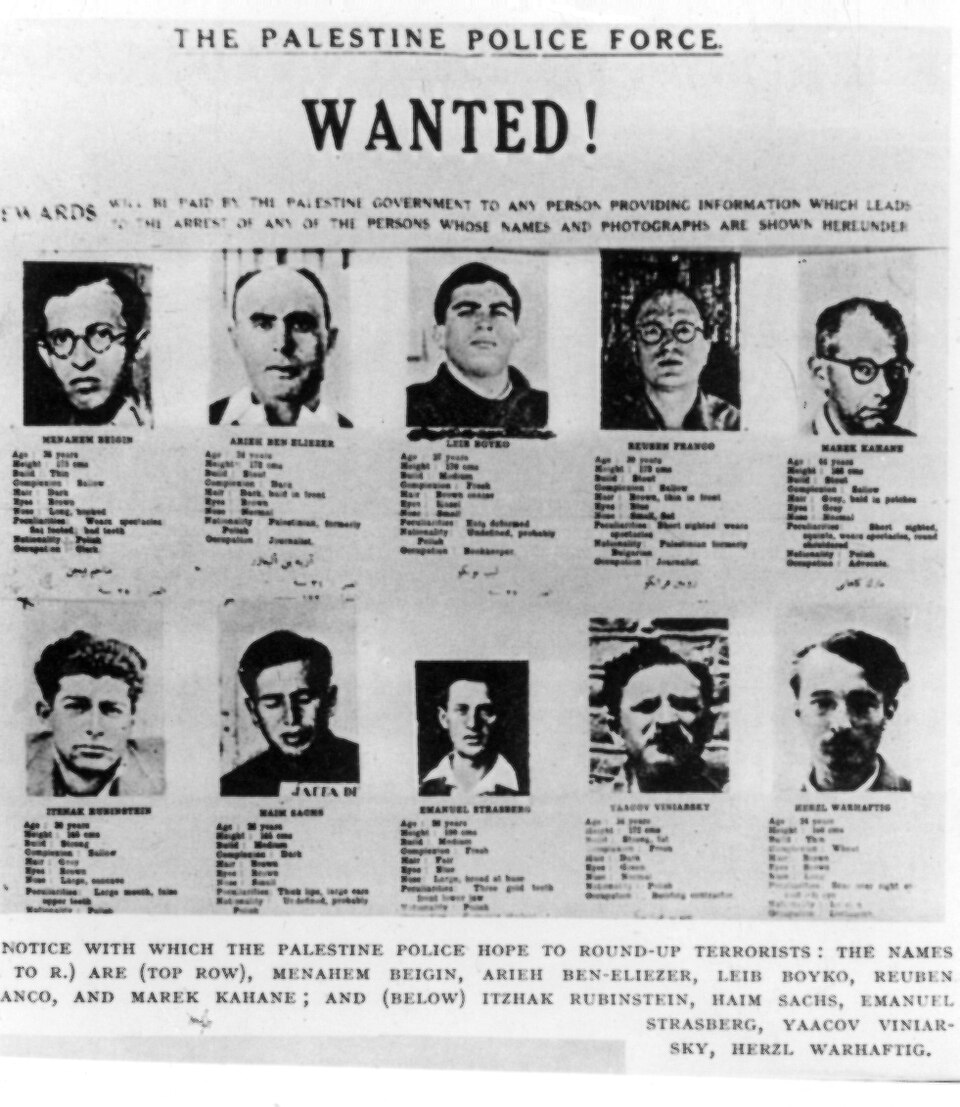
[Palestine Police Force](https://en.wikipedia.org/wiki/Palestine_Police_Force "Palestine Police Force") wanted poster of Irgun and Lehi members. Begin appears at the top left.

The Irgun and Lehi attacks intensified throughout 1944. These operations were financed by demanding money from Jewish merchants and engaging in insurance scams in the local diamond industry.[<sup><span class="editor-theme-superscript">\[24\]</span></sup>](https://en.wikipedia.org/wiki/Menachem_Begin#cite_note-25)

[![](https://thumb.wikimedia.org/wikipedia/commons/thumb/b/b9/Menahem_Begin_during_his_%22Rabbi_Sassover%22_period_with_wife_Aliza_and_son_Benyamin-Zeev_in_Tel_Aviv.jpg/250px-Menahem_Begin_during_his_%22Rabbi_Sassover%22_period_with_wife_Aliza_and_son_Benyamin-Zeev_in_Tel_Aviv.jpg?utm_source=en.wikipedia.org&utm_campaign=parser&utm_content=thumbnail)](https://en.wikipedia.org/wiki/File:Menahem_Begin_during_his_%22Rabbi_Sassover%22_period_with_wife_Aliza_and_son_Benyamin-Zeev_in_Tel_Aviv.jpg)

<span style="background-color: rgb(251, 238, 184);">Begin in the guise of "Rabbi Sassover" </span>with wife Aliza and son Benyamin-Zeev, Tel Aviv, December 1946

[![](https://thumb.wikimedia.org/wikipedia/commons/thumb/c/c4/Flickr_-_Government_Press_Office_-_Menahem_Begin_visit_the_%22Etzel%22_camp.jpg/250px-Flickr_-_Government_Press_Office_-_Menahem_Begin_visit_the_%22Etzel%22_camp.jpg?utm_source=en.wikipedia.org&utm_campaign=parser&utm_content=thumbnail)](https://en.wikipedia.org/wiki/File:Flickr_-_Government_Press_Office_-_Menahem_Begin_visit_the_%22Etzel%22_camp.jpg)

Begin with Irgun members, 1948

In 1944, after Lehi gunmen assassinated [Lord Moyne](https://en.wikipedia.org/wiki/Walter_Guinness,_1st_Baron_Moyne "Walter Guinness, 1st Baron Moyne"), the British Resident Minister in the Middle East, the official Jewish authorities, fearing British retaliation, ordered the Haganah to undertake a campaign of collaboration with the British. Known as [The Hunting Season](https://en.wikipedia.org/wiki/The_Hunting_Season "The Hunting Season"), the campaign seriously crippled the Irgun for several months, while Lehi, having agreed to suspend their anti-British attacks, was spared. Begin, anxious to prevent a civil war, ordered his men not to retaliate or resist being taken captive, convinced that the Irgun could ride out the Season, and that the Jewish Agency would eventually side with the Irgun when it became apparent the British government had no intention of making concessions. Gradually, shamed at participating in what was viewed as a collaborationist campaign, the enthusiasm of the Haganah began to wane, and Begin's assumptions were proven correct. The Irgun's restraint also earned it much sympathy from the Yishuv, whereas previously it had been assumed by many that it had placed its own political interests before those of the Yishuv.[<sup><span class="editor-theme-superscript">\[23\]</span></sup>](https://en.wikipedia.org/wiki/Menachem_Begin#cite_note-Bell-24)

In the summer of 1945, as it became clear that the British were not planning on establishing a Jewish state and would not allow significant Jewish immigration to Palestine, Jewish public opinion shifted decisively against the British, and the Jewish authorities sent feelers to the Irgun and Lehi to discuss an alliance. The result was the [Jewish Resistance Movement](https://en.wikipedia.org/wiki/Jewish_Resistance_Movement "Jewish Resistance Movement"), a framework under which the Haganah, Irgun, and Lehi launched coordinated series of anti-British operations. For several months in 1945–46, the Irgun fought as part of the Jewish Resistance Movement. Following [Operation Agatha](https://en.wikipedia.org/wiki/Operation_Agatha "Operation Agatha"), during which the British arrested many Jews, seized arms caches, and occupied the Jewish Agency building, from which many documents were removed, Begin ordered an attack on the British military and administrative headquarters at the [King David Hotel](https://en.wikipedia.org/wiki/King_David_Hotel "King David Hotel") following a request from the Haganah, although the Haganah's permission was later rescinded. The [King David Hotel bombing](https://en.wikipedia.org/wiki/King_David_Hotel_bombing "King David Hotel bombing") resulted in the destruction of the building's southern wing, and 91 people, mostly British, Arabs, and Jews, were killed.

The fragile partnership collapsed following the bombing, partly because contrary to instructions, it was carried out during the busiest part of the day at the hotel. The Haganah, from then on, would rarely mount attacks against British forces and would focus mainly on the [Aliyah Bet](https://en.wikipedia.org/wiki/Aliyah_Bet "Aliyah Bet") illegal immigration campaign, and while it occasionally took half-hearted measures against the Irgun, it never returned to full-scale collaboration with the British. The Irgun and Lehi continued waging a full-scale insurgency against the British, and together with the Haganah's illegal immigration campaign, this forced a large commitment of British forces to Palestine that was gradually sapping British financial resources. Three particular Irgun operations directly ordered by Begin—the [Night of the Beatings](https://en.wikipedia.org/wiki/Night_of_the_Beatings "Night of the Beatings"), the [Acre Prison break](https://en.wikipedia.org/wiki/Acre_Prison_break "Acre Prison break"), and the [Sergeants affair](https://en.wikipedia.org/wiki/The_Sergeants_affair "The Sergeants affair")—were cited as particularly influencing the British to leave due to Britain's decreasing international prestige and the growing public opposition they generated at home to Britain's remaining. In September 1947, the British cabinet voted to leave Palestine, and in November of that year, the United Nations approved a resolution to partition the country between Arabs and Jews. The financial burden imposed on Britain by the Jewish insurgency, together with the tremendous public opposition to keeping troops in Palestine it generated among the British public was later cited by British officials as a major factor in Britain's decision to evacuate Palestine.[<sup><span class="editor-theme-superscript">\[25\]</span></sup>](https://en.wikipedia.org/wiki/Menachem_Begin#cite_note-Hoffman-26)[<sup><span class="editor-theme-superscript">\[26\]</span></sup>](https://en.wikipedia.org/wiki/Menachem_Begin#cite_note-27)

### 1948 Palestine war

Further information: [1948 Palestine war](https://en.wikipedia.org/wiki/1948_Palestine_war "1948 Palestine war")

[![](https://thumb.wikimedia.org/wikipedia/commons/thumb/c/c6/Menachem_Begin_inspecting_Irgun_members_1948.jpg/250px-Menachem_Begin_inspecting_Irgun_members_1948.jpg?utm_source=en.wikipedia.org&utm_campaign=parser&utm_content=thumbnail)](https://en.wikipedia.org/wiki/File:Menachem_Begin_inspecting_Irgun_members_1948.jpg)

Menachem Begin (left) inspecting members of the Irgun in Jerusalem, August 1948.

In December 1947, immediately following the UN partition vote, the [1947–1948 Civil War in Mandatory Palestine](https://en.wikipedia.org/wiki/1947%E2%80%931948_Civil_War_in_Mandatory_Palestine "1947–1948 Civil War in Mandatory Palestine") broke out between the Yishuv and Palestinian Arabs. The Irgun fought together with the Haganah and Lehi during that period. Notable operations in which they took part were the [battle of Jaffa](https://en.wikipedia.org/wiki/Operation_Hametz "Operation Hametz") and the [Jordanian siege](https://en.wikipedia.org/wiki/Battle_for_Jerusalem "Battle for Jerusalem") on the [Jewish Quarter](https://en.wikipedia.org/wiki/Jewish_Quarter_(Jerusalem) "Jewish Quarter (Jerusalem)") in the Old City of [Jerusalem](https://en.wikipedia.org/wiki/Jerusalem "Jerusalem"). The Irgun's most controversial operation during this period, carried out alongside Lehi, was an assault on the Arab village of [Deir Yassin](https://en.wikipedia.org/wiki/Deir_Yassin "Deir Yassin") in which more than a hundred villagers and four of the attackers were killed. The event later became known as the [Deir Yassin massacre](https://en.wikipedia.org/wiki/Deir_Yassin_massacre "Deir Yassin massacre"), though Irgun and Lehi sources would deny a massacre took place there. Begin also repeatedly threatened to declare independence if the Jewish Agency did not do so.[<sup><span class="editor-theme-superscript">\[23\]</span></sup>](https://en.wikipedia.org/wiki/Menachem_Begin#cite_note-Bell-24)

Throughout the period of the rebellion against the British and the civil war against the Arabs, Begin lived openly under a series of assumed names, often while sporting a beard. Begin would not come out of hiding until April 1948, when the British, who still maintained nominal authority over Palestine, were almost totally gone. During the period of revolt, Begin was the most wanted man in Palestine, and [MI5](https://en.wikipedia.org/wiki/MI5 "MI5") placed a 'dead-or-alive' bounty of [£](https://en.wikipedia.org/wiki/Pound_sterling "Pound sterling")10,000 on his head. Begin had been forced into hiding immediately prior to the declaration of revolt, when Aliza noticed that their house was being watched. He initially lived in a room in the Savoy Hotel, a small hotel in [Tel Aviv](https://en.wikipedia.org/wiki/Tel_Aviv "Tel Aviv") whose owner was sympathetic to the Irgun's cause, and his wife and son were smuggled in to join him after two months. He decided to grow a beard and live openly under an assumed name rather than go completely into hiding. He was aided by the fact that the British authorities possessed only two photographs of his likeness, of which one, which they believed to be his military identity card, bore only a slight resemblance to him, according to Begin, and were fed misinformation by [Yaakov Meridor](https://en.wikipedia.org/wiki/Yaakov_Meridor "Yaakov Meridor") that he had had plastic surgery, and were thus confused over his appearance. Due to the British police conducting searches in the hotel's vicinity, he relocated to a Yemenite neighborhood in [Petah Tikva](https://en.wikipedia.org/wiki/Petah_Tikva "Petah Tikva"), and after a month, moved to the Hasidof neighborhood near [Kfar Sirkin](https://en.wikipedia.org/wiki/Kfar_Sirkin "Kfar Sirkin"), where he pretended to be a lawyer named Yisrael Halperin. After the British searched the area but missed the street where his house was located, Begin and his family moved to a new home on a Tel Aviv side street, where he assumed the name Yisrael Sassover and masqueraded as a rabbi. Following the King David Hotel bombing, when the British searched the entire city of Tel Aviv, Begin evaded capture by hiding in a secret compartment in his home.[<sup><span class="editor-theme-superscript">\[23\]</span></sup>](https://en.wikipedia.org/wiki/Menachem_Begin#cite_note-Bell-24) In 1947, he moved to the heart of Tel Aviv and took the identity of Dr. Yonah Koenigshoffer, the name he found on an abandoned passport in a library.

In the years following the establishment of the State of Israel, the Irgun's contribution to precipitating British withdrawal became a hotly contested debate as different factions vied for control over the emerging narrative of Israeli independence.[<sup><span class="editor-theme-superscript">\[27\]</span></sup>](https://en.wikipedia.org/wiki/Menachem_Begin#cite_note-28) Begin resented his portrayal as a belligerent dissident.[<sup><span class="editor-theme-superscript">\[28\]</span></sup>](https://en.wikipedia.org/wiki/Menachem_Begin#cite_note-29)

#### *Altalena Affair*

[![](https://thumb.wikimedia.org/wikipedia/commons/thumb/5/53/Altalena_off_Tel-Aviv_beach.jpg/250px-Altalena_off_Tel-Aviv_beach.jpg?utm_source=en.wikipedia.org&utm_campaign=parser&utm_content=thumbnail)](https://en.wikipedia.org/wiki/File:Altalena_off_Tel-Aviv_beach.jpg)

*Altalena* on fire after being shelled near Tel-Aviv

Main article: [Altalena Affair](https://en.wikipedia.org/wiki/Altalena_Affair "Altalena Affair")

After the [Israeli Declaration of Independence](https://en.wikipedia.org/wiki/Declaration_of_Independence_(Israel) "Declaration of Independence (Israel)") on 14 May 1948 and the start of the [1948 Arab–Israeli War](https://en.wikipedia.org/wiki/1948_Arab%E2%80%93Israeli_War "1948 Arab–Israeli War"), Irgun continued to fight alongside Haganah and Lehi. On 15 May 1948, Begin broadcast a speech on radio declaring that the Irgun was finally moving out of its underground status.[<sup><span class="editor-theme-superscript">\[29\]</span></sup>](https://en.wikipedia.org/wiki/Menachem_Begin#cite_note-30) On 3 June Begin signed an agreement with the provisional government headed by [David Ben-Gurion](https://en.wikipedia.org/wiki/David_Ben-Gurion "David Ben-Gurion"), where the Irgun agreed to formally disband and to integrate its force with the newly formed [Israel Defense Forces](https://en.wikipedia.org/wiki/Israel_Defense_Forces "Israel Defense Forces") (IDF),[<sup><span class="editor-theme-superscript">\[30\]</span></sup>](https://en.wikipedia.org/wiki/Menachem_Begin#cite_note-31) but was not truthful of the armaments aboard the [*Altalena*](https://en.wikipedia.org/wiki/Altalena_Affair "Altalena Affair") as it was scheduled to arrive during the cease-fire ordered by the United Nations and therefore would have put the State of Israel in peril as Britain was adamant the partition of Jewish and Arab Palestine would not occur. This delivery was the smoking gun Britain would need to urge the UN to end the partition action.

Intense negotiations between representatives of the [provisional government](https://en.wikipedia.org/wiki/Provisional_government_of_Israel "Provisional government of Israel") (headed by Ben-Gurion) and the Irgun (headed by Begin) followed the departure of *Altalena* from France. Among the issues discussed were logistics of the ship's landing and distribution of the cargo between the military organizations. Whilst there was agreement on the anchoring place of the *Altalena*, there were differences of opinion about the allocation of the cargo. Ben-Gurion agreed to Begin's initial request that 20% of the weapons be dispatched to the Irgun's Jerusalem Battalion, which was still fighting independently. His second request, however, that the remainder be transferred to the IDF to equip the newly incorporated Irgun battalions, was rejected by the Government representatives, who interpreted the request as a demand to reinforce an "army within an army."

The *Altalena* reached Kfar Vitkin in the late afternoon of Sunday, 20 June. Among the Irgun members waiting on the shore was Menachem Begin, who greeted the arrivals with great emotion. After the passengers had disembarked, members of the fishing village of [Mikhmoret](https://en.wikipedia.org/wiki/Mikhmoret "Mikhmoret") helped unload the cargo of military equipment. Concomitantly with the events at Kfar Vitkin, the government had convened in Tel Aviv for its weekly meeting. Ben-Gurion reported on the meetings which had preceded the arrival of the *Altalena*, and was adamant in his demand that Begin surrender and hand over all of the weapons:

> We must decide whether to hand over power to Begin or to order him to cease his separate activities. If he does not do so, we will open fire! Otherwise, we must decide to disperse our own army.

The debate ended in a resolution to empower the army to use force if necessary to overcome the Irgun and to confiscate the ship and its cargo. Implementation of this decision was assigned to the Alexandroni Brigade, commanded by [Dan Even](https://en.wikipedia.org/wiki/Dan_Even?action=edit&redlink=1 "Dan Even (page does not exist)") \[[he](https://he.wikipedia.org/wiki/%D7%93%D7%9F%20%D7%90%D7%91%D7%9F "he:דן אבן")\] (Epstein), which the following day surrounded the Kfar Vitkin area. Dan Even issued the following ultimatum:

> To: M. Begin  
> By special order from the Chief of the General Staff of the Israel Defense Forces, I am empowered to confiscate the weapons and military materials which have arrived on the Israeli coast in the area of my jurisdiction in the name of the Israel Government. I have been authorized to demand that you hand over the weapons to me for safekeeping and to inform you that you should establish contact with the supreme command. You are required to carry out this order immediately. If you do not agree to carry out this order, I shall use all the means at my disposal in order to implement the order and to requisition the weapons which have reached shore and transfer them from private possession into the possession of the Israel government. I wish to inform you that the entire area is surrounded by fully armed military units and armored cars, and all roads are blocked. I hold you fully responsible for any consequences in the event of your refusal to carry out this order. The immigrants – unarmed – will be permitted to travel to the camps in accordance with your arrangements. You have ten minutes to give me your answer.  
> D.E., Brigade Commander

The ultimatum was made, according to Even, "in order not to give the Irgun commander time for lengthy considerations and to gain the advantage of surprise." Begin refused to respond to the ultimatum, and all attempts at mediation failed. Begin's failure to respond was a blow to Even's prestige, and a clash was now inevitable. Fighting ensued and there were a number of casualties. In order to prevent further bloodshed, the Kfar Vitkin settlers initiated negotiations between [Yaakov Meridor](https://en.wikipedia.org/wiki/Yaakov_Meridor "Yaakov Meridor") (Begin's deputy) and [Dan Even](https://en.wikipedia.org/wiki/Dan_Even?action=edit&redlink=1 "Dan Even (page does not exist)"), which ended in a general ceasefire and the transfer of the weapons on shore to the local IDF commander.

[![](https://thumb.wikimedia.org/wikipedia/commons/thumb/a/aa/Atalena_crew.jpg/250px-Atalena_crew.jpg?utm_source=en.wikipedia.org&utm_campaign=parser&utm_content=thumbnail)](https://en.wikipedia.org/wiki/File:Atalena_crew.jpg)

Some of the crew of the *Altalena*. Bottom row center is Captain Monroe Fein.

Begin had meanwhile boarded the *Altalena*, which was headed for Tel Aviv where the Irgun had more supporters. Many Irgun members, who joined the IDF earlier that month, left their bases and concentrated on the Tel Aviv beach. A confrontation between them and the IDF units started. In response, Ben-Gurion ordered [Yigael Yadin](https://en.wikipedia.org/wiki/Yigael_Yadin "Yigael Yadin") (acting Chief of Staff) to concentrate large forces on the Tel Aviv beach and to take the ship by force. Heavy guns were transferred to the area and at four in the afternoon, Ben-Gurion ordered the shelling of the *Altalena*. One of the shells hit the ship, which began to burn. [Yigal Allon](https://en.wikipedia.org/wiki/Yigal_Allon "Yigal Allon"), commander of the troops on the shore, later claimed only five or six shells were fired, as warning shots, and the ship was hit by accident.[<sup><span class="editor-theme-superscript">\[31\]</span></sup>](https://en.wikipedia.org/wiki/Menachem_Begin#cite_note-32)

There was danger that the fire would spread to the holds which contained explosives, and Captain [Monroe Fein](https://en.wikipedia.org/wiki/Monroe_Fein "Monroe Fein") ordered all aboard to abandon ship. People jumped into the water, whilst their comrades on shore set out to meet them on rafts. Although Captain Fein flew the white flag of surrender, automatic fire continued to be directed at the unarmed survivors swimming in the water.<sup><span class="editor-theme-superscript">\[</span></sup>[*<sup>*citation needed*</sup>*](https://en.wikipedia.org/wiki/Wikipedia:Citation_needed "Wikipedia:Citation needed")<sup><span class="editor-theme-superscript">\]</span></sup> Begin, who was on deck, agreed to leave the ship only after the last of the wounded had been evacuated. Sixteen Irgun fighters were killed in the confrontation with the army (all but three were veteran members and not newcomers in the ship); six were killed in the Kfar Vitkin area and ten on Tel Aviv beach. Three IDF soldiers were killed: two at Kfar Vitkin and one in Tel Aviv.[<sup><span class="editor-theme-superscript">\[32\]</span></sup>](https://en.wikipedia.org/wiki/Menachem_Begin#cite_note-33)[<sup><span class="editor-theme-superscript">\[33\]</span></sup>](https://en.wikipedia.org/wiki/Menachem_Begin#cite_note-34)[<sup><span class="editor-theme-superscript">\[34\]</span></sup>](https://en.wikipedia.org/wiki/Menachem_Begin#cite_note-35)

After the shelling of the *Altalena*, more than 200 Irgun fighters were arrested. Most of them were released several weeks later, with the exception of five senior commanders (Moshe Hason, [Eliyahu Lankin](https://en.wikipedia.org/wiki/Eliyahu_Lankin "Eliyahu Lankin"), [Yaakov Meridor](https://en.wikipedia.org/wiki/Yaakov_Meridor "Yaakov Meridor"), [Bezalel Amitzur](https://en.wikipedia.org/wiki/Bezalel_Amitzur?action=edit&redlink=1 "Bezalel Amitzur (page does not exist)"), and [Hillel Kook](https://en.wikipedia.org/wiki/Hillel_Kook "Hillel Kook")), who were detained for more than two months, until 27 August 1948. Begin agreed the Irgun soldiers would be fully integrated with the IDF and not kept in separate units.

About a year later, *Altalena* was refloated, towed 15 miles out to sea and sunk.[<sup><span class="editor-theme-superscript">\[35\]</span></sup>](https://en.wikipedia.org/wiki/Menachem_Begin#cite_note-Altalena_PalYam-36)

## Political career

[![](https://thumb.wikimedia.org/wikipedia/commons/thumb/8/8f/Menachem_Begin_p%C5%99i_projevu_v_srpnu_1948.jpg/250px-Menachem_Begin_p%C5%99i_projevu_v_srpnu_1948.jpg?utm_source=en.wikipedia.org&utm_campaign=parser&utm_content=thumbnail)](https://en.wikipedia.org/wiki/File:Menachem_Begin_p%C5%99i_projevu_v_srpnu_1948.jpg)

Begin; August 1948

### Herut opposition years

In August 1948, Begin and members of the Irgun High Command emerged from the underground and formed the right-wing political party [Herut](https://en.wikipedia.org/wiki/Herut "Herut") ("Freedom") party.[<sup><span class="editor-theme-superscript">\[36\]</span></sup>](https://en.wikipedia.org/wiki/Menachem_Begin#cite_note-37) The move countered the weakening attraction for the earlier [revisionist party](https://en.wikipedia.org/wiki/Revisionist_Zionism "Revisionist Zionism"), [Hatzohar](https://en.wikipedia.org/wiki/Hatzohar "Hatzohar"), founded by his late mentor [Ze'ev Jabotinsky](https://en.wikipedia.org/wiki/Ze'ev_Jabotinsky "Ze'ev Jabotinsky"). Revisionist 'purists' alleged nonetheless that Begin was out to steal Jabotinsky's mantle and ran against him with the old party. The Herut party can be seen as the forerunner of today's [Likud](https://en.wikipedia.org/wiki/Likud "Likud").

In November 1948, Begin visited the US on a campaigning trip. During his visit, [a letter](https://en.wikisource.org/wiki/New%20Palestine%20Party;%20Visit%20of%20Menachen%20Begin%20and%20Aims%20of%20Political%20Movement%20Discussed "s:New Palestine Party; Visit of Menachen Begin and Aims of Political Movement Discussed") signed by [Albert Einstein](https://en.wikipedia.org/wiki/Albert_Einstein "Albert Einstein"), [Sidney Hook](https://en.wikipedia.org/wiki/Sidney_Hook "Sidney Hook"), [Hannah Arendt](https://en.wikipedia.org/wiki/Hannah_Arendt "Hannah Arendt"), and other prominent Americans and several rabbis was published which described Begin's Herut party as "terrorist, right-wing chauvinist organization in Palestine,"[<sup><span class="editor-theme-superscript">\[37\]</span></sup>](https://en.wikipedia.org/wiki/Menachem_Begin#cite_note-38) "closely akin in its organization, methods, political philosophy and social appeal to the [Nazi](https://en.wikipedia.org/wiki/Nazi "Nazi") and Fascist parties" and accused his group (along with the smaller, militant, [Stern Gang](https://en.wikipedia.org/wiki/Stern_Gang "Stern Gang")) of preaching "racial superiority" and having "inaugurated a reign of terror in the Palestine Jewish community".[<sup><span class="editor-theme-superscript">\[38\]</span></sup>](https://en.wikipedia.org/wiki/Menachem_Begin#cite_note-39)[<sup><span class="editor-theme-superscript">\[39\]</span></sup>](https://en.wikipedia.org/wiki/Menachem_Begin#cite_note-40)

In the [first elections in 1949](https://en.wikipedia.org/wiki/1949_Israeli_legislative_election "1949 Israeli legislative election"), Herut, with 11.5 percent of the vote, won 14 seats, while Hatzohar failed to break the threshold and disbanded shortly thereafter. This provided Begin with legitimacy as the leader of the Revisionist stream of Zionism. During the 1950s, Begin was banned from entering the [United Kingdom](https://en.wikipedia.org/wiki/United_Kingdom "United Kingdom"), as the British government regarded him as "leader of the notorious terrorist organisation Irgun."[<sup><span class="editor-theme-superscript">\[4\]</span></sup>](https://en.wikipedia.org/wiki/Menachem_Begin#cite_note-haaretz7jul11-5) Begin's disappointment at the result of the [1951 Israeli legislative election](https://en.wikipedia.org/wiki/1951_Israeli_legislative_election "1951 Israeli legislative election"), in which Herut lost six of its 14 seats, led Begin to resign as Herut leader in August 1951, and naming [Aryeh Ben-Eliezer](https://en.wikipedia.org/wiki/Aryeh_Ben-Eliezer "Aryeh Ben-Eliezer") as his successor. Despite sending the party his resignation letter and going abroad to Europe, the party's national council voted instead to make Ben-Eliezer deputy chairman and grant Begin a six-month [leave of absence](https://en.wikipedia.org/wiki/Leave_of_absence "Leave of absence"), while re-electing him as party chairman. Begin did not return to public life until January 1952, prompted to do so by the growing debate around the [Reparations Agreement between Israel and the Federal Republic of Germany](https://en.wikipedia.org/wiki/Reparations_Agreement_between_Israel_and_the_Federal_Republic_of_Germany "Reparations Agreement between Israel and the Federal Republic of Germany") as well as by Ben-Eliezer being hospitalized due to a serious heart attack in December 1951.[<sup><span class="editor-theme-superscript">\[40\]</span></sup>](https://en.wikipedia.org/wiki/Menachem_Begin#cite_note-41)

Between 1948 and 1977, under Begin, Herut and the alliances it formed ([Gahal](https://en.wikipedia.org/wiki/Gahal "Gahal") in 1965 and [Likud](https://en.wikipedia.org/wiki/Likud "Likud") in 1973) formed the main opposition to the dominant [Mapai](https://en.wikipedia.org/wiki/Mapai "Mapai") and later the [Alignment](https://en.wikipedia.org/wiki/Alignment_(political_party) "Alignment (political party)") (the forerunners of today's [Labor Party](https://en.wikipedia.org/wiki/Labor_Party_(Israel) "Labor Party (Israel)")) in the [Knesset](https://en.wikipedia.org/wiki/Knesset "Knesset"); Herut adopted a radical nationalistic agenda committed to the [irredentist](https://en.wikipedia.org/wiki/Irredentism "Irredentism") idea of [Greater Israel](https://en.wikipedia.org/wiki/Greater_Israel "Greater Israel") that usually included [Jordan](https://en.wikipedia.org/wiki/Jordan "Jordan").[<sup><span class="editor-theme-superscript">\[41\]</span></sup>](https://en.wikipedia.org/wiki/Menachem_Begin#cite_note-42) During those years, Begin was systematically delegitimized by the ruling party, and was often personally derided by [Ben-Gurion](https://en.wikipedia.org/wiki/David_Ben-Gurion "David Ben-Gurion") who refused to either speak to or refer to him by name. Ben-Gurion famously coined the phrase 'without Herut and [Maki](https://en.wikipedia.org/wiki/Maki_(historical_political_party) "Maki (historical political party)")' (Maki was the [communist party](https://en.wikipedia.org/wiki/Communist_party "Communist party")), referring to his refusal to consider them for coalition, effectively pushing both parties and their voters beyond the margins of political consensus.

The personal animosity between Ben-Gurion and Begin, going back to the hostilities over the [*Altalena* Affair](https://en.wikipedia.org/wiki/Altalena_Affair "Altalena Affair"), underpinned the political dichotomy between Mapai and Herut. Begin was a keen critic of Mapai, accusing it of [coercive](https://en.wikipedia.org/wiki/Coercion "Coercion") [Bolshevism](https://en.wikipedia.org/wiki/Bolshevism "Bolshevism") and deep-rooted [institutional corruption](https://en.wikipedia.org/wiki/Institutional_corruption "Institutional corruption"). Drawing on his training as a lawyer in Poland, he preferred wearing a formal suit and tie and evincing the dry demeanor of a legislator to the socialist informality of Mapai, as a means of accentuating their differences.

One of the fiercest confrontations between Begin and Ben-Gurion revolved around the [Reparations Agreement between Israel and West Germany](https://en.wikipedia.org/wiki/Reparations_Agreement_between_Israel_and_West_Germany "Reparations Agreement between Israel and West Germany"), signed in 1952. Begin vehemently opposed the agreement, claiming that it was tantamount to a pardon of Nazi crimes against the Jewish people.[<sup><span class="editor-theme-superscript">\[42\]</span></sup>](https://en.wikipedia.org/wiki/Menachem_Begin#cite_note-43) While the agreement was debated in the [Knesset](https://en.wikipedia.org/wiki/Knesset "Knesset") in January 1952, he led a demonstration in [Jerusalem](https://en.wikipedia.org/wiki/Jerusalem "Jerusalem") attended by some 15,000 people, and gave a passionate and dramatic speech in which he attacked the government and called for its violent overthrow. Referring to the Altalena Affair, Begin stated that "when you fired at me with a cannon, I gave the order: 'No!' Today I will give the order, 'Yes!'"[<sup><span class="editor-theme-superscript">\[43\]</span></sup>](https://en.wikipedia.org/wiki/Menachem_Begin#cite_note-44) Incited by his speech, the crowd marched towards the Knesset (then at the Frumin Building on King George Street) and threw stones at the windows, and at police as they intervened. After five hours of rioting, police managed to suppress the riots using water cannons and tear gas. Hundreds were arrested, while some 200 rioters, 140 police officers, and several Knesset members were injured. Many held Begin personally responsible for the violence, and he was consequently barred from the Knesset for several months. His behavior was strongly condemned in mainstream public discourse, reinforcing his image as a provocateur. The vehemence of Revisionist opposition was deep; in March 1952, during the ongoing reparations negotiations, a parcel bomb addressed to [Konrad Adenauer](https://en.wikipedia.org/wiki/Konrad_Adenauer "Konrad Adenauer"), the sitting [West German](https://en.wikipedia.org/wiki/West_Germany "West Germany") [Chancellor](https://en.wikipedia.org/wiki/Chancellor_of_Germany_(Federal_Republic_of_Germany) "Chancellor of Germany (Federal Republic of Germany)"), was intercepted at a German post office. While being defused, the bomb exploded, killing one [sapper](https://en.wikipedia.org/wiki/Sapper "Sapper") and injuring two others. Five Israelis, all former members of Irgun, were later arrested in Paris for their involvement in the plot. Chancellor Adenauer decided to keep secret the involvement of Israeli opposition party members in the plot, thus avoiding Israeli embarrassment and a likely backlash. The five Irgun conspirators were later extradited from both France and Germany, without charge, and sent back to Israel. Forty years after the assassination attempt, Begin was implicated as the organizer of the assassination attempt in a memoir written by one of the conspirators, Elieser Sudit.[<sup><span class="editor-theme-superscript">\[44\]</span></sup>](https://en.wikipedia.org/wiki/Menachem_Begin#cite_note-45)[<sup><span class="editor-theme-superscript">\[45\]</span></sup>](https://en.wikipedia.org/wiki/Menachem_Begin#cite_note-46)[<sup><span class="editor-theme-superscript">\[46\]</span></sup>](https://en.wikipedia.org/wiki/Menachem_Begin#cite_note-47)[<sup><span class="editor-theme-superscript">\[47\]</span></sup>](https://en.wikipedia.org/wiki/Menachem_Begin#cite_note-48)

Begin's impassioned rhetoric, laden with pathos and evocations of the Holocaust, appealed to many, but was deemed inflammatory and [demagoguery](https://en.wikipedia.org/wiki/Demagoguery "Demagoguery") by others.

### Gahal and unity government

In the following years, Begin failed to gain electoral momentum, and Herut remained far behind [Labor](https://en.wikipedia.org/wiki/Labor_Party_(Israel) "Labor Party (Israel)") with a total of 17 seats until 1961. In the [1965 Israeli legislative election](https://en.wikipedia.org/wiki/1965_Israeli_legislative_election "1965 Israeli legislative election"), Herut and the [Liberal Party](https://en.wikipedia.org/wiki/Liberal_Party_(Israel) "Liberal Party (Israel)") united to form the [Gahal](https://en.wikipedia.org/wiki/Gahal "Gahal") bloc under Begin's leadership, but the merger prompted several Liberal MKs to split and form the [Independent Liberals](https://en.wikipedia.org/wiki/Independent_Liberals_(Israel) "Independent Liberals (Israel)") and Gahal failed to gain seats in the election, or make up the seats it lost from the Independent Liberal defection. In 1966, during Herut's party convention, he was challenged by the young [Ehud Olmert](https://en.wikipedia.org/wiki/Ehud_Olmert "Ehud Olmert"). The opposition group within Herut, however, sensed that Begin's leadership position was too strong to challenge directly and concentrated on winning control over the party organization. They won overwhelming victories in all votes for the composition of party institutions. Begin responded to these challenges by announcing his retirement as party chairman and suggesting he would also resign seat in the Knesset. Begin's move mobilized delegates in support of him, but the party convention ended without a party chairman being elected; the chair would be vacant for eight months. Internal opposition to Begin' leadership came to a head a month after the convention, when Haim Amsterdam, an assistant to one of the opposition leaders, [Shmuel Tamir](https://en.wikipedia.org/wiki/Shmuel_Tamir "Shmuel Tamir"), published a devastating attack on Begin in [*Ha'aretz*](https://en.wikipedia.org/wiki/Ha'aretz "Ha'aretz");[<sup><span class="editor-theme-superscript">\[48\]</span></sup>](https://en.wikipedia.org/wiki/Menachem_Begin#cite_note-49) this led to the suspension of Tamir's party membership.[<sup><span class="editor-theme-superscript">\[49\]</span></sup>](https://en.wikipedia.org/wiki/Menachem_Begin#cite_note-50) The leaders of the opposition then established a new party in the Knesset, the [Free Center](https://en.wikipedia.org/wiki/Free_Center "Free Center"), with the loss of three seats for Herut. After this revolt, Begin reversed his decision to retire and returned as party chairman in February 1967.[<sup><span class="editor-theme-superscript">\[50\]</span></sup>](https://en.wikipedia.org/wiki/Menachem_Begin#cite_note-51)[<sup><span class="editor-theme-superscript">\[51\]</span></sup>](https://en.wikipedia.org/wiki/Menachem_Begin#cite_note-52)[<sup><span class="editor-theme-superscript">\[52\]</span></sup>](https://en.wikipedia.org/wiki/Menachem_Begin#cite_note-weitz-53)

The day the [Six-Day War](https://en.wikipedia.org/wiki/Six-Day_War "Six-Day War") started in June 1967, Gahal joined the [national unity government](https://en.wikipedia.org/wiki/National_unity_government "National unity government") under Prime Minister [Levi Eshkol](https://en.wikipedia.org/wiki/Levi_Eshkol "Levi Eshkol") of the Alignment, resulting in Begin serving in the [cabinet](https://en.wikipedia.org/wiki/Cabinet_of_Israel "Cabinet of Israel") for the first time, as a [Minister without Portfolio](https://en.wikipedia.org/wiki/Minister_without_Portfolio "Minister without Portfolio"). [Rafi](https://en.wikipedia.org/wiki/Rafi_(political_party) "Rafi (political party)") also joined the unity government at that time, with [Moshe Dayan](https://en.wikipedia.org/wiki/Moshe_Dayan "Moshe Dayan") becoming Defense Minister. Gahal's arrangement lasted until August 1970, when Begin and Gahal quit the government, then led by [Golda Meir](https://en.wikipedia.org/wiki/Golda_Meir "Golda Meir") due to disagreements over the [Rogers Plan](https://en.wikipedia.org/wiki/Rogers_Plan "Rogers Plan") and its "in place" cease-fire with Egypt along the Suez Canal,[<sup><span class="editor-theme-superscript">\[53\]</span></sup>](https://en.wikipedia.org/wiki/Menachem_Begin#cite_note-54) Other sources, including [William B. Quandt](https://en.wikipedia.org/wiki/William_B._Quandt "William B. Quandt"), note that the Labor party, by formally accepting [UN 242](https://en.wikipedia.org/wiki/UN_242 "UN 242") in mid-1970, had accepted "peace for withdrawal" on all fronts, and because of this Begin had left the unity government. On 5 August, Begin explained before the Knesset why he was resigning from the cabinet. He said, "As far as we are concerned, what do the words 'withdrawal from territories administered since 1967 by Israel' mean other than Judea and Samaria. Not all the territories; but by all opinion, most of them."[<sup><span class="editor-theme-superscript">\[54\]</span></sup>](https://en.wikipedia.org/wiki/Menachem_Begin#cite_note-55)

### Likud chairmanship

[![](https://thumb.wikimedia.org/wikipedia/commons/thumb/7/7d/Flickr_-_Government_Press_Office_%28GPO%29_-_Begin_in_the_Knesset.jpg/250px-Flickr_-_Government_Press_Office_%28GPO%29_-_Begin_in_the_Knesset.jpg?utm_source=en.wikipedia.org&utm_campaign=parser&utm_content=thumbnail)](https://en.wikipedia.org/wiki/File:Flickr_-_Government_Press_Office_(GPO)_-_Begin_in_the_Knesset.jpg)

Begin addressing the Knesset in 1974

In 1973, Begin agreed to a plan by [Ariel Sharon](https://en.wikipedia.org/wiki/Ariel_Sharon "Ariel Sharon") to form a larger bloc of opposition parties, made up from Gahal, the [Free Centre](https://en.wikipedia.org/wiki/Free_Centre "Free Centre"), and other smaller groups. They came through with a tenuous alliance called the [Likud](https://en.wikipedia.org/wiki/Likud "Likud") ("Consolidation"). In the elections held later that year, two months after the [Yom Kippur War](https://en.wikipedia.org/wiki/Yom_Kippur_War "Yom Kippur War"), the Likud won a considerable share of the votes, though with 39 seats still remained in opposition.<sup><span class="editor-theme-superscript">\[</span></sup>[*<sup>*citation needed*</sup>*](https://en.wikipedia.org/wiki/Wikipedia:Citation_needed "Wikipedia:Citation needed")<sup><span class="editor-theme-superscript">\]</span></sup>

Yet the aftermath of the Yom Kippur War saw ensuing public disenchantment with the Alignment. Voices of criticism about the government's misconduct of the war gave rise to growing public resentment. Personifying the antithesis to the Alignment's socialist ethos, Begin appealed to many [Mizrahi](https://en.wikipedia.org/wiki/Mizrahi_Jews "Mizrahi Jews") Israelis, mostly first and second generation [Jewish refugees from Arab countries](https://en.wikipedia.org/wiki/Jewish_exodus_from_Arab_lands "Jewish exodus from Arab lands"), who felt they were continuously being treated by the establishment as second-class citizens. His open embrace of Judaism stood in stark contrast to the Alignment's secularism, which alienated Mizrahi voters and drew many of them to support Begin, becoming his burgeoning political base. In the years 1974–77 [Yitzhak Rabin](https://en.wikipedia.org/wiki/Yitzhak_Rabin "Yitzhak Rabin")'s government suffered from instability due to infighting within the labor party (Rabin and [Shimon Peres](https://en.wikipedia.org/wiki/Shimon_Peres "Shimon Peres")) and the shift to the right by the National Religious Party, as well as numerous corruption scandals. All these weakened the labor camp and finally allowed Begin to capture the center stage of Israeli politics.<sup><span class="editor-theme-superscript">\[</span></sup>[*<sup>*citation needed*</sup>*](https://en.wikipedia.org/wiki/Wikipedia:Citation_needed "Wikipedia:Citation needed")<sup><span class="editor-theme-superscript">\]</span></sup>

In 1977 Begin declared that "between [the \[Mediterranean\] Sea and the Jordan River](https://en.wikipedia.org/wiki/From_the_river_to_the_sea "From the river to the sea") there shall only be Israeli sovereignty".[<sup><span class="editor-theme-superscript">\[55\]</span></sup>](https://en.wikipedia.org/wiki/Menachem_Begin#cite_note-56)

#### Prime Minister of Israel 

#### 1977 electoral victory

[![](https://thumb.wikimedia.org/wikipedia/commons/thumb/1/16/Menachem_Begin_1978.jpg/250px-Menachem_Begin_1978.jpg?utm_source=en.wikipedia.org&utm_campaign=parser&utm_content=thumbnail)](https://en.wikipedia.org/wiki/File:Menachem_Begin_1978.jpg)

Menachem Begin in 1978

Main article: [1977 Israeli legislative election](https://en.wikipedia.org/wiki/1977_Israeli_legislative_election "1977 Israeli legislative election")

On 17 May 1977, the Likud, headed by Begin, won the [Knesset elections](https://en.wikipedia.org/wiki/1977_Israeli_legislative_election "1977 Israeli legislative election") by a landslide, becoming the biggest party in the [Knesset](https://en.wikipedia.org/wiki/Knesset "Knesset"). Popularly known as the *Mahapakh* ("upheaval"), the election results had seismic ramifications as for the first time in Israeli history a party other than the Alignment/Mapai could form a government, effectively ending the left's hitherto unrivalled domination over Israeli politics. Likud's electoral victory signified a fundamental restructuring of Israeli society in which the founding socialist Ashkenazi elite was being replaced by a coalition representing marginalized [Mizrahi](https://en.wikipedia.org/wiki/Mizrahi_Jews "Mizrahi Jews") and Jewish-religious communities, promoting a socially conservative and [economically liberal](https://en.wikipedia.org/wiki/Economic_liberalism "Economic liberalism") agenda.

[![](https://thumb.wikimedia.org/wikipedia/commons/thumb/9/9a/Menachem_Begin_and_Moshe_Dayan_exits_from_an_aircraft.JPEG/250px-Menachem_Begin_and_Moshe_Dayan_exits_from_an_aircraft.JPEG?utm_source=en.wikipedia.org&utm_campaign=parser&utm_content=thumbnail)](https://en.wikipedia.org/wiki/File:Menachem_Begin_and_Moshe_Dayan_exits_from_an_aircraft.JPEG)

Begin and [Moshe Dayan](https://en.wikipedia.org/wiki/Moshe_Dayan "Moshe Dayan") exit from an aircraft at [Andrews Air Force Base](https://en.wikipedia.org/wiki/Andrews_Air_Force_Base "Andrews Air Force Base"), [Maryland](https://en.wikipedia.org/wiki/Maryland "Maryland"), United States

The Likud campaign leading up to the election centered on Begin's personality. Demonized by the Alignment as [totalitarian](https://en.wikipedia.org/wiki/Totalitarian "Totalitarian") and extremist, his self-portrayal as a humble and pious leader struck a chord with many who felt abandoned by the ruling party's ideology. In the predominantly [Mizrahi](https://en.wikipedia.org/wiki/Mizrahi_Jews "Mizrahi Jews") working class urban neighborhoods and peripheral towns, the Likud won overwhelming majorities, while disillusionment with the Alignment's corruption prompted many middle and upper class voters to support the newly founded [centrist](https://en.wikipedia.org/wiki/Centrism "Centrism") [Democratic Movement for Change](https://en.wikipedia.org/wiki/Democratic_Movement_for_Change "Democratic Movement for Change") ("Dash") headed by [Yigael Yadin](https://en.wikipedia.org/wiki/Yigael_Yadin "Yigael Yadin"). Dash won 15 seats out of 120, largely at the expense of the Alignment, which was led by [Shimon Peres](https://en.wikipedia.org/wiki/Shimon_Peres "Shimon Peres") and had shrunk from 51 to 32 seats. Well aware of his momentous achievement and employing his trademark sense for drama, when speaking that night in the Likud headquarters Begin quoted from the [Gettysburg Address](https://en.wikipedia.org/wiki/Gettysburg_Address "Gettysburg Address") and the [Torah](https://en.wikipedia.org/wiki/Torah "Torah"), referring to his victory as a 'turning point in the history of the Jewish people'.

With 43 seats, the Likud still required the support of other parties in order to reach a parliamentary majority that would enable it to form a government under [Israel's proportionate representation parliamentary system](https://en.wikipedia.org/wiki/Politics_of_Israel "Politics of Israel"). Though able to form a narrow coalition with smaller Jewish religious and [ultra-orthodox](https://en.wikipedia.org/wiki/Haredi_Judaism "Haredi Judaism") parties, Begin also sought support from centrist elements in the Knesset to provide his government with greater public legitimacy. He controversially offered the foreign affairs portfolio to [Moshe Dayan](https://en.wikipedia.org/wiki/Moshe_Dayan "Moshe Dayan"), a former [IDF Chief of Staff](https://en.wikipedia.org/wiki/Ramatkal "Ramatkal") and [Defense Minister](https://en.wikipedia.org/wiki/Defense_Minister_of_Israel "Defense Minister of Israel"), and a prominent Alignment politician identified with the old establishment. Dash eventually joined his government several months later, thus providing it with the broad support of almost two thirds of the Knesset. While prime ministerial adviser, [Yehuda Avner](https://en.wikipedia.org/wiki/Yehuda_Avner "Yehuda Avner"), served as Begin's speech writer.

On 19 June 1977, Likud signed a coalition agreement with the [National Religious Party](https://en.wikipedia.org/wiki/National_Religious_Party "National Religious Party") (which held twelve seats) and the [Agudat Yisrael](https://en.wikipedia.org/wiki/Agudat_Yisrael "Agudat Yisrael") party. Without defections, the coalition of Likud and these two parties created the narrowest-possible majority in a full Knesset (61 seats).[<sup><span class="editor-theme-superscript">\[56\]</span></sup>](https://en.wikipedia.org/wiki/Menachem_Begin#cite_note-57) After eight hours of debate, Begin's government was officially approved in a Knesset vote on 21 June 1977, making him the new [prime minister of Israel](https://en.wikipedia.org/wiki/Prime_minister_of_Israel "Prime minister of Israel").[<sup><span class="editor-theme-superscript">\[57\]</span></sup>](https://en.wikipedia.org/wiki/Menachem_Begin#cite_note-58)

### Socioeconomic policies

[![](https://thumb.wikimedia.org/wikipedia/commons/thumb/2/21/Flickr_-_Government_Press_Office_%28GPO%29_-_Menahem_Begin_with_Ariel_Sharon.jpg/250px-Flickr_-_Government_Press_Office_%28GPO%29_-_Menahem_Begin_with_Ariel_Sharon.jpg?utm_source=en.wikipedia.org&utm_campaign=parser&utm_content=thumbnail)](https://en.wikipedia.org/wiki/File:Flickr_-_Government_Press_Office_(GPO)_-_Menahem_Begin_with_Ariel_Sharon.jpg)

Prime Minister Menahem Begin (left) meets with Agriculture Minister [Ariel Sharon](https://en.wikipedia.org/wiki/Ariel_Sharon "Ariel Sharon") at the Prime Minister's Office in Jerusalem. August 1977

As Prime Minister, Begin presided over various reforms in the domestic field. Tuition fees for secondary education were eliminated and compulsory education was extended to the tenth grade,[<sup><span class="editor-theme-superscript">\[58\]</span></sup>](https://en.wikipedia.org/wiki/Menachem_Begin#cite_note-59) while new social programmes were introduced such as long-term care insurance[<sup><span class="editor-theme-superscript">\[59\]</span></sup>](https://en.wikipedia.org/wiki/Menachem_Begin#cite_note-60) and a national income support system.[<sup><span class="editor-theme-superscript">\[60\]</span></sup>](https://en.wikipedia.org/wiki/Menachem_Begin#cite_note-61) A [ban on color television](https://en.wikipedia.org/wiki/Television_in_Israel "Television in Israel") that had been imposed to enforce social equality was abolished, and the minimum age for a driver's license was lowered to 17.[<sup><span class="editor-theme-superscript">\[61\]</span></sup>](https://en.wikipedia.org/wiki/Menachem_Begin#cite_note-benn-62)

Begin's economic policies sought to liberalize Israel's [socialist](https://en.wikipedia.org/wiki/Socialism "Socialism") economy towards a more free-market approach, and he appointed [Simha Erlich](https://en.wikipedia.org/wiki/Simha_Erlich "Simha Erlich") as Finance Minister. Erlich unveiled a new economic policy that became known as the "economic transformation". Under the new plan, the exchange rate would from then on be determined by market forces rather than the government, subsidies for many consumer products were cancelled, [foreign exchange controls](https://en.wikipedia.org/wiki/Foreign_exchange_controls "Foreign exchange controls") were eased, the [VAT](https://en.wikipedia.org/wiki/Value_added_tax "Value added tax") tax was raised while the travel tax was cancelled, and customs duties were lowered to encourage imports of more products. The plan generated some improvement; cheap and high-quality imported products began to fill consumer shelves, the business sector benefited greatly, and the stock market recorded rising share prices. However, the program did not improve the lives of the Israeli people as Begin had hoped. The combination of the increased VAT, the end of subsidies, and a rise in the U.S. dollar exchange rate set off a wave of inflation and price increases. In particular, the fact that government spending was not significantly reduced in tandem with the liberalization program triggered a massive bout of inflation. On 17 July 1978, the Israeli cabinet met to discuss rising inflation, but Begin, declaring that "you cannot manage economics over the housewife's back", halted all proposals. In the end, the government decided not to take any actions and allow inflation to ride its course. Begin and his other ministers did not internalize the full meaning of the liberalization plan. As a result, he blocked attempts by Erlich to lower government spending and government plans to privatize public-sector enterprises out of fear of harming the weaker sectors of society, allowing the privatization of only eighteen government companies during his six-year tenure.[<sup><span class="editor-theme-superscript">\[61\]</span></sup>](https://en.wikipedia.org/wiki/Menachem_Begin#cite_note-benn-62)[<sup><span class="editor-theme-superscript">\[62\]</span></sup>](https://en.wikipedia.org/wiki/Menachem_Begin#cite_note-63) In 1983, shortly before Begin's resignation, a major [financial crisis](https://en.wikipedia.org/wiki/1983_Israel_bank_stock_crisis "1983 Israel bank stock crisis") hit Israel after the stocks of the country's four largest banks collapsed and were subsequently nationalized by the state. Inflation would continue rapidly rising past Begin's tenure, and was only brought under control after the [1985 Israel Economic Stabilization Plan](https://en.wikipedia.org/wiki/1985_Israel_Economic_Stabilization_Plan "1985 Israel Economic Stabilization Plan"), which among other things greatly curbed government spending, was introduced. The years of rampant inflation devastated the economic power of the powerful [Histadrut](https://en.wikipedia.org/wiki/Histadrut "Histadrut") labor federation and the [kibbutzim](https://en.wikipedia.org/wiki/Kibbutz "Kibbutz"), which would help Israel's approach towards a free-market economy.[<sup><span class="editor-theme-superscript">\[61\]</span></sup>](https://en.wikipedia.org/wiki/Menachem_Begin#cite_note-benn-62)

Begin's government has been credited with starting a trend that would move Israel towards a capitalist economy that would see the rise of a consumer culture and a pursuit of wealth and higher living standards, replacing a culture that scorned capitalism and valued social, as well as government restrictions to enforce equality.[<sup><span class="editor-theme-superscript">\[61\]</span></sup>](https://en.wikipedia.org/wiki/Menachem_Begin#cite_note-benn-62)

In terms of social justice, however, the legacy of the Begin Government was arguably a questionable one. In 1980, the state Social Security Institute estimated that from 1977 to 1980 the number of babies born in poverty doubled, while there had been a 300% increase in the number of families with four to five children below the poverty line. Additionally, the number of families with more than five children below the poverty line went up by 400,% while child poverty estimates suggested that from 1977 to 1981 the number of children living below the poverty line had risen from 3.8% to 8.4%,[<sup><span class="editor-theme-superscript">\[63\]</span></sup>](https://en.wikipedia.org/wiki/Menachem_Begin#cite_note-64) while officials at the National Institute of Insurance estimated that the incidence of poverty had doubled during Begin's five years in office.[<sup><span class="editor-theme-superscript">\[64\]</span></sup>](https://en.wikipedia.org/wiki/Menachem_Begin#cite_note-65)

#### Camp David accords

[![](https://thumb.wikimedia.org/wikipedia/commons/thumb/b/b0/Sadat_and_Begin_clean3.jpg/250px-Sadat_and_Begin_clean3.jpg?utm_source=en.wikipedia.org&utm_campaign=parser&utm_content=thumbnail)](https://en.wikipedia.org/wiki/File:Sadat_and_Begin_clean3.jpg)

Egyptian President [Anwar Sadat](https://en.wikipedia.org/wiki/Anwar_Sadat "Anwar Sadat") and Menachem Begin acknowledge applause during a joint session of Congress in Washington, D.C., during which President [Jimmy Carter](https://en.wikipedia.org/wiki/Jimmy_Carter "Jimmy Carter") announced the results of the [Camp David Accords](https://en.wikipedia.org/wiki/Camp_David_Accords "Camp David Accords"), 18 September 1978.

[![](https://thumb.wikimedia.org/wikipedia/commons/thumb/c/c9/Begin_Brzezinski_Camp_David_Chess.jpg/250px-Begin_Brzezinski_Camp_David_Chess.jpg?utm_source=en.wikipedia.org&utm_campaign=parser&utm_content=thumbnail)](https://en.wikipedia.org/wiki/File:Begin_Brzezinski_Camp_David_Chess.jpg)

Prime Minister Menachem Begin engages [Zbigniew Brzezinski](https://en.wikipedia.org/wiki/Zbigniew_Brzezinski "Zbigniew Brzezinski") in a game of [chess](https://en.wikipedia.org/wiki/Chess "Chess") at [Camp David](https://en.wikipedia.org/wiki/Camp_David "Camp David"), 1978.

In 1978, Begin, aided by Foreign Minister [Moshe Dayan](https://en.wikipedia.org/wiki/Moshe_Dayan "Moshe Dayan") and Defense Minister [Ezer Weizman](https://en.wikipedia.org/wiki/Ezer_Weizman "Ezer Weizman"), came to Washington and Camp David to negotiate the [Camp David Accords](https://en.wikipedia.org/wiki/Camp_David_Accords_(1978) "Camp David Accords (1978)"), leading to the 1979 [Egypt–Israel peace treaty](https://en.wikipedia.org/wiki/Egypt%E2%80%93Israel_peace_treaty "Egypt–Israel peace treaty") with Egyptian President, [Anwar Sadat](https://en.wikipedia.org/wiki/Anwar_Sadat "Anwar Sadat"). Before going to Washington to meet President Carter, Begin visited Rabbi [Menachem M. Schneerson](https://en.wikipedia.org/wiki/Menachem_M._Schneerson "Menachem M. Schneerson") for his advice.[<sup><span class="editor-theme-superscript">\[65\]</span></sup>](https://en.wikipedia.org/wiki/Menachem_Begin#cite_note-66) Under the terms of the treaty, brokered by US President [Jimmy Carter](https://en.wikipedia.org/wiki/Jimmy_Carter "Jimmy Carter"), Israel was to hand over the [Sinai Peninsula](https://en.wikipedia.org/wiki/Sinai_Peninsula "Sinai Peninsula") in its entirety to Egypt. The peace treaty with Egypt was a watershed moment in Middle Eastern history, as it was the first time an [Arab](https://en.wikipedia.org/wiki/Arab "Arab") state recognized Israel's legitimacy whereas Israel effectively accepted the [land for peace](https://en.wikipedia.org/wiki/Land_for_peace "Land for peace") principle as blueprint for resolving the [Arab–Israeli conflict](https://en.wikipedia.org/wiki/Arab%E2%80%93Israeli_conflict "Arab–Israeli conflict"). Given Egypt's prominent position within the [Arab World](https://en.wikipedia.org/wiki/Arab_World "Arab World"), especially as Israel's biggest and most powerful enemy, the treaty had far reaching strategic and [geopolitical](https://en.wikipedia.org/wiki/Geopolitics "Geopolitics") implications.

Almost overnight, Begin's public image of an irresponsible nationalist radical was transformed into that of a statesman of historic proportions. This image was reinforced by international recognition which culminated with him being awarded, together with Sadat, the [Nobel Peace Prize](https://en.wikipedia.org/wiki/Nobel_Peace_Prize "Nobel Peace Prize") in 1978.

Yet while establishing Begin as a leader with broad public appeal, the peace treaty with Egypt was met with fierce criticism within his own Likud party. His devout followers found it difficult to reconcile Begin's history as a keen promoter of the [Greater Israel](https://en.wikipedia.org/wiki/Greater_Israel "Greater Israel") agenda with his willingness to relinquish occupied territory. Agreeing to the removal of [Israeli settlements](https://en.wikipedia.org/wiki/Israeli_settlements "Israeli settlements") from the Sinai was perceived by many as a clear departure from Likud's [Revisionist](https://en.wikipedia.org/wiki/Revisionist_Zionism "Revisionist Zionism") ideology. Several prominent Likud members, most notably [Yitzhak Shamir](https://en.wikipedia.org/wiki/Yitzhak_Shamir "Yitzhak Shamir"), objected to the treaty and abstained when it was ratified with an overwhelming majority in the Knesset, achieved only thanks to support from the opposition. A small group of hardliners within Likud, associated with [Gush Emunim](https://en.wikipedia.org/wiki/Gush_Emunim "Gush Emunim") Jewish settlement movement, eventually decided to split and form the [Tehiya](https://en.wikipedia.org/wiki/Tehiya "Tehiya") party in 1979. They led the *Movement for Stopping the Withdrawal from Sinai*, violently clashing with IDF soldiers during the forceful eviction of [Yamit](https://en.wikipedia.org/wiki/Yamit "Yamit") settlement in April 1982. Despite the traumatic scenes from Yamit, political support for the treaty did not diminish and the Sinai was handed over to Egypt in 1982.

[![](https://thumb.wikimedia.org/wikipedia/commons/thumb/3/3a/A_Torah_Scroll_was_placed_in_the_provional_synagogue_of_the_new_settlement_of_Kadum_in_Samaria_in_the_presence_of_right_wing_movements_members%2C_including_Likud_leader_Menachem_Begin_%28FL45805873%29.jpg/250px-thumbnail.jpg?utm_source=en.wikipedia.org&utm_campaign=parser&utm_content=thumbnail)](https://en.wikipedia.org/wiki/File:A_Torah_Scroll_was_placed_in_the_provional_synagogue_of_the_new_settlement_of_Kadum_in_Samaria_in_the_presence_of_right_wing_movements_members,_including_Likud_leader_Menachem_Begin_(FL45805873).jpg)

A Torah Scroll placed in the provional synagogue of [Kedumim](https://en.wikipedia.org/wiki/Kedumim "Kedumim") Jewish settlement, in the presence of Likud leader Menachem Begin, 25 May 1977

Begin was less resolute in implementing the section of the Camp David Accord calling for [Palestinian](https://en.wikipedia.org/wiki/Palestinian_people "Palestinian people") self-rule in the [West Bank](https://en.wikipedia.org/wiki/West_Bank "West Bank") and [Gaza Strip](https://en.wikipedia.org/wiki/Gaza_Strip "Gaza Strip"). He appointed [Agriculture Minister](https://en.wikipedia.org/wiki/Agriculture_Minister_of_Israel "Agriculture Minister of Israel") [Ariel Sharon](https://en.wikipedia.org/wiki/Ariel_Sharon "Ariel Sharon") to implement a large scale expansion of Jewish settlements in the [Israeli-occupied territories](https://en.wikipedia.org/wiki/Israeli-occupied_territories "Israeli-occupied territories"), a policy intended to make future territorial concessions in these areas effectively impossible.<sup><span class="editor-theme-superscript">\[</span></sup>[*<sup>*citation needed*</sup>*](https://en.wikipedia.org/wiki/Wikipedia:Citation_needed "Wikipedia:Citation needed")<sup><span class="editor-theme-superscript">\]</span></sup> Begin refocused Israeli settlement strategy from populating peripheral areas in accordance with the [Allon Plan](https://en.wikipedia.org/wiki/Allon_Plan "Allon Plan"), to building Jewish settlements in areas of Biblical and historic significance. When the settlement of [Elon Moreh](https://en.wikipedia.org/wiki/Elon_Moreh "Elon Moreh") was established on the outskirts of [Nablus](https://en.wikipedia.org/wiki/Nablus "Nablus") in 1979, following years of campaigning by Gush Emunim, Begin declared that there are "many more Elon Morehs to come." During his term dozens of new settlements were built, and Jewish population in the West Bank and Gaza more than quadrupled.

#### Bombing Iraqi nuclear reactor

Main articles: [Operation Opera](https://en.wikipedia.org/wiki/Operation_Opera "Operation Opera") and [Begin Doctrine](https://en.wikipedia.org/wiki/Begin_Doctrine "Begin Doctrine")

[![](https://thumb.wikimedia.org/wikipedia/commons/thumb/d/d5/Menachem_Begin_at_UN_General_Assembly_%281982%29.jpg/250px-Menachem_Begin_at_UN_General_Assembly_%281982%29.jpg?utm_source=en.wikipedia.org&utm_campaign=parser&utm_content=thumbnail)](https://en.wikipedia.org/wiki/File:Menachem_Begin_at_UN_General_Assembly_(1982).jpg)

Begin speaking at the [United Nations General Assembly](https://en.wikipedia.org/wiki/United_Nations_General_Assembly "United Nations General Assembly") (1982)

Begin took [Saddam Hussein](https://en.wikipedia.org/wiki/Saddam_Hussein "Saddam Hussein")'s [anti-Zionist](https://en.wikipedia.org/wiki/Anti-Zionism "Anti-Zionism") threats seriously and therefore took aim at [Iraq](https://en.wikipedia.org/wiki/Iraq "Iraq"), which was building a [nuclear reactor](https://en.wikipedia.org/wiki/Nuclear_reactor "Nuclear reactor") named Osirak or Tammuz 1 with [French](https://en.wikipedia.org/wiki/France "France") and [Italian](https://en.wikipedia.org/wiki/Italy "Italy") assistance. When Begin took office, preparations were intensified. Begin authorized the construction of a full-scale model of the Iraqi reactor which Israeli pilots could practice bombing.[<sup><span class="editor-theme-superscript">\[66\]</span></sup>](https://en.wikipedia.org/wiki/Menachem_Begin#cite_note-67) Israel attempted to negotiate with France and Italy to cut off assistance and with the United States to obtain assurances that the program would be halted. The negotiations failed. Begin considered the diplomatic option fruitless, and worried that prolonging the attack would lead to a fatal inability to act in response to the perceived threat.

The decision to attack was hotly contested within Begin's government.[<sup><span class="editor-theme-superscript">\[67\]</span></sup>](https://en.wikipedia.org/wiki/Menachem_Begin#cite_note-68) However, in October 1980, the [Mossad](https://en.wikipedia.org/wiki/Mossad "Mossad") informed Begin that the reactor would be fueled and operational by June 1981. This assessment was aided by reconnaissance photos supplied by the United States, and the [Israeli cabinet](https://en.wikipedia.org/wiki/Cabinet_of_Israel "Cabinet of Israel") voted to approve an attack.[<sup><span class="editor-theme-superscript">\[68\]</span></sup>](https://en.wikipedia.org/wiki/Menachem_Begin#cite_note-69) In June 1981, Begin ordered the destruction of the reactor. On 7 June 1981, the [Israeli Air Force](https://en.wikipedia.org/wiki/Israeli_Air_Force "Israeli Air Force") destroyed the reactor in a successful long-range operation called [*Operation Opera*](https://en.wikipedia.org/wiki/Operation_Opera "Operation Opera").[<sup><span class="editor-theme-superscript">\[69\]</span></sup>](https://en.wikipedia.org/wiki/Menachem_Begin#cite_note-name_of_reference_goes_here-70) Soon after, the government and Begin expounded on what came to be known as the [Begin Doctrine](https://en.wikipedia.org/wiki/Begin_Doctrine "Begin Doctrine"): "On no account shall we permit an enemy to develop [weapons of mass destruction](https://en.wikipedia.org/wiki/Weapons_of_mass_destruction "Weapons of mass destruction") (WMD) against the people of Israel." Begin explicitly stated the strike was not an anomaly, but instead called the event "a precedent for every future government in Israel"; it remains a feature of Israeli security planning policy.[<sup><span class="editor-theme-superscript">\[70\]</span></sup>](https://en.wikipedia.org/wiki/Menachem_Begin#cite_note-71) Many foreign governments, including the United States, condemned the operation, and the [United Nations Security Council](https://en.wikipedia.org/wiki/United_Nations_Security_Council "United Nations Security Council") unanimously passed [Resolution 487](https://en.wikipedia.org/wiki/United_Nations_Security_Council_Resolution_487 "United Nations Security Council Resolution 487") condemning it. The Israeli left-wing opposition criticized it also at the time, but mainly for its timing relative to domestic elections only three weeks later, when Likud was reelected.[<sup><span class="editor-theme-superscript">\[71\]</span></sup>](https://en.wikipedia.org/wiki/Menachem_Begin#cite_note-72) The new government [annexed the Golan Heights](https://en.wikipedia.org/wiki/Golan_Heights_Law "Golan Heights Law") and banned the [national airline](https://en.wikipedia.org/wiki/El_Al "El Al") from flying on [Shabbat](https://en.wikipedia.org/wiki/Shabbat "Shabbat").[<sup><span class="editor-theme-superscript">\[72\]</span></sup>](https://en.wikipedia.org/wiki/Menachem_Begin#cite_note-shabbat-73)

#### Lebanon invasion

Main article: [1982 Lebanon War](https://en.wikipedia.org/wiki/1982_Lebanon_War "1982 Lebanon War")

[![](https://thumb.wikimedia.org/wikipedia/commons/thumb/c/ce/%D7%91%D7%92%D7%99%D7%9F_%D7%91%D7%91%D7%95%D7%A4%D7%95%D7%A8.jpg/250px-%D7%91%D7%92%D7%99%D7%9F_%D7%91%D7%91%D7%95%D7%A4%D7%95%D7%A8.jpg?utm_source=en.wikipedia.org&utm_campaign=parser&utm_content=thumbnail)](https://en.wikipedia.org/wiki/File:%D7%91%D7%92%D7%99%D7%9F_%D7%91%D7%91%D7%95%D7%A4%D7%95%D7%A8.jpg)

Menachem Begin and Ariel Sharon at the [Beaufort Castle, Lebanon](https://en.wikipedia.org/wiki/Beaufort_Castle,_Lebanon "Beaufort Castle, Lebanon") after its [capture](https://en.wikipedia.org/wiki/Battle_of_the_Beaufort "Battle of the Beaufort") by IDF forces in June 1982

On 6 June 1982, Begin's government authorized the [Israel Defense Forces](https://en.wikipedia.org/wiki/Israel_Defense_Forces "Israel Defense Forces") [invasion of Lebanon](https://en.wikipedia.org/wiki/1982_Invasion_of_Lebanon "1982 Invasion of Lebanon"), in response to the attempted assassination of the Israeli ambassador to the United Kingdom, [Shlomo Argov](https://en.wikipedia.org/wiki/Shlomo_Argov "Shlomo Argov"). The objective of Operation *Peace for Galilee* was to force the [PLO](https://en.wikipedia.org/wiki/PLO "PLO") out of rocket range of Israel's northern border. Begin was hoping for a short and limited Israeli involvement that would destroy the PLO's political and military infrastructure in southern Lebanon, effectively reshaping the balance of Lebanese power in favor of the Christian Militias who were allied with Israel. Nevertheless, fighting soon escalated into war with Palestinian and Lebanese militias, as well as the Syrian military, and the IDF progressed as far as [Beirut](https://en.wikipedia.org/wiki/Beirut "Beirut"), well beyond the 40 km limit initially authorized by the government. Israeli forces were successful in driving the PLO out of Lebanon and forcing its leadership to relocate to Tunisia, but the war ultimately failed to achieve its political goals of bringing security to Israel's northern border and creating stability in Lebanon. Begin referred to the invasion as an inevitable act of survival, often comparing [Yasser Arafat](https://en.wikipedia.org/wiki/Yasser_Arafat "Yasser Arafat") to [Hitler](https://en.wikipedia.org/wiki/Adolf_Hitler "Adolf Hitler").

#### Sabra and Shatila massacre

Public dissatisfaction reached a peak in September 1982, after the [Sabra and Shatila Massacre](https://en.wikipedia.org/wiki/Sabra_and_Shatila_Massacre "Sabra and Shatila Massacre"). Hundreds of thousands gathered in [Tel Aviv](https://en.wikipedia.org/wiki/Tel_Aviv "Tel Aviv") in what was one of the biggest public demonstrations in Israeli history. The [Kahan Commission](https://en.wikipedia.org/wiki/Kahan_Commission "Kahan Commission"), appointed to investigate the events, issued its report on 9 February 1983, found the government indirectly responsible for the massacre but that Defense Minister [Ariel Sharon](https://en.wikipedia.org/wiki/Ariel_Sharon "Ariel Sharon") "bears personal responsibility." The commission recommended that Sharon be removed from office and never serve in any future Israeli government. Initially, Sharon attempted to remain in office and Begin refused to fire him. But Sharon resigned as Defense Minister after the death of [Emil Grunzweig](https://en.wikipedia.org/wiki/Emil_Grunzweig "Emil Grunzweig"), who was killed by a grenade tossed into a crowd of demonstrators leaving a [Peace Now](https://en.wikipedia.org/wiki/Peace_Now "Peace Now") organized march, which also injured ten others, including the son of an Israeli cabinet minister. Sharon remained in the cabinet as a minister without portfolio. Public pressure on Begin to resign increased.[<sup><span class="editor-theme-superscript">\[73\]</span></sup>](https://en.wikipedia.org/wiki/Menachem_Begin#cite_note-74)

Begin's disoriented appearance on national television while visiting the [Beaufort battle](https://en.wikipedia.org/wiki/Battle_of_the_Beaufort_(1982) "Battle of the Beaufort (1982)") site raised concerns that he was being misinformed about the war's progress. Asking Sharon whether PLO fighters had 'machine guns', Begin seemed out of touch with the nature and scale of the military campaign he had authorized. Almost a decade later, [*Haaretz*](https://en.wikipedia.org/wiki/Haaretz "Haaretz") reporter [Uzi Benziman](https://en.wikipedia.org/wiki/Uzi_Benziman?action=edit&redlink=1 "Uzi Benziman (page does not exist)") published a series of articles accusing Sharon of intentionally deceiving Begin about the operation's initial objectives, and continuously misleading him as the war progressed. Sharon sued both the newspaper and Benziman for [libel](https://en.wikipedia.org/wiki/Libel "Libel") in 1991. The trial lasted 11 years, with one of the highlights being the deposition of Begin's son, [Benny](https://en.wikipedia.org/wiki/Benny_Begin "Benny Begin"), in favor of the defendants. Sharon lost the case.[<sup><span class="editor-theme-superscript">\[74\]</span></sup>](https://en.wikipedia.org/wiki/Menachem_Begin#cite_note-75)

Argentine journalist [Hernan Dobry](https://en.wikipedia.org/wiki/Hernan_Dobry?action=edit&redlink=1 "Hernan Dobry (page does not exist)") has alleged that during this time Begin also ordered an airlift of weapons to Argentina during the [Falklands War](https://en.wikipedia.org/wiki/Falklands_War "Falklands War"), because he still hated the British decades after fighting them in the 1940s, and wanted to avenge the hanging of his friend [Dov Gruner](https://en.wikipedia.org/wiki/Dov_Gruner "Dov Gruner").[<sup><span class="editor-theme-superscript">\[75\]</span></sup>](https://en.wikipedia.org/wiki/Menachem_Begin#cite_note-76)

#### Resignation

After Begin's wife Aliza died in November 1982 while he was away on an official visit to Washington DC, he fell into a deep depression.[<sup><span class="editor-theme-superscript">\[76\]</span></sup>](https://en.wikipedia.org/wiki/Menachem_Begin#cite_note-77) Begin also became disappointed by the war in Lebanon because he had hoped to sign a peace treaty with the government of President [Bashir Gemayel](https://en.wikipedia.org/wiki/Bashir_Gemayel "Bashir Gemayel"), who was assassinated.[<sup><span class="editor-theme-superscript">\[77\]</span></sup>](https://en.wikipedia.org/wiki/Menachem_Begin#cite_note-78) Instead, there were mounting Israeli casualties, and protesters outside his office maintained a constant vigil with a sign showing the number of Israeli soldiers killed in Lebanon, which was constantly updated. Begin also continued to be plagued by the ill health and occasional hospitalizations that he had endured for years. In October 1983, he resigned, telling his colleagues that "I cannot go on any longer", and handed over the reins of the office of Prime Minister to his old comrade-in-arms [Yitzhak Shamir](https://en.wikipedia.org/wiki/Yitzhak_Shamir "Yitzhak Shamir"), who had been the leader of the [Lehi](https://en.wikipedia.org/wiki/Lehi_(group) "Lehi (group)") resistance to the British.[<sup><span class="editor-theme-superscript">\[78\]</span></sup>](https://en.wikipedia.org/wiki/Menachem_Begin#cite_note-79)

#### Tertiated

Begin, in his first meeting with President Carter, used the word **tertiated** to describe how, during the *Holocaust* one in three Jews, of the worldwide Jewish population, were murdered.[<sup><span class="editor-theme-superscript">\[79\]</span></sup>](https://en.wikipedia.org/wiki/Menachem_Begin#cite_note-80) When Carter asked "What was that word, Mr. Prime Minister?" Begin compared it to the Roman army term [*Decimation*](https://en.wikipedia.org/wiki/Decimation_(punishment) "Decimation (punishment)") and then added "one in three – tertiated!"[<sup><span class="editor-theme-superscript">\[80\]</span></sup>](https://en.wikipedia.org/wiki/Menachem_Begin#cite_note-81)

Begin elaborated later on: "When I use the word "Tertiated" I mean to say that we do not accept the known term of "Decimation".[<sup><span class="editor-theme-superscript">\[81\]</span></sup>](https://en.wikipedia.org/wiki/Menachem_Begin#cite_note-82) [Avi Weiss](https://en.wikipedia.org/wiki/Avi_Weiss "Avi Weiss") highlighted: "But the Holocaust is different" and noted "As Menachem Begin once said, during the Holocaust our people were not decimated, but "*tertiated*" — it was not one in ten, but one in three that were murdered."[<sup><span class="editor-theme-superscript">\[82\]</span></sup>](https://en.wikipedia.org/wiki/Menachem_Begin#cite_note-83)

#### Retirement and seclusion

Begin subsequently retired to an apartment overlooking the [Jerusalem Forest](https://en.wikipedia.org/wiki/Jerusalem_Forest "Jerusalem Forest") and spent the rest of his life in seclusion. According to Israeli psychologist [Ofer Grosbard](https://en.wikipedia.org/wiki/Ofer_Grosbard "Ofer Grosbard"), he suffered from clinical depression.[<sup><span class="editor-theme-superscript">\[83\]</span></sup>](https://en.wikipedia.org/wiki/Menachem_Begin#cite_note-84) He would rarely leave his apartment, and then usually to visit his wife's grave-site to say the traditional [Kaddish](https://en.wikipedia.org/wiki/Kaddish "Kaddish") [prayer](https://en.wikipedia.org/wiki/Jewish_prayer "Jewish prayer") for the departed. His seclusion was watched over by his children and his personal secretary Yechiel Kadishai, who monitored all official requests for meetings. Begin would meet almost no one other than close friends or family. After a year, he changed his telephone number due to journalists constantly calling him. He was cared for by his daughter, Leah, and a housekeeper. According to Kadishai, Begin spent most of his days reading and watching movies, and would start and finish a book almost every day. He also kept up with world events by continuing his lifelong habit of listening to the [BBC](https://en.wikipedia.org/wiki/BBC "BBC") every morning, which had begun during his underground days, and maintaining a subscription to several newspapers. Begin retained some clout in the Likud party, which he used to influence it behind the scenes.[<sup><span class="editor-theme-superscript">\[84\]</span></sup>](https://en.wikipedia.org/wiki/Menachem_Begin#cite_note-85)[<sup><span class="editor-theme-superscript">\[85\]</span></sup>](https://en.wikipedia.org/wiki/Menachem_Begin#cite_note-86)[<sup><span class="editor-theme-superscript">\[86\]</span></sup>](https://en.wikipedia.org/wiki/Menachem_Begin#cite_note-87)

He broke his hip in a fall in 1990 and underwent surgery at [Shaare Zedek Medical Center](https://en.wikipedia.org/wiki/Shaare_Zedek_Medical_Center "Shaare Zedek Medical Center"). Afterwards, doctors recommended moving him to Ichilov Hospital at the [Tel Aviv Sourasky Medical Center](https://en.wikipedia.org/wiki/Tel_Aviv_Sourasky_Medical_Center "Tel Aviv Sourasky Medical Center") for rehabilitation. He was released from hospital in March 1991 and subsequently moved to an apartment in the [Afeka](https://en.wikipedia.org/wiki/Afeka "Afeka") neighborhood in Tel Aviv. The hospital stay and permanent move to Tel Aviv greatly improved his health and mood and his seclusion somewhat loosened. He gave a telephone interview on the eve of [Passover](https://en.wikipedia.org/wiki/Passover "Passover") in 1991, as part of a television broadcast marking fifty years since the death of Ze'ev Jabotinsky. He gave another telephone interview in July 1991, which would be the last interview of his life.[<sup><span class="editor-theme-superscript">\[87\]</span></sup>](https://en.wikipedia.org/wiki/Menachem_Begin#cite_note-88)

#### Death

[![](https://thumb.wikimedia.org/wikipedia/commons/thumb/c/c4/Menachem_Begin_commemorative_plaque.jpg/250px-Menachem_Begin_commemorative_plaque.jpg?utm_source=en.wikipedia.org&utm_campaign=parser&utm_content=thumbnail)](https://en.wikipedia.org/wiki/File:Menachem_Begin_commemorative_plaque.jpg)

Commemorative plaque in memory of Menachem Begin in [Brest, Belarus](https://en.wikipedia.org/wiki/Brest,_Belarus "Brest, Belarus"); he was born in the city

[![](https://thumb.wikimedia.org/wikipedia/commons/thumb/4/40/Tablica_pami%C4%85tkowa_Menachem_Begin_Auditorium_Maximum_UW.JPG/250px-Tablica_pami%C4%85tkowa_Menachem_Begin_Auditorium_Maximum_UW.JPG?utm_source=en.wikipedia.org&utm_campaign=parser&utm_content=thumbnail)](https://en.wikipedia.org/wiki/File:Tablica_pami%C4%85tkowa_Menachem_Begin_Auditorium_Maximum_UW.JPG)

Plaque in memory of Menachem Begin at the Auditorium Maximum, [University of Warsaw](https://en.wikipedia.org/wiki/University_of_Warsaw "University of Warsaw"), where he studied law

On 3 March 1992, Begin suffered a severe heart attack in his apartment, and was rushed to [Ichilov Hospital](https://en.wikipedia.org/wiki/Tel_Aviv_Sourasky_Medical_Center "Tel Aviv Sourasky Medical Center"), where he was put in the [intensive care unit](https://en.wikipedia.org/wiki/Intensive_care_unit "Intensive care unit"). Begin arrived there unconscious and paralyzed on the left side of his body. His condition slightly improved following treatment, and he regained consciousness after 20 hours. For the next six days, Begin remained in serious condition. A [pacemaker](https://en.wikipedia.org/wiki/Pacemaker "Pacemaker") was implanted in his chest to stabilize his heartbeat on 5 March.[<sup><span class="editor-theme-superscript">\[88\]</span></sup>](https://en.wikipedia.org/wiki/Menachem_Begin#cite_note-89) Begin was too frail to overcome the effects of the heart attack, and his condition began to rapidly deteriorate on 9 March at about 3:15 AM. An emergency team of doctors and nurses attempted to resuscitate his failing heart. His children were notified of his condition and immediately rushed to his side. Begin died at 3:30 AM. His death was announced an hour and a half later. Shortly before 6:00 AM, the hospital rabbi arrived at his bedside to say the [Kaddish](https://en.wikipedia.org/wiki/Kaddish "Kaddish") prayer.[<sup><span class="editor-theme-superscript">\[89\]</span></sup>](https://en.wikipedia.org/wiki/Menachem_Begin#cite_note-90)[<sup><span class="editor-theme-superscript">\[90\]</span></sup>](https://en.wikipedia.org/wiki/Menachem_Begin#cite_note-91)

Begin's funeral took place in [Jerusalem](https://en.wikipedia.org/wiki/Jerusalem "Jerusalem") that afternoon. His coffin was carried four kilometers from the [Sanhedria Funeral Parlor](https://en.wikipedia.org/wiki/Sanhedria_Cemetery#Operation "Sanhedria Cemetery") to [Mount of Olives](https://en.wikipedia.org/wiki/Mount_of_Olives "Mount of Olives") in a funeral procession attended by thousands of people.[<sup><span class="editor-theme-superscript">\[91\]</span></sup>](https://en.wikipedia.org/wiki/Menachem_Begin#cite_note-92) In accordance with his wishes, Begin was given a simple Jewish burial ceremony rather than a state funeral and buried on the Mount of Olives in the [Jewish Cemetery](https://en.wikipedia.org/wiki/Mount_of_Olives_Jewish_Cemetery "Mount of Olives Jewish Cemetery") there. He had asked to be buried there instead of [Mount Herzl](https://en.wikipedia.org/wiki/Mount_Herzl "Mount Herzl"), where most Israeli leaders are laid to rest, because he wanted to be buried beside his wife Aliza, as well as [Meir Feinstein](https://en.wikipedia.org/wiki/Meir_Feinstein "Meir Feinstein") of [Irgun](https://en.wikipedia.org/wiki/Irgun "Irgun") and [Moshe Barazani](https://en.wikipedia.org/wiki/Moshe_Barazani "Moshe Barazani") of [Lehi](https://en.wikipedia.org/wiki/Lehi_(group) "Lehi (group)"), who committed suicide together in jail while awaiting execution by the British.[<sup><span class="editor-theme-superscript">\[92\]</span></sup>](https://en.wikipedia.org/wiki/Menachem_Begin#cite_note-93) An estimated 75,000 mourners were present at the funeral. Prime Minister [Yitzhak Shamir](https://en.wikipedia.org/wiki/Yitzhak_Shamir "Yitzhak Shamir"), President [Chaim Herzog](https://en.wikipedia.org/wiki/Chaim_Herzog "Chaim Herzog"), all cabinet ministers present in Israel, Supreme Court justices, Knesset members from most parties and a number of foreign ambassadors attended the funeral. Former members of the Irgun High Command served as pallbearers.[<sup><span class="editor-theme-superscript">\[93\]</span></sup>](https://en.wikipedia.org/wiki/Menachem_Begin#cite_note-94)

#### Overview of offices held

Begin served as prime minister (Israel's [head of government](https://en.wikipedia.org/wiki/Head_of_government "Head of government")) from 21 June 1977 through 10 October 1983, leading the [18th government](https://en.wikipedia.org/wiki/Eighteenth_government_of_Israel "Eighteenth government of Israel") during the [9th Knesset](https://en.wikipedia.org/wiki/List_of_members_of_the_ninth_Knesset "List of members of the ninth Knesset") and the [19th government](https://en.wikipedia.org/wiki/Nineteenth_government_of_Israel "Nineteenth government of Israel") during the first portion of the [10th Knesset](https://en.wikipedia.org/wiki/List_of_members_of_the_tenth_Knesset "List of members of the tenth Knesset").

Begin was a member of the Knesset from 1949 through until he resigned in 1983. Begin was twice the [Knesset's opposition leader](https://en.wikipedia.org/wiki/Leader_of_the_Opposition_(Israel) "Leader of the Opposition (Israel)") (at the time an unofficial and honorary role). He was first opposition leader from November 1955 through June 1967, holding the role during the entirety of the [3rd](https://en.wikipedia.org/wiki/List_of_members_of_the_third_Knesset "List of members of the third Knesset"), [4th](https://en.wikipedia.org/wiki/List_of_members_of_the_fourth_Knesset "List of members of the fourth Knesset"), [5th](https://en.wikipedia.org/wiki/List_of_members_of_the_fifth_Knesset "List of members of the fifth Knesset"), and the first portion of the [6th](https://en.wikipedia.org/wiki/List_of_members_of_the_sixth_Knesset "List of members of the sixth Knesset") Knessets, during the second premiership of David Ben-Gurion and the premiership of Levi Eshkol\] He again served as opposition leader from August 1970 through June 1977, during the last portion of the [7th Knesset](https://en.wikipedia.org/wiki/List_of_members_of_the_seventh_Knesset "List of members of the seventh Knesset") and entirety of the [8th Knesset](https://en.wikipedia.org/wiki/List_of_members_of_the_eighth_Knesset "List of members of the eighth Knesset"), during which period Golda Meir and Yitzhak Rabin served as prime minister.

Begin was the founding leader of Herut, and served as the party's leader until 1983. He was also made leader of the Likud coalition at its founding in 1973, and also held that position until 1983.

### Ministerial posts

<table id="bkmrk-ministerial-postsmin"><caption>Ministerial posts</caption><colgroup><col></col><col></col><col></col><col></col><col></col><col></col></colgroup><tbody><tr><th>Ministerial post

</th><th>Tenure

</th><th>Prime Minister(s)

</th><th>Government(s)

</th><th>Predecessor

</th><th>Successor

</th></tr><tr><td>[Minister without portfolio](https://en.wikipedia.org/wiki/Minister_without_portfolio "Minister without portfolio")

</td><td>5 June 1967 – 10 March 1975

</td><td>[Levi Eshkol](https://en.wikipedia.org/wiki/Levi_Eshkol "Levi Eshkol")

(until 26 February 1969)[Yigal Allon](https://en.wikipedia.org/wiki/Yigal_Allon "Yigal Allon")

(acting 26 February 1969–17 March 1969)[Golda Meir](https://en.wikipedia.org/wiki/Golda_Meir "Golda Meir")

(from 17 March 1969)

</td><td>[13](https://en.wikipedia.org/wiki/Thirteenth_government_of_Israel "Thirteenth government of Israel")

,

[14](https://en.wikipedia.org/wiki/Fourteenth_government_of_Israel "Fourteenth government of Israel")

,

[15](https://en.wikipedia.org/wiki/Fifteenth_government_of_Israel "Fifteenth government of Israel")

</td><td class="align-center" style="background: var(--background-color-interactive, #ececec); color: var(--color-base, inherit); vertical-align: middle; text-align: center;">—N/a

</td><td class="align-center" style="background: var(--background-color-interactive, #ececec); color: var(--color-base, inherit); vertical-align: middle; text-align: center;">—N/a

</td></tr><tr><td>[Minister of Communications](https://en.wikipedia.org/wiki/Ministry_of_Communications_(Israel) "Ministry of Communications (Israel)")

</td><td>21 June 1977 – 24 October 1977

</td><td>*Menachem Begin*

</td><td>[18](https://en.wikipedia.org/wiki/Eighteenth_government_of_Israel "Eighteenth government of Israel")

</td><td>[Aharon Uzan](https://en.wikipedia.org/wiki/Aharon_Uzan "Aharon Uzan")

</td><td>[Meir Amit](https://en.wikipedia.org/wiki/Meir_Amit "Meir Amit")

</td></tr><tr><td>[Minister of Justice](https://en.wikipedia.org/wiki/Ministry_of_Justice_(Israel) "Ministry of Justice (Israel)")

</td><td>21 June 1977 – 24 October 1977

</td><td>*Menachem Begin*

</td><td>18

</td><td>[Moshe Baram](https://en.wikipedia.org/wiki/Moshe_Baram "Moshe Baram")

</td><td>[Yisrael Katz](https://en.wikipedia.org/wiki/Yisrael_Katz "Yisrael Katz")

</td></tr><tr><td>[Minister of Labour and Social Welfare](https://en.wikipedia.org/wiki/Ministry_of_Labor,_Social_Affairs_and_Social_Services "Ministry of Labor, Social Affairs and Social Services")

</td><td>21 June 1977 – 24 October 1977

</td><td>*Menachem Begin*

</td><td>18

</td><td>[Haim Yosef Zadok](https://en.wikipedia.org/wiki/Haim_Yosef_Zadok "Haim Yosef Zadok")

</td><td>[Shmuel Tamir](https://en.wikipedia.org/wiki/Shmuel_Tamir "Shmuel Tamir")

</td></tr><tr><td>[Minister of Transportation](https://en.wikipedia.org/wiki/Ministry_of_Transport_and_Road_Safety "Ministry of Transport and Road Safety")

</td><td>21 June 1977 – 24 October 1977

</td><td>*Menachem Begin*

</td><td>18

</td><td>[Gad Yaacobi](https://en.wikipedia.org/wiki/Gad_Yaacobi "Gad Yaacobi")

</td><td>Meir Amit

</td></tr><tr><td>[Minister of Foreign Affairs](https://en.wikipedia.org/wiki/Ministry_of_Foreign_Affairs_(Israel) "Ministry of Foreign Affairs (Israel)")

</td><td>23 October 1979 – 10 March 1980

</td><td>*Menachem Begin*

</td><td>18

</td><td>[Moshe Dayan](https://en.wikipedia.org/wiki/Moshe_Dayan "Moshe Dayan")

</td><td>[Yitzhak Shamir](https://en.wikipedia.org/wiki/Yitzhak_Shamir "Yitzhak Shamir")

</td></tr><tr><td>[Minister of Defense](https://en.wikipedia.org/wiki/Ministry_of_Defense_(Israel) "Ministry of Defense (Israel)")

</td><td>28 May 1980 – 5 August 1981

</td><td>*Menachem Begin*

</td><td>18,

[19](https://en.wikipedia.org/wiki/Nineteenth_government_of_Israel "Nineteenth government of Israel")

</td><td>[Ezer Weizman](https://en.wikipedia.org/wiki/Ezer_Weizman "Ezer Weizman")

</td><td>[Ariel Sharon](https://en.wikipedia.org/wiki/Ariel_Sharon "Ariel Sharon")

</td></tr><tr><td>[Minister of Agriculture](https://en.wikipedia.org/wiki/Ministry_of_Agriculture_and_Rural_Development_(Israel) "Ministry of Agriculture and Rural Development (Israel)")

</td><td>19 June 1983 – 10 October 1983

</td><td>*Menachem Begin*

</td><td>19

</td><td>[Simha Erlich](https://en.wikipedia.org/wiki/Simha_Erlich)

</td><td>[Pesah Grupper](https://en.wikipedia.org/wiki/Pesah_Grupper "Pesah Grupper")

</td></tr></tbody></table>

\[1\] [https://en.wikipedia.org/wiki/Menachem\_Begin](https://en.wikipedia.org/wiki/Menachem_Begin)

# Irgun

The **Irgun** ([Hebrew](https://en.wikipedia.org/wiki/Hebrew_language "Hebrew language"): ארגון), officially the **National Military Organization in the Land of Israel**,[<sup><span class="editor-theme-superscript">\[a\]</span></sup>](https://en.wikipedia.org/wiki/Irgun#cite_note-7) often abbreviated as **Etzel** (אצ״ל) or **IZL**, was a [Zionist](https://en.wikipedia.org/wiki/Zionism "Zionism") [paramilitary](https://en.wikipedia.org/wiki/Paramilitary "Paramilitary") organization that operated in [Mandatory Palestine](https://en.wikipedia.org/wiki/Mandatory_Palestine "Mandatory Palestine") between 1931 and 1948. It was an offshoot of the older and larger [Jewish](https://en.wikipedia.org/wiki/Jewish "Jewish") paramilitary organization [Haganah](https://en.wikipedia.org/wiki/Haganah "Haganah").[<sup><span class="editor-theme-superscript">\[7\]</span></sup>](https://en.wikipedia.org/wiki/Irgun#cite_note-8)

The Irgun policy was based on [Revisionist Zionism](https://en.wikipedia.org/wiki/Revisionist_Zionism "Revisionist Zionism"), founded by [Ze'ev Jabotinsky](https://en.wikipedia.org/wiki/Ze'ev_Jabotinsky "Ze'ev Jabotinsky").[<sup><span class="editor-theme-superscript">\[8\]</span></sup>](https://en.wikipedia.org/wiki/Irgun#cite_note-9) Two of the most infamous operations for which the Irgun were known were the [bombing of the British administrative headquarters for Mandatory Palestine](https://en.wikipedia.org/wiki/King_David_Hotel_bombing "King David Hotel bombing") in Jerusalem on 22 July 1946 and the [Deir Yassin massacre](https://en.wikipedia.org/wiki/Deir_Yassin_massacre "Deir Yassin massacre"), carried out with [Lehi](https://en.wikipedia.org/wiki/Lehi_(group) "Lehi (group)") on 9 April 1948.

The organization committed acts of [terrorism](https://en.wikipedia.org/wiki/Terrorism "Terrorism") against [Palestinian Arabs](https://en.wikipedia.org/wiki/Palestinian_Arabs "Palestinian Arabs"), as well as against the British authorities, who were regarded as illegal occupiers.[<sup><span class="editor-theme-superscript">\[9\]</span></sup>](https://en.wikipedia.org/wiki/Irgun#cite_note-10)[<sup><span class="editor-theme-superscript">\[10\]</span></sup>](https://en.wikipedia.org/wiki/Irgun#cite_note-SshmidtFCPRIOT-11)[<sup><span class="editor-theme-superscript">\[11\]</span></sup>](https://en.wikipedia.org/wiki/Irgun#cite_note-12)[<sup><span class="editor-theme-superscript">\[12\]</span></sup>](https://en.wikipedia.org/wiki/Irgun#cite_note-13)[<sup><span class="editor-theme-superscript">\[13\]</span></sup>](https://en.wikipedia.org/wiki/Irgun#cite_note-14) In particular the Irgun was described as a terrorist organization by the [United Nations](https://en.wikipedia.org/wiki/United_Nations "United Nations"), British, and United States governments; in media such as [*The New York Times*](https://en.wikipedia.org/wiki/The_New_York_Times "The New York Times") newspaper;[<sup><span class="editor-theme-superscript">\[14\]</span></sup>](https://en.wikipedia.org/wiki/Irgun#cite_note-select.nytimes.com-15)[<sup><span class="editor-theme-superscript">\[15\]</span></sup>](https://en.wikipedia.org/wiki/Irgun#cite_note-FA0E16F93D55147B93C4A81783D85F438485F9_1947-16) as well as by the [Anglo-American Committee of Inquiry](https://en.wikipedia.org/wiki/Anglo-American_Committee_of_Inquiry "Anglo-American Committee of Inquiry"),[<sup><span class="editor-theme-superscript">\[16\]</span></sup>](https://en.wikipedia.org/wiki/Irgun#cite_note-17)[<sup><span class="editor-theme-superscript">\[17\]</span></sup>](https://en.wikipedia.org/wiki/Irgun#cite_note-18) the 1946 [Zionist Congress](https://en.wikipedia.org/wiki/Zionist_Congress "Zionist Congress")[<sup><span class="editor-theme-superscript">\[18\]</span></sup>](https://en.wikipedia.org/wiki/Irgun#cite_note-19) and the [Jewish Agency](https://en.wikipedia.org/wiki/Jewish_Agency "Jewish Agency").[<sup><span class="editor-theme-superscript">\[19\]</span></sup>](https://en.wikipedia.org/wiki/Irgun#cite_note-20) [Hannah Arendt](https://en.wikipedia.org/wiki/Hannah_Arendt "Hannah Arendt") and [Albert Einstein](https://en.wikipedia.org/wiki/Albert_Einstein "Albert Einstein"), in a letter to *The New York Times* in 1948, compared Irgun and its successor [Herut](https://en.wikipedia.org/wiki/Herut "Herut") party to "Nazi and Fascist parties" and described it as a "terrorist, right wing, chauvinist organization".[<sup><span class="editor-theme-superscript">\[20\]</span></sup>](https://en.wikipedia.org/wiki/Irgun#cite_note-einstein-21)

Following the [establishment of the State of Israel](https://en.wikipedia.org/wiki/Declaration_of_the_Establishment_of_the_State_of_Israel "Declaration of the Establishment of the State of Israel") during the [1948 Palestine war](https://en.wikipedia.org/wiki/1948_Palestine_war "1948 Palestine war"), the Irgun began to be absorbed into the newly created [Israel Defense Forces](https://en.wikipedia.org/wiki/Israel_Defense_Forces "Israel Defense Forces"). Conflict between the Irgun and the IDF escalated into the 1948 [Altalena Affair](https://en.wikipedia.org/wiki/Altalena_Affair), and the Irgun formally disbanded on 12 January 1949. The Irgun was a political predecessor to Israel's [right-wing](https://en.wikipedia.org/wiki/Right-wing_politics "Right-wing politics") [Herut](https://en.wikipedia.org/wiki/Herut "Herut") ("Freedom") party, which led to today's [Likud](https://en.wikipedia.org/wiki/Likud "Likud") party.[<sup><span class="editor-theme-superscript">\[21\]</span></sup>](https://en.wikipedia.org/wiki/Irgun#cite_note-22) Likud has led or been part of most [Israeli governments](https://en.wikipedia.org/wiki/Israeli_government "Israeli government") since 1977.

## Ideology and organization

[![](https://thumb.wikimedia.org/wikipedia/commons/thumb/0/02/Zeev_Jabotinsky_portrait.png/250px-Zeev_Jabotinsky_portrait.png?utm_source=en.wikipedia.org&utm_campaign=parser&utm_content=thumbnail)](https://en.wikipedia.org/wiki/File:Zeev_Jabotinsky_portrait.png)

[Ze'ev Jabotinsky](https://en.wikipedia.org/wiki/Ze'ev_Jabotinsky "Ze'ev Jabotinsky"), who formulated the movement's ideology and was *Supreme Commander* of the Etzel

Members of the Irgun came mostly from [Betar](https://en.wikipedia.org/wiki/Betar "Betar") and from the [Revisionist Party](https://en.wikipedia.org/wiki/Revisionist_Zionism "Revisionist Zionism") both in Palestine and abroad. The Revisionist Movement made up a popular backing for the underground organization. [Ze'ev Jabotinsky](https://en.wikipedia.org/wiki/Ze'ev_Jabotinsky "Ze'ev Jabotinsky"), founder of Revisionist Zionism, commanded the organization until he died in 1940. He formulated the general realm of operation, regarding [*Restraint*](https://en.wikipedia.org/wiki/Havlagah "Havlagah") and the end thereof, and was the inspiration for the organization overall. An additional major source of ideological inspiration was the poetry of [Uri Zvi Greenberg](https://en.wikipedia.org/wiki/Uri_Zvi_Greenberg "Uri Zvi Greenberg"). The symbol of the organization, with the motto רק כך (only thus), underneath a hand holding a rifle in the foreground of a map showing both [Mandatory Palestine](https://en.wikipedia.org/wiki/Mandatory_Palestine "Mandatory Palestine") and the [Emirate of Transjordan](https://en.wikipedia.org/wiki/Emirate_of_Transjordan "Emirate of Transjordan") (at the time, both were administered under the terms of the [British Mandate for Palestine](https://en.wikipedia.org/wiki/Mandate_for_Palestine "Mandate for Palestine")), implied that force was the only way to "liberate the homeland."[<sup><span class="editor-theme-superscript">\[22\]</span></sup>](https://en.wikipedia.org/wiki/Irgun#cite_note-23)

The number of members of the Irgun varied from a few hundred to a few thousand. Most of its members were people who joined the organization's command,<sup><span class="editor-theme-superscript">\[</span></sup>[*<sup>*clarification needed*</sup>*](https://en.wikipedia.org/wiki/Wikipedia:Please_clarify "Wikipedia:Please clarify")<sup><span class="editor-theme-superscript">\]</span></sup> under which they carried out various operations and filled positions, largely in opposition to British law. Most of them were "ordinary" people, who held regular jobs, and only a few dozen worked full-time in the Irgun.

The Irgun disagreed with the policy of the [Yishuv](https://en.wikipedia.org/wiki/Yishuv "Yishuv") and with the [World Zionist Organization](https://en.wikipedia.org/wiki/World_Zionist_Organization "World Zionist Organization"), both with regard to strategy and basic ideology and with regard to [PR](https://en.wikipedia.org/wiki/Public_relations "Public relations") and military tactics, such as use of armed force to accomplish the Zionist ends, operations against the Arabs during the riots, and relations with the British mandatory government. Therefore, the Irgun tended to ignore the decisions made by the Zionist leadership and the Yishuv's institutions. This fact caused the elected bodies not to recognize the independent organization, and during most of the time of its existence the organization was seen<sup><span class="editor-theme-superscript">\[</span></sup>[*<sup>*by whom?*</sup>*](https://en.wikipedia.org/wiki/Wikipedia:Manual_of_Style/Words_to_watch#Unsupported_attributions "Wikipedia:Manual of Style/Words to watch")<sup><span class="editor-theme-superscript">\]</span></sup> as irresponsible, and its actions thus worthy of thwarting. Accordingly, the Irgun accompanied its armed operations with public-relations campaigns aiming to convince the public of the Irgun's way and the problems with the official political leadership of the Yishuv. The Irgun put out numerous advertisements, an underground newspaper and even ran the first independent Hebrew radio station – [Kol Zion HaLochemet](https://en.wikipedia.org/wiki/Kol_TSion_HaLokhemet "Kol TSion HaLokhemet").

### Structure of organization

<table id="bkmrk-irgun-operational-co" style="float: right; clear: right; margin-left: 1em; width: 18em; font-size: 95%;"><colgroup><col></col><col></col></colgroup><tbody><tr><th colspan="2" style="background: rgb(176, 196, 222);">Irgun operational commanders

</th></tr><tr><th>Period

</th><th>Commander

</th></tr><tr><td>1931–1937

</td><td>[Avraham Tehomi](https://en.wikipedia.org/wiki/Avraham_Tehomi "Avraham Tehomi")

</td></tr><tr><td>1937

</td><td>[Robert Bitker](https://en.wikipedia.org/wiki/Robert_Bitker "Robert Bitker")

</td></tr><tr><td>1937–1938

</td><td>[Moshe Rosenberg](https://en.wikipedia.org/wiki/Moshe_Rosenberg "Moshe Rosenberg")[<sup><span class="editor-theme-superscript">\[23\]</span></sup>](https://en.wikipedia.org/wiki/Irgun#cite_note-:1-24)

</td></tr><tr><td>1938–1939

</td><td>[David Raziel](https://en.wikipedia.org/wiki/David_Raziel "David Raziel")

</td></tr><tr><td>1939

</td><td>[Hanoch Kalai](https://en.wikipedia.org/wiki/Hanoch_Kalai "Hanoch Kalai")[<sup><span class="editor-theme-superscript">\[24\]</span></sup>](https://en.wikipedia.org/wiki/Irgun#cite_note-:2-25)

</td></tr><tr><td>1939

</td><td>[Benyamin Zeroni](https://en.wikipedia.org/wiki/Benyamin_Zeroni?action=edit&redlink=1 "Benyamin Zeroni (page does not exist)")[<sup><span class="editor-theme-superscript">\[25\]</span></sup>](https://en.wikipedia.org/wiki/Irgun#cite_note-:3-26)

</td></tr><tr><td>1939–1941

</td><td>[David Raziel](https://en.wikipedia.org/wiki/David_Raziel "David Raziel")

</td></tr><tr><td>1941–1943

</td><td>[Yaakov Meridor](https://en.wikipedia.org/wiki/Yaakov_Meridor "Yaakov Meridor")

</td></tr><tr><td>1943–1948

</td><td>[Menachem Begin](https://en.wikipedia.org/wiki/Menachem_Begin "Menachem Begin")

</td></tr><tr><td colspan="2" style="background: rgb(248, 249, 250); font-size: 85%; padding: 5px; line-height: 1.2em;">*Note: 1937–1940* [*Jabotinsky*](https://en.wikipedia.org/wiki/Ze'ev_Jabotinsky "Ze'ev Jabotinsky") *was Supreme Commander of the Irgun*

</td></tr></tbody></table>

As members of an underground armed organization, Irgun personnel did not normally call Irgun by its name but rather used other names. In the first years of its existence it was known primarily as *Ha-Haganah Leumit* (The National Defense), and also by names such as *Haganah Bet* ("Second Defense"), *Irgun Bet* ("Second Irgun"), the *Parallel Organization* and the *Rightwing Organization*. Later on<sup><span class="editor-theme-superscript">\[</span></sup>[*<sup>*when?*</sup>*](https://en.wikipedia.org/wiki/Wikipedia:Manual_of_Style/Dates_and_numbers#Chronological_items "Wikipedia:Manual of Style/Dates and numbers")<sup><span class="editor-theme-superscript">\]</span></sup> it became most widely known as המעמד (the Stand). The anthem adopted by the Irgun was "Anonymous Soldiers",[<sup><span class="editor-theme-superscript">\[26\]</span></sup>](https://en.wikipedia.org/wiki/Irgun#cite_note-27)[<sup><span class="editor-theme-superscript">\[27\]</span></sup>](https://en.wikipedia.org/wiki/Irgun#cite_note-28) written by [Avraham (Yair) Stern](https://en.wikipedia.org/wiki/Avraham_Stern "Avraham Stern") who was at the time a commander in the Irgun. Later on Stern defected from the Irgun and founded [Lehi](https://en.wikipedia.org/wiki/Lehi_(group) "Lehi (group)"), and the song became the anthem of the Lehi. The Irgun's new anthem then became the third verse of the "[Betar Song](https://en.wikipedia.org/wiki/Shir_Betar "Shir Betar")", by Ze'ev Jabotinsky.

The Irgun gradually evolved from its humble origins into a serious and well-organized paramilitary organization. The movement developed a hierarchy of ranks and a sophisticated command-structure, and came to demand serious military training and strict discipline from its members. It developed clandestine networks of hidden arms-caches and weapons-production workshops, safe-houses, and training camps, along with a secret printing facility for propaganda posters.

The ranks of the Irgun were (in ascending order):

- *Khayal* = (Private)
- *Segen Rosh Kvutza*, *Segen* ("Deputy Group Leader", "Deputy") = Assistant Squad Leader ([Lance Corporal](https://en.wikipedia.org/wiki/Lance_Corporal "Lance Corporal"))
- *Rosh Kvutza* ("Group Leader") = Squad Leader ([Corporal](https://en.wikipedia.org/wiki/Corporal "Corporal"))
- *Samal* ("Sergeant") = Section Leader ([Sergeant](https://en.wikipedia.org/wiki/Staff_Sergeant "Staff Sergeant"))
- *Samal Rishon* ("Sergeant First Class") = Brigade Leader ([Platoon Sergeant](https://en.wikipedia.org/wiki/Sergeant_First_Class "Sergeant First Class"))
- *Rav Samal* ("Chief Sergeant") = Battalion Leader ([Master Sergeant](https://en.wikipedia.org/wiki/Master_Sergeant "Master Sergeant"))
- *Gundar Sheni*, *Gundar* ("Commander Second Class", "Commander") = District Commander ([2nd Lieutenant](https://en.wikipedia.org/wiki/2nd_Lieutenant "2nd Lieutenant"))
- *Gundar Rishon* ("Commander First Class") = Senior Branch Commander, Headquarters Staff ([Lieutenant](https://en.wikipedia.org/wiki/Lieutenant "Lieutenant")).

The Irgun was led by a High Command, which set policy and gave orders. Directly underneath it was a General Staff, which oversaw the activities of the Irgun. The General Staff was divided into a military and a support staff. The military staff was divided into operational units that oversaw operations and support units in charge of planning, instruction, weapons caches and manufacture, and first aid. The military and support staff never met jointly; they communicated through the High Command. Beneath the General Staff were six district commands: [Jerusalem](https://en.wikipedia.org/wiki/Jerusalem "Jerusalem"), [Tel Aviv](https://en.wikipedia.org/wiki/Tel_Aviv "Tel Aviv"), [Haifa](https://en.wikipedia.org/wiki/Haifa "Haifa")-[Galilee](https://en.wikipedia.org/wiki/Galilee "Galilee"), [Southern](https://en.wikipedia.org/wiki/Southern_District_(Israel) "Southern District (Israel)"), [Sharon](https://en.wikipedia.org/wiki/Sharon_plain "Sharon plain"), and [Shomron](https://en.wikipedia.org/wiki/Samaria "Samaria"), each led by a district commander.[<sup><span class="editor-theme-superscript">\[28\]</span></sup>](https://en.wikipedia.org/wiki/Irgun#cite_note-Bell-29) A local Irgun district unit was called a "Branch". A "brigade" in the Irgun was made up of three sections. A section was made up of two groups, at the head of each was a "Group Head", and a deputy. Eventually, various units were established, which answered to a "Center" or "Staff".

The head of the Irgun High Command was the overall commander of the organization, but the designation of his rank varied. During the revolt against the British, Irgun commander [Menachem Begin](https://en.wikipedia.org/wiki/Menachem_Begin "Menachem Begin") and the entire High Command held the rank of *Gundar Rishon*. His predecessors, however, had held their own ranks. A rank of Military Commander ([Seren](https://en.wikipedia.org/wiki/Israel_Defense_Forces_ranks "Israel Defense Forces ranks")) was awarded to the Irgun commander [Yaakov Meridor](https://en.wikipedia.org/wiki/Yaakov_Meridor "Yaakov Meridor") and a rank of High Commander ([Aluf](https://en.wikipedia.org/wiki/Aluf "Aluf")) to [David Raziel](https://en.wikipedia.org/wiki/David_Raziel "David Raziel"). Until his death in 1940, Jabotinsky was known as the "Military Commander of the Etzel" or the *Ha-Matzbi Ha-Elyon* ("Supreme Commander").

Under the command of Menachem Begin, the Irgun was divided into different corps:

- *Hayil Kravi* (Combat Corps) – responsible for combat operations
- *Delek* ("Gasoline") – the intelligence section; responsible for gathering and translating intelligence, and maintaining contact with local and foreign journalists
- *HAT* (Planning Division) – responsible for planning activities
- *HATAM* (Revolutionary Publicity Corps) – responsible for printing and disseminating propaganda

The Irgun's commanders planned for it to have a regular combat force, a reserve, and shock units, but in practice there were not enough personnel for a reserve or for a shock force.[<sup><span class="editor-theme-superscript">\[28\]</span></sup>](https://en.wikipedia.org/wiki/Irgun#cite_note-Bell-29)

The Irgun emphasized that its fighters be highly disciplined. Strict drill exercises were carried out at ceremonies at different times, and strict attention was given to discipline, formal ceremonies and military relationships between the various ranks. The Irgun put out professional publications on combat doctrine, weaponry, leadership, drill exercises, etc. Among these publications were three books written by David Raziel, who had studied military history, techniques, and strategy:[<sup><span class="editor-theme-superscript">\[29\]</span></sup>](https://en.wikipedia.org/wiki/Irgun#cite_note-30)

- *The Pistol* (written in collaboration with Avraham Stern)
- *The Theory of Training*
- *Parade Ground and Field Drill*

A British analysis noted that the Irgun's discipline was "as strict as any army in the world."[<sup><span class="editor-theme-superscript">\[30\]</span></sup>](https://en.wikipedia.org/wiki/Irgun#cite_note-Hoffman-31)

The Irgun operated a sophisticated recruitment and military-training regime. Those wishing to join had to find and make contact with a member, meaning only those who personally knew a member or were persistent could find their way in. Once contact had been established, a meeting was set up with the three-member selection committee at a safe-house, where the recruit was interviewed in a darkened room, with the committee either positioned behind a screen, or with a flashlight shone into the recruit's eyes. The interviewers asked basic biographical questions, and then asked a series of questions designed to weed out romantics and adventurers and those who had not seriously contemplated the potential sacrifices. Those selected attended a four-month series of indoctrination seminars in groups of five to ten, where they were taught the Irgun's ideology and the code of conduct it expected of its members. These seminars also had another purpose - to weed out the impatient and those of flawed purpose who had gotten past the selection interview. Then, members were introduced to other members, were taught the locations of safe-houses, and given military training. Irgun recruits trained with firearms, hand grenades, and were taught how to conduct combined attacks on targets. Arms handling and tactics courses were given in clandestine training camps, while practice shooting took place in the desert or by the sea. Eventually, separate training camps were established for heavy-weapons training. The most rigorous course was the explosives course for bomb-makers, which lasted a year.[<sup><span class="editor-theme-superscript">\[28\]</span></sup>](https://en.wikipedia.org/wiki/Irgun#cite_note-Bell-29) The British authorities believed that some Irgun members enlisted in the Jewish section of the [Palestine Police Force](https://en.wikipedia.org/wiki/Palestine_Police_Force "Palestine Police Force") for a year as part of their training, during which they also passed intelligence.[<sup><span class="editor-theme-superscript">\[30\]</span></sup>](https://en.wikipedia.org/wiki/Irgun#cite_note-Hoffman-31) In addition to the Irgun's sophisticated training program, many Irgun members were veterans of the Haganah (including the [Palmach](https://en.wikipedia.org/wiki/Palmach "Palmach")), the [British Armed Forces](https://en.wikipedia.org/wiki/British_Armed_Forces "British Armed Forces"), and Jewish partisan groups that had waged guerrilla warfare in Nazi-occupied Europe, thus bringing significant military training and combat experience into the organization.[<sup><span class="editor-theme-superscript">\[30\]</span></sup>](https://en.wikipedia.org/wiki/Irgun#cite_note-Hoffman-31) The Irgun also operated a course for its intelligence operatives, in which recruits were taught espionage, cryptography, and analysis techniques.[<sup><span class="editor-theme-superscript">\[30\]</span></sup>](https://en.wikipedia.org/wiki/Irgun#cite_note-Hoffman-31)

Of the Irgun's members, almost all were part-time members. They were expected to maintain their civilian lives and jobs, dividing their time between their civilian lives and underground activities. There were never more than 40 full-time members, who were given a small expense stipend on which to live on.[<sup><span class="editor-theme-superscript">\[28\]</span></sup>](https://en.wikipedia.org/wiki/Irgun#cite_note-Bell-29) Upon joining, every member received an underground name. The Irgun's members were divided into cells, and worked with the members of their own cells. The identities of Irgun members in other cells were withheld. This ensured that an Irgun member taken prisoner could betray no more than a few comrades.

In addition to the Irgun's members in Palestine, underground Irgun cells composed of local Jews were established in [Europe](https://en.wikipedia.org/wiki/Europe "Europe") following [World War II](https://en.wikipedia.org/wiki/World_War_II "World War II"). An Irgun cell was also established in [Shanghai](https://en.wikipedia.org/wiki/Shanghai "Shanghai"), home to many European-Jewish refugees. The Irgun also set up a Swiss bank account. Eli Tavin, the former head of Irgun intelligence, was appointed commander of the Irgun abroad.[<sup><span class="editor-theme-superscript">\[28\]</span></sup>](https://en.wikipedia.org/wiki/Irgun#cite_note-Bell-29)

In November 1947, the [Jewish insurgency](https://en.wikipedia.org/wiki/Jewish_insurgency_in_Palestine "Jewish insurgency in Palestine") came to an end as the UN approved of the partition of Palestine, and the British had announced their intention to withdraw the previous month. As the British left and the [1947-48 Civil War in Mandatory Palestine](https://en.wikipedia.org/wiki/1947-48_Civil_War_in_Mandatory_Palestine "1947-48 Civil War in Mandatory Palestine") got underway, the Irgun came out of the underground and began to function more as a standing army rather an underground organization. It began openly recruiting, training, and raising funds, and established bases, including training facilities. It also introduced field communications and created a medical unit and supply service.[<sup><span class="editor-theme-superscript">\[31\]</span></sup>](https://en.wikipedia.org/wiki/Irgun#cite_note-32)[<sup><span class="editor-theme-superscript">\[32\]</span></sup>](https://en.wikipedia.org/wiki/Irgun#cite_note-33)

Until World War II the group armed itself with weapons purchased in Europe, primarily [Italy](https://en.wikipedia.org/wiki/Italy "Italy") and [Poland](https://en.wikipedia.org/wiki/Poland "Poland"), and smuggled to Palestine. The Irgun also established workshops that manufactured spare parts and attachments for the weapons. Also manufactured were land mines and simple hand grenades. Another way in which the Irgun armed itself was theft of weapons from the [British Police](https://en.wikipedia.org/wiki/Palestine_Police_Force "Palestine Police Force") and military.

## Prior to World War II

### Zionism

The modern Zionist movement emerged in the late 19th century. At the First Zionist Congress in Basel in 1897, the movement adopted the [Basel Program](https://en.wikipedia.org/wiki/Basel_Program "Basel Program"), which stated its goal as "to create for the Jewish people a home in Palestine secured by public law."[<sup><span class="editor-theme-superscript">\[33\]</span></sup>](https://en.wikipedia.org/wiki/Irgun#cite_note-34)[<sup><span class="editor-theme-superscript">\[34\]</span></sup>](https://en.wikipedia.org/wiki/Irgun#cite_note-35) In the early decades of the 1900s, Zionist activity was focused on the practical implementation though land purchase strategies in Ottoman and then Mandatory Palestine territories, as well as Jewish immigration waves ([Aliyah](https://en.wikipedia.org/wiki/Aliyah "Aliyah")).[<sup><span class="editor-theme-superscript">\[35\]</span></sup>](https://en.wikipedia.org/wiki/Irgun#cite_note-36)[<sup><span class="editor-theme-superscript">\[36\]</span></sup>](https://en.wikipedia.org/wiki/Irgun#cite_note-37)[<sup><span class="editor-theme-superscript">\[37\]</span></sup>](https://en.wikipedia.org/wiki/Irgun#cite_note-38) British rule during the Mandatory Palestine era (1917-1947), committed to the 1917 [Balfour Declaration](https://en.wikipedia.org/wiki/Balfour_Declaration "Balfour Declaration"), which gave international backing to Zionist aims.[<sup><span class="editor-theme-superscript">\[38\]</span></sup>](https://en.wikipedia.org/wiki/Irgun#cite_note-39) The 1919 [King–Crane Commission](https://en.wikipedia.org/wiki/King%E2%80%93Crane_Commission "King–Crane Commission") reported that at the time, the non-Jewish inhabitants of Palestine, who comprised nearly nine-tenths of the population, had been "emphatically against the entire Zionist program" and recommended that "only a greatly reduced Zionist program be attempted". However, the Commission's recommendations were not adopted as policy by the major Allied powers who effectively gave international legal backing to the Balfour Declaration framework.[<sup><span class="editor-theme-superscript">\[39\]</span></sup>](https://en.wikipedia.org/wiki/Irgun#cite_note-40) Initially, Arab political opposition to Zionist immigration and British rule found expression in "political Arabism" during the late Ottoman period (1908–1914) but the opposition developed primarily during the British Mandate period, particularly in response to increased Jewish immigration, land acquisition, and British administrative policies, including riots in 1920, 1921, and 1929.[<sup><span class="editor-theme-superscript">\[40\]</span></sup>](https://en.wikipedia.org/wiki/Irgun#cite_note-41)[<sup><span class="editor-theme-superscript">\[41\]</span></sup>](https://en.wikipedia.org/wiki/Irgun#cite_note-42)

### Founding

The Irgun's first steps were in the aftermath of the [Riots of 1929](https://en.wikipedia.org/wiki/1929_Palestine_riots "1929 Palestine riots"). In the [Jerusalem](https://en.wikipedia.org/wiki/Jerusalem "Jerusalem") branch of the Haganah there were feelings of disappointment and internal unrest towards the leadership of the movements and the [Histadrut](https://en.wikipedia.org/wiki/Histadrut "Histadrut") (at that time the organization running the Haganah). These feelings were a result of the view that the Haganah was not adequately defending Jewish interests in the region. Likewise, critics of the leadership spoke out against alleged failures in the number of weapons, readiness of the movement and its policy of restraint and not fighting back. On April 10, 1931, commanders and equipment managers announced that they refused to return weapons to the Haganah that had been issued to them earlier, prior to the [Nebi Musa](https://en.wikipedia.org/wiki/Nebi_Musa "Nebi Musa") holiday. These weapons were later returned by the commander of the Jerusalem branch, [Avraham Tehomi](https://en.wikipedia.org/wiki/Avraham_Tehomi "Avraham Tehomi"), a.k.a. "Gideon". However, the commanders who decided to rebel against the leadership of the Haganah relayed a message regarding their resignations to the [Vaad Leumi](https://en.wikipedia.org/wiki/Vaad_Leumi "Vaad Leumi"), and thus this schism created a new independent movement.

The leader of the new underground movement was [Avraham Tehomi](https://en.wikipedia.org/wiki/Avraham_Tehomi "Avraham Tehomi"), alongside other founding members who were all senior commanders in the Haganah, members of [Hapoel Hatzair](https://en.wikipedia.org/wiki/Hapoel_Hatzair "Hapoel Hatzair") and of the Histadrut. Also among them was [Eliyahu Ben Horin](https://en.wikipedia.org/wiki/Eliyahu_Ben_Horin?action=edit&redlink=1 "Eliyahu Ben Horin (page does not exist)"), an activist in the [Revisionist Party](https://en.wikipedia.org/wiki/Revisionist_Zionism "Revisionist Zionism"). This group was known as the "Odessan Gang", because they previously had been members of the *Haganah Ha'Atzmit* of Jewish [Odessa](https://en.wikipedia.org/wiki/Odessa "Odessa"). The new movement was named *Irgun Tsvai Leumi*, ("National Military Organization") in order to emphasize its active nature in contrast to the Haganah. Moreover, the organization was founded with the desire to become a true military organization and not just a [militia](https://en.wikipedia.org/wiki/Militia "Militia") as the Haganah was at the time.

In the autumn of that year the Jerusalem group merged with other armed groups affiliated with [Betar](https://en.wikipedia.org/wiki/Betar "Betar"). The Betar groups' center of activity was in [Tel Aviv](https://en.wikipedia.org/wiki/Tel_Aviv "Tel Aviv"), and they began their activity in 1928 with the establishment of "Officers and Instructors School of Betar". Students at this institution had broken away from the Haganah earlier, for political reasons, and the new group called itself the "National Defense", הגנה הלאומית. During the riots of 1929 Betar youth participated in the defense of Tel Aviv neighborhoods under the command of Yermiyahu Halperin, at the behest of the Tel Aviv city hall. After the riots the Tel Avivian group expanded, and was known as "The [Right Wing](https://en.wikipedia.org/wiki/Right_Wing "Right Wing") Organization".

After the Tel Aviv expansion another branch was established in [Haifa](https://en.wikipedia.org/wiki/Haifa "Haifa"). Towards the end of 1932 the Haganah branch of [Safed](https://en.wikipedia.org/wiki/Safed "Safed") also defected and joined the Irgun, as well as many members of the [Maccabi](https://en.wikipedia.org/wiki/Maccabi_World_Union "Maccabi World Union") sports association. At that time the movement's underground newsletter, *Ha'Metsudah* (the Fortress) also began publication, expressing the active trend of the movement. The Irgun also increased its numbers by expanding draft regiments of Betar – groups of volunteers, committed to two years of security and pioneer activities. These regiments were based in places that from which stemmed new Irgun strongholds in the many places, including the settlements of [Yesod HaMa'ala](https://en.wikipedia.org/wiki/Yesod_HaMa'ala "Yesod HaMa'ala"), [Mishmar HaYarden](https://en.wikipedia.org/wiki/Mishmar_HaYarden "Mishmar HaYarden"), [Rosh Pina](https://en.wikipedia.org/wiki/Rosh_Pinna "Rosh Pinna"), [Metula](https://en.wikipedia.org/wiki/Metula "Metula") and [Nahariya](https://en.wikipedia.org/wiki/Nahariya "Nahariya") in the north; in the center – [Hadera](https://en.wikipedia.org/wiki/Hadera "Hadera"), [Binyamina](https://en.wikipedia.org/wiki/Binyamina "Binyamina"), [Herzliya](https://en.wikipedia.org/wiki/Herzliya "Herzliya"), [Netanya](https://en.wikipedia.org/wiki/Netanya "Netanya") and [Kfar Saba](https://en.wikipedia.org/wiki/Kfar_Saba "Kfar Saba"), and south of there – [Rishon LeZion](https://en.wikipedia.org/wiki/Rishon_LeZion "Rishon LeZion"), [Rehovot](https://en.wikipedia.org/wiki/Rehovot "Rehovot") and [Ness Ziona](https://en.wikipedia.org/wiki/Ness_Ziona "Ness Ziona"). Later on regiments were also active in the [Old City of Jerusalem](https://en.wikipedia.org/wiki/Old_City_of_Jerusalem "Old City of Jerusalem") ("the Kotel Brigades") among others. Primary training centers were based in [Ramat Gan](https://en.wikipedia.org/wiki/Ramat_Gan "Ramat Gan"), [Qastina](https://en.wikipedia.org/wiki/Qastina "Qastina") (by [Kiryat Mal'akhi](https://en.wikipedia.org/wiki/Kiryat_Mal'akhi "Kiryat Mal'akhi") of today) and other places.

### Under Tehomi's command

Main article: [1936–1939 Arab revolt in Palestine](https://en.wikipedia.org/wiki/1936%E2%80%931939_Arab_revolt_in_Palestine "1936–1939 Arab revolt in Palestine")

[![](https://thumb.wikimedia.org/wikipedia/commons/thumb/e/ed/Tehomi.jpg/250px-Tehomi.jpg?utm_source=en.wikipedia.org&utm_campaign=parser&utm_content=thumbnail)](https://en.wikipedia.org/wiki/File:Tehomi.jpg)

[Avraham Tehomi](https://en.wikipedia.org/wiki/Avraham_Tehomi "Avraham Tehomi"), the first Commander of the Irgun

In 1933 there were some signs of unrest, seen by the incitement of the local Arab leadership to act against the authorities. The strong British response put down the disturbances quickly. During that time the Irgun operated in a similar manner to the Haganah and was a guarding organization. The two organizations cooperated in ways such as coordination of posts and even intelligence sharing.

Within the Irgun, Tehomi was the first to serve as "Head of the Headquarters" or "Chief Commander". Alongside Tehomi served the senior commanders, or "Headquarters" of the movement. As the organization grew, it was divided into district commands.

In August 1933 a "Supervisory Committee" for the Irgun was established, which included representatives from most of the Zionist political parties. The members of this committee were [Meir Grossman](https://en.wikipedia.org/wiki/Meir_Grossman?action=edit&redlink=1 "Meir Grossman (page does not exist)") (of the Hebrew State Party), Rabbi [Meir Bar-Ilan](https://en.wikipedia.org/wiki/Meir_Bar-Ilan "Meir Bar-Ilan") (of the [Mizrachi Party](https://en.wikipedia.org/wiki/Mizrachi_(Religious_Zionism) "Mizrachi (Religious Zionism)")), either [Immanuel Neumann](https://en.wikipedia.org/wiki/Immanuel_Neumann?action=edit&redlink=1 "Immanuel Neumann (page does not exist)") or [Yehoshua Supersky](https://en.wikipedia.org/wiki/Yehoshua_Supersky?action=edit&redlink=1 "Yehoshua Supersky (page does not exist)") (of the [General Zionists](https://en.wikipedia.org/wiki/General_Zionists "General Zionists")) and [Ze'ev Jabotinsky](https://en.wikipedia.org/wiki/Ze'ev_Jabotinsky "Ze'ev Jabotinsky") or [Eliyahu Ben Horin](https://en.wikipedia.org/wiki/Eliyahu_Ben_Horin?action=edit&redlink=1 "Eliyahu Ben Horin (page does not exist)") (of [Hatzohar](https://en.wikipedia.org/wiki/Hatzohar "Hatzohar")).

In protest against, and with the aim of ending [Jewish immigration to Palestine](https://en.wikipedia.org/wiki/Jewish_immigration_to_Palestine "Jewish immigration to Palestine"), the [Great Arab Revolt of 1936–1939](https://en.wikipedia.org/wiki/1936%E2%80%931939_Arab_revolt_in_Palestine "1936–1939 Arab revolt in Palestine") broke out on April 19, 1936. The riots took the form of attacks by Arab rioters ambushing main roads, bombing of roads and settlements as well as property and agriculture vandalism. In the beginning, the Irgun and the Haganah generally maintained a policy of restraint, apart from a few instances. Some expressed resentment at this policy, leading up internal unrest in the two organizations. The Irgun tended to retaliate more often, and sometimes Irgun members patrolled areas beyond their positions in order to encounter attackers ahead of time. However, there were differences of opinion regarding what to do in the Haganah, as well. Due to the joining of many [Betar](https://en.wikipedia.org/wiki/Betar "Betar") Youth members, Jabotinsky (founder of Betar) had a great deal of influence over Irgun policy. Nevertheless, Jabotinsky was of the opinion that for moral reasons violent retaliation was not to be undertaken.[<sup><span class="editor-theme-superscript">\[42\]</span></sup>](https://en.wikipedia.org/wiki/Irgun#cite_note-:0-43)

In November 1936 the [Peel Commission](https://en.wikipedia.org/wiki/Peel_Commission "Peel Commission") was sent to inquire regarding the breakout of the riots and propose a solution to end the Revolt. In early 1937 there were still some in the [Yishuv](https://en.wikipedia.org/wiki/Yishuv "Yishuv") who felt the commission would recommend a partition of [Mandatory Palestine](https://en.wikipedia.org/wiki/Mandatory_Palestine "Mandatory Palestine") (the land west of the [Jordan River](https://en.wikipedia.org/wiki/Jordan_River "Jordan River")), thus creating a Jewish state on part of the land. The Irgun leadership, as well as the "Supervisory Committee" held similar beliefs, as did some members of the Haganah and the [Jewish Agency](https://en.wikipedia.org/wiki/Jewish_Agency "Jewish Agency"). This belief strengthened the policy of [restraint](https://en.wikipedia.org/wiki/Havlagah "Havlagah") and led to the position that there was no room for defense institutions in the future Jewish state. Tehomi was quoted as saying: "We stand before great events: a Jewish state and a Jewish army. There is a need for a single military force". This position intensified the differences of opinion regarding the policy of restraint, both within the Irgun and within the political camp aligned with the organization. The leadership committee of the Irgun supported a merger with the Haganah. On April 24, 1937, a referendum was held among Irgun members regarding its continued independent existence. David Raziel and Avraham (Yair) Stern came out publicly in support for the continued existence of the Irgun:

> The Irgun has been placed ... before a decision to make, whether to submit to the authority of the government and the [Jewish Agency](https://en.wikipedia.org/wiki/Jewish_Agency "Jewish Agency") or to prepare for a double sacrifice and endangerment. Some of our friends do not have appropriate willingness for this difficult position, and have submitted to the Jewish Agency and has left the battle ... all of the attempts ... to unite with the leftist organization have failed, because the Left entered into negotiations not on the basis of unification of forces, but the submission of one such force to the other....[<sup><span class="editor-theme-superscript">\[43\]</span></sup>](https://en.wikipedia.org/wiki/Irgun#cite_note-44)

### The first split

In April 1937 the Irgun split after the referendum. Approximately 1,500–2,000 people, about half of the Irgun's membership, including the senior command staff, regional committee members, along with most of the Irgun's weapons, returned to the Haganah, which at that time was under the Jewish Agency's leadership. The Supervisory Committee's control over the Irgun ended, and Jabotinsky assumed command. In their opinion, the removal of the Haganah from the Jewish Agency's leadership to the national institutions necessitated their return. Furthermore, they no longer saw significant ideological differences between the movements. Those who remained in the Irgun were primarily young activists, mostly laypeople, who sided with the independent existence of the Irgun. In fact, most of those who remained were originally Betar people. [Moshe Rosenberg](https://en.wikipedia.org/wiki/Moshe_Rosenberg "Moshe Rosenberg") estimated that approximately 1,800 members remained. In theory, the Irgun remained an organization not aligned with a political party, but in reality the supervisory committee was disbanded and the Irgun's continued ideological path was outlined according to Ze'ev Jabotinsky's school of thought and his decisions, until the movement eventually became Revisionist Zionism's military arm. One of the major changes in policy by Jabotinsky was the end of the policy of [restraint](https://en.wikipedia.org/wiki/Havlagah "Havlagah").

On April 27, 1937, the Irgun founded a new headquarters, staffed by Moshe Rosenberg at the head, [Avraham (Yair) Stern](https://en.wikipedia.org/wiki/Avraham_Stern "Avraham Stern") as secretary, [David Raziel](https://en.wikipedia.org/wiki/David_Raziel "David Raziel") as head of the Jerusalem branch, [Hanoch Kalai](https://en.wikipedia.org/wiki/Hanoch_Kalai "Hanoch Kalai") as commander of Haifa and [Aharon Haichman](https://en.wikipedia.org/wiki/Aharon_Haichman?action=edit&redlink=1 "Aharon Haichman (page does not exist)") as commander of Tel Aviv. On 20 [Tammuz](https://en.wikipedia.org/wiki/Tammuz_(Hebrew_month) "Tammuz (Hebrew month)"), (June 29) the day of [Theodor Herzl](https://en.wikipedia.org/wiki/Theodor_Herzl "Theodor Herzl")'s death, a ceremony was held in honor of the reorganization of the underground movement. For security purposes this ceremony was held at a construction site in Tel Aviv.

Ze'ev Jabotinsky placed Col. [Robert Bitker](https://en.wikipedia.org/wiki/Robert_Bitker "Robert Bitker") at the head of the Irgun. Bitker had previously served as Betar commissioner in China and had military experience. A few months later, probably due to total incompatibility with the position, Jabotinsky replaced Bitker with Moshe Rosenberg. When the [Peel Commission](https://en.wikipedia.org/wiki/Peel_Commission "Peel Commission") report was published a few months later, the Revisionist camp decided not to accept the commission's recommendations.[<sup><span class="editor-theme-superscript">\[42\]</span></sup>](https://en.wikipedia.org/wiki/Irgun#cite_note-:0-43) Moreover, the organizations of Betar, [Hatzohar](https://en.wikipedia.org/wiki/Hatzohar "Hatzohar") and the Irgun began to increase their efforts to bring Jews to [*Eretz Israel*](https://en.wikipedia.org/wiki/Eretz_Israel "Eretz Israel") (the Land of Israel), illegally. This [Aliyah](https://en.wikipedia.org/wiki/Aliyah "Aliyah") was known as the עליית אף על פי "Af Al Pi (Nevertheless) Aliyah". As opposed to this position, the Jewish Agency began acting on behalf of the Zionist interest on the political front, and continued the policy of restraint. From this point onwards the differences between the Haganah and the Irgun were much more obvious.

### Illegal immigration

[![](https://thumb.wikimedia.org/wikipedia/commons/thumb/0/08/Parita22839.jpg/250px-Parita22839.jpg?utm_source=en.wikipedia.org&utm_campaign=parser&utm_content=thumbnail)](https://en.wikipedia.org/wiki/File:Parita22839.jpg)

The ship [*Parita*](https://he.wikipedia.org/wiki/%D7%A4%D7%90%D7%A8%D7%99%D7%98%D7%94 "he:פאריטה") unloading immigrants at the beach in [Tel Aviv](https://en.wikipedia.org/wiki/Tel_Aviv "Tel Aviv")

According to Jabotinsky's "Evacuation Plan", which called for millions of [European Jews](https://en.wikipedia.org/wiki/European_Jews "European Jews") to be brought to Palestine at once, the Irgun helped the [illegal immigration](https://en.wikipedia.org/wiki/Aliyah_Bet "Aliyah Bet") of European Jews to Palestine. This was named by Jabotinsky the "National Sport". The most significant part of this immigration prior to [World War II](https://en.wikipedia.org/wiki/World_War_II "World War II") was carried out by the [Revisionist](https://en.wikipedia.org/wiki/Revisionist_Zionism "Revisionist Zionism") camp, largely because the [Yishuv](https://en.wikipedia.org/wiki/Yishuv "Yishuv") institutions and the Jewish Agency shied away from such actions on grounds of cost and their belief that Britain would in the future allow widespread Jewish immigration.

The Irgun joined forces with [Hatzohar](https://en.wikipedia.org/wiki/Hatzohar "Hatzohar") and [Betar](https://en.wikipedia.org/wiki/Betar "Betar") in September 1937, when it assisted with the landing of a convoy of 54 Betar members at Tantura Beach (near [Haifa](https://en.wikipedia.org/wiki/Haifa "Haifa").) The Irgun was responsible for discreetly bringing the [Olim](https://en.wikipedia.org/wiki/Olim "Olim"), or Jewish immigrants, to the beaches, and dispersing them among the various Jewish settlements. The Irgun also began participating in the organisation of the immigration enterprise and undertook the process of accompanying the ships. This began with the ship *Draga* which arrived at the coast of British Palestine in September 1938. In August of the same year, an agreement was made between Ari Jabotinsky (the son of Ze'ev Jabotinsky), the Betar representative and [Hillel Kook](https://en.wikipedia.org/wiki/Hillel_Kook "Hillel Kook"), the Irgun representative, to coordinate the immigration (also known as [Ha'apala](https://en.wikipedia.org/wiki/Ha'apala "Ha'apala")). This agreement was also made in the "Paris Convention" in February 1939, at which Ze'ev Jabotinsky and David Raziel were present. Afterwards, the "Aliyah Center" was founded, made up of representatives of Hatzohar, Betar, and the Irgun, thereby making the Irgun a full participant in the process.

The difficult conditions on the ships demanded a high level of discipline. The people on board the ships were often split into units, led by commanders. In addition to having a daily roll call and the distribution of food and water (usually very little of either), organized talks were held to provide information regarding the actual arrival in Palestine. One of the largest ships was the *Sakaria*, with 2,300 passengers, which equalled about 0.5% of the Jewish population in Palestine. The first vessel arrived on April 13, 1937, and the last on February 13, 1940. All told, about 18,000 Jews immigrated to Palestine with the help of the Revisionist organizations and private initiatives by other Revisionists. Most were not caught by the British.

### End of restraint

<table id="bkmrk-this-section-needs-m"><colgroup><col></col><col></col></colgroup><tbody><tr><td>[![icon](https://thumb.wikimedia.org/wikipedia/en/thumb/9/99/Question_book-new.svg/60px-Question_book-new.svg.png?utm_source=en.wikipedia.org&utm_campaign=parser&utm_content=thumbnail)](https://en.wikipedia.org/wiki/File:Question_book-new.svg)

</td><td>This section **needs** [**more citations**](https://en.wikipedia.org/wiki/Wikipedia:Verifiability "Wikipedia:Verifiability"). Please help [improve this section](https://en.wikipedia.org/wiki/Special:EditPage/Irgun "Special:EditPage/Irgun") by [adding citations to reliable sources](https://en.wikipedia.org/wiki/Help:Referencing_for_beginners "Help:Referencing for beginners"). Unsourced material may be challenged and [removed](https://en.wikipedia.org/wiki/Wikipedia:Verifiability#Burden_of_evidence "Wikipedia:Verifiability"). *(August 2022) (*[*Learn how and when to remove this message*](https://en.wikipedia.org/wiki/Help:Maintenance_template_removal "Help:Maintenance template removal")*)*

</td></tr></tbody></table>

Main article: [List of Irgun attacks](https://en.wikipedia.org/wiki/List_of_Irgun_attacks "List of Irgun attacks")

[![](https://thumb.wikimedia.org/wikipedia/commons/thumb/f/f0/David_raziel.jpg/250px-David_raziel.jpg?utm_source=en.wikipedia.org&utm_campaign=parser&utm_content=thumbnail)](https://en.wikipedia.org/wiki/File:David_raziel.jpg)

[David Raziel](https://en.wikipedia.org/wiki/David_Raziel "David Raziel"), commander of the Irgun

While continuing to defend settlements, Irgun members began attacks on Arab villages around April 1936, thus ending the policy of restraint. These attacks were intended to instill fear in the Arab side, in order to cause the Arabs to wish for peace and quiet. In March 1938, [David Raziel](https://en.wikipedia.org/wiki/David_Raziel "David Raziel") wrote in the underground newspaper "By the Sword" a constitutive article for the Irgun overall, in which he coined the term **"Active Defense"**:

> The actions of the Haganah alone will never be a true victory. If the goal of the war is to break the will of the enemy – and this cannot be attained without destroying his spirit – clearly we cannot be satisfied with solely defensive operations.... Such a method of defense, that allows the enemy to attack at will, to reorganize and attack again ... and does not intend to remove the enemy's ability to attack a second time – is called passive defense, and ends in downfall and destruction ... whoever does not wish to be beaten has no choice but to attack. The fighting side, that does not intend to oppress but to save its liberty and honor, he too has only one way available – the way of attack. Defensiveness by way of offensiveness, in order to deprive the enemy the option of attacking, is called *active defense*.

By the end of World War II, more than 250 Arabs had been killed. During 1936, Irgun members carried out approximately ten attacks. Throughout 1937 the Irgun continued this line of operation.

At that time, however, these acts were not yet a part of a formulated policy of the Irgun.[<sup><span class="editor-theme-superscript">\[44\]</span></sup>](https://en.wikipedia.org/wiki/Irgun#cite_note-45) Not all of the aforementioned operations received a commander's approval, and Jabotinsky was not in favor of such actions at the time. Jabotinsky still hoped to establish a Jewish force out in the open that would not have to operate underground. However, the failure, in its eyes, of the [Peel Commission](https://en.wikipedia.org/wiki/Peel_Commission "Peel Commission") and the renewal of violence on the part of the Arabs caused the Irgun to rethink its official policy.

### Increase in operations

14 November 1937 was a watershed in Irgun activity. From that date, the Irgun increased its reprisals. Following an increase in the number of attacks aimed at Jews, including the killing of five [kibbutz](https://en.wikipedia.org/wiki/Kibbutz "Kibbutz") members near [Kiryat Anavim](https://en.wikipedia.org/wiki/Kiryat_Anavim "Kiryat Anavim") (today kibbutz [Ma'ale HaHamisha](https://en.wikipedia.org/wiki/Ma'ale_HaHamisha "Ma'ale HaHamisha")), the Irgun undertook a series of attacks in various places in Jerusalem, killing five Arabs. Operations were also undertaken in [Haifa](https://en.wikipedia.org/wiki/Haifa "Haifa") (shooting at the Arab-populated [Wadi Nisnas](https://en.wikipedia.org/wiki/Wadi_Nisnas "Wadi Nisnas") neighborhood) and in [Herzliya](https://en.wikipedia.org/wiki/Herzliya "Herzliya"). The date is known as the day the policy of restraint ([Havlagah](https://en.wikipedia.org/wiki/Havlagah "Havlagah")) ended, or as [Black Sunday](https://en.wikipedia.org/wiki/Black_Sunday,_1937 "Black Sunday, 1937") when operations resulted in the murder of 10 Arabs. This is when the organization fully changed its policy, with the approval of Jabotinsky and Headquarters to the policy of "active defense" in respect of Irgun actions.[<sup><span class="editor-theme-superscript">\[45\]</span></sup>](https://en.wikipedia.org/wiki/Irgun#cite_note-46)

The British responded with the arrest of Betar and Hatzohar members as suspected members of the Irgun. [Military courts](https://en.wikipedia.org/wiki/Military_court "Military court") were allowed to act under "Time of Emergency Regulations" and even sentence people to death. In this manner [Yehezkel Altman](https://en.wikipedia.org/wiki/Yehezkel_Altman?action=edit&redlink=1 "Yehezkel Altman (page does not exist)"), a guard in a Betar battalion in the [Nahalat Yizchak](https://en.wikipedia.org/wiki/Nahalat_Yizchak?action=edit&redlink=1 "Nahalat Yizchak (page does not exist)") neighborhood of Tel Aviv, shot at an Arab bus, without his commanders' knowledge. Altman was acting in response to a shooting at Jewish vehicles on the Tel Aviv–Jerusalem road the day before. He turned himself in later and was sentenced to death, a sentence which was later commuted to a life sentence.

Despite the arrests, Irgun members continued fighting. Jabotinsky lent his moral support to these activities. In a letter to Moshe Rosenberg on 18 March 1938 he wrote:

> Tell them: from afar I collect and save, as precious treasures, news items about your lives. I know of the obstacles that have not impeded your spirit; and I know of your actions as well. I am overjoyed that I have been blessed with such students.

Although the Irgun continued activities such as these, following Rosenberg's orders, they were greatly curtailed. Furthermore, in fear of the British threat of the death sentence for anyone found carrying a weapon, all operations were suspended for eight months. However, opposition to this policy gradually increased. In April 1938, in retaliation for the killing of six Jews, three members of the Irgun, acting without the consent of their regional commander, conducted an unauthorized ambush on an Arab bus near Safed. The attackers attempted to force the vehicle off the mountain road using firearms and a grenade; however, the grenade failed to detonate, and the bus escaped.[<sup><span class="editor-theme-superscript">\[46\]</span></sup>](https://en.wikipedia.org/wiki/Irgun#cite_note-47)

Although the incident ended without casualties, the three were caught, and one of them, [Shlomo Ben-Yosef](https://en.wikipedia.org/wiki/Shlomo_Ben-Yosef "Shlomo Ben-Yosef"), was sentenced to death. Demonstrations around the country, as well as pressure from institutions and people such as [Dr. Chaim Weizmann](https://en.wikipedia.org/wiki/Haim_Weizman "Haim Weizman") and the [Chief Rabbi](https://en.wikipedia.org/wiki/Chief_Rabbi "Chief Rabbi") of [Mandatory Palestine](https://en.wikipedia.org/wiki/Mandatory_Palestine "Mandatory Palestine"), [Yitzhak HaLevi Herzog](https://en.wikipedia.org/wiki/Yitzhak_HaLevi_Herzog "Yitzhak HaLevi Herzog") did not reduce his sentence. In Shlomo Ben-Yosef's writings in Hebrew were later found:

> I am going to die and I am not sorry at all. Why? Because I am going to die for our country. Shlomo Ben-Yosef.[<sup><span class="editor-theme-superscript">\[42\]</span></sup>](https://en.wikipedia.org/wiki/Irgun#cite_note-:0-43)

On 29 June 1938 he was executed, and was the first of the [Olei Hagardom](https://en.wikipedia.org/wiki/Olei_Hagardom "Olei Hagardom"). The Irgun revered him after his death and many regarded him as an example. In light of this, and due to the anger of the Irgun leadership over the decision to adopt a policy of restraint until that point, Jabotinsky relieved Rosenberg of his post and replaced him with David Raziel, who proved to be the most prominent Irgun commander until [Menachem Begin](https://en.wikipedia.org/wiki/Menachem_Begin "Menachem Begin"). Jabotinsky simultaneously instructed the Irgun to end its policy of restraint, leading to armed offensive operations until the end of the Arab Revolt in 1939. In this time, the Irgun mounted about 40 operations against Arabs and Arab villages, for instance:

- After a Jewish father and son were killed in the [Old City of Jerusalem](https://en.wikipedia.org/wiki/Old_City_of_Jerusalem "Old City of Jerusalem"), on June 6, 1938, Irgun members threw explosives from the roof of a nearby house, killing two Arabs and injuring four.
- The Irgun planted [land mines](https://en.wikipedia.org/wiki/Land_mine "Land mine") in a number of Arab [markets](https://en.wikipedia.org/wiki/Souk "Souk"), primarily in places identified by the Irgun as activity centers of armed Arab gangs.
- Explosives detonated in the Arab [souk](https://en.wikipedia.org/wiki/Souk "Souk") in Jerusalem on July 15, killed ten local Arabs.
- In similar circumstances, 70 Arabs were killed by a [land mine](https://en.wikipedia.org/wiki/Land_mine "Land mine") planted in the Arab souk in Haifa.

This action led the [British Parliament](https://en.wikipedia.org/wiki/Parliament_of_the_United_Kingdom "Parliament of the United Kingdom") to discuss the disturbances in Palestine. On 23 February 1939 the [Secretary of State for the Colonies](https://en.wikipedia.org/wiki/Secretary_of_State_for_the_Colonies "Secretary of State for the Colonies"), [Malcolm MacDonald](https://en.wikipedia.org/wiki/Malcolm_MacDonald "Malcolm MacDonald") revealed the British intention to cancel the mandate and establish a state that would preserve Arab rights. This caused a wave of riots and attacks by Arabs against Jews. The Irgun responded four days later with a series of attacks on Arab buses and other sites. The British used military force against the Arab rioters and in the latter stages of the revolt by the Arab community in Palestine, it deteriorated into a series of internal gang wars.

#### During the same period

[![](https://thumb.wikimedia.org/wikipedia/commons/thumb/e/e9/Irgun_poster_Erez_Jisrael.jpg/250px-Irgun_poster_Erez_Jisrael.jpg?utm_source=en.wikipedia.org&utm_campaign=parser&utm_content=thumbnail)](https://en.wikipedia.org/wiki/File:Irgun_poster_Erez_Jisrael.jpg)

1931 [propaganda](https://en.wikipedia.org/wiki/Propaganda "Propaganda") poster of the Irgun for distribution in [central Europe](https://en.wikipedia.org/wiki/Central_Europe "Central Europe") – the map shows Israel defined in the borders of both [Mandatory Palestine](https://en.wikipedia.org/wiki/Mandatory_Palestine "Mandatory Palestine") and the [Emirate of Transjordan](https://en.wikipedia.org/wiki/Emirate_of_Transjordan "Emirate of Transjordan"), which the Irgun claimed in its entirety for a future Jewish state.

At the same time, the Irgun also established itself in Europe. The Irgun built underground cells that participated in organizing migration to Palestine. The cells were made up almost entirely of Betar members, and their primary activity was military training in preparation for emigration to Palestine. Ties formed with the Polish authorities brought about courses in which Irgun commanders were trained by Polish officers in advanced military issues such as [guerrilla warfare](https://en.wikipedia.org/wiki/Guerrilla_warfare "Guerrilla warfare"), [tactics](https://en.wikipedia.org/wiki/Tactic_(method) "Tactic (method)") and laying land mines. [Avraham (Yair) Stern](https://en.wikipedia.org/wiki/Avraham_Stern "Avraham Stern") was notable among the cell organizers in Europe. In 1937 the Polish authorities began to deliver large amounts of weapons to the underground. According to Irgun activists Poland supplied the organization with 25,000 rifles, and additional material and weapons, by summer 1939 the Warsaw warehouses of Irgun held 5,000 rifles and 1,000 machine guns. The training and support by Poland would allow the organization to mobilize 30,000–40,000 men.[<sup><span class="editor-theme-superscript">\[47\]</span></sup>](https://en.wikipedia.org/wiki/Irgun#cite_note-48) The transfer of handguns, rifles, explosives and ammunition stopped with the outbreak of World War II. Another field in which the Irgun operated was the training of pilots, so they could serve in the [Air Force](https://en.wikipedia.org/wiki/Israeli_Air_Force "Israeli Air Force") in the future war for independence, in the flight school in [Lod](https://en.wikipedia.org/wiki/Lod "Lod").

Towards the end of 1938 there was progress towards aligning the ideologies of the Irgun and the Haganah. Many abandoned the belief that the land would be divided and a Jewish state would soon exist. The Haganah founded פו"מ, a special operations unit, (pronounced *poom*), which carried out reprisal attacks following Arab violence. These operations continued into 1939. Furthermore, the opposition within the [Yishuv](https://en.wikipedia.org/wiki/Yishuv "Yishuv") to illegal immigration significantly decreased, and the Haganah began to bring Jews to Palestine using rented ships, as the Irgun had in the past.

### First operations against the British

The publishing of the MacDonald [White Paper of 1939](https://en.wikipedia.org/wiki/White_Paper_of_1939 "White Paper of 1939") brought with it new edicts that were intended to lead to a more equitable settlement between Jews and Arabs. However, it was considered by some Jews to have an adverse effect on the continued development of the Jewish community in Palestine. Chief among these was the prohibition on selling land to Jews, and the smaller quotas for Jewish immigration. The entire Yishuv was furious at the contents of the White Paper. There were demonstrations against the "Treacherous Paper", as it was considered that it would preclude the establishment of a Jewish homeland in Palestine.

Under the temporary command of [Hanoch Kalai](https://en.wikipedia.org/wiki/Hanoch_Kalai "Hanoch Kalai"), the Irgun began sabotaging strategic infrastructure such as electricity facilities, radio and telephone lines. It also started publicizing its activity and its goals. This was done in street announcements, newspapers, as well as the underground radio station [Kol Zion HaLochemet](https://en.wikipedia.org/wiki/Kol_TSion_HaLokhemet "Kol TSion HaLokhemet"). On August 26, 1939, the Irgun killed [Ralph Cairns](https://en.wikipedia.org/wiki/Ralph_Cairns "Ralph Cairns"), a British police officer who, as head of the Jewish Department in the [Palestine Police](https://en.wikipedia.org/wiki/Palestine_Police "Palestine Police"), had been closing the net on [Avraham Stern](https://en.wikipedia.org/wiki/Avraham_Stern "Avraham Stern").[<sup><span class="editor-theme-superscript">\[48\]</span></sup>](https://en.wikipedia.org/wiki/Irgun#cite_note-49) Irgun had accused him of the [torture](https://en.wikipedia.org/wiki/Torture "Torture") of a number of its members.[<sup><span class="editor-theme-superscript">\[49\]</span></sup>](https://en.wikipedia.org/wiki/Irgun#cite_note-50)[<sup><span class="editor-theme-superscript">\[50\]</span></sup>](https://en.wikipedia.org/wiki/Irgun#cite_note-51) Cairns and Ronald Barker, another British police officer, were killed by a remotely detonated Irgun [landmine](https://en.wikipedia.org/wiki/Landmine "Landmine").[<sup><span class="editor-theme-superscript">\[51\]</span></sup>](https://en.wikipedia.org/wiki/Irgun#cite_note-52)

The British increased their efforts against the Irgun. As a result, on August 31 the British police arrested members meeting in the Irgun headquarters. On the next day, September 1, 1939, World War II broke out.

## During World War II

Following the outbreak of war, Ze'ev Jabotinsky and the [New Zionist Organization](https://en.wikipedia.org/wiki/New_Zionist_Organization "New Zionist Organization") voiced their support for Britain and France. In mid-September 1939 Raziel was moved from his place of detention in [Tzrifin](https://en.wikipedia.org/wiki/Tzrifin "Tzrifin"). This, among other events, encouraged the Irgun to announce a cessation of its activities against the British so as not to hinder Britain's effort to fight "the Hebrew's greatest enemy in the world – German [Nazism](https://en.wikipedia.org/wiki/Nazism "Nazism")". This announcement ended with the hope that after the war a Hebrew state would be founded "within the historical borders of the liberated homeland". After this announcement Irgun, Betar and Hatzohar members, including Raziel and the Irgun leadership, were gradually released from detention. The Irgun did not rule out joining the British military. Irgun members did enlist in various British units. Irgun members also assisted British forces with intelligence in [Romania](https://en.wikipedia.org/wiki/Romania "Romania"), [Bulgaria](https://en.wikipedia.org/wiki/Bulgaria "Bulgaria"), [Morocco](https://en.wikipedia.org/wiki/Morocco "Morocco") and [Tunisia](https://en.wikipedia.org/wiki/Tunisia "Tunisia"). An Irgun unit also operated in [Syria](https://en.wikipedia.org/wiki/Syria "Syria") and [Lebanon](https://en.wikipedia.org/wiki/Lebanon "Lebanon"). David Raziel later died during one of these operations.

During the [Holocaust](https://en.wikipedia.org/wiki/The_Holocaust "The Holocaust"), Betar members revolted numerous times against the Nazis in [occupied Europe](https://en.wikipedia.org/wiki/Occupied_Europe "Occupied Europe"). The largest of these revolts was the [Warsaw Ghetto Uprising](https://en.wikipedia.org/wiki/Warsaw_Ghetto_Uprising "Warsaw Ghetto Uprising"), in which an armed underground organization fought, formed by Betar and Hatzoar and known as the [*Żydowski Związek Wojskowy*](https://en.wikipedia.org/wiki/Jewish_Military_Union_(League) "Jewish Military Union (League)") *(ŻZW)* (Jewish Military Union). Despite its political origins, the ŻZW accepted members without regard to political affiliation, and had contacts established before the war with elements of the Polish military. Because of differences over objectives and strategy, the ŻZW was unable to form a common front with the mainstream ghetto fighters of the [Żydowska Organizacja Bojowa](https://en.wikipedia.org/wiki/Jewish_Combat_Organization "Jewish Combat Organization"), and fought independently under the military leadership of [Paweł Frenkiel](https://en.wikipedia.org/wiki/Pawe%C5%82_Frenkiel "Paweł Frenkiel") and the political leadership of [Dawid Wdowiński](https://en.wikipedia.org/wiki/Dawid_Wdowi%C5%84ski "Dawid Wdowiński").[<sup><span class="editor-theme-superscript">\[52\]</span></sup>](https://en.wikipedia.org/wiki/Irgun#cite_note-53)

From 1939 onwards, an Irgun delegation in the United States worked for the creation of a Jewish army made up of Jewish refugees and Jews from Palestine, to fight alongside the [Allied Forces](https://en.wikipedia.org/wiki/Allies_of_World_War_II "Allies of World War II"). In July 1943 the "Emergency Committee to Save the Jewish People in Europe" was formed, and worked until the end of the war to rescue the [Jews of Europe](https://en.wikipedia.org/wiki/Jews_of_Europe "Jews of Europe") from the Nazis and to garner public support for a Jewish state. However, it was not until January 1944 that [US President](https://en.wikipedia.org/wiki/US_President "US President") [Franklin Roosevelt](https://en.wikipedia.org/wiki/Franklin_D._Roosevelt "Franklin D. Roosevelt") established the [War Refugee Board](https://en.wikipedia.org/wiki/War_Refugee_Board "War Refugee Board"), which achieved some success in saving European Jews.

### Second split

[![](https://thumb.wikimedia.org/wikipedia/commons/thumb/0/04/Avraham_Stern.jpg/250px-Avraham_Stern.jpg?utm_source=en.wikipedia.org&utm_campaign=parser&utm_content=thumbnail)](https://en.wikipedia.org/wiki/File:Avraham_Stern.jpg)

[Avraham (Yair) Stern](https://en.wikipedia.org/wiki/Avraham_Stern "Avraham Stern")

Throughout this entire period, the British continued enforcing the [White Paper](https://en.wikipedia.org/wiki/White_Paper_of_1939 "White Paper of 1939")'s provisions, which included a ban on the sale of land, restrictions on Jewish immigration and increased vigilance against illegal immigration. Part of the reason why the British banned land sales (to anyone) was the confused state of the post Ottoman land registry; it was difficult to determine who actually owned the land that was for sale.

Within the ranks of the Irgun this created much disappointment and unrest, at the center of which was disagreement with the leadership of the [New Zionist Organization](https://en.wikipedia.org/wiki/New_Zionist_Organization "New Zionist Organization"), David Raziel and the Irgun Headquarters. On June 18, 1939, Avraham (Yair) Stern and others of the leadership were released from prison and a rift opened between them the Irgun and Hatzohar leadership. The controversy centred on the issues of the underground movement submitting to public political leadership and fighting the British. On his release from prison Raziel resigned from Headquarters. To his chagrin, independent operations of senior members of the Irgun were carried out and some commanders even doubted Raziel's loyalty.

In his place, Stern was elected to the leadership. In the past, Stern had founded secret Irgun cells in Poland without Jabotinsky's knowledge, in opposition to his wishes. Furthermore, Stern was in favor of removing the Irgun from the authority of the New Zionist Organization, whose leadership urged Raziel to return to the command of the Irgun. He finally consented. Jabotinsky wrote to Raziel and to Stern, and these letters were distributed to the branches of the Irgun:

> ... I call upon you: Let nothing disturb our unity. Listen to the commissioner (Raziel), whom I trust, and promise me that you and [Betar](https://en.wikipedia.org/wiki/Betar "Betar"), the greatest of my life's achievements, will stand strong and united and allow me to continue with the hope for victory in the war to realize our old [Maccabean](https://en.wikipedia.org/wiki/Maccabees "Maccabees") dream....

Stern was sent a telegram with an order to obey Raziel, who was reappointed. However, these events did not prevent the splitting of the organization. Suspicion and distrust were rampant among the members. Out of the Irgun a new organization was created on July 17, 1940,[<sup><span class="editor-theme-superscript">\[53\]</span></sup>](https://en.wikipedia.org/wiki/Irgun#cite_note-54) which was first named "The National Military Organization in Israel" (as opposed to the "National Military Organization in **the Land of** Israel") and later on changed its name to [Lehi](https://en.wikipedia.org/wiki/Lehi_(group) "Lehi (group)"), an acronym for **Lohamei Herut Israel**, "Fighters for the Freedom of Israel", (לח"י – לוחמי חירות ישראל). Jabotinsky died in [New York](https://en.wikipedia.org/wiki/New_York_(state) "New York (state)") on August 4, 1940, yet this did not prevent the Lehi split. Following Jabotinsky's death, ties were formed between the Irgun and the [New Zionist Organization](https://en.wikipedia.org/wiki/New_Zionist_Organization "New Zionist Organization"). These ties would last until 1944, when the Irgun declared a revolt against the British.

The primary difference between the Irgun and the newly formed organization was its intention to fight the British in Palestine, regardless of their war against Germany. Later, additional operational and ideological differences developed that contradicted some of the Irgun's guiding principles. For example, the Lehi, unlike the Irgun, supported a [population exchange](https://en.wikipedia.org/wiki/Population_exchange "Population exchange") with local Arabs.

### Change of policy

<table id="bkmrk-the-irgun%27s-anthem%5B5" style="width: 22em; font-size: 88%;"><colgroup><col></col></colgroup><tbody><tr><th style="background: lavender; font-size: 120%;">The Irgun's Anthem

[<sup><span class="editor-theme-superscript">\[54\]</span></sup>](https://en.wikipedia.org/wiki/Irgun#cite_note-55)</th></tr><tr><td>Tagar -  
Through all obstacles and enemies  
Whether you go up or down  
In the flames of revolt  
Carry a flame to kindle – never mind!  
For silence is filth  
Worthless is blood and soul  
For the sake of the hidden glory

To die or to conquer the hill -  
Yodefet, Masada, Betar.

</td></tr></tbody></table>

The split damaged the Irgun both organizationally and from a morale point of view. As their spiritual leader, Jabotinsky's death also added to this feeling. Together, these factors brought about a mass abandonment by members. The British took advantage of this weakness to gather intelligence and arrest Irgun activists. The new Irgun leadership, which included Meridor, Yerachmiel Ha'Levi, [Rabbi Moshe Zvi Segal](https://en.wikipedia.org/wiki/Moshe_Zvi_Segal_(Rabbi) "Moshe Zvi Segal (Rabbi)") and others used the forced hiatus in activity to rebuild the injured organization. This period was also marked by more cooperation between the Irgun and the Jewish Agency, however [David Ben-Gurion](https://en.wikipedia.org/wiki/David_Ben-Gurion "David Ben-Gurion")'s uncompromising demand that Irgun accept the Agency's command foiled any further cooperation.

In both the Irgun and the Haganah more voices were being heard opposing any cooperation with the British. Nevertheless, an Irgun operation carried out in the service of Britain was aimed at sabotaging pro-Nazi forces in [Iraq](https://en.wikipedia.org/wiki/Iraq "Iraq"), including the assassination of [Haj Amin al-Husayni](https://en.wikipedia.org/wiki/Haj_Amin_al-Husayni "Haj Amin al-Husayni"). Among others, Raziel and [Yaakov Meridor](https://en.wikipedia.org/wiki/Yaakov_Meridor "Yaakov Meridor") participated. On April 20, 1941, during a [Luftwaffe](https://en.wikipedia.org/wiki/Luftwaffe "Luftwaffe") air raid on [RAF Habbaniya](https://en.wikipedia.org/wiki/RAF_Habbaniya "RAF Habbaniya") near [Baghdad](https://en.wikipedia.org/wiki/Baghdad "Baghdad"), David Raziel, commander of the Irgun, was killed during the operation.

In late 1943 a joint Haganah – Irgun initiative was developed, to form a single fighting body, unaligned with any political party, by the name of עם לוחם (*Fighting Nation*).[<sup><span class="editor-theme-superscript">\[55\]</span></sup>](https://en.wikipedia.org/wiki/Irgun#cite_note-56)[<sup><span class="editor-theme-superscript">\[56\]</span></sup>](https://en.wikipedia.org/wiki/Irgun#cite_note-57) The new body's first plan was to kidnap the British High Commissioner of Palestine, [Sir Harold MacMichael](https://en.wikipedia.org/wiki/Harold_MacMichael "Harold MacMichael") and take him to [Cyprus](https://en.wikipedia.org/wiki/Cyprus "Cyprus"). However, the Haganah leaked the planned operation and it was thwarted before it got off the ground. Nevertheless, at this stage the Irgun ceased its cooperation with the British. As [Eliyahu Lankin](https://en.wikipedia.org/wiki/Eliyahu_Lankin "Eliyahu Lankin") tells in his book:

> Immediately following the failure of *Fighting Nation* practical discussions began in the Irgun Headquarters regarding a declaration of war.

## Revolt

[![](https://thumb.wikimedia.org/wikipedia/commons/thumb/1/1d/PalestineAntiterrorCommunique1944.png/250px-PalestineAntiterrorCommunique1944.png?utm_source=en.wikipedia.org&utm_campaign=parser&utm_content=thumbnail)](https://en.wikipedia.org/wiki/File:PalestineAntiterrorCommunique1944.png)

The British government accuses Jewish terrorists of assisting the Nazis by their attacks in Palestine while the war in Europe continued.

In 1943 the [Polish II Corps](https://en.wikipedia.org/wiki/2nd_Polish_Corps_(Polish_Armed_Forces_in_the_West) "2nd Polish Corps (Polish Armed Forces in the West)"), commanded by [Władysław Anders](https://en.wikipedia.org/wiki/W%C5%82adys%C5%82aw_Anders "Władysław Anders"), arrived in Palestine from [Iraq](https://en.wikipedia.org/wiki/Iraq "Iraq"). The British insisted that no Jewish units of the army be created. Eventually, many of the soldiers of Jewish origin that arrived with the army were released and allowed to stay in Palestine. One of them was [Menachem Begin](https://en.wikipedia.org/wiki/Menachem_Begin "Menachem Begin"),[<sup><span class="editor-theme-superscript">\[57\]</span></sup>](https://en.wikipedia.org/wiki/Irgun#cite_note-58) whose arrival in Palestine created new-found expectations within the Irgun and Betar. Begin had served as head of the Betar movement in [Poland](https://en.wikipedia.org/wiki/Poland "Poland"),[<sup><span class="editor-theme-superscript">\[58\]</span></sup>](https://en.wikipedia.org/wiki/Irgun#cite_note-59) and was a respected leader. [Ya'akov Meridor](https://en.wikipedia.org/wiki/Ya'akov_Meridor "Ya'akov Meridor"), then the commander of the Irgun, raised the idea of appointing Begin to the post. In late 1943, when Begin accepted the position, a new leadership was formed. Meridor became Begin's deputy, and other members of the board were Aryeh Ben Eliezer, Eliyahu Lankin, and Shlomo Lev Ami.

Begin, who had studied the Irish and Indian independence movements, proceeded to begin planning an insurrection against British rule. By this time, it was clear that the defeat of Nazi Germany was only a matter of time and there was persistent frustration over British immigration restrictions. Begin's plan was to launch a series of guerrilla attacks that would damage British prestige, draw the world's attention and thus making Palestine what he referred to as a "glass house", and cause the British to respond with increasingly repressive measures that would turn the Yishuv against the authorities. Begin was certain that when faced with a choice between escalating repression or withdrawal, the British would choose to leave. So as not to harm the war effort against the Nazis, the Irgun would refrain from attacking military targets until the defeat of Germany, focusing only on administrative targets.[<sup><span class="editor-theme-superscript">\[30\]</span></sup>](https://en.wikipedia.org/wiki/Irgun#cite_note-Hoffman-31)

On February 1, 1944, the Irgun put up posters all around the country, proclaiming a revolt against the British mandatory government. The posters began by saying that all of the [Zionist](https://en.wikipedia.org/wiki/Zionism "Zionism") movements stood by the [Allied Forces](https://en.wikipedia.org/wiki/Allies_of_World_War_II "Allies of World War II") and over 25,000 Jews had enlisted in the British military. The hope to establish a Jewish army had died. European Jewry was trapped and was being destroyed, yet Britain, for its part, did not allow any rescue missions. This part of the document ends with the following words:

> [The White Paper](https://en.wikipedia.org/wiki/White_Paper_of_1939 "White Paper of 1939") is still in effect. It is enforced, despite the betrayal of the Arabs and the loyalty of the Jews; despite the mass enlisting to the British Army; despite the [ceasefire](https://en.wikipedia.org/wiki/Ceasefire "Ceasefire") and the quiet in The Land of Israel; despite the massacre of masses of the Jewish people in Europe....
> 
> The facts are simple and horrible as one. Over the last four years of [the war](https://en.wikipedia.org/wiki/World_War_II "World War II") we have lost millions of the best of our people; millions more are in danger of eradication. And The Land of Israel is closed off and quarantined because the British rule it, realizing the White Paper, and strives for the destruction of our people's last hope.

The Irgun then declared that, for its part, the ceasefire was over and they were now at war with the British. It demanded the transfer of rule to a Jewish government, to implement ten policies. Among these were the mass evacuation of Jews from Europe, the signing of treaties with any state that recognized the Jewish state's sovereignty, including Britain, granting social justice to the state's residents, and full equality to the Arab population. The proclamation ended with:

> The God of Israel, God of Hosts, will be at our side. There is no retreat. Liberty or death.... The fighting youth will not recoil in the face of sacrifices and suffering, blood and torment. They will not surrender, so long as our days of old are not renewed, so long as our nation is not ensured a homeland, liberty, honor, bread, justice and law.

The Irgun began this campaign rather weakly. At the time of the start of the revolt, it was only about 1,000 strong, including some 200 fighters. It possessed about 4 submachine guns, 40 rifles, 60 pistols, 150 hand grenades, and 2,000 kilograms of explosive material, and its funds were about £800.[<sup><span class="editor-theme-superscript">\[30\]</span></sup>](https://en.wikipedia.org/wiki/Irgun#cite_note-Hoffman-31)

### Struggle against the British

Main article: [Jewish insurgency in Palestine](https://en.wikipedia.org/wiki/Jewish_insurgency_in_Palestine "Jewish insurgency in Palestine")

The Irgun began a militant operation against the symbols of government, in an attempt to harm the regime's operation as well as its reputation. The first attack was on February 12, 1944, at the government immigration offices, a symbol of the immigration laws. The attacks went smoothly and ended with no casualties – as they took place on a Saturday night, when the buildings were empty – in the three largest cities: Jerusalem, Tel Aviv, and Haifa. On February 27 the income tax offices were bombed. Parts of the same cities were blown up, also on a Saturday night; prior warnings were put up near the buildings. On March 23 the national headquarters building of the British police in the [Russian Compound](https://en.wikipedia.org/wiki/Migrash_Harusim "Migrash Harusim") in Jerusalem was attacked, and part of it was blown up. These attacks in the first few months were sharply condemned by the organized leadership of the Yishuv and by the Jewish Agency, who saw them as dangerous provocations.

At the same time the [Lehi](https://en.wikipedia.org/wiki/Lehi_(group) "Lehi (group)") also renewed its attacks against the British.[<sup><span class="editor-theme-superscript">\[59\]</span></sup>](https://en.wikipedia.org/wiki/Irgun#cite_note-60) The Irgun continued to attack police stations and headquarters, and [Tegart Fort](https://en.wikipedia.org/wiki/Tegart_fort "Tegart fort"), a fortified police station (today the location of [Latrun](https://en.wikipedia.org/wiki/Latrun "Latrun")). One relatively complex operation was the takeover of the radio station in [Ramallah](https://en.wikipedia.org/wiki/Ramallah "Ramallah"), on May 17, 1944.

One symbolic act by the Irgun happened before [Yom Kippur](https://en.wikipedia.org/wiki/Yom_Kippur "Yom Kippur") of 1944. They plastered notices around town, warning that no British officers should come to the [Western Wall](https://en.wikipedia.org/wiki/Western_Wall "Western Wall") on Yom Kippur, and for the first time since the mandate began no British police officers were there to prevent the Jews from the traditional [Shofar](https://en.wikipedia.org/wiki/Shofar "Shofar") blowing at the end of the fast.[<sup><span class="editor-theme-superscript">\[60\]</span></sup>](https://en.wikipedia.org/wiki/Irgun#cite_note-61) After the fast that year the Irgun attacked four police stations in Arab settlements. In order to obtain weapons, the Irgun carried out "confiscation" operations – they robbed British armouries and smuggled stolen weapons to their own hiding places. During this phase of activity the Irgun also cut all of its official ties with the [New Zionist Organization](https://en.wikipedia.org/wiki/New_Zionist_Organization "New Zionist Organization"), so as not to tie their fate in the underground organization.

Begin wrote in his [memoirs](https://en.wikipedia.org/wiki/Memoir "Memoir"), [*The Revolt*](https://en.wikipedia.org/wiki/The_Revolt "The Revolt"):

> History and experience taught us that if we are able to destroy the prestige of the British in Palestine, the regime will break. Since we found the enslaving government's weak point, we did not let go of it.[<sup><span class="editor-theme-superscript">\[61\]</span></sup>](https://en.wikipedia.org/wiki/Irgun#cite_note-62)

### Underground exiles

Main article: [Irgun and Lehi internment in Africa](https://en.wikipedia.org/wiki/Irgun_and_Lehi_internment_in_Africa "Irgun and Lehi internment in Africa")

In October 1944 the British began expelling hundreds of arrested Irgun and Lehi members to detention camps in [Africa](https://en.wikipedia.org/wiki/Africa "Africa"). 251 detainees from [Latrun](https://en.wikipedia.org/wiki/Latrun "Latrun") were flown on thirteen planes, on October 19 to a camp in [Asmara](https://en.wikipedia.org/wiki/Asmara "Asmara"), Eritrea. Eleven additional transports were made. Throughout the period of their detention, the detainees often initiated rebellions and hunger strikes. Many escape attempts were made until July 1948 when the exiles were returned to Israel. While there were numerous successful escapes from the camp itself, only nine men actually made it back all the way. One noted success was that of [Yaakov Meridor](https://en.wikipedia.org/wiki/Yaakov_Meridor "Yaakov Meridor"), who escaped nine times before finally reaching Europe in April 1948. These tribulations were the subject of his book *Long is the Path to Freedom: Chronicles of one of the Exiles*.

### Hunting Season

Main article: [The Hunting Season](https://en.wikipedia.org/wiki/The_Hunting_Season "The Hunting Season")

On November 6, 1944, [Lord Moyne](https://en.wikipedia.org/wiki/Walter_Guinness,_1st_Baron_Moyne "Walter Guinness, 1st Baron Moyne"), British Deputy Resident Minister of State in [Cairo](https://en.wikipedia.org/wiki/Cairo "Cairo") was assassinated by Lehi members [Eliyahu Hakim](https://en.wikipedia.org/wiki/Eliyahu_Hakim "Eliyahu Hakim") and [Eliyahu Bet-Zuri](https://en.wikipedia.org/wiki/Eliyahu_Bet-Zuri "Eliyahu Bet-Zuri"). This act raised concerns within the Yishuv from the British regime's reaction to the underground's violent acts against them. Therefore, the Jewish Agency decided on starting a *Hunting Season*,[<sup><span class="editor-theme-superscript">\[62\]</span></sup>](https://en.wikipedia.org/wiki/Irgun#cite_note-63)[<sup><span class="editor-theme-superscript">\[63\]</span></sup>](https://en.wikipedia.org/wiki/Irgun#cite_note-64) known as the *saison*, (from the [French](https://en.wikipedia.org/wiki/French_language "French language") "la saison de chasse").

The Irgun's recuperation was noticeable when it began to renew its cooperation with the Lehi in May 1945, when it sabotaged oil pipelines, telephone lines and railroad bridges. All in all, over 1,000 members of the Irgun and Lehi were arrested and interned in British camps during the *Saison*. Eventually the Hunting Season died out, and there was even talk of cooperation with the Haganah leading to the formation of the [Jewish Resistance Movement](https://en.wikipedia.org/wiki/Jewish_Resistance_Movement "Jewish Resistance Movement").

### Jewish Resistance Movement

Main article: [Jewish Resistance Movement](https://en.wikipedia.org/wiki/Jewish_Resistance_Movement "Jewish Resistance Movement")

[![](https://thumb.wikimedia.org/wikipedia/commons/thumb/f/f4/King_David_Hotel_bombing%2C_Jerusalem_1946.jpg/250px-King_David_Hotel_bombing%2C_Jerusalem_1946.jpg?utm_source=en.wikipedia.org&utm_campaign=parser&utm_content=thumbnail)](https://en.wikipedia.org/wiki/File:King_David_Hotel_bombing,_Jerusalem_1946.jpg)

The King David Hotel after the bombing, photo from [*The Palestine Post*](https://en.wikipedia.org/wiki/The_Jerusalem_Post "The Jerusalem Post")

Towards the end of July 1945 the [Labour Party](https://en.wikipedia.org/wiki/Labour_Party_(UK) "Labour Party (UK)") in Britain was elected to power. The Yishuv leadership had high hopes that this would change the anti-Zionist policy that the British maintained at the time. However, these hopes were quickly dashed when the government limited Jewish immigration, with the intention that the population of [Mandatory Palestine](https://en.wikipedia.org/wiki/Mandatory_Palestine "Mandatory Palestine") (the land west of the [Jordan River](https://en.wikipedia.org/wiki/Jordan_River "Jordan River")) would not be more than one-third of the total. This, along with the stepping up of arrests and their pursuit of underground members and illegal immigration organizers led to the formation of the [Jewish Resistance Movement](https://en.wikipedia.org/wiki/The_Jewish_Resistance_Movement "The Jewish Resistance Movement"). This body consolidated the armed resistance to the British of the Irgun, Lehi, and Haganah. For ten months the Irgun and the Lehi cooperated and they carried out nineteen attacks and defense operations. The Haganah and Palmach carried out ten such operations. The Haganah also assisted in landing 13,000 illegal immigrants.

Tension between the underground movements and the British increased with the increase in operations. On April 23, 1946, an operation undertaken by the Irgun to gain weapons from the [Tegart fort](https://en.wikipedia.org/wiki/Tegart_fort "Tegart fort") at [Ramat Gan](https://en.wikipedia.org/wiki/Ramat_Gan "Ramat Gan") resulted in a firefight with the police in which an Arab constable and two Irgun fighters were killed, including one who jumped on an explosive device to save his comrades. A third fighter, [Dov Gruner](https://en.wikipedia.org/wiki/Dov_Gruner "Dov Gruner"), was wounded and captured. He stood trial and was sentenced to be death by hanging, refusing to sign a pardon request.[<sup><span class="editor-theme-superscript">\[64\]</span></sup>](https://en.wikipedia.org/wiki/Irgun#cite_note-65)

In 1946, British relations with the Yishuv worsened, building up to [Operation Agatha](https://en.wikipedia.org/wiki/Operation_Agatha "Operation Agatha") of June 29. The authorities ignored the [Anglo-American Committee of Inquiry](https://en.wikipedia.org/wiki/Anglo-American_Committee_of_Inquiry "Anglo-American Committee of Inquiry")'s recommendation to allow 100,000 Jews into Palestine at once. As a result of the discovery of documents tying the Jewish Agency to the Jewish Resistance Movement, the Irgun was asked to speed up the plans for the [King David Hotel bombing](https://en.wikipedia.org/wiki/King_David_Hotel_bombing "King David Hotel bombing") of July 22.[<sup><span class="editor-theme-superscript">\[65\]</span></sup>](https://en.wikipedia.org/wiki/Irgun#cite_note-66) The hotel was where the documents were located, the base for the British Secretariat, the military command and a branch of the [Criminal Investigation Division](https://en.wikipedia.org/wiki/Criminal_Investigation_Department "Criminal Investigation Department") of the police. The Irgun later claimed to have sent a warning that was ignored.[<sup><span class="editor-theme-superscript">\[66\]</span></sup>](https://en.wikipedia.org/wiki/Irgun#cite_note-67) Palestinian and U.S. sources confirm that the Irgun issued numerous warnings for civilians to evacuate the hotel prior to the bombing.[<sup><span class="editor-theme-superscript">\[67\]</span></sup>](https://en.wikipedia.org/wiki/Irgun#cite_note-Abrahms-68) 91 people were killed in the attack where a 350 kg bomb was placed in the basement of the hotel and caused a large section of it to collapse. Only 13 were British soldiers.

### Further struggle against the British

[![](https://thumb.wikimedia.org/wikipedia/commons/thumb/b/b9/Menahem_Begin_during_his_%22Rabbi_Sassover%22_period_with_wife_Aliza_and_son_Benyamin-Zeev_in_Tel_Aviv.jpg/250px-Menahem_Begin_during_his_%22Rabbi_Sassover%22_period_with_wife_Aliza_and_son_Benyamin-Zeev_in_Tel_Aviv.jpg?utm_source=en.wikipedia.org&utm_campaign=parser&utm_content=thumbnail)](https://en.wikipedia.org/wiki/File:Menahem_Begin_during_his_%22Rabbi_Sassover%22_period_with_wife_Aliza_and_son_Benyamin-Zeev_in_Tel_Aviv.jpg)

[Menachem Begin](https://en.wikipedia.org/wiki/Menachem_Begin "Menachem Begin") as "Rabbi Sassover", with wife Aliza and son Benyamin-Zeev, Tel Aviv, December 1946

The King David Hotel bombing and the arrest of Jewish Agency and other Yishuv leaders as part of [Operation Agatha](https://en.wikipedia.org/wiki/Operation_Agatha "Operation Agatha") caused the Haganah to cease their armed activity against the British. Yishuv and Jewish Agency leaders were released from prison. From then until the end of the British mandate, resistance activities were led by the Irgun and Lehi. In early September 1946 the Irgun renewed its attacks against civil structures, railroads, communication lines and bridges. One operation was the attack on the train station in Jerusalem, in which [Meir Feinstein](https://en.wikipedia.org/wiki/Meir_Feinstein "Meir Feinstein") was arrested and later committed suicide awaiting execution. According to the Irgun these sorts of armed attacks were legitimate, since the trains primarily served the British, for redeployment of their forces. The Irgun also publicized leaflets, in three languages, not to use specific trains in danger of being attacked. For a while, the British stopped train traffic at night. The Irgun also carried out repeated attacks against military and police traffic using disguised, electronically detonated roadside mines which could be detonated by an operator hiding nearby as a vehicle passed, carried out arms raids against military bases and police stations (often disguised as British soldiers), launched bombing, shooting, and mortar attacks against military and police installations and checkpoints, and robbed banks to gain funds as a result of losing access to Haganah funding following the collapse of the Jewish Resistance Movement.[<sup><span class="editor-theme-superscript">\[30\]</span></sup>](https://en.wikipedia.org/wiki/Irgun#cite_note-Hoffman-31)

On October 31, 1946, in response to the British barring entry of Jews from Palestine, the Irgun [blew up the British Embassy](https://en.wikipedia.org/wiki/1946_British_Embassy_bombing "1946 British Embassy bombing") in [Rome](https://en.wikipedia.org/wiki/Rome "Rome"), a center of British efforts to monitor and stop Jewish immigration. The Irgun also carried out a few other operations in Europe: a British troop train was derailed and an attempt against another troop train failed. An attack on a British officers club in [Vienna](https://en.wikipedia.org/wiki/Vienna "Vienna") took place in 1947, and an attack on another British officer's club in Vienna and a sergeant's club in [Germany](https://en.wikipedia.org/wiki/Germany "Germany") took place in 1948.[<sup><span class="editor-theme-superscript">\[28\]</span></sup>](https://en.wikipedia.org/wiki/Irgun#cite_note-Bell-29)

In December 1946 a sentence of 18 years and 18 beatings was handed down to a young Irgun member for robbing a bank. The Irgun made good on a threat they made[<sup><span class="editor-theme-superscript">\[68\]</span></sup>](https://en.wikipedia.org/wiki/Irgun#cite_note-69) and after the detainee was whipped, Irgun members kidnapped British officers and beat them in public. The operation, known as the "[Night of the Beatings](https://en.wikipedia.org/wiki/Night_of_the_Beatings "Night of the Beatings")" brought an end to British punitive beatings. The British, taking these acts seriously, moved many British families in Palestine into the confines of military bases, and some moved home.

[![](https://thumb.wikimedia.org/wikipedia/commons/thumb/0/0d/Bombe_Irgoun_29_dec_1947.jpg/250px-Bombe_Irgoun_29_dec_1947.jpg?utm_source=en.wikipedia.org&utm_campaign=parser&utm_content=thumbnail)](https://en.wikipedia.org/wiki/File:Bombe_Irgoun_29_dec_1947.jpg)

Arab bus after a bomb attack by the Irgun, 29 December 1947

On February 14, 1947, [Ernest Bevin](https://en.wikipedia.org/wiki/Ernest_Bevin "Ernest Bevin") announced that the Jews and Arabs would not be able to agree on any British proposed solution for the land, and therefore the issue must be brought to the [United Nations](https://en.wikipedia.org/wiki/United_Nations "United Nations") (UN) for a final decision. The Yishuv thought of the idea to transfer the issue to the UN as a British attempt to achieve delay while a UN inquiry commission would be established, and its ideas discussed, and all the while the Yishuv would weaken. [Foundation for Immigration B](https://en.wikipedia.org/wiki/Mossad_Le'aliyah_Bet "Mossad Le'aliyah Bet") increased the number of ships bringing in Jewish refugees. The British still strictly enforced the policy of limited Jewish immigration and illegal immigrants were placed in detention camps in [Cyprus](https://en.wikipedia.org/wiki/Cyprus "Cyprus"), which increased the anger of the Jewish community towards the mandate government.

The Irgun stepped up its activity and from February 19 until March 3 it attacked 18 British military camps, convoy routes, vehicles, and other facilities. The most notable of these attacks was the bombing of a British officer's club located in Goldsmith House in Jerusalem, which was in a heavily guarded security zone. Covered by machine-gun fire, an Irgun assault team in a truck penetrated the security zone and lobbed explosives into the building.[<sup><span class="editor-theme-superscript">\[69\]</span></sup>](https://en.wikipedia.org/wiki/Irgun#cite_note-70) Thirteen people, including two officers, were killed.[<sup><span class="editor-theme-superscript">\[30\]</span></sup>](https://en.wikipedia.org/wiki/Irgun#cite_note-Hoffman-31) As a result, martial law was imposed over much of the country, enforced by approximately 20,000 British soldiers. Despite this, attacks continued throughout the martial law period. The most notable one was an Irgun attack against the Royal Army Pay Corps base at the [Schneller Orphanage](https://en.wikipedia.org/wiki/Schneller_Orphanage "Schneller Orphanage"), in which a British soldier was killed.[<sup><span class="editor-theme-superscript">\[30\]</span></sup>](https://en.wikipedia.org/wiki/Irgun#cite_note-Hoffman-31)

Throughout its struggle against the British, the Irgun sought to publicize its cause around the world. By humiliating the British, it attempted to focus global attention on Palestine, hoping that any British overreaction would be widely reported, and thus result in more political pressure against the British. Begin described this strategy as turning Palestine into a "glass house". The Irgun also re-established many representative offices internationally, and by 1948 operated in 23 states. In these countries, the Irgun sometimes acted against the local British representatives or led public relations campaigns against Britain. According to [Bruce Hoffman](https://en.wikipedia.org/wiki/Bruce_Hoffman "Bruce Hoffman"): "*In an era long before the advent of 24/7 global news coverage and instantaneous satellite-transmitted broadcasts, the Irgun deliberately attempted to appeal to a worldwide audience far beyond the immediate confines of its local struggle, and beyond even the ruling regime's own homeland*."[<sup><span class="editor-theme-superscript">\[28\]</span></sup>](https://en.wikipedia.org/wiki/Irgun#cite_note-Bell-29)[<sup><span class="editor-theme-superscript">\[30\]</span></sup>](https://en.wikipedia.org/wiki/Irgun#cite_note-Hoffman-31)

<table id="bkmrk-executed-members-of-" style="width: 22em; font-size: 88%;"><colgroup><col></col></colgroup><tbody><tr><th style="background: lavender; font-size: 110%;">[Executed Members of the Irgun](https://en.wikipedia.org/wiki/Olei_Hagardom "Olei Hagardom")</th></tr><tr><td>- [Shlomo Ben-Yosef](https://en.wikipedia.org/wiki/Shlomo_Ben-Yosef "Shlomo Ben-Yosef")
- [Dov Gruner](https://en.wikipedia.org/wiki/Dov_Gruner "Dov Gruner")
- [Mordechai Alkahi](https://en.wikipedia.org/wiki/Mordechai_Alkahi "Mordechai Alkahi")
- [Yehiel Dresner](https://en.wikipedia.org/wiki/Yehiel_Dresner "Yehiel Dresner")
- [Eliezer Kashani](https://en.wikipedia.org/wiki/Eliezer_Kashani "Eliezer Kashani")
- [Yaakov Weiss](https://en.wikipedia.org/wiki/Yaakov_Weiss "Yaakov Weiss")
- [Avshalom Haviv](https://en.wikipedia.org/wiki/Avshalom_Haviv "Avshalom Haviv")
- [Meir Nakar](https://en.wikipedia.org/wiki/Meir_Nakar "Meir Nakar")

</td></tr></tbody></table>

### Acre Prison break

Main article: [Acre Prison break](https://en.wikipedia.org/wiki/Acre_Prison_break "Acre Prison break")

On April 16, 1947, Irgun members Dov Gruner, Yehiel Dresner, Eliezer Kashani, and Mordechai Alkahi were hanged in [Acre Prison](https://en.wikipedia.org/wiki/Acre_Prison "Acre Prison"), while singing [Hatikvah](https://en.wikipedia.org/wiki/Hatikvah "Hatikvah"). On April 21 [Meir Feinstein](https://en.wikipedia.org/wiki/Meir_Feinstein "Meir Feinstein") and Lehi member [Moshe Barazani](https://en.wikipedia.org/wiki/Moshe_Barazani "Moshe Barazani") blew themselves up, using a smuggled grenade, hours before their scheduled hanging. And on May 4 one of the Irgun's largest operations took place – the raid on Acre Prison. The operation was carried out by 23 men, commanded by Dov Cohen – AKA "Shimshon", along with the help of the Irgun and [Lehi](https://en.wikipedia.org/wiki/Lehi_(group) "Lehi (group)") prisoners inside the prison. The Irgun had informed them of the plan in advance and smuggled in explosives. After a hole was blasted in the prison wall, the 41 Irgun and Lehi members who had been chosen to escape then ran to the hole, blasting through inner prison gates with the smuggled explosives. Meanwhile, Irgun teams mined roads and launched a mortar attack on a nearby British Army camp to delay the arrival of responding British forces. Although the 41 escapees managed to get out of the prison and board the escape trucks, some were rapidly recaptured and nine of the escapees and attackers were killed. Five Irgun men in the attacking party were also captured. Overall, 27 of the 41 designated escapees managed to escape. Along with the underground movement members, other criminals – including 214 Arabs[<sup><span class="editor-theme-superscript">\[70\]</span></sup>](https://en.wikipedia.org/wiki/Irgun#cite_note-71) – also escaped. Of the five attackers who were caught, three of them – [Avshalom Haviv](https://en.wikipedia.org/wiki/Avshalom_Haviv "Avshalom Haviv"), [Meir Nakar](https://en.wikipedia.org/wiki/Meir_Nakar "Meir Nakar"), and [Yaakov Weiss](https://en.wikipedia.org/wiki/Yaakov_Weiss "Yaakov Weiss"), were sentenced to death.

### The Sergeants affair

Main article: [The Sergeants affair](https://en.wikipedia.org/wiki/The_Sergeants_affair "The Sergeants affair")

[![](https://thumb.wikimedia.org/wikipedia/commons/thumb/6/63/British_sergeants_kidnapped_and_hanged_by_the_Irgun%2C_1947.jpg/250px-British_sergeants_kidnapped_and_hanged_by_the_Irgun%2C_1947.jpg?utm_source=en.wikipedia.org&utm_campaign=parser&utm_content=thumbnail)](https://en.wikipedia.org/wiki/File:British_sergeants_kidnapped_and_hanged_by_the_Irgun,_1947.jpg)

Two British sergeants hanged by the Irgun

After the death sentences of the three were confirmed, the Irgun tried to save them by kidnapping [hostages](https://en.wikipedia.org/wiki/Hostage "Hostage") – British sergeants Clifford Martin and Mervyn Paice – in the streets of [Netanya](https://en.wikipedia.org/wiki/Netanya "Netanya"). British forces closed off and combed the area in search of the two, but did not find them. On July 29, 1947, in the afternoon, Meir Nakar, Avshalom Haviv, and Yaakov Weiss were executed. Approximately thirteen hours later the hostages were hanged in retaliation by the Irgun and their bodies, booby-trapped with an explosive, afterwards strung up from trees in woodlands south of Netanya. This action caused an outcry in Britain and was condemned both there and by Jewish leaders in Palestine.[<sup><span class="editor-theme-superscript">\[71\]</span></sup>](https://en.wikipedia.org/wiki/Irgun#cite_note-72)

This episode has been given<sup><span class="editor-theme-superscript">\[</span></sup>[*<sup>*by whom?*</sup>*](https://en.wikipedia.org/wiki/Wikipedia:Manual_of_Style/Words_to_watch#Unsupported_attributions "Wikipedia:Manual of Style/Words to watch")<sup><span class="editor-theme-superscript">\]</span></sup> as a major influence on the British decision to terminate the Mandate and leave Palestine. The [United Nations Special Committee on Palestine (UNSCOP)](https://en.wikipedia.org/wiki/United_Nations_Special_Committee_on_Palestine "United Nations Special Committee on Palestine") was also influenced by this and other actions. At the same time another incident was developing – the events of the ship [*Exodus 1947*](https://en.wikipedia.org/wiki/Exodus_(ship) "Exodus (ship)").<sup><span class="editor-theme-superscript">\[</span></sup>[*<sup>*citation needed*</sup>*](https://en.wikipedia.org/wiki/Wikipedia:Citation_needed "Wikipedia:Citation needed")<sup><span class="editor-theme-superscript">\]</span></sup> The 4,500 Holocaust survivors on board were not allowed to enter Palestine. UNSCOP also covered the events. Some of its members were even present at [Haifa](https://en.wikipedia.org/wiki/Haifa "Haifa") port when the putative immigrants were forcefully removed from their ship (later found to have been rigged with an IED by some of its passengers) onto the deportation ships, and later commented that this strong image helped them press for an immediate solution for Jewish immigration and the question of Palestine.<sup><span class="editor-theme-superscript">\[</span></sup>[*<sup>*citation needed*</sup>*](https://en.wikipedia.org/wiki/Wikipedia:Citation_needed "Wikipedia:Citation needed")<sup><span class="editor-theme-superscript">\]</span></sup>

Two weeks later, the House of Commons convened for a special debate on events in Palestine, and concluded that their soldiers should be withdrawn as soon as possible.<sup><span class="editor-theme-superscript">\[</span></sup>[*<sup>*citation needed*</sup>*](https://en.wikipedia.org/wiki/Wikipedia:Citation_needed "Wikipedia:Citation needed")<sup><span class="editor-theme-superscript">\]</span></sup>

## 1948 Palestine War

Main article: [1948 Palestine War](https://en.wikipedia.org/wiki/1948_Palestine_War "1948 Palestine War")

[![](https://thumb.wikimedia.org/wikipedia/commons/thumb/c/c6/Menachem_Begin_inspecting_Irgun_members_1948.jpg/250px-Menachem_Begin_inspecting_Irgun_members_1948.jpg?utm_source=en.wikipedia.org&utm_campaign=parser&utm_content=thumbnail)](https://en.wikipedia.org/wiki/File:Menachem_Begin_inspecting_Irgun_members_1948.jpg)

[Menachem Begin](https://en.wikipedia.org/wiki/Menachem_Begin "Menachem Begin") (left) inspecting members of the Irgun in Jerusalem, August 1948.

[![](https://thumb.wikimedia.org/wikipedia/commons/thumb/8/82/PikiWiki_Israel_1102_Israel_Defense_Forces_%D7%9C%D7%95%D7%97%D7%9E%D7%99_%D7%94%D7%90%D7%A6%22%D7%9C_%D7%91%D7%A9%D7%A2%D7%AA_%D7%A9%D7%99%D7%A2%D7%95%D7%A8_%D7%A0%D7%A9%D7%A7.jpg/250px-PikiWiki_Israel_1102_Israel_Defense_Forces_%D7%9C%D7%95%D7%97%D7%9E%D7%99_%D7%94%D7%90%D7%A6%22%D7%9C_%D7%91%D7%A9%D7%A2%D7%AA_%D7%A9%D7%99%D7%A2%D7%95%D7%A8_%D7%A0%D7%A9%D7%A7.jpg?utm_source=en.wikipedia.org&utm_campaign=parser&utm_content=thumbnail)](https://en.wikipedia.org/wiki/File:PikiWiki_Israel_1102_Israel_Defense_Forces_%D7%9C%D7%95%D7%97%D7%9E%D7%99_%D7%94%D7%90%D7%A6%22%D7%9C_%D7%91%D7%A9%D7%A2%D7%AA_%D7%A9%D7%99%D7%A2%D7%95%D7%A8_%D7%A0%D7%A9%D7%A7.jpg)

Irgun fighters training in 1947

[![](https://thumb.wikimedia.org/wikipedia/commons/thumb/f/fc/Mitzad.jpg/250px-Mitzad.jpg?utm_source=en.wikipedia.org&utm_campaign=parser&utm_content=thumbnail)](https://en.wikipedia.org/wiki/File:Mitzad.jpg)

Irgun parade in 1948

UNSCOP's conclusion was a unanimous decision to end the British mandate, and a majority decision to divide [Mandatory Palestine](https://en.wikipedia.org/wiki/Mandatory_Palestine "Mandatory Palestine") (the land west of the [Jordan River](https://en.wikipedia.org/wiki/Jordan_River "Jordan River")) between a Jewish state and an Arab state. During the UN's deliberations regarding the committee's recommendations the Irgun avoided initiating any attacks, so as not to influence the UN negatively on the idea of a Jewish state. On November 29 the [UN General Assembly](https://en.wikipedia.org/wiki/UN_General_Assembly "UN General Assembly") voted in favor of ending the mandate and [establishing two states](https://en.wikipedia.org/wiki/1947_UN_Partition_Plan "1947 UN Partition Plan") on the land. That very same day the Irgun and the Lehi renewed their attacks on British targets. The next day the local Arabs began attacking the Jewish community, thus beginning the first stage of the [1948 Palestine War](https://en.wikipedia.org/wiki/1948_Palestine_War "1948 Palestine War"). The first attacks on Jews were in Jewish neighborhoods of [Jerusalem](https://en.wikipedia.org/wiki/Jerusalem "Jerusalem"), in and around [Jaffa](https://en.wikipedia.org/wiki/Jaffa "Jaffa"), and in [Bat Yam](https://en.wikipedia.org/wiki/Bat_Yam "Bat Yam"), [Holon](https://en.wikipedia.org/wiki/Holon "Holon"), and the [Ha'Tikvah](https://en.wikipedia.org/wiki/Ha'Tikvah?action=edit&redlink=1 "Ha'Tikvah (page does not exist)") neighborhood in [Tel Aviv](https://en.wikipedia.org/wiki/Tel_Aviv "Tel Aviv").

In the autumn of 1947, the Irgun had approximately 4,000 members. The goal of the organization at that point was the conquest of the land between the Jordan River and the Mediterranean Sea for the future Jewish state and preventing Arab forces from driving out the Jewish community. The Irgun became almost an overt organization, establishing military bases in [Ramat Gan](https://en.wikipedia.org/wiki/Ramat_Gan "Ramat Gan") and [Petah Tikva](https://en.wikipedia.org/wiki/Petah_Tikva "Petah Tikva"). It began recruiting openly, thus significantly increasing in size. During the war the Irgun fought alongside the Lehi and the Haganah in the front against the Arab attacks. At first the Haganah maintained a defensive policy, as it had until then, but after the [Convoy of 35](https://en.wikipedia.org/wiki/Convoy_of_35 "Convoy of 35") incident it completely abandoned its policy of restraint: "Distinguishing between individuals is no longer possible, for now – it is a war, and even the innocent shall not be absolved."[<sup><span class="editor-theme-superscript">\[72\]</span></sup>](https://en.wikipedia.org/wiki/Irgun#cite_note-73)

The Irgun also began carrying out reprisal missions, as it had under David Raziel's command. At the same time though, it published announcements calling on the Arabs to lay down their weapons and maintain a ceasefire:

> The National Military Organization has warned you, if the murderous attacks on Jewish civilians shall continue, its soldiers will penetrate your centers of activity and plague you. You have not heeded the warning. You continued to harm our brothers and murder them in wild cruelty. Therefore soldiers of the National Military Organization will go on the attack, as we have warned you.
> 
> ... However even in these frenzied times, when Arab and Jewish blood is spilled at the British enslaver, we hereby call upon you ... to stop the attacks and create peace between us. We do not want a war with you. We are certain that neither do you want a war with us...[<sup><span class="editor-theme-superscript">\[73\]</span></sup>](https://en.wikipedia.org/wiki/Irgun#cite_note-74)

However, the mutual attacks continued. The Irgun attacked the Arab villages of [Tira](https://en.wikipedia.org/wiki/Al-Tira_(Haifa) "Al-Tira (Haifa)") near [Haifa](https://en.wikipedia.org/wiki/Haifa "Haifa"), [Yehudiya](https://en.wikipedia.org/wiki/Yehudiya "Yehudiya") ('Abassiya) in the center, and [Shuafat](https://en.wikipedia.org/wiki/Shuafat "Shuafat") by Jerusalem. The Irgun also attacked in the [Wadi Rushmiya](https://en.wikipedia.org/wiki/Wadi_Rushmiya?action=edit&redlink=1 "Wadi Rushmiya (page does not exist)") neighborhood in Haifa and [Abu Kabir](https://en.wikipedia.org/wiki/Abu_Kabir "Abu Kabir") in Jaffa. On December 29 Irgun units arrived by boat to the Jaffa shore and a gunfight between them and Arab gangs ensued. The following day a bomb was thrown from a speeding Irgun car at a group of Arab men waiting to be hired for the day at the Haifa oil refinery, resulting in seven Arabs killed, and dozens injured. In response, some Arab workers [attacked Jews in the area](https://en.wikipedia.org/wiki/Haifa_Oil_Refinery_massacre "Haifa Oil Refinery massacre"), killing 41. This sparked a Haganah response in [Balad al-Sheykh](https://en.wikipedia.org/wiki/Balad_al-Shaykh_raid "Balad al-Shaykh raid"), which resulted in the deaths of 60 civilians. The Irgun's goal in the fighting was to move the battles from Jewish populated areas to Arab populated areas. On January 1, 1948, the Irgun attacked again in Jaffa, its men wearing British uniforms; later in the month it attacked in [Beit Nabala](https://en.wikipedia.org/wiki/Beit_Nabala "Beit Nabala"), a base for many Arab fighters. On 5 January 1948 the Irgun detonated a lorry bomb outside Jaffa's Ottoman built Town Hall, killing 14 and injuring 19.[<sup><span class="editor-theme-superscript">\[74\]</span></sup>](https://en.wikipedia.org/wiki/Irgun#cite_note-75) In Jerusalem, two days later, Irgun members in a stolen police van rolled a barrel bomb into a large group of civilians who were waiting for a bus by the [Jaffa Gate](https://en.wikipedia.org/wiki/Jaffa_Gate "Jaffa Gate"), killing around sixteen.[<sup><span class="editor-theme-superscript">\[75\]</span></sup>](https://en.wikipedia.org/wiki/Irgun#cite_note-76)[<sup><span class="editor-theme-superscript">\[76\]</span></sup>](https://en.wikipedia.org/wiki/Irgun#cite_note-77)[<sup><span class="editor-theme-superscript">\[77\]</span></sup>](https://en.wikipedia.org/wiki/Irgun#cite_note-78) In the pursuit that followed three of the attackers were killed and two taken prisoner.[<sup><span class="editor-theme-superscript">\[78\]</span></sup>](https://en.wikipedia.org/wiki/Irgun#cite_note-79)

On 6 April 1948, the Irgun raided the British Army camp at [Pardes Hanna](https://en.wikipedia.org/wiki/Pardes_Hanna "Pardes Hanna") killing six British soldiers and their commanding officer.[<sup><span class="editor-theme-superscript">\[79\]</span></sup>](https://en.wikipedia.org/wiki/Irgun#cite_note-80)

The [Deir Yassin massacre](https://en.wikipedia.org/wiki/Deir_Yassin_massacre "Deir Yassin massacre") was carried out in a village west of Jerusalem that had signed a non-belligerency pact with its Jewish neighbors and the Haganah, and repeatedly had barred entry to foreign irregulars.[<sup><span class="editor-theme-superscript">\[80\]</span></sup>](https://en.wikipedia.org/wiki/Irgun#cite_note-81)[<sup><span class="editor-theme-superscript">\[81\]</span></sup>](https://en.wikipedia.org/wiki/Irgun#cite_note-82) On 9 April approximately 120 Irgun and Lehi members began an operation to capture the village. During the operation, the villagers fiercely resisted the attack, and a battle broke out. In the end, the Irgun and Lehi forces advanced gradually through house-to-house fighting. The village was only taken after the Irgun began systematically dynamiting houses, and after a Palmach unit intervened and employed mortar fire to silence the villagers' sniper positions.[<sup><span class="editor-theme-superscript">\[28\]</span></sup>](https://en.wikipedia.org/wiki/Irgun#cite_note-Bell-29)[<sup><span class="editor-theme-superscript">\[82\]</span></sup>](https://en.wikipedia.org/wiki/Irgun#cite_note-Milstein-83) The operation resulted in five Jewish fighters dead and 40 injured. Some 100 to 120 villagers were also killed.[<sup><span class="editor-theme-superscript">\[83\]</span></sup>](https://en.wikipedia.org/wiki/Irgun#cite_note-84)

There are allegations that Irgun and Lehi forces committed war crimes during and after the capture of the village. These allegations include reports that fleeing individuals and families were fired at, and prisoners of war were killed after their capture. A Haganah report writes:

> *The conquest of the village was carried out with great cruelty. Whole families – women, old people, children – were killed. ... Some of the prisoners moved to places of detention, including women and children, were murdered viciously by their captors.*[<sup><span class="editor-theme-superscript">\[84\]</span></sup>](https://en.wikipedia.org/wiki/Irgun#cite_note-85)

Some say that this incident was an event that accelerated the Arab exodus from Palestine.[<sup><span class="editor-theme-superscript">\[85\]</span></sup>](https://en.wikipedia.org/wiki/Irgun#cite_note-86)

The Irgun cooperated with the Haganah in the conquest of Haifa. At the regional commander's request, on April 21 the Irgun took over an Arab post above Hadar Ha'Carmel as well as the Arab neighborhood of Wadi Nisnas, adjacent to the Lower City.

The Irgun acted independently in the conquest of Jaffa (part of the proposed Arab State according to the [UN Partition Plan](https://en.wikipedia.org/wiki/UN_Partition_Plan "UN Partition Plan")). On April 25 Irgun units, about 600 strong, left the Irgun base in [Ramat Gan](https://en.wikipedia.org/wiki/Ramat_Gan "Ramat Gan") towards Arab Jaffa. Difficult battles ensued, and the Irgun faced resistance from the Arabs as well as the British.[<sup><span class="editor-theme-superscript">\[86\]</span></sup>](https://en.wikipedia.org/wiki/Irgun#cite_note-87) Under the command of [Amichai "Gidi" Paglin](https://en.wikipedia.org/wiki/Amichai_Paglin "Amichai Paglin"), the Irgun's chief operations officer, the Irgun captured the neighborhood of Manshiya, which threatened the city of [Tel Aviv](https://en.wikipedia.org/wiki/Tel_Aviv "Tel Aviv"). Afterwards the force continued to the sea, towards the area of the port, and using mortars, shelled the southern neighborhoods.

[![](https://thumb.wikimedia.org/wikipedia/commons/thumb/1/18/Manshiyeh.jpg/250px-Manshiyeh.jpg?utm_source=en.wikipedia.org&utm_campaign=parser&utm_content=thumbnail)](https://en.wikipedia.org/wiki/File:Manshiyeh.jpg)

The Manshiya quarter between [Jaffa](https://en.wikipedia.org/wiki/Jaffa "Jaffa") and Tel Aviv after the Irgun mortar bombardment.

In his report concerning the fall of Jaffa the local Arab military commander, Michel Issa, wrote: "Continuous shelling with mortars of the city by Jews for four days, beginning 25 April, \[...\] caused inhabitants of city, unaccustomed to such bombardment, to panic and flee."[<sup><span class="editor-theme-superscript">\[87\]</span></sup>](https://en.wikipedia.org/wiki/Irgun#cite_note-88) According to Morris the shelling was done by the Irgun. Their objective was "to prevent constant military traffic in the city, to break the spirit of the enemy troops \[and\] to cause chaos among the civilian population in order to create a mass flight."[<sup><span class="editor-theme-superscript">\[88\]</span></sup>](https://en.wikipedia.org/wiki/Irgun#cite_note-autogenerated1-89) High Commissioner Cunningham wrote a few days later "It should be made clear that IZL attack with mortars was indiscriminate and designed to create panic among the civilian inhabitants."[<sup><span class="editor-theme-superscript">\[88\]</span></sup>](https://en.wikipedia.org/wiki/Irgun#cite_note-autogenerated1-89) The British demanded the evacuation of the newly conquered city, and militarily intervened, ending the Irgun offensive. Heavy British shelling against Irgun positions in Jaffa failed to dislodge them, and when British armor pushed into the city, the Irgun resisted; a bazooka team managed to knock out one tank, buildings were blown up and collapsed onto the streets as the armor advanced, and Irgun men crawled up and tossed live dynamite sticks onto the tanks. The British withdrew, and opened negotiations with the Jewish authorities.[<sup><span class="editor-theme-superscript">\[28\]</span></sup>](https://en.wikipedia.org/wiki/Irgun#cite_note-Bell-29) An agreement was worked out, under which Operation Hametz would be stopped and the Haganah would not attack Jaffa until the end of the Mandate. The Irgun would evacuate Manshiya, with Haganah fighters replacing them. British troops would patrol its southern end and occupy the police fort. The Irgun had previously agreed with the Haganah that British pressure would not lead to withdrawal from Jaffa and that custody of captured areas would be turned over to the Haganah. The city ultimately fell on May 13 after Haganah forces entered the city and took control of the rest of the city, from the south – part of the *Hametz Operation* which included the conquest of a number of villages in the area. The battles in Jaffa were a great victory for the Irgun. This operation was the largest in the history of the organization, which took place in a highly built up area that had many militants in shooting positions. During the battles explosives were used in order to break into homes and continue forging a way through them. Furthermore, this was the first occasion in which the Irgun had directly fought British forces, reinforced with armor and heavy weaponry. The city began these battles with an Arab population estimated at 70,000, which shrank to some 4,100 Arab residents by the end of major hostilities. Since the Irgun captured the neighborhood of Manshiya on its own, causing the flight of many of Jaffa's residents, the Irgun took credit for the conquest of Jaffa. It had lost 42 dead and about 400 wounded during the battle.[<sup><span class="editor-theme-superscript">\[28\]</span></sup>](https://en.wikipedia.org/wiki/Irgun#cite_note-Bell-29)

## Integration with the IDF and the Altalena Affair

Main article: [Altalena Affair](https://en.wikipedia.org/wiki/Altalena_Affair "Altalena Affair")

On May 14, 1948 [the establishment](https://en.wikipedia.org/wiki/Declaration_of_Independence_(Israel) "Declaration of Independence (Israel)") of the [State of Israel](https://en.wikipedia.org/wiki/Israel "Israel") was proclaimed. The declaration of independence was followed by the establishment of the [Israel Defense Forces](https://en.wikipedia.org/wiki/Israel_Defense_Forces "Israel Defense Forces") (IDF), and the process of absorbing all military organizations into the IDF started. On June 1, an agreement had been signed between [Menachem Begin](https://en.wikipedia.org/wiki/Menachem_Begin "Menachem Begin") and [Yisrael Galili](https://en.wikipedia.org/wiki/Yisrael_Galili "Yisrael Galili") for the absorption of the Irgun into the IDF. One of the clauses stated that the Irgun had to stop smuggling arms. Meanwhile, in France, Irgun representatives purchased a ship, renamed [*Altalena*](https://en.wikipedia.org/wiki/Altalena "Altalena") (a pseudonym of [Ze'ev Jabotinsky](https://en.wikipedia.org/wiki/Ze'ev_Jabotinsky "Ze'ev Jabotinsky")), and weapons. The ship sailed on June 11 and arrived at the Israeli coast on June 20, during the first truce of the [1948 Arab–Israeli War](https://en.wikipedia.org/wiki/1948_Arab%E2%80%93Israeli_War "1948 Arab–Israeli War"). Despite [United Nations Security Council Resolution 50](https://en.wikipedia.org/wiki/United_Nations_Security_Council_Resolution_50 "United Nations Security Council Resolution 50") declaring an arms embargo in the region, neither side respected it.[<sup><span class="editor-theme-superscript">\[89\]</span></sup>](https://en.wikipedia.org/wiki/Irgun#cite_note-90)

When the ship arrived the Israeli government, headed by Ben-Gurion, was adamant in its demand that the Irgun surrender and hand over all of the weapons. Ben-Gurion said: "We must decide whether to hand over power to Begin or to order him to cease his activities. If he does not do so, we will open fire! Otherwise, we must decide to disperse our own army."

[![](https://thumb.wikimedia.org/wikipedia/commons/thumb/5/53/Altalena_off_Tel-Aviv_beach.jpg/250px-Altalena_off_Tel-Aviv_beach.jpg?utm_source=en.wikipedia.org&utm_campaign=parser&utm_content=thumbnail)](https://en.wikipedia.org/wiki/File:Altalena_off_Tel-Aviv_beach.jpg)

*Altalena* on fire after the Israeli government quelling of the Irgun's attempt to smuggle weapons

There were two confrontations between the newly formed IDF and the Irgun: when *Altalena* reached [Kfar Vitkin](https://en.wikipedia.org/wiki/Kfar_Vitkin "Kfar Vitkin") in the late afternoon of Sunday, June 20 many Irgun militants, including Begin, waited on the shore. A clash with the [Alexandroni Brigade](https://en.wikipedia.org/wiki/Alexandroni_Brigade "Alexandroni Brigade"), commanded by [Dan Even](https://en.wikipedia.org/wiki/Dan_Even?action=edit&redlink=1 "Dan Even (page does not exist)") \[[he](https://he.wikipedia.org/wiki/%D7%93%D7%9F%20%D7%90%D7%91%D7%9F "he:דן אבן")\] (Epstein), occurred. Fighting ensued and there were a number of casualties on both sides. The clash ended in a ceasefire and the transfer of the weapons on shore to the local IDF commander, and with the ship, now reinforced with local Irgun members, including Begin, sailing to Tel Aviv, where the Irgun had more supporters. Many Irgun members, who joined the IDF earlier that month, left their bases and concentrated on the Tel Aviv beach. A confrontation between them and the IDF units started. In response, Ben-Gurion ordered [Yigael Yadin](https://en.wikipedia.org/wiki/Yigael_Yadin "Yigael Yadin") (acting Chief of Staff) to concentrate large forces on the Tel Aviv beach and to take the ship by force. Heavy guns were transferred to the area and at four in the afternoon, Ben-Gurion ordered the shelling of the *Altalena*. One of the shells hit the ship, which began to burn. Sixteen Irgun fighters were killed in the confrontation with the army; six were killed in the Kfar Vitkin area and ten on [Tel Aviv beach](https://en.wikipedia.org/wiki/Tel_Aviv_beach "Tel Aviv beach"). Three IDF soldiers were killed: two at Kfar Vitkin and one in Tel Aviv.

After the shelling of the *Altalena*, more than 200 Irgun fighters were arrested. Most of them were freed several weeks later. The Irgun militants were then fully integrated with the IDF and not kept in separate units.

The initial agreement for the integration of the Irgun into the IDF did not include [Jerusalem](https://en.wikipedia.org/wiki/Jerusalem "Jerusalem"), where a small remnant of the Irgun called the *Jerusalem Battalion*, numbering around 400 fighters, and Lehi, continued to operate independently of the government. Following the assassination of UN Envoy for Peace [Folke Bernadotte](https://en.wikipedia.org/wiki/Folke_Bernadotte "Folke Bernadotte") by Lehi in September 1948, the Israeli government determined to immediately dismantle the underground organizations. An ultimatum was issued to the Irgun to liquidate as an independent organization and integrate into the IDF or be destroyed, and Israeli troops surrounded the Irgun camp in the Katamon Quarter of Jerusalem. The Irgun accepted the ultimatum on September 22, 1948, and shortly afterward the remaining Irgun fighters in Jerusalem began enlisting in the IDF and turning over their arms.[<sup><span class="editor-theme-superscript">\[90\]</span></sup>](https://en.wikipedia.org/wiki/Irgun#cite_note-91)[<sup><span class="editor-theme-superscript">\[91\]</span></sup>](https://en.wikipedia.org/wiki/Irgun#cite_note-92) At Begin's orders, the Irgun in the diaspora formally disbanded on January 12, 1949, with the Irgun's former Paris headquarters becoming the European bureau of the [Herut](https://en.wikipedia.org/wiki/Herut "Herut") movement.<sup><span class="editor-theme-superscript">\[</span></sup>[*<sup>*citation needed*</sup>*](https://en.wikipedia.org/wiki/Wikipedia:Citation_needed "Wikipedia:Citation needed")<sup><span class="editor-theme-superscript">\]</span></sup>

## Propaganda

In order to increase the popularity of the Irgun organization and ideology, Irgun employed propaganda. This propaganda was mainly aimed at the British, and included the idea of [Eretz Israel](https://en.wikipedia.org/wiki/Land_of_Israel "Land of Israel"). According to Irgun [propaganda posters](https://en.wikipedia.org/wiki/File:Irgun_poster_Erez_Jisrael.jpg "File:Irgun poster Erez Jisrael.jpg"), the Jewish state was not only to encompass all of [Mandatory Palestine](https://en.wikipedia.org/wiki/Mandatory_Palestine "Mandatory Palestine"), but also [The Emirate of Transjordan](https://en.wikipedia.org/wiki/The_Emirate_of_Transjordan "The Emirate of Transjordan").[<sup><span class="editor-theme-superscript">\[92\]</span></sup>](https://en.wikipedia.org/wiki/Irgun#cite_note-Irgun_Documentation-93)

When the Labour Party came into power in Britain in July 1945, Irgun published an announcement entitled, "We shall give the Labour Government a Chance to Keep Its Word." In this publication, Irgun stated, "Before it came to power, this Party undertook to return the Land of Israel to the people of Israel as a free state... Men and parties in opposition or in their struggle with their rivals, have, for twenty-five years, made us many promises and undertaken clear obligations; but, on coming to power, they have gone back on their words."[<sup><span class="editor-theme-superscript">\[92\]</span></sup>](https://en.wikipedia.org/wiki/Irgun#cite_note-Irgun_Documentation-93) Another publication, which followed a British counter-offensive against Jewish organizations in Palestine, Irgun released a document titled, "Mobilize the Nation!" Irgun used this publication to paint the British regime as hostile to the Jewish people, even comparing the British to the Nazis. In response to what was seen as British aggression, Irgun called for a Hebrew Provisional Government, and a Hebrew Liberation Army.[<sup><span class="editor-theme-superscript">\[92\]</span></sup>](https://en.wikipedia.org/wiki/Irgun#cite_note-Irgun_Documentation-93)

## Criticism

[![](https://thumb.wikimedia.org/wikipedia/commons/thumb/d/db/Etzel_%28Irgun%29_Museum_inTel-Aviv.jpg/250px-Etzel_%28Irgun%29_Museum_inTel-Aviv.jpg?utm_source=en.wikipedia.org&utm_campaign=parser&utm_content=thumbnail)](https://en.wikipedia.org/wiki/File:Etzel_(Irgun)_Museum_inTel-Aviv.jpg)

The Irgun museum in [Tel Aviv](https://en.wikipedia.org/wiki/Tel_Aviv "Tel Aviv")

### Description as a terrorist organization

References to the Irgun as a [terrorist](https://en.wikipedia.org/wiki/Terrorist "Terrorist") organization came from sources including the [Anglo-American Committee of Inquiry](https://en.wikipedia.org/wiki/Anglo-American_Committee_of_Inquiry "Anglo-American Committee of Inquiry"),[<sup><span class="editor-theme-superscript">\[93\]</span></sup>](https://en.wikipedia.org/wiki/Irgun#cite_note-94) newspapers[<sup><span class="editor-theme-superscript">\[94\]</span></sup>](https://en.wikipedia.org/wiki/Irgun#cite_note-95)[<sup><span class="editor-theme-superscript">\[95\]</span></sup>](https://en.wikipedia.org/wiki/Irgun#cite_note-96)[<sup><span class="editor-theme-superscript">\[96\]</span></sup>](https://en.wikipedia.org/wiki/Irgun#cite_note-LTimes1-97)[<sup><span class="editor-theme-superscript">\[97\]</span></sup>](https://en.wikipedia.org/wiki/Irgun#cite_note-98) and a number of prominent world and Jewish figures.[<sup><span class="editor-theme-superscript">\[98\]</span></sup>](https://en.wikipedia.org/wiki/Irgun#cite_note-gilbert-99)[<sup><span class="editor-theme-superscript">\[99\]</span></sup>](https://en.wikipedia.org/wiki/Irgun#cite_note-segev-100)[<sup><span class="editor-theme-superscript">\[100\]</span></sup>](https://en.wikipedia.org/wiki/Irgun#cite_note-shatz-101) Leaders within the mainstream Jewish organizations, the [Jewish Agency](https://en.wikipedia.org/wiki/Jewish_Agency "Jewish Agency"), [Haganah](https://en.wikipedia.org/wiki/Haganah "Haganah") and [Histadrut](https://en.wikipedia.org/wiki/Histadrut "Histadrut"), as well as the British authorities, routinely condemned Irgun operations as [terrorism](https://en.wikipedia.org/wiki/Terrorism "Terrorism") and branded it an illegal organization as a result of the group's attacks on [civilian targets](https://en.wikipedia.org/wiki/List_of_Irgun_attacks_during_the_1930s "List of Irgun attacks during the 1930s").<sup><span class="editor-theme-superscript">\[</span></sup>[*<sup>*citation needed*</sup>*](https://en.wikipedia.org/wiki/Wikipedia:Citation_needed "Wikipedia:Citation needed")<sup><span class="editor-theme-superscript">\]</span></sup> However, privately at least the Haganah kept a dialogue with the dissident groups.[<sup><span class="editor-theme-superscript">\[101\]</span></sup>](https://en.wikipedia.org/wiki/Irgun#cite_note-WilsonD11-102) Ironically, in early 1947, "the British army in Mandate Palestine banned the use of the term 'terrorist' to refer to the Irgun zvai Leumi ... because it implied that British forces had reason to be terrified."[<sup><span class="editor-theme-superscript">\[102\]</span></sup>](https://en.wikipedia.org/wiki/Irgun#cite_note-103)

Irgun attacks prompted a formal declaration from the [World Zionist Congress](https://en.wikipedia.org/wiki/World_Zionist_Congress "World Zionist Congress") in 1946, which strongly condemned "the shedding of innocent blood as a means of political warfare."[<sup><span class="editor-theme-superscript">\[103\]</span></sup>](https://en.wikipedia.org/wiki/Irgun#cite_note-104)

The Israeli government, in September 1948, acting in response to the assassination of Count [Folke Bernadotte](https://en.wikipedia.org/wiki/Folke_Bernadotte "Folke Bernadotte"), outlawed the Irgun and [Lehi](https://en.wikipedia.org/wiki/Lehi_(group) "Lehi (group)") groups, declaring them terrorist organizations under the Prevention of Terrorism Ordinance.[<sup><span class="editor-theme-superscript">\[10\]</span></sup>](https://en.wikipedia.org/wiki/Irgun#cite_note-SshmidtFCPRIOT-11)

In 1948, [*The New York Times*](https://en.wikipedia.org/wiki/The_New_York_Times "The New York Times") published a letter signed by a number of prominent Jewish figures including [Hannah Arendt](https://en.wikipedia.org/wiki/Hannah_Arendt "Hannah Arendt"), [Albert Einstein](https://en.wikipedia.org/wiki/Albert_Einstein "Albert Einstein"), [Sidney Hook](https://en.wikipedia.org/wiki/Sidney_Hook "Sidney Hook"), and [Rabbi](https://en.wikipedia.org/wiki/Rabbi "Rabbi") [Jessurun Cardozo](https://en.wikipedia.org/wiki/Jessurun_Cardozo "Jessurun Cardozo"), which described Irgun as "a terrorist, [right-wing](https://en.wikipedia.org/wiki/Right-wing "Right-wing"), [chauvinist](https://en.wikipedia.org/wiki/Chauvinist "Chauvinist") organization in Palestine".[<sup><span class="editor-theme-superscript">\[104\]</span></sup>](https://en.wikipedia.org/wiki/Irgun#cite_note-105)[<sup><span class="editor-theme-superscript">\[105\]</span></sup>](https://en.wikipedia.org/wiki/Irgun#cite_note-106)[<sup><span class="editor-theme-superscript">\[20\]</span></sup>](https://en.wikipedia.org/wiki/Irgun#cite_note-einstein-21) The letter went on to state that Irgun and the Stern gang "inaugurated a reign of terror in the Palestine Jewish community. Teachers were beaten up for speaking against them, adults were shot for not letting their children join them. By gangster methods, beatings, window-smashing, and widespread robberies, the terrorists intimidated the population and exacted a heavy tribute."[<sup><span class="editor-theme-superscript">\[100\]</span></sup>](https://en.wikipedia.org/wiki/Irgun#cite_note-shatz-101)

Soon after World War II, Winston Churchill said "we should never have stopped immigration before the war", but that the Irgun were "the vilest [gangsters](https://en.wikipedia.org/wiki/Gangster "Gangster")" and that he would "never forgive the Irgun terrorists."[<sup><span class="editor-theme-superscript">\[98\]</span></sup>](https://en.wikipedia.org/wiki/Irgun#cite_note-gilbert-99)

In 2006, Simon McDonald, the British ambassador in Tel Aviv, and John Jenkins, the Consul-General in Jerusalem, wrote in response to a pro-Irgun commemoration of the [King David Hotel bombing](https://en.wikipedia.org/wiki/King_David_Hotel_bombing "King David Hotel bombing"): "We do not think that it is right for an act of terrorism, which led to the loss of many lives, to be commemorated." They also called for the removal of plaques at the site which presented as a fact that the deaths were due to the British ignoring warning calls. The plaques, in their original version, read:

> Warning phone calls had been made urging the hotel's occupants to leave immediately. For reasons known only to the British the hotel was not evacuated and after 25 minutes the bombs exploded, and to the Irgun's regret and dismay 91 persons were killed.

McDonald and Jenkins said that no such warning calls were made, adding that even if they had, "this does not absolve those who planted the bomb from responsibility for the deaths."[<sup><span class="editor-theme-superscript">\[96\]</span></sup>](https://en.wikipedia.org/wiki/Irgun#cite_note-LTimes1-97)

Bruce Hoffman states: "Unlike many terrorist groups today, the Irgun's strategy was not deliberately to target or wantonly harm civilians." [Max Abrahms](https://en.wikipedia.org/wiki/Max_Abrahms "Max Abrahms") writes that the Irgun "pioneered the practice of issuing pre-attack warnings to spare civilians", which was later emulated by the [African National Congress](https://en.wikipedia.org/wiki/African_National_Congress "African National Congress") (ANC) and other groups and proved "effective but not foolproof". In addition, Begin ordered attacks to take place at night and even during [Shabbat](https://en.wikipedia.org/wiki/Shabbat "Shabbat") to reduce the likelihood of civilian casualties. U.S. military intelligence found that "the Irgun Zvai Leumi is waging a general war against the government and at all times took special care not to cause damage or injury to persons". Although the King David Hotel bombing is widely considered a *prima facie* case of Irgun terrorism, Abrahms comments: "But this hotel wasn't a normal hotel. It served as the headquarters for the British Armed Forces in Palestine. By all accounts, the intent wasn't to harm civilians."[<sup><span class="editor-theme-superscript">\[67\]</span></sup>](https://en.wikipedia.org/wiki/Irgun#cite_note-Abrahms-68)

### Other

A January 1948 [US military intelligence](https://en.wikipedia.org/wiki/US_military_intelligence "US military intelligence") report alleged that the Irgun used intimidation, threats, and violence to control [Displaced Persons](https://en.wikipedia.org/wiki/Displaced_Persons "Displaced Persons") (DP) camps in Germany, particularly by targeting members of the camp police force.[<sup><span class="editor-theme-superscript">\[106\]</span></sup>](https://en.wikipedia.org/wiki/Irgun#cite_note-107)

[Alan Dershowitz](https://en.wikipedia.org/wiki/Alan_Dershowitz "Alan Dershowitz") wrote in his book [*The Case for Israel*](https://en.wikipedia.org/wiki/The_Case_for_Israel "The Case for Israel") that unlike the Haganah, the policy of the Irgun had been to encourage the flight of local Arabs.[<sup><span class="editor-theme-superscript">\[107\]</span></sup>](https://en.wikipedia.org/wiki/Irgun#cite_note-108)

\[1\] [https://en.wikipedia.org/wiki/Irgun](https://en.wikipedia.org/wiki/Irgun)

# Haganah

The **Haganah** ([Hebrew](https://en.wikipedia.org/wiki/Hebrew_language "Hebrew language"): הַהֲגָנָה,[romanized](https://en.wikipedia.org/wiki/Romanization_of_Hebrew "Romanization of Hebrew"): *ha-Haganah*,[lit.](https://en.wikipedia.org/wiki/Literal_translation "Literal translation") 'The Defense')[<sup><span class="editor-theme-superscript">\[a\]</span></sup>](https://en.wikipedia.org/wiki/Haganah#cite_note-9) was the main [Zionist paramilitary organization](https://en.wikipedia.org/wiki/Zionist_political_violence "Zionist political violence") that operated for the [Yishuv](https://en.wikipedia.org/wiki/Yishuv "Yishuv") in the [British Mandate for Palestine](https://en.wikipedia.org/wiki/Mandatory_Palestine "Mandatory Palestine"). It was founded in 1920 to defend the Yishuv's presence in the region, and was formally disbanded in 1948, when it became the core force integrated into the [Israel Defense Forces](https://en.wikipedia.org/wiki/Israel_Defense_Forces "Israel Defense Forces") shortly after the [Israeli Declaration of Independence](https://en.wikipedia.org/wiki/Israeli_Declaration_of_Independence "Israeli Declaration of Independence").

Formed out of previous existing militias, the Haganah's original purpose was to [defend Jewish settlements against Arab attacks](https://en.wikipedia.org/wiki/Intercommunal_conflict_in_Mandatory_Palestine "Intercommunal conflict in Mandatory Palestine"); this was the case during the [1921 Jaffa riots](https://en.wikipedia.org/wiki/Jaffa_riots_(May_1921) "Jaffa riots (May 1921)"), the [1929 Palestine riots](https://en.wikipedia.org/wiki/1929_Palestine_riots "1929 Palestine riots"), the [1936 Jaffa riots](https://en.wikipedia.org/wiki/Jaffa_riots_(April_1936) "Jaffa riots (April 1936)"), and the [1936–1939 Arab revolt in Palestine](https://en.wikipedia.org/wiki/1936%E2%80%931939_Arab_revolt_in_Palestine "1936–1939 Arab revolt in Palestine"), among others. The paramilitary was under the control of the [Jewish Agency](https://en.wikipedia.org/wiki/Jewish_Agency_for_Israel "Jewish Agency for Israel"), the official governmental body in charge of Palestine's Jewish community during the British era. Until the end of [World War II](https://en.wikipedia.org/wiki/World_War_II "World War II"), the Haganah's activities were moderate, in accordance with the strategic policy of [*havlagah*](https://en.wikipedia.org/wiki/Havlagah "Havlagah") (lit. 'self-restraint'), which caused the breakaway of the more radical paramilitaries: [Irgun](https://en.wikipedia.org/wiki/Irgun "Irgun") and [Lehi](https://en.wikipedia.org/wiki/Lehi_(militant_group) "Lehi (militant group)"). The Haganah received clandestine military support from [Poland](https://en.wikipedia.org/wiki/Second_Polish_Republic "Second Polish Republic") and sought cooperation with the [United Kingdom](https://en.wikipedia.org/wiki/United_Kingdom "United Kingdom") in the event of an [Axis](https://en.wikipedia.org/wiki/Axis_powers "Axis powers")-led invasion of Palestine through [North Africa](https://en.wikipedia.org/wiki/North_African_campaign "North African campaign"), prompting the creation of the [Palmach](https://en.wikipedia.org/wiki/Palmach "Palmach"), their elite fighting force, in 1941.

Following the end of World War II, the British refused to lift the restrictions on Jewish immigration that they had imposed with the [1939 White Paper](https://en.wikipedia.org/wiki/White_Paper_of_1939 "White Paper of 1939"). This resulted in the Haganah leading a [Jewish insurgency against the British authorities in Palestine](https://en.wikipedia.org/wiki/Jewish_insurgency_in_Mandatory_Palestine "Jewish insurgency in Mandatory Palestine"); the campaign included the paramilitaries' bombing of bridges, railways, and ships used to deport [illegal Jewish immigrants](https://en.wikipedia.org/wiki/Aliyah_Bet "Aliyah Bet") fleeing [The Holocaust](https://en.wikipedia.org/wiki/The_Holocaust "The Holocaust"), as well as assisting in bringing more [diaspora Jews](https://en.wikipedia.org/wiki/Jewish_diaspora "Jewish diaspora") to Palestine in defiance of British policies. After the adoption of the [United Nations Partition Plan for Palestine](https://en.wikipedia.org/wiki/United_Nations_Partition_Plan_for_Palestine "United Nations Partition Plan for Palestine") in 1947, the Haganah came into the open as the biggest fighting force among the [Palestinian Jews](https://en.wikipedia.org/wiki/Palestinian_Jews "Palestinian Jews"), successfully overcoming Arab militias during the [Palestinian civil war](https://en.wikipedia.org/wiki/1947%E2%80%931948_civil_war_in_Mandatory_Palestine "1947–1948 civil war in Mandatory Palestine"). After the [Declaration of Independence](https://en.wikipedia.org/wiki/Israeli_Declaration_of_Independence "Israeli Declaration of Independence") of the [State of Israel](https://en.wikipedia.org/wiki/State_of_Israel "State of Israel"), the Haganah became the new nation's military force. Shortly after Israeli independence and the beginning of the [1948 Arab–Israeli War](https://en.wikipedia.org/wiki/1948_Arab%E2%80%93Israeli_War "1948 Arab–Israeli War"), the Haganah was merged with other paramilitary groups and reorganized into the [Israel Defense Forces](https://en.wikipedia.org/wiki/Israel_Defense_Forces "Israel Defense Forces") (IDF).

## History

### Overview

[![](https://thumb.wikimedia.org/wikipedia/commons/thumb/f/f8/HAGANA_POSTER_FROM_THE_1940._%D7%9B%D7%A8%D7%96%D7%94_%D7%9E%D7%A9%D7%A0%D7%95%D7%AA_%D7%94-40_%D7%A9%D7%9C_%D7%90%D7%99%D7%A8%D7%92%D7%95%D7%9F_%D7%94%D7%94%D7%92%D7%A0%D7%94.D247-012.jpg/250px-HAGANA_POSTER_FROM_THE_1940._%D7%9B%D7%A8%D7%96%D7%94_%D7%9E%D7%A9%D7%A0%D7%95%D7%AA_%D7%94-40_%D7%A9%D7%9C_%D7%90%D7%99%D7%A8%D7%92%D7%95%D7%9F_%D7%94%D7%94%D7%92%D7%A0%D7%94.D247-012.jpg?utm_source=en.wikipedia.org&utm_campaign=parser&utm_content=thumbnail)](https://en.wikipedia.org/wiki/File:HAGANA_POSTER_FROM_THE_1940._%D7%9B%D7%A8%D7%96%D7%94_%D7%9E%D7%A9%D7%A0%D7%95%D7%AA_%D7%94-40_%D7%A9%D7%9C_%D7%90%D7%99%D7%A8%D7%92%D7%95%D7%9F_%D7%94%D7%94%D7%92%D7%A0%D7%94.D247-012.jpg)

Haganah poster from the 1940s

The evolution of Jewish defense organizations in Palestine and later Israel went from small self-defense groups active during [Ottoman](https://en.wikipedia.org/wiki/Ottoman_Empire "Ottoman Empire") rule, to ever-larger and more sophisticated ones during the [British Mandate](https://en.wikipedia.org/wiki/Mandatory_Palestine "Mandatory Palestine"), leading through the Haganah to the national army of Israel, the IDF. The evolution went step by step from [Bar-Giora](https://en.wikipedia.org/wiki/Bar-Giora "Bar-Giora"), to [Hashomer](https://en.wikipedia.org/wiki/Hashomer "Hashomer"), to the Haganah, to the IDF.<sup><span class="editor-theme-superscript">\[</span></sup>[*<sup>*citation needed*</sup>*](https://en.wikipedia.org/wiki/Wikipedia:Citation_needed "Wikipedia:Citation needed")<sup><span class="editor-theme-superscript">\]</span></sup>

The Jewish paramilitary organizations in the [New Yishuv](https://en.wikipedia.org/wiki/New_Yishuv "New Yishuv") (the Zionist enterprise in Palestine) started with the [Second Aliyah](https://en.wikipedia.org/wiki/Second_Aliyah "Second Aliyah") (1904 to 1914).<sup><span class="editor-theme-superscript">\[</span></sup>[*<sup>*citation needed*</sup>*](https://en.wikipedia.org/wiki/Wikipedia:Citation_needed "Wikipedia:Citation needed")<sup><span class="editor-theme-superscript">\]</span></sup> The first such organization was [Bar-Giora](https://en.wikipedia.org/wiki/Bar-Giora_(organization) "Bar-Giora (organization)"), founded in September 1907. It consisted of a small group of Jewish immigrants who guarded settlements for an annual fee.<sup><span class="editor-theme-superscript">\[</span></sup>[*<sup>*citation needed*</sup>*](https://en.wikipedia.org/wiki/Wikipedia:Citation_needed "Wikipedia:Citation needed")<sup><span class="editor-theme-superscript">\]</span></sup> It was converted to Hashomer ([Hebrew](https://en.wikipedia.org/wiki/Hebrew_language "Hebrew language"): השומר; "The Watchman") in April 1909, which operated until the British Mandate of Palestine came into being in 1920. Hashomer was an elitist organization which never had more than 100 members.[<sup><span class="editor-theme-superscript">\[9\]</span></sup>](https://en.wikipedia.org/wiki/Haganah#cite_note-10) During [World War I](https://en.wikipedia.org/wiki/World_War_I "World War I"), the forerunners of the Haganah/IDF were the [Zion Mule Corps](https://en.wikipedia.org/wiki/Zion_Mule_Corps "Zion Mule Corps") and the [Jewish Legion](https://en.wikipedia.org/wiki/Jewish_Legion "Jewish Legion"), both of which were part of the British Army. After the [Arab riots](https://en.wikipedia.org/wiki/1920_Palestine_riots "1920 Palestine riots") against Jews in April 1920, the Yishuv's leadership saw the need to create a nationwide underground defense organization, and the Haganah was founded in June of the same year. The Haganah became a full-scale defense force after the [1936–1939 Arab revolt in Palestine](https://en.wikipedia.org/wiki/1936%E2%80%931939_Arab_revolt_in_Palestine "1936–1939 Arab revolt in Palestine") with an organized structure, consisting of three main units—the [Field Corps](https://en.wikipedia.org/wiki/Hish_(Haganah_corps) "Hish (Haganah corps)"), [Guard Corps](https://en.wikipedia.org/wiki/Guard_Corps_(Haganah) "Guard Corps (Haganah)"), and the [Palmach](https://en.wikipedia.org/wiki/Palmach "Palmach") strike force. During World War II the successor to the Jewish Legion of World War I was the [Jewish Brigade](https://en.wikipedia.org/wiki/Jewish_Brigade "Jewish Brigade"), which was joined by many Haganah fighters. During the 1947–48 civil war between the Arab and Jewish communities in what was still Mandatory Palestine, a reorganized Haganah managed to defend or wrestle most of the territory it was ordered to hold or capture. At the beginning of the ensuing 1948–1949 full-scale conventional war against regular Arab armies, the Haganah was reorganized to become the core of the new Israel Defense Forces.<sup><span class="editor-theme-superscript">\[</span></sup>[*<sup>*citation needed*</sup>*](https://en.wikipedia.org/wiki/Wikipedia:Citation_needed "Wikipedia:Citation needed")<sup><span class="editor-theme-superscript">\]</span></sup>

### 1920 Palestine riots and 1921 Jaffa riots

After the [1920 Nebi Musa riots](https://en.wikipedia.org/wiki/1920_Nebi_Musa_riots "1920 Nebi Musa riots"), the Jewish leadership in Palestine believed that the British, to whom the [League of Nations](https://en.wikipedia.org/wiki/League_of_Nations "League of Nations") had given a mandate over Palestine in 1920, had no desire to confront local Arab groups that frequently attacked Palestinian Jews.[<sup><span class="editor-theme-superscript">\[10\]</span></sup>](https://en.wikipedia.org/wiki/Haganah#cite_note-11) Believing that they could not rely on the British administration for protection from these gangs, the Jewish leadership created the Haganah to protect Jewish farms and [kibbutzim](https://en.wikipedia.org/wiki/Kibbutz "Kibbutz"). The first head of the Haganah was a 28-year-old named [Yosef Hecht](https://en.wikipedia.org/wiki/Yosef_Hecht?action=edit&redlink=1 "Yosef Hecht (page does not exist)") \[[he](https://he.wikipedia.org/wiki/%D7%99%D7%95%D7%A1%D7%A3%20%D7%94%D7%9B%D7%98 "he:יוסף הכט")\], a veteran of the [Jewish Legion](https://en.wikipedia.org/wiki/Jewish_Legion "Jewish Legion").[<sup><span class="editor-theme-superscript">\[11\]</span></sup>](https://en.wikipedia.org/wiki/Haganah#cite_note-vanCreveld-12)

In addition to guarding Jewish communities, the role of the Haganah was to warn the residents of and repel attacks by Palestinians. In the period between 1920 and 1929, the Haganah lacked a strong central authority or coordination. Haganah "units" were very localized and poorly armed: they consisted mainly of Jewish farmers who took turns guarding their farms or their kibbutzim.<sup><span class="editor-theme-superscript">\[</span></sup>[*<sup>*citation needed*</sup>*](https://en.wikipedia.org/wiki/Wikipedia:Citation_needed "Wikipedia:Citation needed")<sup><span class="editor-theme-superscript">\]</span></sup>

Following the [1929 Palestine riots](https://en.wikipedia.org/wiki/1929_Palestine_riots "1929 Palestine riots"), the Haganah's role changed dramatically. It became a much larger organization encompassing nearly all the youth and adults in the Jewish settlements, as well as thousands of members from the cities. It also acquired foreign arms and began to develop workshops to create [grenades](https://en.wikipedia.org/wiki/Grenade "Grenade") and simple military equipment, transforming from an untrained [militia](https://en.wikipedia.org/wiki/Militia "Militia") to a capable underground army.<sup><span class="editor-theme-superscript">\[</span></sup>[*<sup>*citation needed*</sup>*](https://en.wikipedia.org/wiki/Wikipedia:Citation_needed "Wikipedia:Citation needed")<sup><span class="editor-theme-superscript">\]</span></sup>

### 1931 Irgun split

Many Haganah fighters objected to the official policy of [*havlagah*](https://en.wikipedia.org/wiki/Havlagah "Havlagah") (restraint) that Jewish political leaders (who had become increasingly controlling of the Haganah) had imposed on the militia.<sup><span class="editor-theme-superscript">\[</span></sup>[*<sup>*citation needed*</sup>*](https://en.wikipedia.org/wiki/Wikipedia:Citation_needed "Wikipedia:Citation needed")<sup><span class="editor-theme-superscript">\]</span></sup> Fighters had been instructed to only defend communities and not initiate counterattacks against Arab gangs or their communities. This policy appeared [defeatist](https://en.wikipedia.org/wiki/Defeatist "Defeatist") to many who believed that [the best defense is a good offense](https://en.wikipedia.org/wiki/The_best_defense_is_a_good_offense "The best defense is a good offense"). In 1931, the more militant elements of the Haganah splintered off and formed the *Irgun Tsva'i-Leumi* (National Military Organization), better known as "[Irgun](https://en.wikipedia.org/wiki/Irgun "Irgun")" (or by its Hebrew acronym, pronounced "Etzel").<sup><span class="editor-theme-superscript">\[</span></sup>[*<sup>*citation needed*</sup>*](https://en.wikipedia.org/wiki/Wikipedia:Citation_needed "Wikipedia:Citation needed")<sup><span class="editor-theme-superscript">\]</span></sup>

### 1936–1939 Arab revolt in Palestine

[![](https://thumb.wikimedia.org/wikipedia/commons/thumb/b/b7/PikiWiki_Israel_51_hagana_military_post.jpg/250px-PikiWiki_Israel_51_hagana_military_post.jpg?utm_source=en.wikipedia.org&utm_campaign=parser&utm_content=thumbnail)](https://en.wikipedia.org/wiki/File:PikiWiki_Israel_51_hagana_military_post.jpg)

Haganah fighters guarding [Migdal Tzedek](https://en.wikipedia.org/wiki/Migdal_Tzedek "Migdal Tzedek"), 1936

During the [1936–1939 Arab revolt in Palestine](https://en.wikipedia.org/wiki/1936%E2%80%931939_Arab_revolt_in_Palestine "1936–1939 Arab revolt in Palestine"), the Haganah worked to protect British interests and to quell the rebellion using the [Posh](https://en.wikipedia.org/wiki/Posh_(Haganah_unit) "Posh (Haganah unit)") and then the [Hish](https://en.wikipedia.org/wiki/Hish_(Haganah_corps) "Hish (Haganah corps)") units. At that time, the Haganah fielded 10,000 mobilized men along with 40,000 reservists. Although the British administration did not officially recognize the Haganah, the British security forces cooperated with it by forming the [Jewish Settlement Police](https://en.wikipedia.org/wiki/Jewish_Settlement_Police "Jewish Settlement Police"), [Jewish Supernumerary Police](https://en.wikipedia.org/wiki/Jewish_Supernumerary_Police "Jewish Supernumerary Police") and [Special Night Squads](https://en.wikipedia.org/wiki/Special_Night_Squads "Special Night Squads"), which were trained and led by Colonel [Orde Wingate](https://en.wikipedia.org/wiki/Orde_Wingate "Orde Wingate"). The battle experience gained during the training was useful in the [1948 Arab–Israeli War](https://en.wikipedia.org/wiki/1948_Arab%E2%80%93Israeli_War "1948 Arab–Israeli War").[<sup><span class="editor-theme-superscript">\[12\]</span></sup>](https://en.wikipedia.org/wiki/Haganah#cite_note-13)

### Support from the Second Polish Republic

During the interwar period, as part of its policy of supporting a Jewish state in Palestine in order to facilitate mass Jewish emigration from its territory, the [Second Polish Republic](https://en.wikipedia.org/wiki/Second_Polish_Republic "Second Polish Republic") provided military training and weapons to Zionist paramilitary groups, including Haganah.[<sup><span class="editor-theme-superscript">\[13\]</span></sup>](https://en.wikipedia.org/wiki/Haganah#cite_note-14) Envoys from Haganah headed by [Yehuda Arazi](https://en.wikipedia.org/wiki/Yehuda_Arazi "Yehuda Arazi") received dozens of shipments with military supplies, including 2,750 Mauser rifles, 225 RKM machine guns, 10,000 hand grenades, two million cartridges for rifles and machine guns, and a large number of pistols with ammunition. The British exerted heavy pressure on the Polish government to stop these deliveries. One of the last purchases of Arazi were two airplanes and two gliders. When he fled Poland to France, around 500 rifles were abandoned in a Warsaw warehouse.[<sup><span class="editor-theme-superscript">\[14\]</span></sup>](https://en.wikipedia.org/wiki/Haganah#cite_note-15) Members of the Haganah were also trained in a military camp in [Rembertow](https://en.wikipedia.org/wiki/Rembertow "Rembertow") along with [Betar](https://en.wikipedia.org/wiki/Betar "Betar") members between 1931 and 1937; it is estimated that training courses at the camp were attended by around 8,000 to 10,000 participants during their existence.[<sup><span class="editor-theme-superscript">\[15\]</span></sup>](https://en.wikipedia.org/wiki/Haganah#cite_note-16)

### 1939 White Paper

By 1939, the British had issued the [White Paper](https://en.wikipedia.org/wiki/White_Paper_of_1939 "White Paper of 1939"), which severely restricted Jewish immigration to Palestine, deeply angering the Zionist leadership. [David Ben-Gurion](https://en.wikipedia.org/wiki/David_Ben-Gurion "David Ben-Gurion"), then chairman of the [Jewish Agency](https://en.wikipedia.org/wiki/Jewish_Agency "Jewish Agency"), set the policy for the Zionist relationship with the British: "We shall fight the war against Hitler as if there were no White Paper, and we shall fight the White Paper as if there were no war."[<sup><span class="editor-theme-superscript">\[16\]</span></sup>](https://en.wikipedia.org/wiki/Haganah#cite_note-17)

In reaction to the White Paper, the Haganah built up the [Palmach](https://en.wikipedia.org/wiki/Palmach "Palmach") as the Haganah's elite strike force and organized illegal Jewish immigration to Palestine. Approximately 100,000 Jews were brought to Palestine in over one hundred ships during the final decade of what became known as [Aliyah Bet](https://en.wikipedia.org/wiki/Aliyah_Bet "Aliyah Bet"). The Haganah also organized demonstrations against British immigration quotas.<sup><span class="editor-theme-superscript">\[</span></sup>[*<sup>*citation needed*</sup>*](https://en.wikipedia.org/wiki/Wikipedia:Citation_needed "Wikipedia:Citation needed")<sup><span class="editor-theme-superscript">\]</span></sup>

### Bombing of the SS *Patria* in Haifa

[![](https://thumb.wikimedia.org/wikipedia/commons/thumb/4/4e/Sinking_of_the_Patria_%281940%29.jpg/250px-Sinking_of_the_Patria_%281940%29.jpg?utm_source=en.wikipedia.org&utm_campaign=parser&utm_content=thumbnail)](https://en.wikipedia.org/wiki/File:Sinking_of_the_Patria_(1940).jpg)

In 1940 a Haganah bomb sank the [SS *Patria*](https://en.wikipedia.org/wiki/SS_Patria_(1913) "SS Patria (1913)"), killing 267 people.

In 1940 the Haganah sabotaged the [*Patria*](https://en.wikipedia.org/wiki/Patria_disaster "Patria disaster"), an ocean liner being used by the British to deport 1,800 Jews to Mauritius, with a bomb intended to cripple the ship. However, the ship sank, killing 267 people and injuring 172.[<sup><span class="editor-theme-superscript">\[17\]</span></sup>](https://en.wikipedia.org/wiki/Haganah#cite_note-jewishmag-18)[<sup><span class="editor-theme-superscript">\[18\]</span></sup>](https://en.wikipedia.org/wiki/Haganah#cite_note-Perl-19)

### World War II

[![](https://thumb.wikimedia.org/wikipedia/commons/thumb/b/b4/JEWISH_SOLIDERS_IN_THE_BRITISH_ARMY_MARCHING_ON_%22PETAH_TIKVA%22_ROAD_IN_TEL_AVIV_ON_%22JEWISH_SOLDIERS_DAY%22._%D7%99%D7%95%D7%9D_%D7%94%D7%97%D7%99%D7%99%D7%9C_%D7%94%D7%99%D7%94%D7%95%D7%93%D7%99._%D7%91%D7%A6%D7%99%D7%9C%D7%95%D7%9D%2C_%D7%9E%D7%A6%D7%A2%D7%93_%D7%A9%D7%9C_%D7%97%D7%99%D7%99%D7%9C%D7%99%D7%9D_%D7%99%D7%94%D7%95%D7%93D817-121.jpg/250px-thumbnail.jpg?utm_source=en.wikipedia.org&utm_campaign=parser&utm_content=thumbnail)](https://en.wikipedia.org/wiki/File:JEWISH_SOLIDERS_IN_THE_BRITISH_ARMY_MARCHING_ON_%22PETAH_TIKVA%22_ROAD_IN_TEL_AVIV_ON_%22JEWISH_SOLDIERS_DAY%22._%D7%99%D7%95%D7%9D_%D7%94%D7%97%D7%99%D7%99%D7%9C_%D7%94%D7%99%D7%94%D7%95%D7%93%D7%99._%D7%91%D7%A6%D7%99%D7%9C%D7%95%D7%9D,_%D7%9E%D7%A6%D7%A2%D7%93_%D7%A9%D7%9C_%D7%97%D7%99%D7%99%D7%9C%D7%99%D7%9D_%D7%99%D7%94%D7%95%D7%93D817-121.jpg)

Marching Jewish troops in the British army (1942)

In the first years of [World War II](https://en.wikipedia.org/wiki/World_War_II "World War II"), the British authorities asked Haganah for cooperation again, due to the fear of an [Axis](https://en.wikipedia.org/wiki/Axis_powers "Axis powers") breakthrough in North Africa.<sup><span class="editor-theme-superscript">\[</span></sup>[*<sup>*citation needed*</sup>*](https://en.wikipedia.org/wiki/Wikipedia:Citation_needed "Wikipedia:Citation needed")<sup><span class="editor-theme-superscript">\]</span></sup> After [Rommel](https://en.wikipedia.org/wiki/Rommel "Rommel") was defeated at [El Alamein](https://en.wikipedia.org/wiki/El_Alamein "El Alamein") in 1942, the British stepped back from their all-out support for Haganah.<sup><span class="editor-theme-superscript">\[</span></sup>[*<sup>*citation needed*</sup>*](https://en.wikipedia.org/wiki/Wikipedia:Citation_needed "Wikipedia:Citation needed")<sup><span class="editor-theme-superscript">\]</span></sup> In 1943, after a long series of requests and negotiations, the British Army announced the creation of the [Jewish Brigade Group](https://en.wikipedia.org/wiki/Jewish_Brigade "Jewish Brigade"). While Palestinian Jews had been permitted to enlist in the British army since 1940, this was the first time an exclusively Jewish military unit served in the war under a Jewish flag. The Jewish Brigade Group consisted of 5,000 soldiers and was initially deployed with the 8th Army in North Africa and later in [Italy](https://en.wikipedia.org/wiki/Italy "Italy") in September 1944. The brigade was disbanded in 1946.<sup><span class="editor-theme-superscript">\[</span></sup>[*<sup>*citation needed*</sup>*](https://en.wikipedia.org/wiki/Wikipedia:Citation_needed "Wikipedia:Citation needed")<sup><span class="editor-theme-superscript">\]</span></sup> All in all, some 30,000 Palestinian Jews served in the British army during the war.[<sup><span class="editor-theme-superscript">\[19\]</span></sup>](https://en.wikipedia.org/wiki/Haganah#cite_note-20)

On May 14, 1941, the Haganah created the [Palmach](https://en.wikipedia.org/wiki/Palmach "Palmach") (an acronym for *Plugot Mahatz*—strike companies), an elite commando section, in preparation against the possibility of a British withdrawal and [Axis](https://en.wikipedia.org/wiki/Axis_powers "Axis powers") invasion of Palestine. Its members, young men and women, received specialist training in guerrilla tactics and sabotage.[<sup><span class="editor-theme-superscript">\[20\]</span></sup>](https://en.wikipedia.org/wiki/Haganah#cite_note-21) During 1942 the British gave assistance in the training of Palmach volunteers but in early 1943 they withdrew their support and attempted to disarm them.[<sup><span class="editor-theme-superscript">\[21\]</span></sup>](https://en.wikipedia.org/wiki/Haganah#cite_note-22) The Palmach, then numbering over 1,000, continued as an underground organization with its members working half of each month as [kibbutz](https://en.wikipedia.org/wiki/Kibbutz "Kibbutz") volunteers, the rest of the month spent training.[<sup><span class="editor-theme-superscript">\[22\]</span></sup>](https://en.wikipedia.org/wiki/Haganah#cite_note-23) It was never large—by 1947 it amounted to merely five battalions (about 2,000 men)—but its members had not only received physical and military training, but also acquired leadership skills that would subsequently enable them to take up command positions in Israel's army.<sup><span class="editor-theme-superscript">\[</span></sup>[*<sup>*citation needed*</sup>*](https://en.wikipedia.org/wiki/Wikipedia:Citation_needed "Wikipedia:Citation needed")<sup><span class="editor-theme-superscript">\]</span></sup>

#### "The Saison" post-assassination of Lord Moyne

In 1944, after the assassination of [Lord Moyne](https://en.wikipedia.org/wiki/Lord_Moyne "Lord Moyne") (the British Minister of State for the Middle East) by members of the [Lehi](https://en.wikipedia.org/wiki/Lehi_(group) "Lehi (group)"), the Haganah worked with the British to kidnap, interrogate, and, in some cases, deport Irgun members. This action, which lasted from November 1944 to February 1945, was called the [*Saison*](https://en.wikipedia.org/wiki/The_Hunting_Season "The Hunting Season"), or the Hunting Season, and was directed against the Irgun and not the Lehi.<sup><span class="editor-theme-superscript">\[</span></sup>[*<sup>*citation needed*</sup>*](https://en.wikipedia.org/wiki/Wikipedia:Citation_needed "Wikipedia:Citation needed")<sup><span class="editor-theme-superscript">\]</span></sup> Future [Jerusalem](https://en.wikipedia.org/wiki/Jerusalem "Jerusalem") mayor [Teddy Kollek](https://en.wikipedia.org/wiki/Teddy_Kollek "Teddy Kollek") was later revealed to be a [Jewish Agency](https://en.wikipedia.org/wiki/Jewish_Agency "Jewish Agency") liaison officer working with the British authorities who had passed on information that led to the arrest of many Irgun activists.[<sup><span class="editor-theme-superscript">\[23\]</span></sup>](https://en.wikipedia.org/wiki/Haganah#cite_note-24)

Many Jewish youth, who had joined the Haganah in order to defend the Jewish people, were greatly demoralized by operations against their own people.[<sup><span class="editor-theme-superscript">\[24\]</span></sup>](https://en.wikipedia.org/wiki/Haganah#cite_note-Bell-25) The Irgun, paralyzed by the Saison, were ordered by their commander, [Menachem Begin](https://en.wikipedia.org/wiki/Menachem_Begin "Menachem Begin"), not to retaliate in an effort to avoid a full blown civil war. Although many Irgunists objected to these orders, they obeyed Begin and refrained from fighting back. The Saison eventually ended due to perceived British betrayal of the Yishuv becoming more obvious to the public and increased opposition from Haganah members.[<sup><span class="editor-theme-superscript">\[24\]</span></sup>](https://en.wikipedia.org/wiki/Haganah#cite_note-Bell-25)

### Post–World War II

[![](https://thumb.wikimedia.org/wikipedia/en/thumb/7/7a/Haganah.jpg/250px-Haganah.jpg?utm_source=en.wikipedia.org&utm_campaign=parser&utm_content=thumbnail)](https://en.wikipedia.org/wiki/File:Haganah.jpg)

Haganah members in training (1947)

[![](https://thumb.wikimedia.org/wikipedia/commons/thumb/3/3d/Hagana_Ship_-_Jewish_State_at_Haifa_Port_%281947%29.jpg/250px-Hagana_Ship_-_Jewish_State_at_Haifa_Port_%281947%29.jpg?utm_source=en.wikipedia.org&utm_campaign=parser&utm_content=thumbnail)](https://en.wikipedia.org/wiki/File:Hagana_Ship_-_Jewish_State_at_Haifa_Port_(1947).jpg)

Haganah ship *Jewish State* carrying illegal Jewish immigrants from Europe at the [Haifa Port](https://en.wikipedia.org/wiki/Port_of_Haifa "Port of Haifa") (1947)

The Saison officially ended when the Haganah, Irgun and the Lehi formed the [Jewish Resistance Movement](https://en.wikipedia.org/wiki/Jewish_Resistance_Movement "Jewish Resistance Movement"), in 1945. Within this new framework, the three groups agreed to operate under a joint command. They had different functions, which served to drive the British out of Palestine and create a [Jewish state](https://en.wikipedia.org/wiki/Jewish_state "Jewish state").

The Haganah was less active in the [Jewish Rebellion](https://en.wikipedia.org/wiki/Jewish_insurgency_in_Palestine "Jewish insurgency in Palestine") than the other two groups, but the Palmach did carry out anti-British operations, including a raid on the [Atlit detainee camp](https://en.wikipedia.org/wiki/Atlit_detainee_camp "Atlit detainee camp") that released 208 illegal immigrants, the [Night of the Trains](https://en.wikipedia.org/wiki/Night_of_the_Trains "Night of the Trains"), the [Night of the Bridges](https://en.wikipedia.org/wiki/Night_of_the_Bridges "Night of the Bridges"), and attacks on [Palestine Police](https://en.wikipedia.org/wiki/Palestine_Police_Force "Palestine Police Force") bases.[<sup><span class="editor-theme-superscript">\[25\]</span></sup>](https://en.wikipedia.org/wiki/Haganah#cite_note-26) The Haganah withdrew on 1 July 1946, but "remained permanently unco-operative" with the British authorities.[<sup><span class="editor-theme-superscript">\[26\]</span></sup>](https://en.wikipedia.org/wiki/Haganah#cite_note-27) It continued to organize illegal Jewish immigration as part of the [Aliyah Bet](https://en.wikipedia.org/wiki/Aliyah_Bet "Aliyah Bet") program, in which ships carrying illegal immigrants attempted to breach the British blockade of Palestine and land illegal immigrants on the shore (most were intercepted by the [Royal Navy](https://en.wikipedia.org/wiki/Royal_Navy "Royal Navy")), and the Palmach performed operations against the British to support the illegal immigration program. The Palmach repeatedly bombed British radar stations being used to track illegal immigrant ships, and sabotaged British ships being used to deport illegal immigrants, as well as two British landing and patrol craft.[<sup><span class="editor-theme-superscript">\[27\]</span></sup>](https://en.wikipedia.org/wiki/Haganah#cite_note-28) The Palmach performed a single assassination operation in which a British official who had been judged to be excessively cruel to Jewish prisoners was shot dead.[<sup><span class="editor-theme-superscript">\[28\]</span></sup>](https://en.wikipedia.org/wiki/Haganah#cite_note-29) The Haganah also organized the [Birya affair](https://en.wikipedia.org/wiki/Birya_affair "Birya affair"). Following the expulsion of the residents of the Jewish settlement of Birya for illegal weapons possession, thousands of Jewish youth organized by the Haganah marched to the site and rebuilt the settlement. They were expelled by British shortly afterward while showing [passive resistance](https://en.wikipedia.org/wiki/Passive_resistance "Passive resistance"), but after they returned a third time, the British backed off and allowed them to remain.[<sup><span class="editor-theme-superscript">\[29\]</span></sup>](https://en.wikipedia.org/wiki/Haganah#cite_note-30)

In addition to its operations, the Haganah continued to secretly prepare for a war with the Arabs once the British left by building up its arms and munitions stocks. It maintained a secret arms industry, with the most significant facility being an underground "bullet factory" underneath Ayalon, a kibbutz that had been established specifically to cover it up.[<sup><span class="editor-theme-superscript">\[30\]</span></sup>](https://en.wikipedia.org/wiki/Haganah#cite_note-31)

British estimates of the Haganah's strength at this time were a *paper strength of 75,000 men and women* with an effective strength of 30,000.[<sup><span class="editor-theme-superscript">\[31\]</span></sup>](https://en.wikipedia.org/wiki/Haganah#cite_note-32) After the British army, the Haganah was considered the most powerful military force in the Middle East.[<sup><span class="editor-theme-superscript">\[32\]</span></sup>](https://en.wikipedia.org/wiki/Haganah#cite_note-33) Research by Amos Perlmutter estimated that the Haganah budget in 1946 was £400,000, and by October 1947 its budget had reached £3.3 million. The same source estimated that the membership of the Haganah was 7% of the Jewish population in Palestine.[<sup><span class="editor-theme-superscript">\[33\]</span></sup>](https://en.wikipedia.org/wiki/Haganah#cite_note-34)

In July 1947, eager to maintain order with the visit of [UNSCOP](https://en.wikipedia.org/wiki/UNSCOP "UNSCOP") to Palestine and under heavy pressure from the British authorities to resume collaboration, the Jewish Agency reluctantly came into brief conflict with the Irgun and Lehi, and ordered the Haganah to put a stop to the operations of the other two groups for the time being. As Palmach members refused to participate, a unit of about 200 men from regular Haganah units was mobilized, and foiled several operations against the British, including a potentially devastating attack on the British military headquarters at Citrus House in Tel Aviv, in which a Haganah member was killed by an Irgun bomb. The Haganah also joined the search for two British sergeants abducted by the Irgun as hostages against the death sentences of three Irgun members in what became known as [the Sergeants affair](https://en.wikipedia.org/wiki/The_Sergeants_affair "The Sergeants affair"). The Jewish Agency leadership feared the damage this act would do to the Jewish cause, and also believed that holding the hostages would only jeopardize the fates of the three condemned Irgun members. The attempts to free the sergeants failed, and following the executions of the three Irgun members, the two sergeants were killed and hanged in a eucalyptus grove. However, the campaign soon disintegrated into a series of retaliatory abductions and beatings of each other's members by the Haganah and Irgun, and eventually petered out. The campaign was dubbed the "Little Season" by the Irgun.[<sup><span class="editor-theme-superscript">\[24\]</span></sup>](https://en.wikipedia.org/wiki/Haganah#cite_note-Bell-25)[<sup><span class="editor-theme-superscript">\[34\]</span></sup>](https://en.wikipedia.org/wiki/Haganah#cite_note-Hoffman-35)

### Reorganization

[![](https://thumb.wikimedia.org/wikipedia/commons/thumb/d/d5/Ordre_de_bataille_Palestine_avril_48.gif/250px-Ordre_de_bataille_Palestine_avril_48.gif?utm_source=en.wikipedia.org&utm_campaign=parser&utm_content=thumbnail)](https://en.wikipedia.org/wiki/File:Ordre_de_bataille_Palestine_avril_48.gif)

Theatre of Operation of each Haganah brigade.

After "having gotten the Jews of Palestine and of elsewhere to do everything that they could, personally and financially, to help [Yishuv](https://en.wikipedia.org/wiki/Yishuv "Yishuv")," Ben-Gurion's second-greatest achievement was his having successfully transformed Haganah from being a clandestine paramilitary organization into a true army.[<sup><span class="editor-theme-superscript">\[35\]</span></sup>](https://en.wikipedia.org/wiki/Haganah#cite_note-36) Ben-Gurion appointed [Israel Galili](https://en.wikipedia.org/wiki/Israel_Galili "Israel Galili") to the position of head of the High Command counsel of Haganah and divided Haganah into six [infantry](https://en.wikipedia.org/wiki/Infantry "Infantry") brigades, numbered 1 to 6, allotting a precise theatre of operation to each one. [Yaakov Dori](https://en.wikipedia.org/wiki/Yaakov_Dori "Yaakov Dori") was named Chief of Staff, but it was [Yigael Yadin](https://en.wikipedia.org/wiki/Yigael_Yadin "Yigael Yadin") who assumed the responsibility on the ground as chief of Operations. Palmach, commanded by [Yigal Allon](https://en.wikipedia.org/wiki/Yigal_Allon "Yigal Allon"), was divided into three elite brigades, numbered 10–12, and constituted the mobile force of Haganah.[<sup><span class="editor-theme-superscript">\[36\]</span></sup>](https://en.wikipedia.org/wiki/Haganah#cite_note-37) Ben-Gurion's attempts to retain personal control over the newly formed [IDF](https://en.wikipedia.org/wiki/IDF "IDF") culminated with [the Generals' Revolt](https://en.wikipedia.org/wiki/The_Generals'_Revolt "The Generals' Revolt").<sup><span class="editor-theme-superscript">\[</span></sup>[*<sup>*citation needed*</sup>*](https://en.wikipedia.org/wiki/Wikipedia:Citation_needed "Wikipedia:Citation needed")<sup><span class="editor-theme-superscript">\]</span></sup>

On 19 November 1947, obligatory [conscription](https://en.wikipedia.org/wiki/Conscription "Conscription") was instituted for all men and women aged between 17 and 25. By end of March 21,000 people had been conscripted.[<sup><span class="editor-theme-superscript">\[37\]</span></sup>](https://en.wikipedia.org/wiki/Haganah#cite_note-38)[<sup><span class="editor-theme-superscript">\[38\]</span></sup>](https://en.wikipedia.org/wiki/Haganah#cite_note-39) On 30 March the call-up was extended to men and single women aged between 26 and 35. Five days later a General Mobilization order was issued for all men under 40.[<sup><span class="editor-theme-superscript">\[39\]</span></sup>](https://en.wikipedia.org/wiki/Haganah#cite_note-40)

"From November 1947, the Haganah ... began to change from a territorial militia into a regular army. ... Few of the units had been well trained by December. ... By March–April, it fielded still under-equipped battalion and brigades. By April–May, the Haganah was conducting brigade size offensive.[<sup><span class="editor-theme-superscript">\[40\]</span></sup>](https://en.wikipedia.org/wiki/Haganah#cite_note-41)

The brigades of the Haganah which merged into the IDF once this was created on 26 May 1948:

The northern [Levanoni Brigade](https://en.wikipedia.org/wiki/Levanoni_Brigade?action=edit&redlink=1 "Levanoni Brigade (page does not exist)"), located in the Galilee, was split on February 22, 1948 into the 1st and 2nd Brigades.

- The 1st or [Golani Brigade](https://en.wikipedia.org/wiki/Golani_Brigade "Golani Brigade") – was deployed in the Lower Galilee
- The 2nd or [Carmeli Brigade](https://en.wikipedia.org/wiki/188th_Armored_Brigade_(Israel) "188th Armored Brigade (Israel)") – was deployed in the north and took its name after its commander, [Moshe Carmel](https://en.wikipedia.org/wiki/Moshe_Carmel "Moshe Carmel")
- The 3rd or [Alexandroni Brigade](https://en.wikipedia.org/wiki/Alexandroni_Brigade "Alexandroni Brigade") – headquartered in [Netanya](https://en.wikipedia.org/wiki/Netanya "Netanya"), it covered the area from [Tel Aviv](https://en.wikipedia.org/wiki/Tel_Aviv "Tel Aviv") to [Zichron Ya'akov](https://en.wikipedia.org/wiki/Zichron_Ya'akov "Zichron Ya'akov")[<sup><span class="editor-theme-superscript">\[41\]</span></sup>](https://en.wikipedia.org/wiki/Haganah#cite_note-42)[<sup><span class="editor-theme-superscript">\[42\]</span></sup>](https://en.wikipedia.org/wiki/Haganah#cite_note-43)
- The 4th or [Kiryati Brigade](https://en.wikipedia.org/wiki/Kiryati_Brigade "Kiryati Brigade") – formed in 1948 in the Tel Aviv area
- The 5th or [Givati Brigade](https://en.wikipedia.org/wiki/Givati_Brigade "Givati Brigade") – formed in December 1947. During civil war the Givati Brigade was deployed in the central region, and during the conventional war in the south as the 5th Brigade
- The 6th or [Etzioni or Jerusalem Brigade](https://en.wikipedia.org/wiki/Etzioni_Brigade "Etzioni Brigade") – formed on December 1, 1947 and dismantled in the summer of 1949  
    [![](https://thumb.wikimedia.org/wikipedia/commons/thumb/4/4d/Flickr_-_Government_Press_Office_%28GPO%29_-_TRAINING_FOR_THE_HAGANA.jpg/250px-Flickr_-_Government_Press_Office_%28GPO%29_-_TRAINING_FOR_THE_HAGANA.jpg?utm_source=en.wikipedia.org&utm_campaign=parser&utm_content=thumbnail)](https://en.wikipedia.org/wiki/File:Flickr_-_Government_Press_Office_(GPO)_-_TRAINING_FOR_THE_HAGANA.jpg)  
    The Haganah mobilized Jewish youth for military training.

To the initial six brigades, three were added later during the war:

- The [7th Brigade](https://en.wikipedia.org/wiki/7th_Armored_Brigade_(Israel) "7th Armored Brigade (Israel)"), in Hebrew "Hativat Sheva" – formed in 1948, manned mainly with [Holocaust](https://en.wikipedia.org/wiki/Holocaust "Holocaust") survivors and including a number of [Machal](https://en.wikipedia.org/wiki/Mahal_(Israel) "Mahal (Israel)") troops. Almost annihilated at Latrun, then re-formed in the north. It had tanks and mounted infantry.
- The [8th Brigade](https://en.wikipedia.org/wiki/8th_Armored_Brigade_(Israel) "8th Armored Brigade (Israel)") – founded on May 24, 1948, and subordinated to [Yitzhak Sadeh](https://en.wikipedia.org/wiki/Yitzhak_Sadeh "Yitzhak Sadeh") as the IDF's first armoured brigade, headquartered near Jerusalem.
- The 9th or [Oded Brigade](https://en.wikipedia.org/wiki/Oded_Brigade "Oded Brigade") – headquartered in Jerusalem.

The Palmach brigades which merged into the IDF:

- The 10th or [Harel Brigade](https://en.wikipedia.org/wiki/Harel_Brigade "Harel Brigade") – established on 16 April 1948
- The 11th or [Yiftach Brigade](https://en.wikipedia.org/wiki/Yiftach_Brigade "Yiftach Brigade")
- The 12th or [Negev Brigade](https://en.wikipedia.org/wiki/Negev_Brigade "Negev Brigade") – established in March 1948

### 1948 Arab–Israeli War

Main articles: [1948 Palestine war](https://en.wikipedia.org/wiki/1948_Palestine_war "1948 Palestine war") and [1948 Arab–Israeli War](https://en.wikipedia.org/wiki/1948_Arab%E2%80%93Israeli_War "1948 Arab–Israeli War")

[![](https://thumb.wikimedia.org/wikipedia/commons/thumb/5/57/Haganah_fighters_-_1947.jpg/250px-Haganah_fighters_-_1947.jpg?utm_source=en.wikipedia.org&utm_campaign=parser&utm_content=thumbnail)](https://en.wikipedia.org/wiki/File:Haganah_fighters_-_1947.jpg)

Haganah fighters in 1947

[![](https://thumb.wikimedia.org/wikipedia/commons/thumb/c/c8/Haganah_command.jpg/250px-Haganah_command.jpg?utm_source=en.wikipedia.org&utm_campaign=parser&utm_content=thumbnail)](https://en.wikipedia.org/wiki/File:Haganah_command.jpg)

Haganah High Command on the eve of the creation of the IDF, June 1948

After the British announced they would withdraw from Palestine, and the United Nations approved the partition of Palestine, the [1947–1948 civil war in Mandatory Palestine](https://en.wikipedia.org/wiki/1947%E2%80%931948_civil_war_in_Mandatory_Palestine "1947–1948 civil war in Mandatory Palestine") broke out. The Haganah played the leading role in the Yishuv's war with the Palestinian Arabs. Initially, it concentrated on defending Jewish areas from Arab raids, but after the danger of British intervention subsided as the British withdrew, the Haganah went on the offensive and seized more territory. Following the [Israeli Declaration of Independence](https://en.wikipedia.org/wiki/Israeli_Declaration_of_Independence "Israeli Declaration of Independence") and the start of the [1948 Arab–Israeli War](https://en.wikipedia.org/wiki/1948_Arab%E2%80%93Israeli_War "1948 Arab–Israeli War") on May 15, 1948, the Haganah, now the army of the new state, engaged the invading armies of the surrounding Arab states.[<sup><span class="editor-theme-superscript">\[24\]</span></sup>](https://en.wikipedia.org/wiki/Haganah#cite_note-Bell-25)

On May 28, 1948, less than two weeks after the creation of the state of Israel on May 15, the provisional government created the [Israel Defense Forces](https://en.wikipedia.org/wiki/Israel_Defense_Forces "Israel Defense Forces"), merging the Haganah, Irgun, and Lehi, although the other two groups continued to operate independently in Jerusalem and abroad for some time after.[<sup><span class="editor-theme-superscript">\[24\]</span></sup>](https://en.wikipedia.org/wiki/Haganah#cite_note-Bell-25) The reorganization led to several conflicts between Ben-Gurion and the Haganah leadership, including what was known as [the Generals' Revolt](https://en.wikipedia.org/wiki/The_Generals'_Revolt "The Generals' Revolt") and the dismantling of the Palmach.

Famous members of the Haganah included [Yitzhak Rabin](https://en.wikipedia.org/wiki/Yitzhak_Rabin "Yitzhak Rabin"), [Ariel Sharon](https://en.wikipedia.org/wiki/Ariel_Sharon "Ariel Sharon"), [Rehavam Ze'evi](https://en.wikipedia.org/wiki/Rehavam_Ze'evi "Rehavam Ze'evi"), [Dov Hoz](https://en.wikipedia.org/wiki/Dov_Hoz "Dov Hoz"), [Moshe Dayan](https://en.wikipedia.org/wiki/Moshe_Dayan "Moshe Dayan"), [Yigal Allon](https://en.wikipedia.org/wiki/Yigal_Allon "Yigal Allon") and Dr. [Ruth Westheimer](https://en.wikipedia.org/wiki/Ruth_Westheimer "Ruth Westheimer").

The [Museum of Underground Prisoners](https://en.wikipedia.org/wiki/Museum_of_Underground_Prisoners "Museum of Underground Prisoners") in Jerusalem commemorates the activity of the underground groups in the pre-state period, recreating the everyday life of those imprisoned there.

### Pal-Heib Unit for Bedouins

Some [Bedouins](https://en.wikipedia.org/wiki/Bedouin "Bedouin") had longstanding ties with nearby [Jewish](https://en.wikipedia.org/wiki/Jews "Jews") communities. They helped defend these communities in the [1936–1939 Arab revolt in Palestine](https://en.wikipedia.org/wiki/1936%E2%80%931939_Arab_revolt_in_Palestine "1936–1939 Arab revolt in Palestine"). During the [1948 Arab–Israeli War](https://en.wikipedia.org/wiki/1948_Arab%E2%80%93Israeli_War "1948 Arab–Israeli War"), some Bedouins of [Tuba](https://en.wikipedia.org/wiki/Tuba-Zangariyye "Tuba-Zangariyye") formed an alliance with the Haganah defending Jewish communities in the [Upper Galilee](https://en.wikipedia.org/wiki/Upper_Galilee "Upper Galilee") against [Syria](https://en.wikipedia.org/wiki/First_Syrian_Republic "First Syrian Republic"). Some were part of a Pal-Heib unit of the Haganah. Sheik Hussein Mohammed Ali Abu Yussef of Tuba was quoted in 1948 as saying, "Is it not written in the [Koran](https://en.wikipedia.org/wiki/Koran "Koran") that the ties of neighbors are as dear as those of relations? Our friendship with the Jews goes back for many years. We felt we could trust them and they learned from us too".[<sup><span class="editor-theme-superscript">\[43\]</span></sup>](https://en.wikipedia.org/wiki/Haganah#cite_note-44)

\[1\] [https://en.wikipedia.org/wiki/Haganah](https://en.wikipedia.org/wiki/Haganah)

# Jewish Agency

**The Jewish Agency for Israel** ([Hebrew](https://en.wikipedia.org/wiki/Hebrew_language "Hebrew language"): הסוכנות היהודית לארץ ישראל,[romanized](https://en.wikipedia.org/wiki/Romanization_of_Hebrew "Romanization of Hebrew"): *HaSochnut HaYehudit L'Eretz Yisra'el*), formerly known as the **Jewish Agency for Palestine**,[<sup><span class="editor-theme-superscript">\[2\]</span></sup>](https://en.wikipedia.org/wiki/Jewish_Agency_for_Israel#cite_note-2) is the largest [Jewish](https://en.wikipedia.org/wiki/Jews "Jews") non-profit organization in the world. It was established in 1929 as the operative branch of the [World Zionist Organization](https://en.wikipedia.org/wiki/World_Zionist_Organization "World Zionist Organization") (WZO).[<sup><span class="editor-theme-superscript">\[3\]</span></sup>](https://en.wikipedia.org/wiki/Jewish_Agency_for_Israel#cite_note-auto2-3)

As an organization, it encourages immigration of [Jews in diaspora](https://en.wikipedia.org/wiki/Jewish_diaspora "Jewish diaspora") to the [Land of Israel](https://en.wikipedia.org/wiki/Land_of_Israel "Land of Israel"), and oversees their integration with the [State of Israel](https://en.wikipedia.org/wiki/Israel "Israel").[<sup><span class="editor-theme-superscript">\[4\]</span></sup>](https://en.wikipedia.org/wiki/Jewish_Agency_for_Israel#cite_note-JAAliyah-4) Since 1948, the Jewish Agency claims to have brought 3 million immigrants to Israel,[<sup><span class="editor-theme-superscript">\[5\]</span></sup>](https://en.wikipedia.org/wiki/Jewish_Agency_for_Israel#cite_note-5) where it offers them transitional housing in "absorption centers" throughout the country.[<sup><span class="editor-theme-superscript">\[6\]</span></sup>](https://en.wikipedia.org/wiki/Jewish_Agency_for_Israel#cite_note-AliyahRescue-6) [David Ben-Gurion](https://en.wikipedia.org/wiki/David_Ben-Gurion "David Ben-Gurion") served as the chairman of its executive committee from 1935, and in this capacity on 14 May 1948, he [proclaimed Israel's independence](https://en.wikipedia.org/wiki/Israeli_Declaration_of_Independence "Israeli Declaration of Independence"),[<sup><span class="editor-theme-superscript">\[7\]</span></sup>](https://en.wikipedia.org/wiki/Jewish_Agency_for_Israel#cite_note-7) following which he served as the [first Israeli prime minister](https://en.wikipedia.org/wiki/List_of_prime_ministers_of_Israel "List of prime ministers of Israel"). In the years preceding the founding of Israel, the Jewish Agency oversaw the establishment of about 1,000 towns and villages in the [British Mandate of Palestine](https://en.wikipedia.org/wiki/Mandatory_Palestine "Mandatory Palestine"). The organization serves as the main link between Israel and Jewish communities around the world.[<sup><span class="editor-theme-superscript">\[8\]</span></sup>](https://en.wikipedia.org/wiki/Jewish_Agency_for_Israel#cite_note-JAAbout-8)[<sup><span class="editor-theme-superscript">\[9\]</span></sup>](https://en.wikipedia.org/wiki/Jewish_Agency_for_Israel#cite_note-9)

By law, the Jewish Agency is a [parastatal organization](https://en.wikipedia.org/wiki/Quango "Quango"), but does not receive core funding from the [Israeli government](https://en.wikipedia.org/wiki/Cabinet_of_Israel "Cabinet of Israel").[<sup><span class="editor-theme-superscript">\[10\]</span></sup>](https://en.wikipedia.org/wiki/Jewish_Agency_for_Israel#cite_note-10) The Jewish Agency is funded by the [Jewish Federations of North America](https://en.wikipedia.org/wiki/Jewish_Federations_of_North_America "Jewish Federations of North America") (JFNA), [Keren Hayesod](https://en.wikipedia.org/wiki/Keren_Hayesod "Keren Hayesod"), major Jewish communities and federations, and foundations and donors from Israel and around the world.[<sup><span class="editor-theme-superscript">\[11\]</span></sup>](https://en.wikipedia.org/wiki/Jewish_Agency_for_Israel#cite_note-JAAnnual2014-11)[<sup><span class="editor-theme-superscript">\[3\]</span></sup>](https://en.wikipedia.org/wiki/Jewish_Agency_for_Israel#cite_note-auto2-3) In 2008, the Jewish Agency won the [Israel Prize](https://en.wikipedia.org/wiki/Israel_Prize "Israel Prize") for its historical contribution to Israel and to the Jewish community worldwide.[<sup><span class="editor-theme-superscript">\[12\]</span></sup>](https://en.wikipedia.org/wiki/Jewish_Agency_for_Israel#cite_note-12)

#### History

Established as the [Land of Israel Office](https://en.wikipedia.org/wiki/Land_of_Israel_Office?action=edit&redlink=1 "Land of Israel Office (page does not exist)") \[[he](https://he.wikipedia.org/wiki/%D7%94%D7%9E%D7%A9%D7%A8%D7%93%20%D7%94%D7%90%D7%A8%D7%A6%D7%99%D7%A9%D7%A8%D7%90%D7%9C%D7%99 "he:המשרד הארצישראלי")\] ([Hebrew](https://en.wikipedia.org/wiki/Hebrew_language "Hebrew language"): המשרד הארץ-ישראלי) of the [Zionist Organization](https://en.wikipedia.org/wiki/Zionist_Organization "Zionist Organization") in 1908, the organization became the Zionist Commission, then later the Palestine Zionist Executive.[<sup><span class="editor-theme-superscript">\[13\]</span></sup>](https://en.wikipedia.org/wiki/Jewish_Agency_for_Israel#cite_note-Timeline1921-13) The body was designated as the "Jewish agency" responsible for coordinating the establishment of the Jewish National Home provided for in the [League of Nations](https://en.wikipedia.org/wiki/League_of_Nations "League of Nations")' [Mandate for Palestine](https://en.wikipedia.org/wiki/Mandate_for_Palestine#National_home_for_the_Jewish_people_(Preamble_and_Articles_2,_4,_6,_7,_11) "Mandate for Palestine"), and was thus again renamed as **The Jewish Agency for Palestine** in 1929.[<sup><span class="editor-theme-superscript">\[14\]</span></sup>](https://en.wikipedia.org/wiki/Jewish_Agency_for_Israel#cite_note-Art4-14)[<sup><span class="editor-theme-superscript">\[15\]</span></sup>](https://en.wikipedia.org/wiki/Jewish_Agency_for_Israel#cite_note-:3-15) After the establishment of the [State of Israel](https://en.wikipedia.org/wiki/State_of_Israel "State of Israel"), it received its current name: **The Jewish Agency for Israel**.

#### 1908–1928: Beginnings as an arm of the World Zionist Organization

The Jewish Agency began in [Jaffa](https://en.wikipedia.org/wiki/Jaffa "Jaffa") in 1908 as the **Palestine Office** (Hebrew: המשרד הארץ-ישראלי, *HaMisrad HaEretz Yisraeli*; lit. 'Office for the Land of Israel'), of the [Zionist Organization](https://en.wikipedia.org/wiki/Zionist_Organization "Zionist Organization") (ZO) in [Ottoman](https://en.wikipedia.org/wiki/Ottoman_Empire "Ottoman Empire")-controlled [Palestine](https://en.wikipedia.org/wiki/Ottoman_Palestine "Ottoman Palestine"). It was headed by [Arthur Ruppin](https://en.wikipedia.org/wiki/Arthur_Ruppin "Arthur Ruppin") and was founded as the operational branch of the ZO,[<sup><span class="editor-theme-superscript">\[16\]</span></sup>](https://en.wikipedia.org/wiki/Jewish_Agency_for_Israel#cite_note-16) with its main tasks being to represent the Jews of Ottoman Palestine in dealings with [the Sultan](https://en.wikipedia.org/wiki/List_of_sultans_of_the_Ottoman_Empire#State_organisation_of_the_Ottoman_Empire "List of sultans of the Ottoman Empire") and other foreign dignitaries, to aid [Jewish immigration](https://en.wikipedia.org/wiki/Aliyah "Aliyah"), and to buy land for Jewish communities to settle in.<sup><span class="editor-theme-superscript">\[</span></sup>[*<sup>*citation needed*</sup>*](https://en.wikipedia.org/wiki/Wikipedia:Citation_needed "Wikipedia:Citation needed")<sup><span class="editor-theme-superscript">\]</span></sup>

[![](https://thumb.wikimedia.org/wikipedia/commons/thumb/4/4f/Second_aliyah_Pioneers_in_Migdal_1912_in_kuffiyeh.jpg/250px-Second_aliyah_Pioneers_in_Migdal_1912_in_kuffiyeh.jpg?utm_source=en.wikipedia.org&utm_campaign=parser&utm_content=thumbnail)](https://en.wikipedia.org/wiki/File:Second_aliyah_Pioneers_in_Migdal_1912_in_kuffiyeh.jpg)

Jewish immigrants of the Second Aliyah, 1912

The Palestine Office was established under the inspiration of [Theodor Herzl](https://en.wikipedia.org/wiki/Theodor_Herzl "Theodor Herzl")'s vision for a solution to "[the Jewish question](https://en.wikipedia.org/wiki/The_Jewish_question "The Jewish question")": the issue of [anti-Semitism](https://en.wikipedia.org/wiki/Anti-Semitism "Anti-Semitism") and the place of Jews in the world.<sup><span class="editor-theme-superscript">\[</span></sup>[*<sup>*citation needed*</sup>*](https://en.wikipedia.org/wiki/Wikipedia:Citation_needed "Wikipedia:Citation needed")<sup><span class="editor-theme-superscript">\]</span></sup> In his pamphlet "The Jewish State," Herzl envisioned the Jewish people settled as an independent nation on its own land, taking its place among the other nation-states of the world.<sup><span class="editor-theme-superscript">\[</span></sup>[*<sup>*citation needed*</sup>*](https://en.wikipedia.org/wiki/Wikipedia:Citation_needed "Wikipedia:Citation needed")<sup><span class="editor-theme-superscript">\]</span></sup> The Palestine Office, which eventually became the Jewish Agency, was based upon Herzl's organizational ideas for how to bring a Jewish state into being.[<sup><span class="editor-theme-superscript">\[17\]</span></sup>](https://en.wikipedia.org/wiki/Jewish_Agency_for_Israel#cite_note-:12-17)<sup><span class="editor-theme-superscript">\[</span></sup>[*<sup>*better source needed*</sup>*](https://en.wikipedia.org/wiki/Wikipedia:Verifiability#Questionable_sources "Wikipedia:Verifiability")<sup><span class="editor-theme-superscript">\]</span></sup>

The influx of Jews during the [Second Aliyah](https://en.wikipedia.org/wiki/Second_Aliyah "Second Aliyah") (1904–1914) made the purchase of land particularly urgent.<sup><span class="editor-theme-superscript">\[</span></sup>[*<sup>*citation needed*</sup>*](https://en.wikipedia.org/wiki/Wikipedia:Citation_needed "Wikipedia:Citation needed")<sup><span class="editor-theme-superscript">\]</span></sup> With the aid of the [Jewish National Fund](https://en.wikipedia.org/wiki/Jewish_National_Fund "Jewish National Fund") (JNF) ([Hebrew](https://en.wikipedia.org/wiki/Hebrew_language "Hebrew language"): קֶרֶן קַיֶּימֶת לְיִשְׂרָאֵל, *Keren Kayemet L'Yisrael*), the Palestine Office bought land for newcomers in two locations: Chavat Kinneret (near the Sea of Galilee), and [Kibbutz Ruhama](https://en.wikipedia.org/wiki/Ruhama "Ruhama") (near Sderot of today).<sup><span class="editor-theme-superscript">\[</span></sup>[*<sup>*citation needed*</sup>*](https://en.wikipedia.org/wiki/Wikipedia:Citation_needed "Wikipedia:Citation needed")<sup><span class="editor-theme-superscript">\]</span></sup> Kibbutz Ruhama was specifically designated for Russian Jews from the Second Aliyah. Over the following decades, the Palestine Office established hundreds more [*moshavim*](https://en.wikipedia.org/wiki/Moshavim "Moshavim") and kibbutzim[<sup><span class="editor-theme-superscript">\[18\]</span></sup>](https://en.wikipedia.org/wiki/Jewish_Agency_for_Israel#cite_note-18) and continued to purchase land together with the JNF.<sup><span class="editor-theme-superscript">\[</span></sup>[*<sup>*citation needed*</sup>*](https://en.wikipedia.org/wiki/Wikipedia:Citation_needed "Wikipedia:Citation needed")<sup><span class="editor-theme-superscript">\]</span></sup>

With the outbreak of [World War I](https://en.wikipedia.org/wiki/World_War_I "World War I"), the anticipated disintegration of the [Ottoman Empire](https://en.wikipedia.org/wiki/Ottoman_Empire "Ottoman Empire") raised hopes among Zionists for increased Jewish immigration and eventual sovereignty in Palestine.<sup><span class="editor-theme-superscript">\[</span></sup>[*<sup>*citation needed*</sup>*](https://en.wikipedia.org/wiki/Wikipedia:Citation_needed "Wikipedia:Citation needed")<sup><span class="editor-theme-superscript">\]</span></sup> In 1917 the [United Kingdom](https://en.wikipedia.org/wiki/United_Kingdom_of_Great_Britain_and_Ireland "United Kingdom of Great Britain and Ireland") [captured Jerusalem](https://en.wikipedia.org/wiki/Battle_of_Jerusalem "Battle of Jerusalem") from the Ottomans, and in 1918 pushed the Ottomans out of [the Levant](https://en.wikipedia.org/wiki/The_Levant "The Levant") entirely,[<sup><span class="editor-theme-superscript">\[19\]</span></sup>](https://en.wikipedia.org/wiki/Jewish_Agency_for_Israel#cite_note-19) and the region fell under British military rule. After World War I, the Ottoman Empire is dissolved and the [League of Nations](https://en.wikipedia.org/wiki/League_of_Nations "League of Nations") create plans for the administration of former Ottoman territory.[<sup><span class="editor-theme-superscript">\[20\]</span></sup>](https://en.wikipedia.org/wiki/Jewish_Agency_for_Israel#cite_note-Mandates_OPIL-20)

[![](https://thumb.wikimedia.org/wikipedia/commons/thumb/9/9d/PikiWiki_Israel_44384_Haim_Weizman.jpg/250px-PikiWiki_Israel_44384_Haim_Weizman.jpg?utm_source=en.wikipedia.org&utm_campaign=parser&utm_content=thumbnail)](https://en.wikipedia.org/wiki/File:PikiWiki_Israel_44384_Haim_Weizman.jpg)

Chaim Weizmann, founder and director of the Zionist Commission (a precursor of the Jewish Agency), leader of the Zionist Organization, and first President of the State of Israel

Following the promulgation of the [Balfour Declaration](https://en.wikipedia.org/wiki/Balfour_Declaration "Balfour Declaration"), in which the British government promised to facilitate the establishment of a Jewish National Home in the region,[<sup><span class="editor-theme-superscript">\[21\]</span></sup>](https://en.wikipedia.org/wiki/Jewish_Agency_for_Israel#cite_note-balfour-21) Dr. [Chaim Weizmann](https://en.wikipedia.org/wiki/Chaim_Weizmann "Chaim Weizmann"), president of the [British Zionist Federation](https://en.wikipedia.org/wiki/British_Zionist_Federation "British Zionist Federation"), formed the [**Zionist Commission**](https://en.wikipedia.org/wiki/Zionist_Commission "Zionist Commission") in March 1918 to go to Palestine and make recommendations to the British government.[<sup><span class="editor-theme-superscript">\[22\]</span></sup>](https://en.wikipedia.org/wiki/Jewish_Agency_for_Israel#cite_note-22) The Commission reached Palestine on 14 April 1918 and proceeded to study conditions and to report to the British government.[<sup><span class="editor-theme-superscript">\[23\]</span></sup>](https://en.wikipedia.org/wiki/Jewish_Agency_for_Israel#cite_note-23) Weizmann was instrumental in restructuring the ZO's Palestine office into departments for agriculture, settlement, education, land, finance, immigration, and statistics.<sup><span class="editor-theme-superscript">\[</span></sup>[*<sup>*citation needed*</sup>*](https://en.wikipedia.org/wiki/Wikipedia:Citation_needed "Wikipedia:Citation needed")<sup><span class="editor-theme-superscript">\]</span></sup> The Zionist Organization's Palestine Office was merged into the Zionist Commission,<sup><span class="editor-theme-superscript">\[</span></sup>[*<sup>*when?*</sup>*](https://en.wikipedia.org/wiki/Wikipedia:Manual_of_Style/Dates_and_numbers#Chronological_items "Wikipedia:Manual of Style/Dates and numbers")<sup><span class="editor-theme-superscript">\]</span></sup> headed by Chaim Weizmann.[<sup><span class="editor-theme-superscript">\[24\]</span></sup>](https://en.wikipedia.org/wiki/Jewish_Agency_for_Israel#cite_note-24)

[![](https://thumb.wikimedia.org/wikipedia/commons/thumb/7/72/Mandate_for_Palestine_%28legal_instrument%29.png/250px-Mandate_for_Palestine_%28legal_instrument%29.png?utm_source=en.wikipedia.org&utm_campaign=parser&utm_content=thumbnail)](https://en.wikipedia.org/wiki/File:Mandate_for_Palestine_(legal_instrument).png)

The front page of the Mandate for Palestine and Transjordan memorandum, presented to UK Parliament in December 1922, prior to it coming into force in 1923. The British control of the region lasted until 1948.

On 25 April 1920, the Principal Allied Powers agreed at the [San Remo conference](https://en.wikipedia.org/wiki/San_Remo_conference "San Remo conference") on the temporary administration of Ottoman territories by the victorious powers, and assigned Palestine, Transjordan and Iraq as [Mandates](https://en.wikipedia.org/wiki/League_of_Nations_mandate "League of Nations mandate") to Britain.[<sup><span class="editor-theme-superscript">\[20\]</span></sup>](https://en.wikipedia.org/wiki/Jewish_Agency_for_Israel#cite_note-Mandates_OPIL-20) The [League of Nations](https://en.wikipedia.org/wiki/League_of_Nations "League of Nations") formally approved these mandates in 1922,[<sup><span class="editor-theme-superscript">\[25\]</span></sup>](https://en.wikipedia.org/wiki/Jewish_Agency_for_Israel#cite_note-Chronicle-25) with the Balfour Declaration and the requirement to create a Jewish National Homeland being incorporated into the Britain's [Mandate for Palestine](https://en.wikipedia.org/wiki/Mandate_for_Palestine "Mandate for Palestine").[<sup><span class="editor-theme-superscript">\[15\]</span></sup>](https://en.wikipedia.org/wiki/Jewish_Agency_for_Israel#cite_note-:3-15) Article 4 of the Mandate provided for "the recognition of an appropriate *Jewish agency* as a public body for the purpose of advising and co-operating with the Administration of Palestine in such economic, social and other matters as may affect the establishment of the Jewish National Home and the interests of the Jewish population of Palestine."[<sup><span class="editor-theme-superscript">\[15\]</span></sup>](https://en.wikipedia.org/wiki/Jewish_Agency_for_Israel#cite_note-:3-15)[<sup><span class="editor-theme-superscript">\[26\]</span></sup>](https://en.wikipedia.org/wiki/Jewish_Agency_for_Israel#cite_note-IPL1973-26)<sup><span class="editor-theme-superscript">: "Zionism", p. 76 </span></sup> In November 1921, the Zionist Commission became the **Palestine Zionist Executive** and was designated as the "Jewish agency" for the purpose of Article 4 of the League of Nation's Palestine Mandate.[<sup><span class="editor-theme-superscript">\[13\]</span></sup>](https://en.wikipedia.org/wiki/Jewish_Agency_for_Israel#cite_note-Timeline1921-13)[<sup><span class="editor-theme-superscript">\[27\]</span></sup>](https://en.wikipedia.org/wiki/Jewish_Agency_for_Israel#cite_note-27)

In 1921 [Ze'ev Jabotinsky](https://en.wikipedia.org/wiki/Ze'ev_Jabotinsky "Ze'ev Jabotinsky") was elected to the executive but he resigned in 1923, accusing Weizmann of not being vigorous enough with the Mandatory Government. Other issues between the [Revisionists](https://en.wikipedia.org/wiki/Revisionist_Zionism "Revisionist Zionism") and the agency were the distribution of entry permits, Weizmann's support for the Zionist Labour Movement, and the proposal to expand the agency.<sup><span class="editor-theme-superscript">\[</span></sup>[*<sup>*citation needed*</sup>*](https://en.wikipedia.org/wiki/Wikipedia:Citation_needed "Wikipedia:Citation needed")<sup><span class="editor-theme-superscript">\]</span></sup> The Revisionists broke completely with agency in 1935, but rejoined ZO in 1947.<sup><span class="editor-theme-superscript">\[</span></sup>[*<sup>*citation needed*</sup>*](https://en.wikipedia.org/wiki/Wikipedia:Citation_needed "Wikipedia:Citation needed")<sup><span class="editor-theme-superscript">\]</span></sup> In 1951 the ZO/JA included all Zionist organizations except [Herut](https://en.wikipedia.org/wiki/Herut "Herut").[<sup><span class="editor-theme-superscript">\[28\]</span></sup>](https://en.wikipedia.org/wiki/Jewish_Agency_for_Israel#cite_note-28)

The **Palestine Zionist Executive** was charged with carrying out the duties of the ZO's former Land of Israel Office, namely: facilitating Jewish immigration, land purchases for Jewish communities, and planning the general policies of the Zionist leadership. It ran schools and hospitals, and formed a defence force, the [Haganah](https://en.wikipedia.org/wiki/Haganah "Haganah").<sup><span class="editor-theme-superscript">\[</span></sup>[*<sup>*citation needed*</sup>*](https://en.wikipedia.org/wiki/Wikipedia:Citation_needed "Wikipedia:Citation needed")<sup><span class="editor-theme-superscript">\]</span></sup> Chaim Weizmann was the leader of both the World Zionist Organization and the Palestine Zionist Executive until 1929.

#### Jewish Agency for Palestine 1929–1948

[![](https://thumb.wikimedia.org/wikipedia/commons/thumb/f/f3/Palestine_immigrant_certificate.jpg/250px-Palestine_immigrant_certificate.jpg?utm_source=en.wikipedia.org&utm_campaign=parser&utm_content=thumbnail)](https://en.wikipedia.org/wiki/File:Palestine_immigrant_certificate.jpg)

Palestine immigrant certificate issued in Warsaw (16–9–1935) by the Jewish Agency.

In 1929, the 16th [Zionist Congress](https://en.wikipedia.org/wiki/Zionist_Congress "Zionist Congress") decided to restructure and the rename the Palestine Zionist Executive as **The Jewish Agency for Palestine**,[<sup><span class="editor-theme-superscript">\[29\]</span></sup>](https://en.wikipedia.org/wiki/Jewish_Agency_for_Israel#cite_note-29)[<sup><span class="editor-theme-superscript">\[30\]</span></sup>](https://en.wikipedia.org/wiki/Jewish_Agency_for_Israel#cite_note-30) in reference to its role as the "Jewish agency" required by [Article 4 of the League of Nations Mandate](https://en.wikipedia.org/wiki/Mandate_for_Palestine#National_home_for_the_Jewish_people_(Preamble_and_Articles_2,_4,_6,_7,_11) "Mandate for Palestine").[<sup><span class="editor-theme-superscript">\[14\]</span></sup>](https://en.wikipedia.org/wiki/Jewish_Agency_for_Israel#cite_note-Art4-14) The new Jewish Agency was larger to accommodate the growing logistical task of managing the [Yishuv](https://en.wikipedia.org/wiki/Yishuv "Yishuv"), and also included mandatory representation from non-Zionist Jewish organizations. The change was Chaim Weizmann's initiative, and was established on the principle of parity between Zionist and non-Zionist Jews working together in the building of a [Jewish national home](https://en.wikipedia.org/wiki/National_home_for_the_Jewish_people "National home for the Jewish people").[<sup><span class="editor-theme-superscript">\[26\]</span></sup>](https://en.wikipedia.org/wiki/Jewish_Agency_for_Israel#cite_note-IPL1973-26)<sup><span class="editor-theme-superscript">: 142 </span></sup>

The 16th Zionist Congress determined that in the event of the future dissolution of the agency, the [World Zionist Organization](https://en.wikipedia.org/wiki/World_Zionist_Organization "World Zionist Organization") would replace it as representative of the Jews for the purpose of the Mandate.[<sup><span class="editor-theme-superscript">\[31\]</span></sup>](https://en.wikipedia.org/wiki/Jewish_Agency_for_Israel#cite_note-1929-resolutions-31)

Weizmann was criticized for being too pro-British.<sup><span class="editor-theme-superscript">\[</span></sup>[*<sup>*citation needed*</sup>*](https://en.wikipedia.org/wiki/Wikipedia:Citation_needed "Wikipedia:Citation needed")<sup><span class="editor-theme-superscript">\]</span></sup> When the [1930 White Paper](https://en.wikipedia.org/wiki/Passfield_white_paper "Passfield white paper") was published recommending restricting Jewish immigration, his position became untenable and he resigned from the ZO and the Jewish Agency.<sup><span class="editor-theme-superscript">\[</span></sup>[*<sup>*citation needed*</sup>*](https://en.wikipedia.org/wiki/Wikipedia:Citation_needed "Wikipedia:Citation needed")<sup><span class="editor-theme-superscript">\]</span></sup> He protested that the British had betrayed their commitment expressed in the Balfour Declaration and that he could no longer work with them.[<sup><span class="editor-theme-superscript">\[32\]</span></sup>](https://en.wikipedia.org/wiki/Jewish_Agency_for_Israel#cite_note-32)<sup><span class="editor-theme-superscript">\[</span></sup>[*<sup>*better source needed*</sup>*](https://en.wikipedia.org/wiki/Wikipedia:Verifiability#Questionable_sources "Wikipedia:Verifiability")<sup><span class="editor-theme-superscript">\]</span></sup> [Nahum Sokolow](https://en.wikipedia.org/wiki/Nahum_Sokolow "Nahum Sokolow"), who had been elected to succeed Weizmann, remained in his position.<sup><span class="editor-theme-superscript">\[</span></sup>[*<sup>*citation needed*</sup>*](https://en.wikipedia.org/wiki/Wikipedia:Citation_needed "Wikipedia:Citation needed")<sup><span class="editor-theme-superscript">\]</span></sup> Arthur Ruppin succeeded Sokolow as chairman of the Jewish Agency in 1933 and [David Ben-Gurion](https://en.wikipedia.org/wiki/David_Ben-Gurion "David Ben-Gurion") and [Moshe Shertok](https://en.wikipedia.org/wiki/Moshe_Shertok "Moshe Shertok") joined the executive. In 1935, Ben-Gurion was elected chairman of the agency to succeed Ruppin.[<sup><span class="editor-theme-superscript">\[33\]</span></sup>](https://en.wikipedia.org/wiki/Jewish_Agency_for_Israel#cite_note-33)

In 1937 [The Peel Commission](https://en.wikipedia.org/wiki/Peel_Commission "Peel Commission") published its report into the [disturbances](https://en.wikipedia.org/wiki/1936%E2%80%931939_Arab_revolt_in_Palestine "1936–1939 Arab revolt in Palestine") of the year before. For the first time, partition was recommended.<sup><span class="editor-theme-superscript">\[</span></sup>[*<sup>*citation needed*</sup>*](https://en.wikipedia.org/wiki/Wikipedia:Citation_needed "Wikipedia:Citation needed")<sup><span class="editor-theme-superscript">\]</span></sup> The 20th Zionist Congress, meeting in 1937, hotly debates the Peel Commission and the topic of partition.[<sup><span class="editor-theme-superscript">\[34\]</span></sup>](https://en.wikipedia.org/wiki/Jewish_Agency_for_Israel#cite_note-JATimeline1937-34) In a compromise, the Congress rejected the commission's conclusions, demanding a full realization of the requirements of the Mandate; namely, the establishment of a Jewish National Home throughout Mandatory Palestine.[<sup><span class="editor-theme-superscript">\[35\]</span></sup>](https://en.wikipedia.org/wiki/Jewish_Agency_for_Israel#cite_note-Behar-35)[<sup><span class="editor-theme-superscript">\[34\]</span></sup>](https://en.wikipedia.org/wiki/Jewish_Agency_for_Israel#cite_note-JATimeline1937-34) However, in a sign of reluctant openness to partition, the Congress also voted to authorize the executive "to enter into negotiations with a view to ascertaining the precise terms of His Majesty‘s government for the proposed establishment of a Jewish state."[<sup><span class="editor-theme-superscript">\[35\]</span></sup>](https://en.wikipedia.org/wiki/Jewish_Agency_for_Israel#cite_note-Behar-35)[<sup><span class="editor-theme-superscript">\[34\]</span></sup>](https://en.wikipedia.org/wiki/Jewish_Agency_for_Israel#cite_note-JATimeline1937-34) This decision revealed differences within the Jewish Agency, with some of the non-Zionist faction disagreeing with the decision and some calling for a conference of Jews and Arabs.[<sup><span class="editor-theme-superscript">\[26\]</span></sup>](https://en.wikipedia.org/wiki/Jewish_Agency_for_Israel#cite_note-IPL1973-26)<sup><span class="editor-theme-superscript">: 107–108 </span></sup>

#### Non-Zionist representation

The new body was larger and was required by its constitution for half of the members of its governing bodies to be made up of Jewish non-Zionist individuals and organizations.[<sup><span class="editor-theme-superscript">\[36\]</span></sup>](https://en.wikipedia.org/wiki/Jewish_Agency_for_Israel#cite_note-50/50-36) Many of the organizations were philanthropic rather than political, and while they were interested in Jewish immigration to the Yishuv, many opposed talk of a Jewish State.[<sup><span class="editor-theme-superscript">\[26\]</span></sup>](https://en.wikipedia.org/wiki/Jewish_Agency_for_Israel#cite_note-IPL1973-26)<sup><span class="editor-theme-superscript">: 76 </span></sup>

There was strong opposition within the ZO when the idea of enlargement of the board of governors of the Jewish Agency was first raised in 1924 to include non-Zionist Jews, but the idea was accepted by the Zionist Congress in 1927.[<sup><span class="editor-theme-superscript">\[37\]</span></sup>](https://en.wikipedia.org/wiki/Jewish_Agency_for_Israel#cite_note-37)

Even though non-Zionists took part in the agency, it was still closely tied to the Zionist Organization. The president of the ZO served as the chair of the Executive Council and the Assembly of the Jewish Agency, and the half of its membership that was designated for Zionists was selected by the ZO.[<sup><span class="editor-theme-superscript">\[36\]</span></sup>](https://en.wikipedia.org/wiki/Jewish_Agency_for_Israel#cite_note-50/50-36) The two bodies cooperated closely.[<sup><span class="editor-theme-superscript">\[38\]</span></sup>](https://en.wikipedia.org/wiki/Jewish_Agency_for_Israel#cite_note-38)[<sup><span class="editor-theme-superscript">\[31\]</span></sup>](https://en.wikipedia.org/wiki/Jewish_Agency_for_Israel#cite_note-1929-resolutions-31)

Those participating included [Sholem Asch](https://en.wikipedia.org/wiki/Sholem_Asch "Sholem Asch"), [H.N. Bialik](https://en.wikipedia.org/wiki/Hayim_Nahman_Bialik "Hayim Nahman Bialik"), [Leon Blum](https://en.wikipedia.org/wiki/Leon_Blum "Leon Blum"), [Albert Einstein](https://en.wikipedia.org/wiki/Albert_Einstein "Albert Einstein"), [Immanuel Löw](https://en.wikipedia.org/wiki/Immanuel_L%C3%B6w "Immanuel Löw"), [Lord Melchett](https://en.wikipedia.org/wiki/Henry_Mond,_2nd_Baron_Melchett "Henry Mond, 2nd Baron Melchett") and [Herbert Samuel](https://en.wikipedia.org/wiki/Herbert_Samuel "Herbert Samuel").[<sup><span class="editor-theme-superscript">\[26\]</span></sup>](https://en.wikipedia.org/wiki/Jewish_Agency_for_Israel#cite_note-IPL1973-26)<sup><span class="editor-theme-superscript">: 104, 165, 175, 249 </span></sup> American non-Zionists received 44 of the 112 seats allotted to non-Zionists.[<sup><span class="editor-theme-superscript">\[26\]</span></sup>](https://en.wikipedia.org/wiki/Jewish_Agency_for_Israel#cite_note-IPL1973-26)<sup><span class="editor-theme-superscript">: 213 </span></sup> The [British Board of Deputies](https://en.wikipedia.org/wiki/Board_of_Deputies_of_British_Jews "Board of Deputies of British Jews") joined as a constituent body.[<sup><span class="editor-theme-superscript">\[26\]</span></sup>](https://en.wikipedia.org/wiki/Jewish_Agency_for_Israel#cite_note-IPL1973-26)<sup><span class="editor-theme-superscript">: 168 </span></sup>

[![](https://thumb.wikimedia.org/wikipedia/commons/thumb/8/8c/Ben_Gurion_1959.jpg/250px-Ben_Gurion_1959.jpg?utm_source=en.wikipedia.org&utm_campaign=parser&utm_content=thumbnail)](https://en.wikipedia.org/wiki/File:Ben_Gurion_1959.jpg)

David Ben-Gurion was Chairman of the Executive of the Jewish Agency from 1935 to 1948. Upon the founding of the State of Israel, he left his position to become the first Prime Minister of the state.

In 1947 the last non-Zionist member of the Jewish Agency, [Werner Senator](https://en.wikipedia.org/wiki/Werner_Senator?action=edit&redlink=1 "Werner Senator (page does not exist)"), resigned[<sup><span class="editor-theme-superscript">\[26\]</span></sup>](https://en.wikipedia.org/wiki/Jewish_Agency_for_Israel#cite_note-IPL1973-26)<sup><span class="editor-theme-superscript">: 142 </span></sup> and while the 50 percent participation of non-Zionists in the Agency before had not worked in practice, the Jewish Agency and the World Zionist Organization now became de facto identical.[<sup><span class="editor-theme-superscript">\[39\]</span></sup>](https://en.wikipedia.org/wiki/Jewish_Agency_for_Israel#cite_note-39)

#### Organization

From 1929 to 1948, the Jewish Agency was organized into four departments: the Government Department (performing foreign relations on behalf of the Jewish community of Palestine); the Security Department; the Aliyah Department, and the Education Department. The Jewish Agency Executive included [David Ben-Gurion](https://en.wikipedia.org/wiki/David_Ben-Gurion "David Ben-Gurion") as chairman, and Rabbi [Yehuda Leib Maimon](https://en.wikipedia.org/wiki/Yehuda_Leib_Maimon "Yehuda Leib Maimon") and [Yitzhak Gruenbaum](https://en.wikipedia.org/wiki/Yitzhak_Gruenbaum "Yitzhak Gruenbaum"), among others. The Jewish Agency was (and is still) housed in a fortress-like building in the [Rehavia](https://en.wikipedia.org/wiki/Rehavia "Rehavia") neighborhood of Jerusalem.[<sup><span class="editor-theme-superscript">\[40\]</span></sup>](https://en.wikipedia.org/wiki/Jewish_Agency_for_Israel#cite_note-40) The land for the Rehavia neighborhood had been purchased in 1922 by the Palestine Land Development Corporation,[<sup><span class="editor-theme-superscript">\[41\]</span></sup>](https://en.wikipedia.org/wiki/Jewish_Agency_for_Israel#cite_note-mfa.gov.il-41) and construction of the Jewish Agency headquarters was paid for by the ZO. The three-winged structure with a large open courtyard was designed by Yochanan Rattner.[<sup><span class="editor-theme-superscript">\[41\]</span></sup>](https://en.wikipedia.org/wiki/Jewish_Agency_for_Israel#cite_note-mfa.gov.il-41) Along with the Jewish Agency it also houses the headquarters of the JNF and Keren Hayesod-United Israel Appeal.

#### Bombing

Main article: [1948 Jewish Agency bombing](https://en.wikipedia.org/wiki/1948_Jewish_Agency_bombing "1948 Jewish Agency bombing")

On March 11, 1948, a bomb planted in the courtyard of the building by Arab militants killed 13 and wounded many others.[<sup><span class="editor-theme-superscript">\[42\]</span></sup>](https://en.wikipedia.org/wiki/Jewish_Agency_for_Israel#cite_note-42) The Keren Hayesod wing was completely destroyed.[<sup><span class="editor-theme-superscript">\[43\]</span></sup>](https://en.wikipedia.org/wiki/Jewish_Agency_for_Israel#cite_note-43) [Leib Yaffe](https://en.wikipedia.org/wiki/Leib_Yaffe "Leib Yaffe"), director-general of Keren Hayesod, was among those killed in the bombing.[<sup><span class="editor-theme-superscript">\[44\]</span></sup>](https://en.wikipedia.org/wiki/Jewish_Agency_for_Israel#cite_note-44)

[![](https://thumb.wikimedia.org/wikipedia/commons/thumb/d/d9/Jewish_Agency_bombing.jpg/250px-Jewish_Agency_bombing.jpg?utm_source=en.wikipedia.org&utm_campaign=parser&utm_content=thumbnail)](https://en.wikipedia.org/wiki/File:Jewish_Agency_bombing.jpg)

Offices of the Jewish Agency in Jerusalem following car bomb 11 March 1948

The building continues to serve as the headquarters of the Jewish Agency as of 2019. Another building "Kiriyat Moria" is located in southern-east Jerusalem, Armon Hanatziv, Ha-Askan 3. The organization also has satellite sites worldwide.

#### Pre-state immigration and settlement 1934–1948

Throughout the years 1934–1948, in a phenomenon known as the *Ha'apala (*ascension), the Jewish Agency facilitated [clandestine immigration](https://en.wikipedia.org/wiki/Aliyah_Bet "Aliyah Bet") beyond the British quotas. In 1938 it established [*HaMosad LeAliyah Bet*](https://en.wikipedia.org/wiki/Mossad_LeAliyah_Bet "Mossad LeAliyah Bet")[ ](https://en.wikipedia.org/wiki/Mossad_LeAliyah_Bet "Mossad LeAliyah Bet")('המוסד לעלייה ב, lit. *Institution for Immigration B*)*,* which took charge of the effort. Overall, in these years, the agency, in partnership with other organizations, helped over 150,000 people in their attempt to enter Palestine, organizing a total of 141 voyages on 116 ships.[<sup><span class="editor-theme-superscript">\[45\]</span></sup>](https://en.wikipedia.org/wiki/Jewish_Agency_for_Israel#cite_note-45) The potential immigrants were Jews fleeing [the Holocaust](https://en.wikipedia.org/wiki/The_Holocaust "The Holocaust") and, after the war, refugees from [displaced persons camps](https://en.wikipedia.org/wiki/Displaced_persons_camps_in_post%E2%80%93World_War_II_Europe "Displaced persons camps in post–World War II Europe") who sought a home in Palestine. Most of the Ma'apilim ships (of the [Ha'apala](https://en.wikipedia.org/wiki/Aliyah_Bet "Aliyah Bet") movement) were intercepted by the British, but a few thousand Jews did manage to slip past the authorities. The operation as a whole also helped to unify the long-standing Jewish community in Palestine as well as the newcomer Jewish refugees from Europe.[<sup><span class="editor-theme-superscript">\[46\]</span></sup>](https://en.wikipedia.org/wiki/Jewish_Agency_for_Israel#cite_note-46)

[![](https://thumb.wikimedia.org/wikipedia/commons/thumb/7/7a/RehaFreier1964.jpg/250px-RehaFreier1964.jpg?utm_source=en.wikipedia.org&utm_campaign=parser&utm_content=thumbnail)](https://en.wikipedia.org/wiki/File:RehaFreier1964.jpg)

Recha Freier, founder of Youth Aliyah, circa 1964. Youth Aliyah saved more than 5,000 young European Jews by bringing them to Palestine in the years preceding the Holocaust.

In these years The agency made use of the "tower and stockade" (Hebrew: חומה ומגדל) method to establish dozens of new Jewish settlements literally overnight, without obtaining permission from the Mandate authorities. These settlements were built on land purchased by the JNF and relied on an Ottoman law stating that any building with a full roof could not be torn down.[<sup><span class="editor-theme-superscript">\[47\]</span></sup>](https://en.wikipedia.org/wiki/Jewish_Agency_for_Israel#cite_note-47)

In 1933 the Jewish Agency negotiated a Ha'avara (Transfer) Agreement with Nazi Germany under which approximately 50,000 German Jews were allowed to immigrate to Palestine and retain some of their assets as German export goods.[<sup><span class="editor-theme-superscript">\[48\]</span></sup>](https://en.wikipedia.org/wiki/Jewish_Agency_for_Israel#cite_note-48)<sup><span class="editor-theme-superscript">\[</span></sup>[*<sup>*better source needed*</sup>*](https://en.wikipedia.org/wiki/Wikipedia:Verifiability#Questionable_sources "Wikipedia:Verifiability")<sup><span class="editor-theme-superscript">\]</span></sup>

In 1943, the Jewish Agency's [Henrietta Szold](https://en.wikipedia.org/wiki/Henrietta_Szold "Henrietta Szold") joined [Recha Freier](https://en.wikipedia.org/wiki/Recha_Freier "Recha Freier") in developing the [Youth Aliyah](https://en.wikipedia.org/wiki/Youth_Aliyah "Youth Aliyah") program, which between 1933 and 1948 rescued more 5,000 young Jews from Europe, brought them to Palestine, and educated them in special boarding schools.[<sup><span class="editor-theme-superscript">\[49\]</span></sup>](https://en.wikipedia.org/wiki/Jewish_Agency_for_Israel#cite_note-49)[<sup><span class="editor-theme-superscript">\[50\]</span></sup>](https://en.wikipedia.org/wiki/Jewish_Agency_for_Israel#cite_note-:2-50) According to Professor Dvora Hacohen, between 1933 and 2011 the Youth Aliyah movement helped over 300,000 young people make Aliyah.[<sup><span class="editor-theme-superscript">\[50\]</span></sup>](https://en.wikipedia.org/wiki/Jewish_Agency_for_Israel#cite_note-:2-50)

When World War II broke out, the Jewish Agency established a committee to aid European Jewry by finding them entry permits to Palestine, sending them food, and maintaining contact. The agency also helped recruit 40,000 members of the Palestinian Jewish community (a full 8 percent of the Jewish population of Palestine) to be trained by the British military and aid in the Allies' struggle against the Nazis; most served in the Middle East and Africa, but some served behind enemy lines in Europe, among them a group of 32 parachutists that included [Hannah Szenes](https://en.wikipedia.org/wiki/Hannah_Szenes "Hannah Szenes"). In total, 800 were killed in their efforts.[<sup><span class="editor-theme-superscript">\[51\]</span></sup>](https://en.wikipedia.org/wiki/Jewish_Agency_for_Israel#cite_note-51)

[![](https://thumb.wikimedia.org/wikipedia/commons/thumb/1/19/19450715_Buchenwald_survivors_arrive_in_Haifa.jpg/250px-19450715_Buchenwald_survivors_arrive_in_Haifa.jpg?utm_source=en.wikipedia.org&utm_campaign=parser&utm_content=thumbnail)](https://en.wikipedia.org/wiki/File:19450715_Buchenwald_survivors_arrive_in_Haifa.jpg)

Survivors of the Buchenwald concentration camp arriving in Palestine in 1945. Since their immigration was illegal, they were arrested by the British.

When World War II ended the Agency continued to aid illegal immigration to Palestine through [*HaMossad LeAliyah Bet*](https://en.wikipedia.org/wiki/Hamossad_Le'aliyah_Bet "Hamossad Le'aliyah Bet") in an effort known as the [*Bricha*](https://en.wikipedia.org/wiki/Bricha "Bricha"). Between 1945 and 1948 the Jewish Agency sent 66 ships of refugees to Palestine.[<sup><span class="editor-theme-superscript">\[52\]</span></sup>](https://en.wikipedia.org/wiki/Jewish_Agency_for_Israel#cite_note-52) Most were intercepted by British authorities, who placed the illegal immigrants, who had just survived the Holocaust, in detention camps in Palestine and later in [Cyprus](https://en.wikipedia.org/wiki/Cyprus "Cyprus"). Only with the establishment of the State of Israel were the detainees allowed to enter the country.[<sup><span class="editor-theme-superscript">\[53\]</span></sup>](https://en.wikipedia.org/wiki/Jewish_Agency_for_Israel#cite_note-53)

#### Resistance and formation of Israel's first government

[![](https://thumb.wikimedia.org/wikipedia/commons/thumb/3/36/Declaration_of_State_of_Israel_1948.jpg/250px-Declaration_of_State_of_Israel_1948.jpg?utm_source=en.wikipedia.org&utm_campaign=parser&utm_content=thumbnail)](https://en.wikipedia.org/wiki/File:Declaration_of_State_of_Israel_1948.jpg)

David Ben-Gurion, Chairman of the Jewish Agency, declaring the establishment of the State of Israel, in Tel Aviv, May 14, 1948. Ben-Gurion became Israel's first Prime Minister.

Frustrated with the United Kingdom's continued anti-Zionist stance, the Jewish Agency helped put together an agreement signed by the Hagannah, the [Irgun](https://en.wikipedia.org/wiki/Irgun "Irgun"), and the [Lehi](https://en.wikipedia.org/wiki/Lehi_(militant_group) "Lehi (militant group)") to form a [United Resistance Movement](https://en.wikipedia.org/wiki/Jewish_Resistance_Movement "Jewish Resistance Movement") against the British.[<sup><span class="editor-theme-superscript">\[54\]</span></sup>](https://en.wikipedia.org/wiki/Jewish_Agency_for_Israel#cite_note-54)<sup><span class="editor-theme-superscript">\[</span></sup>[*<sup>*better source needed*</sup>*](https://en.wikipedia.org/wiki/Wikipedia:Verifiability#Questionable_sources "Wikipedia:Verifiability")<sup><span class="editor-theme-superscript">\]</span></sup> In 1946 British troops raided Jewish Agency headquarters as part of [Operation Agatha](https://en.wikipedia.org/wiki/Operation_Agatha "Operation Agatha"), a broad effort to quash Jewish resistance in Palestine. Important figures in The Agency including [Moshe Sharett](https://en.wikipedia.org/wiki/Moshe_Sharett "Moshe Sharett"), head of the agency's political department, and [Dov Yosef](https://en.wikipedia.org/wiki/Dov_Yosef "Dov Yosef"), member of the agency's executive committee, were arrested and imprisoned in [Latrun](https://en.wikipedia.org/wiki/Latrun "Latrun").[<sup><span class="editor-theme-superscript">\[55\]</span></sup>](https://en.wikipedia.org/wiki/Jewish_Agency_for_Israel#cite_note-55)

The [United Nations recommended the partition of Palestine](https://en.wikipedia.org/wiki/UN_Partition_Plan "UN Partition Plan") on 29 November 1947. Meanwhile, the Jewish Agency collaborated with the [Jewish National Council](https://en.wikipedia.org/wiki/Jewish_National_Council "Jewish National Council") to set up a People's Council (*Mo'ezet Ha'am)* and National Administration (*Minhelet Ha'am)*.[<sup><span class="editor-theme-superscript">\[56\]</span></sup>](https://en.wikipedia.org/wiki/Jewish_Agency_for_Israel#cite_note-56) After the declaration of independence on 14 May 1948, these two bodies formed the provisional government of the State of Israel.[<sup><span class="editor-theme-superscript">\[57\]</span></sup>](https://en.wikipedia.org/wiki/Jewish_Agency_for_Israel#cite_note-57)

### The Jewish Agency for Israel

#### Post-State immigration, settlement, and infrastructure

Following the establishment of the [State of Israel](https://en.wikipedia.org/wiki/State_of_Israel "State of Israel") in 1948, the Jewish Agency for Israel shifted its focus to facilitating economic development and absorbing immigrants. Organizationally, it changed its structure: The Aliyah Department remained, as well as the Education Department (which promoted Jewish and Zionist education in the diaspora), but the Security and Government Departments were replaced by the Department of Agriculture and Settlement, and by the Israel Department (supporting activities that help vulnerable populations within Israel).

The agency's budget in 1948 was IL 32 million; its funding came from Keren Hayesod, the [JNF](https://en.wikipedia.org/wiki/Jewish_National_Fund "Jewish National Fund"), fund-raising drives, and loans.[<sup><span class="editor-theme-superscript">\[58\]</span></sup>](https://en.wikipedia.org/wiki/Jewish_Agency_for_Israel#cite_note-58)

In 1949, the Jewish Agency brought 239,000 Holocaust survivors, from DP camps in Europe and detention camps in Cyprus, to Israel.[<sup><span class="editor-theme-superscript">\[59\]</span></sup>](https://en.wikipedia.org/wiki/Jewish_Agency_for_Israel#cite_note-auto3-59) In the years following Israel's founding, Jews in many Arab countries suffered from violence and persecution, and [fled or were driven from their homes](https://en.wikipedia.org/wiki/Jewish_exodus_from_Arab_and_Muslim_countries "Jewish exodus from Arab and Muslim countries").<sup><span class="editor-theme-superscript">\[</span></sup>[*<sup>*citation needed*</sup>*](https://en.wikipedia.org/wiki/Wikipedia:Citation_needed "Wikipedia:Citation needed")<sup><span class="editor-theme-superscript">\]</span></sup> The agency helped to airlift 49,000 Yemenite Jews to Israel on [Operation Magic Carpet](https://en.wikipedia.org/wiki/Operation_Magic_Carpet_(Yemen) "Operation Magic Carpet (Yemen)"), and over the next few years brought hundreds of thousands of Jewish refugees to Israel from Northern Africa, Turkey, Iraq, and Iran.

[![](https://thumb.wikimedia.org/wikipedia/commons/thumb/c/ce/4X-ADN_Operation_Magic_Carpet.jpg/250px-4X-ADN_Operation_Magic_Carpet.jpg?utm_source=en.wikipedia.org&utm_campaign=parser&utm_content=thumbnail)](https://en.wikipedia.org/wiki/File:4X-ADN_Operation_Magic_Carpet.jpg)

Yemenite Jews arriving in Israel through [Operation Magic Carpet](https://en.wikipedia.org/wiki/Operation_Magic_Carpet_(Yemen) "Operation Magic Carpet (Yemen)").

Between 1948 and 1952, about 700,000 immigrants arrived in the new state. The Jewish Agency helped these immigrants acclimate to Israel and begin to build new lives. It established schools to teach them [Hebrew](https://en.wikipedia.org/wiki/Hebrew "Hebrew"), beginning with Ulpan Etzion in 1949.[<sup><span class="editor-theme-superscript">\[60\]</span></sup>](https://en.wikipedia.org/wiki/Jewish_Agency_for_Israel#cite_note-60) (The first student to register for Ulpan Etzion was [Ephraim Kishon](https://en.wikipedia.org/wiki/Ephraim_Kishon "Ephraim Kishon").[<sup><span class="editor-theme-superscript">\[61\]</span></sup>](https://en.wikipedia.org/wiki/Jewish_Agency_for_Israel#cite_note-61)) It also provided them with food, housing, and vocational training. For a time the construction of new housing could not keep up with demand, and many of the new immigrants were placed in temporary [*ma'abarot*](https://en.wikipedia.org/wiki/Ma'abarot "Ma'abarot"), or transit camps.[<sup><span class="editor-theme-superscript">\[62\]</span></sup>](https://en.wikipedia.org/wiki/Jewish_Agency_for_Israel#cite_note-62)

In 1952, the "Zionist Organization-Jewish Agency for Israel Status Law" was passed by the Knesset formalizing the roles of each group.<sup><span class="editor-theme-superscript">\[</span></sup>[*<sup>*citation needed*</sup>*](https://en.wikipedia.org/wiki/Wikipedia:Citation_needed "Wikipedia:Citation needed")<sup><span class="editor-theme-superscript">\]</span></sup> It was agreed that the [WZO](https://en.wikipedia.org/wiki/WZO "WZO") and the Jewish Agency would continue to supervise Aliyah, absorption, and settlement, while the state would handle all other matters previously dealt with by The agency including security, education, and employment.[<sup><span class="editor-theme-superscript">\[63\]</span></sup>](https://en.wikipedia.org/wiki/Jewish_Agency_for_Israel#cite_note-63) Article 4 of the Status Law stipulated that the World Zionist Organization (clarified in Article 3 as "also the Jewish Agency") is an "authorized agency" of the State, establishing its ongoing parastatal rather than purely nongovernmental status.[<sup><span class="editor-theme-superscript">\[64\]</span></sup>](https://en.wikipedia.org/wiki/Jewish_Agency_for_Israel#cite_note-64)

In the early years of the state the Jewish Agency aided in the establishment of a variety of different institutions that developed the country's economic and cultural infrastructure. These included [El Al](https://en.wikipedia.org/wiki/El_Al "El Al"), the national airline; [Binyanei HaUma](https://en.wikipedia.org/wiki/Binyanei_HaUma "Binyanei HaUma"), the national theater and cultural center; and museums, agricultural, and land development companies.[<sup><span class="editor-theme-superscript">\[65\]</span></sup>](https://en.wikipedia.org/wiki/Jewish_Agency_for_Israel#cite_note-jafi.org.il-65)

In the years after 1948, the Agency's Department of Agricultural Settlement established an additional 480 new towns and villages throughout Israel. It provided them with equipment, livestock, irrigation infrastructure, and expert guidance. By the late 1960s these towns produced 70% of Israel's total agricultural output.[<sup><span class="editor-theme-superscript">\[65\]</span></sup>](https://en.wikipedia.org/wiki/Jewish_Agency_for_Israel#cite_note-jafi.org.il-65)

The agency also focused its energies on Jews outside of Israel. The Department for Education and Culture in the Diaspora and the Department of Torah Education and Culture in the Diaspora were created to help replace the loss of centers of Jewish learning destroyed by the Holocaust. They trained Hebrew teachers; sent Israelis abroad to supplement Diaspora schools, camps, and youth organizations; and trained [cantors](https://en.wikipedia.org/wiki/Hazzan "Hazzan"), *shochatim* (ritual slaughterers) and *mohelim* (ritual circumcisers) in Diaspora communities.

# Haqanah

<span style="color:rgb(0,0,0);">Haganah evolved from the League of Nations Mandate for Palestine which was administered by Great Britain. Article 4 of the League of Nations Mandate for Palestine recognized a public body for the purpose of advising and cooperating with the Administration of Palestine in such economic, social and other matters as may affect the establishment of the Jewish national home...and...to assis and take part in the develop-merit of the country."</span>

<span style="color:rgb(0,0,0);">Although the Haganah had no legal status and was not recognized by the British mandatory authority, it was tolerated by the British because its "aims were defensive." </span>

<span style="color:rgb(0,0,0);">Concurrent with the 1936-39 Arab Revolt, Haganah Command tightened its control over its combatants and Special Night Squads were organized in conjunction with the British to retaliate against the Arabs. The Jewish squads were equipped an trained by the British under Captain Charles Orde Wingate. Initially, 2800 Jews were enrolled as constables by the British to combat the Arab insurgents. This number eventually rose to 5000 at the peak of the violence. In 1936, Haganah strength was 10,000, including reserves.</span>

<span style="color:rgb(0,0,0);">Three separate organizations within Haganah appeared in the late 1930's: Mosad, Shai and Palmach. </span>

> <span style="color:rgb(0,0,0);">The Mosad was centered in Paris. Its primary concern was the immigration of Jews from Eastern Europe to Palestine via Mediterranean ports. As WWII became imminent, other factors were to come into play which were to increase Mosad's activities. </span>

<span style="color:rgb(0,0,0);">Shai was Haganah counter-intelligence. Although operating primarily against the British in Palestine, it also gathered intelligence on Arab opponents. By 1947, Shai had infiltrated every aspect of the Mandatory Administration with a force of over 2000 members.</span>

<span style="color:rgb(0,0,0);">Palmach was the striking arm of Haganah. Comprised of about 3000 men, women and youths, the Palmach were regular, salaried commandos. These left-wing Zionists were led by Moshe Sneh, who was succeeded in 1946 by Itzhak Sadeh. The Palmach led the British invasion in 1941 to flush the Vichy government out of Syria and Lebanon.</span>

<span style="color:rgb(0,0,0);">In addition to these three main arms of Haganah, there was Ta'as, the illegal arms industry. Scattered throughout Palestine in cottage-style industries, Ta'as built bombs, grenades, made ammunition, refurbished firearms and "acquired" arms from various sources.</span>

<span style="color:rgb(0,0,0);">The events of 1936-1939, the Peel Commission report and the White Paper of 1939 combined to cause an explosion in the Jewish community. The White Paper had served to reduce immigration just when it was most needed to relieve European Jewry from the impact of Hitler's attacks against the Jews in Germany and Austria. </span><span style="color:rgb(0,0,0);background-color:rgb(251,238,184);">The immediate Zionist reaction was an increase in clandestine immigration and an expansion of Haganah</span><span style="color:rgb(0,0,0);">. The primary mission of Haganah became the support of immigration, and Haganah's targets became any force which prevented or worked against immigration.</span>

##### <span style="color:rgb(0,0,0);">Uprising against the British</span>

<span style="color:rgb(0,0,0);">In March and April of 1939, three boats from Germany were sent down the Danube to the Black Sea. The Jews on these boats were sent by the Gestapo in order to relieve Germany of their presence. They were prevented from entering Palestine by the British White Paper and were returned to Germany. The tremendous frustration of the Yishuv gave rise to continual attacks and demolitions against the British presence in Palestine. Police stations were attacked and law courts were blown up. In the summer, Haganah destroyed the pipeline between the Kirkuk and Mosul fields of the Iraqi Petroleum Company and the port cities of Haifa and Tripoli. </span>

> <span style="color:rgb(0,0,0);">On August 8, 1938, Sinbad II, a 60-ton British coast guard vessel enforcing the blockade on Jewish immigration was sunk by a bomb planted by a Haganah crew-member. At least one British sailor was killed. The five months of illegal immigration, which ended in June 1939, bought in 15,000 "illegals." Of these, 4500 were bought in by Haganah, 3500 by private means and 7000 by the Revisionists.</span>

<span style="color:rgb(0,0,0);">Haganah did attack British installations during the war, but only when British operations interfered with the illegal immigration activity. Sabotage in refugee camps and bombing of radar sites (used to locate refugee ships) were frequent. The World Zionist Organization and the Jewish Agency wanted to prevent, at all costs, a feeling in Great Britain that the Jews were fifth columnists stabbing Great Britain in the back while Britain was at war with the common enemy--Hitler.</span>

<span style="color:rgb(0,0,0);">One anti-British incident during the war, the destruction of the refugee ship Patria, was clouded in controversy. In November 1940, 3500 illegal immigrants from Germany, Austria and Czechoslovakia arrived in Haifa Bay on three ships, the Atlantic, the Pacific and the Milos. The British authorities decided to deport 1900 of the immigrants aboard the Patria. </span><span style="color:rgb(0,0,0);background-color:rgb(251,238,184);">Haganah felt that such a precedent was dangerous and could not be allowed to occur. </span>

<span style="color:rgb(0,0,0);">On November 25, 1940, a mine blew a hole in the side of the Patria which burned and sank quickly. Two hundred and fifty refugees were killed aboard the ship or were drowned when it sank. The Jewish Agency immediately claimed it was a mass suicide in protest of the deportation. </span>

> <span style="color:rgb(0,0,0);">In reality, it was a planned attempt to damage the Patria thereby preventing its scheduled sailing. A miscalculation on the part of the Haganah demolition man, Munya Mardor, caused decidedly more damage than was intended. Mardor feels that the prime cause of the tragedy was the poor condition of the Patria which resulted in the bomb damaging the ship much more than was planned.</span>

<span style="color:rgb(0,0,0);">The sinking of the Patria and its subsequent loss of life was to return to both Britain and the Jewish Agency in 1944 as motivation for the assassins of Lord Moyne.</span>

# The Assassinations

Few well recorded and openly admitted assassination of both Jews and Christians at the hands of Zionists. The actual number of assassinations is much larger.

# The Zionists assasination of Yaakov Yisroel Dehan on July 1, 1924

**July 5762/2002**

![GRUpXcGXwAAV7gm|628x500](upload://mudNQCGpkWd0A2UAjqnnrqJ1jvZ.webp)

The young martyr, Dr. Yaakov Yisrael Dehan was murdered on July 1, 1924. He was a man who devoted all his energies and the best years of his life to saving the remnant of loyal Jews, and to promote peace with the veteran Arab residents of the Holy Land. Through his knowledge of politics and diplomacy, Dehan contributed much to crystallizing an independent position for Orthodox Jewry unaffiliated with the Zionist leadership.

> At a time when the first followers of the Zionist movement began streaming into the Holy Land in large numbers, defiling the holiness of the land, and by virtue of their idiotic ideas began to work to expel the Arabs who had been living there for centuries in order to establish a Zionist state.

The Zionists first approached the British authorities by pretending to present themselves as the representatives of the Jewish nation, who desired to establish a “national home” without any regard whatsoever of the fact that the vast majority of the Jewish People opposed Zionism in those days. However, through their various contacts, the Zionists managed to bring about the Balfour Declaration (known among our rabbis of the time as the Baal Peor Declaration – a pun referring to the idolatry mentioned in the Bible), based on the “right” of the Jews to establish a state in Palestine, and ultimately the state itself to our great misfortune.

> Good relations existed between the Jewish and Arab communities, and the leadership of the Orthodox Jewish community conducted themselves according to the principles of Judaism, never provoking their non-Jewish neighbors. The Arabs were very friendly and neighborly, and a spirit of mutual respect was typical.

When the winds of Zionism began to blow through Palestine, the Arabs began to change their attitude because of the fact that they heard that the “Jews” wanted to grab the Land from them and expel them. Of course, they did not distinguish between the Zionist troublemakers and the members of the loyal authentic Jewish community that advocated tolerance and peace. There were outbreaks of violence here and there, until bloodshed began and many people died.

However, instead of learning from this experience that brought suffering upon the Jewish People in the Holy Land, and ceasing their dangerous lawless behavior,the Zionists used these events as “additional proof” for the need for a state and an army to protect the Jews from violence. Jewish blood was of no importance to the Zionists in comparison to their “lofty” nationalist goals.

> ***It was clear to the leaders of the Orthodox community that there was an immediate need for an organization to confront the Zionist organization, and demand that the British desist from endorsing the idea of a Zionist state, and resolve Arab-Jewish tensions peacefully.***

A great and unexpected opportunity presented itself in the form of Dr. Yaakov Yisrael Dehan, who had embraced Judaism from a life of secularism, and had made his way to the Orthodox community of Jerusalem during those difficult days. He sensed the truth, and from then on never ceased to march with the great rabbi of Jerusalem, Rabbi Yosef Chaim Zonnenfeld, who wisely advised Dehan.

Dehan established extensive contacts with many governmental authorities in Europe, including the English, and proceeded to carry out his work immediately. In no time at all he transformed the loyal Jewish community from a tiny one without any international recognition to a community standing up against the Zionist heretics. He and other members of the community represented the Orthodox Jews under the name of “Eida Haredis” (G-d-Fearing Community), and represented the position of the loyal Jewish community.

It goes without saying that the Eida Haredis was accepted warmly among non-Jews, much moreso than was the case with the Zionists – both because of the fact that the Eida Haredis represented traditional, authentic Judaism against Zionism that openly rejected Judaism in its entirety, and because of the fact that the Orthodox position made more sense in order to prevent bloodshed and promote harmony in Palestine.

> Dr. Dehan then organized a delegation of Orthodox leaders to meet with Arab leaders headed by King Abdullah. The Jewish delegation was headed by Rabbi Zonnenfeld, and was welcomed by the Arabs like royalty. The king even gave them expensive gifts as a sign of his affection.

Of course the Zionists were gritting their teeth when they learned of this event, and saw the possibility that all of their projects may end up collapsing in front of their very eyes. The Zionists began their attacks against the loyal Jewish community in general, and against Dr. Dehan in particular. They slandered him with increasing brutality until they went so far as to call for his murder.

In those days the G-d-fearing Jews were persecuted greatly by the Zionists, and whenever they ran into Dehan in the street they would insult him. However, Dehan never ceased his holy work on behalf of our rabbis. When the Zionists realized that their persecution of Dehan had no effect, they decided to kill him.

> In a plan approved by the leading Haganah Zionists a number of young Zionists encountered Dr. Dehan as he left the Shaarei Zedek Hospital in Jerusalem.The Zionist Avraham Tahomi, may his name be obliterated, shot Dehan three times in the chest, and shortly thereafter Dehan expired, returning his soul to heaven. This murder was carried out with the approval of the Zionist leadership.

On that fateful day of July 1, 1924, when the Zionists committed their crime, for which we suffer to this very day and still do not see the end in sight, they shot him in his pure heart. But they did not only shoot him and kill him, but they shot and killed the entire People, thereby preventing any plan that did not comply with their wicked intentions.

Nevertheless, some seventy-eight years after that horrible day, there is still a community of Jews following in the authentic path, and refusing to bow to the Zionist idol. It is in large measure due to the selfless holy efforts of Yaakov Dehan, a martyr of his people who paved the way with self-sacrifice that there are still Jews who refuse to succumb to the Zionist regime of heretics despite the fact that the Zionists overpower the authentic Jews with their laws and power, It is in the merit of Yaakov Dahan that there are still Jews today throughout the world who stand and announce unflinchingly their unswerving loyalty to the countries in which they live, and that there are still Jews in this world who declare to the nations of world that the Zionists and their state has no link with Judaism or the Jewish People.

His murder proved to every loyal Jew that the Zionists appearing on the scene were no friends of the Jewish People, but were murderers who hated Judaism, something that was the beginning of the opportunity of recognizing the enemy. On the most recent anniversary of Dehan’s murder we remembered the good work of Dr. Yaakov Yisrael Dehan on behalf of authentic Judaism in his war against Zionism and its wicked plans. Let us learn from his work to strengthen our resolve and dedication in refusing to bow to the Zionist idol, and to pray for divine providence to redeem the world.

https://youtu.be/r18BpAHVnbQ?si=0VYoih0nHuof\_hv8

**Jul 11, 2024**

On Friday July 5, 2024, a group of Jews went to visit the gravesite of Professor Yaakov Yisroel DeHaan, on the 100th anniversary of his murder at the hands of the Zionists. DeHaan was an important political activist who worked alongside Rabbi Yosef Chaim Sonnenfeld in the 1920’s to establish the Eidah Chareidis, the anti-Zionist Jewish community of the Holy Land, as an independent community not represented by the Zionists. His many political connections, his mastery of diplomacy and his work with Arab leaders to find a haven for Jews outside of the context of Zionism posed a threat to the Zionists, and in 1924 they assassinated him.

The inscription on his gravestone reads: “Here lies the exceptional scholar and professor, Dr. Yaakov Yisroel ben Yitzchak Halevi DeHaan, who gave up a promising career and placed his life in danger to fight like a lion and a warrior, fearlessly advocating with all his heart and soul for the establishment of the Orthodox Jewish community here in Jerusalem. He was murdered by wicked men in the prime of his youth on Monday night, 29 Sivan 5684 (June 30, 1924). He came to the Holy Land in 1919 and became an ally of G-d-fearing leaders. Through his advice and wisdom he assisted them and accomplished great things. He supported numerous charitable organizations in the Holy Land.”

![1-N-1035x688](https://europe1.discourse-cdn.com/flex006/uploads/justice_node/original/2X/a/a4d6d23b8b9498f4379f63fa51530bab7bb2b295.webp)1-N-1035x688![7-1](https://europe1.discourse-cdn.com/flex006/uploads/justice_node/original/2X/a/a9ed204912a81dbb1ed9f96dffbd141c3226d13b.webp)7-1![15-1035x690](https://europe1.discourse-cdn.com/flex006/uploads/justice_node/original/2X/3/34fae42ec7d0719133cc29ae6956c83e254b1041.webp)15-1035x690![4-3-1035x690](https://europe1.discourse-cdn.com/flex006/uploads/justice_node/original/2X/4/4e3d39b282fdbb0314fa4a9cf0f1bb8e60cc8345.webp)4-3-1035x690

![3-1-1035x690](https://europe1.discourse-cdn.com/flex006/uploads/justice_node/original/2X/4/485e909fd663bf43024cfaf2e87beb93f7d8b943.webp)3-1-1035x690![9-1035x690](https://europe1.discourse-cdn.com/flex006/uploads/justice_node/original/2X/f/f1a7d4d83a4d7242290e7c05b1bb0f9f31574114.webp)9-1035x690![12](https://europe1.discourse-cdn.com/flex006/uploads/justice_node/original/2X/e/ea68e7a4bd880573c43bf190ed21654d792d4943.webp)

![6-1-1035x690](https://europe1.discourse-cdn.com/flex006/uploads/justice_node/original/2X/5/597550ad4b92addacbd187b45a90befab3a1d724.webp)![10](https://europe1.discourse-cdn.com/flex006/uploads/justice_node/original/2X/9/9f84cebeec745f4a71a10270abf99d7f5d113a46.webp)![2-4-1035x690](https://europe1.discourse-cdn.com/flex006/uploads/justice_node/original/2X/8/8b3d0fd132ba38ffc4a85b1179839f11bfdf9380.webp)

On Sunday at noon, on the 29th day of the Jewish month of Sivan, a delegation from the religious Haredi community in Jerusalem visited the grave of the holy Jewish martyr Dr. Jacob Israel Dahan on the Mount of Olives in the Old City of Jerusalem. This visit marked the 99th anniversary of his assassination by the Zionists nearly a century ago.

Dr. Dahan, may God avenge his blood, was the right-hand man of Rabbi Yosef Chaim Sonnenfeld, the chief rabbi of Jerusalem. He acted on Rabbi Sonnenfeld’s behalf to prevent the destruction that the Zionists were wreaking on the religious Jewish community in the Holy Land, as well as to oppose the Zionists’ plot to establish their state.

On his tombstone, it is noted that he was active in managing many charitable institutions. Among his efforts with the authorities at that time was ensuring that ultra-Orthodox Jews received separate representation, independent of the Zionists and not subject to the national committee established by the Zionists. This led to the establishment of the Ashkenazi city committee, also known as the “Orthodox community.”

Dr. Dahan was honored with various titles, including Swedish Honorary Consul, and achieved significant success. It is well known that he received a golden forced gift as an appreciation during a visit to the King of Jordan, accompanied by Rabbi Yosef Chaim Sonnenfeld. The Zionists saw him as a major obstacle due to his great political influence, his proximity to the monarchy, and his significant accomplishments.

The Zionists threatened both him and Rabbi Yosef Chaim Sonnenfeld. When they confronted Rabbi Sonnenfeld, he unbuttoned his shirt and challenged them to shoot. They did not act on their threats against Rabbi Sonnenfeld but instead targeted Dr. Dahan, ultimately proving their determination to eliminate him. As Dr. Dahan was leaving the old Shaarei Zedek Hospital, some Zionists approached and shot him three times, killing him.

The assassination of Dr. Dahan was intended to announce and ensure that the existence of the Zionist state depended on his murder and the silencing of the voice of ultra-Orthodox Judaism.

\[1\] [When the Zionists killed Yaakov Yisroel Dehan on July 1, 1924 - Neturei Karta International](https://nkusa.org/when-the-zionists-killed-yaakov-yisroel-dehan-on-july-1-1924/)

\[2\] [100 years since the assassination of Dr. Dehaan by the Zionists - Neturei Karta International](https://nkusa.org/100-years-since-the-assassination-of-dr-dehaan-by-the-zionists/)

\[3\] [Visit to the grave of Jewish martyr Dr. Jacob Israel Dahan - Neturei Karta International](https://nkusa.org/visit-to-grave-of-jewish-martyr-dr-jacob-israel-dahan/)

# The Zionists assassination of Walter Edward Guinness - Lord Moyne – 1944

**Walter Edward Guinness, 1st Baron Moyne**, [DSO](https://en.wikipedia.org/wiki/Distinguished_Service_Order "Distinguished Service Order") [&amp; Bar](https://en.wikipedia.org/wiki/Medal_bar "Medal bar"), [TD](https://en.wikipedia.org/wiki/Territorial_Decoration "Territorial Decoration"), [PC](https://en.wikipedia.org/wiki/Her_Majesty's_Most_Honourable_Privy_Council "Her Majesty's Most Honourable Privy Council") (<span style="color: rgb(0, 0, 0);">29 March 1880 – 6 November 1944), was a British </span>[<span style="color: rgb(0, 0, 0);">Conservative</span>](https://en.wikipedia.org/wiki/Conservative_Party_(UK) "Conservative Party (UK)")<span style="color: rgb(0, 0, 0);"> politician, soldier and businessman. He served as the British minister of state in the</span> [Middle East](https://en.wikipedia.org/wiki/Middle_East "Middle East") <span style="color: rgb(0, 0, 0);">until November 1944, when he was assassinated by the</span> [Zionist](https://en.wikipedia.org/wiki/Zionism "Zionism") [terrorist](https://en.wikipedia.org/wiki/Terrorism "Terrorism") <span style="color: rgb(0, 0, 0);">group</span> [Lehi](https://en.wikipedia.org/wiki/Lehi_(group) "Lehi (group)") <span style="color: rgb(0, 0, 0);">in Cairo. The assassination of Lord Moyne sent shock waves through</span> [Palestine](https://en.wikipedia.org/wiki/Palestine_(region) "Palestine (region)") <span style="color: rgb(0, 0, 0);">and the rest of the world. \[1\]</span>

> <span style="color: rgb(0, 0, 0);">He was an advocate of compromise between Arabs and Jews in Palestine and his death hastened the onset of a conflict in Israel-Palestine that continues to this day.</span>

![image.png](https://wiki.compclassnotes.com/uploads/images/gallery/2026-09/scaled-1680-/image.png)

#### Assassination

<span style="color: rgb(0, 0, 0);">In the early afternoon of 6 November 1944,</span> [Eliyahu Bet-Zuri](https://en.wikipedia.org/wiki/Eliyahu_Bet-Zuri "Eliyahu Bet-Zuri") <span style="color: rgb(0, 0, 0);">and</span> [Eliyahu Hakim](https://en.wikipedia.org/wiki/Eliyahu_Hakim "Eliyahu Hakim") <span style="color: rgb(0, 0, 0);">of the Jewish terrorist group</span> [*Lehi*](https://en.wikipedia.org/wiki/Lehi_(group) "Lehi (group)") <span style="color: rgb(0, 0, 0);">waited for Moyne near his home in Cairo following a well-planned and much practised plan of action to assassinate Moyne</span>.[<sup><span class="editor-theme-superscript">\[67\]</span></sup>](https://en.wikipedia.org/wiki/Walter_Guinness,_1st_Baron_Moyne#cite_note-67)[<sup><span class="editor-theme-superscript">\[68\]</span></sup>](https://en.wikipedia.org/wiki/Walter_Guinness,_1st_Baron_Moyne#cite_note-68)

<span style="color: rgb(0, 0, 0);">Moyne arrived in his car with his driver, Lance Corporal Arthur Fuller, his secretary, Dorothy Osmond, and his </span>[ADC](https://en.wikipedia.org/wiki/Aide-de-camp "Aide-de-camp"), <span style="color: rgb(0, 0, 0);">Major Andrew Hughes-Onslow. The ADC went to open the front door of the residence and the driver got out to open the door for Moyne. They were suddenly told not to move, as Bet-Zuri emerged and shot Fuller in the chest, causing him to collapse in the driveway and bleed to death in minutes. Hakim then pulled the car door open and shot Moyne three times. The first bullet hit him in the neck on the right side, just above the</span> [clavicle](https://en.wikipedia.org/wiki/Clavicle "Clavicle"), <span style="color: rgb(0, 0, 0);">the second penetrated his abdomen, punctured his colon and large intestine, and became embedded to the right of the second</span> [lumbar vertebrae](https://en.wikipedia.org/wiki/Lumbar_vertebrae "Lumbar vertebrae"), <span style="color: rgb(0, 0, 0);">while the third shot, fired after Moyne raised his right hand, ripped across four of his fingers and went in and out of his chest, causing no serious injuries</span>.[<sup><span class="editor-theme-superscript">\[69\]</span></sup>](https://en.wikipedia.org/wiki/Walter_Guinness,_1st_Baron_Moyne#cite_note-Bell-69)

<span style="color: rgb(0, 0, 0);">Hakim and Bet-Zuri ran out of the yard, jumped on their rented bicycles, and began pedalling down the street away from the scene. Major Hughes-Onslow rushed to the sentry box and raised the alarm. Hearing it, Hakim and Bet-Zuri turned onto a side street. They had very nearly gotten away when an Egyptian motorcycle policeman, El-Amin Mahomed Abdullah, caught up to them. Bet-Zuri fired a volley of warning shots in his direction, which he ignored. Abdullah then dismounted and ordered him to drop his weapon. Bet-Zuri attempted to shoot out the motorcycle's tires but found that his pistol had run out of ammunition, and as he attempted to reload it, Abdullah fired, hitting Bet-Zuri in the chest. Hearing the commotion, Hakim turned back to help Bet-Zuri, and within minutes, another policeman appeared, and the two were placed under arrest.</span>[<sup><span class="editor-theme-superscript">\[69\]</span></sup>](https://en.wikipedia.org/wiki/Walter_Guinness,_1st_Baron_Moyne#cite_note-Bell-69)

<span style="color: rgb(0, 0, 0);">Meanwhile, Moyne regained consciousness, and in a few minutes, a doctor and ambulance arrived. Moyne was rushed to a British military hospital in Cairo and admitted at 1:40 p.m., in critical condition, having lost a great deal of blood through gross haemorrhaging and suffering from shock. Five minutes later, he was given the first of three blood transfusions, causing his condition to improve. After he complained of a burning sensation down his right leg and an inability to move it, X-rays revealed an injury to his </span>[<span style="color: rgb(0, 0, 0);">thoracic vertebrae</span>](https://en.wikipedia.org/wiki/Thoracic_vertebrae "Thoracic vertebrae")<span style="color: rgb(0, 0, 0);">. Later, his right arm also became paralyzed as a result of the neck wound. Doctors were reluctant to operate until his condition improved, but at 5:30, a</span> [lumbar puncture](https://en.wikipedia.org/wiki/Lumbar_puncture "Lumbar puncture") <span style="color: rgb(0, 0, 0);">revealed a bloodstain, and it was decided to operate. He was given another blood transfusion, and in the operation that followed, surgeons removed the bullet lodged near the second lumbar vertebra and discovered the injuries to the colon and large intestine, while the neck wound and finger wounds were cleaned. Soon after the operation, his condition began to deteriorate, and he died at 8:40 pm, aged 64</span>.[<sup><span class="editor-theme-superscript">\[69\]</span></sup>](https://en.wikipedia.org/wiki/Walter_Guinness,_1st_Baron_Moyne#cite_note-Bell-69)

<span style="color: rgb(0, 0, 0);">As the principal witness at the trial, Major Hughes-Onslow became a marked man and was sent to </span>[<span style="color: rgb(0, 0, 0);">Aden</span>](https://en.wikipedia.org/wiki/Aden "Aden")<span style="color: rgb(0, 0, 0);"> and then to </span>[<span style="color: rgb(0, 0, 0);">Khartoum</span>](https://en.wikipedia.org/wiki/Khartoum "Khartoum")<span style="color: rgb(0, 0, 0);"> for his safety. He subsequently said, "No doubt Lord Moyne could have been regarded as a target for political assassination, but the shooting of the chauffeur was pure murder."</span>[<sup><span class="editor-theme-superscript">\[70\]</span></sup>](https://en.wikipedia.org/wiki/Walter_Guinness,_1st_Baron_Moyne#cite_note-70)[<sup><span class="editor-theme-superscript">\[71\]</span></sup>](https://en.wikipedia.org/wiki/Walter_Guinness,_1st_Baron_Moyne#cite_note-71)

[![image.png](https://wiki.compclassnotes.com/uploads/images/gallery/2026-09/scaled-1680-/AH0image.png)](https://wiki.compclassnotes.com/uploads/images/gallery/2026-09/AH0image.png)

<span style="color: rgb(0, 0, 0);">Condemnation of the assassination by official Jewish organizations</span>[<sup><span class="editor-theme-superscript">\[66\]</span></sup>](https://en.wikipedia.org/wiki/Walter_Guinness,_1st_Baron_Moyne#cite_note-66)

<span style="color: rgb(0, 0, 0);">Moyne's body was flown home to England and cremated on 17 November at</span> [Golders Green Crematorium](https://en.wikipedia.org/wiki/Golders_Green_Crematorium "Golders Green Crematorium").[<sup><span class="editor-theme-superscript">\[72\]</span></sup>](https://en.wikipedia.org/wiki/Walter_Guinness,_1st_Baron_Moyne#cite_note-odnb2-72) <span style="color: rgb(0, 0, 0);">His will was proven on 2 December, with his estate valued at £2 million (equivalent to £76,681,040 in 2025)</span>.[<sup><span class="editor-theme-superscript">\[73\]</span></sup>](https://en.wikipedia.org/wiki/Walter_Guinness,_1st_Baron_Moyne#cite_note-inflation-UK-73)[<sup><span class="editor-theme-superscript">\[74\]</span></sup>](https://en.wikipedia.org/wiki/Walter_Guinness,_1st_Baron_Moyne#cite_note-probate-74)

<span style="color: rgb(0, 0, 0);">According to a member of the Lehi's three-man executive,</span> [Natan Yellin-Mor](https://en.wikipedia.org/wiki/Natan_Yellin-Mor "Natan Yellin-Mor"), <span style="color: rgb(0, 0, 0);">the group's founder</span> [Ya'ir Stern](https://en.wikipedia.org/wiki/Avraham_Stern "Avraham Stern") <span style="color: rgb(0, 0, 0);">had considered the possibility of assassinating the British Minister Resident in the Middle East as early as 1941 before Moyne held the position.</span>[<sup><span class="editor-theme-superscript">\[75\]</span></sup>](https://en.wikipedia.org/wiki/Walter_Guinness,_1st_Baron_Moyne#cite_note-BY207-75) <span style="color: rgb(0, 0, 0);">Moyne's predecessor</span> [Richard Casey](https://en.wikipedia.org/wiki/Richard_Casey,_Baron_Casey "Richard Casey, Baron Casey") <span style="color: rgb(0, 0, 0);">was deemed unsuitable because he was</span> [Australian](https://en.wikipedia.org/wiki/Australia "Australia").[<sup><span class="editor-theme-superscript">\[76\]</span></sup>](https://en.wikipedia.org/wiki/Walter_Guinness,_1st_Baron_Moyne#cite_note-76) <span style="color: rgb(0, 0, 0);">When Moyne replaced Casey in 1944, planning for the operation began.</span>

<span style="color: rgb(0, 0, 0);">As well as being the highest British official within </span>*Lehi'*<span style="color: rgb(0, 0, 0);">s reach, Moyne was regarded as personally responsible for Britain's Palestine policy. In particular, he was regarded as one of the architects of Britain's strict immigration policy, and to have been responsible for the British hand in the</span> [Struma disaster](https://en.wikipedia.org/wiki/Struma_disaster "Struma disaster"),[<sup><span class="editor-theme-superscript">\[75\]</span></sup>](https://en.wikipedia.org/wiki/Walter_Guinness,_1st_Baron_Moyne#cite_note-BY207-75) <span style="color: rgb(0, 0, 0);">which followed a refusal to grant</span> [visas](https://en.wikipedia.org/wiki/Visa_(document) "Visa (document)")<span style="color: rgb(0, 0, 0);"> to Palestine for its Jewish refugee passengers, decided during his time as Colonial Secretary</span>.[<sup><span class="editor-theme-superscript">\[72\]</span></sup>](https://en.wikipedia.org/wiki/Walter_Guinness,_1st_Baron_Moyne#cite_note-odnb2-72) <span style="color: rgb(0, 0, 0);">According to Bell, Lord Moyne was believed by the underground to be an</span> [Arabist](https://en.wikipedia.org/wiki/Arabist_(political) "Arabist (political)"), <span style="color: rgb(0, 0, 0);">who had consistently followed an</span> [anti-Zionist](https://en.wikipedia.org/wiki/Anti-Zionism "Anti-Zionism") <span style="color: rgb(0, 0, 0);">line</span>.[<sup><span class="editor-theme-superscript">\[77\]</span></sup>](https://en.wikipedia.org/wiki/Walter_Guinness,_1st_Baron_Moyne#cite_note-77)

However, according to Yellin-Mor:[<sup><span class="editor-theme-superscript">\[78\]</span></sup>](https://en.wikipedia.org/wiki/Walter_Guinness,_1st_Baron_Moyne#cite_note-bethell79p181-78)

> "Really these acts by Lord Moyne were without meaning for us. They were useful only as propaganda, because they allowed us to explain to the people why we had killed him. What was important to us was that he symbolized the British Empire in Cairo. We weren't yet in a position to try to hit Churchill in London, so the logical second best was to hit Lord Moyne in Cairo."

According to [Yaakov Banai](https://en.wikipedia.org/wiki/Yaakov_Banai "Yaakov Banai") (Mazal), who served as the commander of the fighting unit of Lehi, there were three purposes in the assassination:[<sup><span class="editor-theme-superscript">\[79\]</span></sup>](https://en.wikipedia.org/wiki/Walter_Guinness,_1st_Baron_Moyne#cite_note-79)

1. To show the world that this conflict was not between a government and its citizens as Britain had tried to show but between citizens and a foreign ruler.
2. To demonstrate that the conflict was between the Jewish people and [British Imperialism](https://en.wikipedia.org/wiki/British_Empire "British Empire").
3. To take the "War of Liberation" out of the [Land of Israel](https://en.wikipedia.org/wiki/Land_of_Israel "Land of Israel") and the [Yishuv](https://en.wikipedia.org/wiki/Yishuv "Yishuv"). The trial was not planned, but the action had to capture a place in the world press and lead political thoughts.

Author [James Barr](https://en.wikipedia.org/wiki/James_Barr_(author) "James Barr (author)") suggests that a [French intelligence](https://en.wikipedia.org/wiki/Deuxi%C3%A8me_Bureau#World_War_II_reorganization "Deuxième Bureau") initiative was behind Moyne's murder, because of his support for the [Greater Syria](https://en.wikipedia.org/wiki/Greater_Syria "Greater Syria") plan.[<sup><span class="editor-theme-superscript">\[80\]</span></sup>](https://en.wikipedia.org/wiki/Walter_Guinness,_1st_Baron_Moyne#cite_note-Barr2011p276-80)

![image.png](https://wiki.compclassnotes.com/uploads/images/gallery/2026-09/scaled-1680-/OwUimage.png)

#### **The Stern Gang**

<span style="color: rgb(0, 0, 0);">By 1941 Lord Moyne had served in various posts which included Kenya and as acting secretary of the Polish Relief Fund. He celebrated Empire Day (24th of May) by speaking on the colonies, protectorates, and mandated territories that the world war had given a new strength and power to Empire Unity</span>

![image.png](https://wiki.compclassnotes.com/uploads/images/gallery/2026-09/scaled-1680-/EsNimage.png)

#### **Minister resident in the Middle East**

![](https://www.theirishstory.com/wp-content/uploads/2021/06/CHURCHHILL-300x134.jpg)

> <span style="color: rgb(0, 0, 0);">Moyne and Churchill, the two were personal friends.</span>

<span style="color: rgb(0, 0, 0);">Lesser men may have been dismayed by the turn of events. However, Lord Moyne remained resolute in his belief in compromise between Jews and Arabs. He dismissed his Egyptian police escort and a police guard that was stationed at his house day and night.</span>

> <span style="color: rgb(0, 0, 0);">In November 1944, Moyne was assassinated near his office in Cairo by two criminal members of Lehi or the ‘Stern gang’. They were later hanged.</span>

<span style="color: rgb(0, 0, 0);">In November 1944 (just three months after the attempt on High Commissioner Mac Michael’s life) two Stern Gang members, Eliahu Hakim and Eliyahu Bet-Zuri waited for Lord Moyne near his Cairo residence when he was shot in the neck, chest and abdomen as he stepped into his automobile in front of his home. His chauffer was killed instantly. Lord Moyne had once survived the gun. This time the overseer of limited Jewish immigration expired in a British military hospital in Cairo -several hours after the event The murderers themselves narrowly escaped lynching at the hands of Egyptian passers-by and they were apprehended soon after.</span>

#### **The aftermath** 

![](https://www.theirishstory.com/wp-content/uploads/2021/06/SHOOTERS-300x199.jpg)

Although the group had been targeting British Mandate personnel since 1940, Moyne was the first high-profile British official to be killed by them, though several failed attempts had been made to assassinate the British High Commissioner in Palestine, Sir [Harold MacMichael](https://en.wikipedia.org/wiki/Harold_MacMichael "Harold MacMichael"). This was therefore the opening shot in the new *Lehi* campaign.

Jewish authorities in Palestine, fearful of British retribution, were quick to distance themselves from *Lehi* actions. On the news of Moyne's death, [Chaim Weizmann](https://en.wikipedia.org/wiki/Chaim_Weizmann "Chaim Weizmann"), who later became the first [President of Israel](https://en.wikipedia.org/wiki/President_of_Israel "President of Israel"), is reported to have said that the death was more painful to him than that of his own son.[<sup><span class="editor-theme-superscript">\[83\]</span></sup>](https://en.wikipedia.org/wiki/Walter_Guinness,_1st_Baron_Moyne#cite_note-Hecht280/195-83)

British prime minister [Winston Churchill](https://en.wikipedia.org/wiki/Winston_Churchill "Winston Churchill"), who once described himself as a "Zionist,"[<sup><span class="editor-theme-superscript">\[84\]</span></sup>](https://en.wikipedia.org/wiki/Walter_Guinness,_1st_Baron_Moyne#cite_note-84) taking the view that the creation of a Jewish state in Palestine would provide Britain with a more reliable and powerful ally,[<sup><span class="editor-theme-superscript">\[78\]</span></sup>](https://en.wikipedia.org/wiki/Walter_Guinness,_1st_Baron_Moyne#cite_note-bethell79p181-78) for the time-being tempered his support for Zionism.[<sup><span class="editor-theme-superscript">\[85\]</span></sup>](https://en.wikipedia.org/wiki/Walter_Guinness,_1st_Baron_Moyne#cite_note-85)[<sup><span class="editor-theme-superscript">\[86\]</span></sup>](https://en.wikipedia.org/wiki/Walter_Guinness,_1st_Baron_Moyne#cite_note-86) Moyne had been sent to Cairo because of their long personal and political friendship, and Churchill told the House of Commons:

If our dreams for Zionism are to end in the smoke of assassins' pistols and our labours for its future to produce only a new set of gangsters worthy of Nazi Germany, many like myself will have to reconsider the position we have maintained so consistently and so long in the past. If there is to be any hope of a peaceful and successful future for Zionism, these wicked activities must cease, and those responsible for them must be destroyed root and branch. \[...\] In Palestine the executive of the [Jewish Agency](https://en.wikipedia.org/wiki/Jewish_Agency "Jewish Agency") have called upon the Jewish community—and I quote their actual words: 'To cast out the members of this destructive band, deprive them of all refuge and shelter, to resist their threats, and to render all necessary assistance to the authorities in the prevention of terrorist acts, and in the eradication of the terrorist organisation.' These are strong words, but we must wait for these words to be translated into deeds.[<sup><span class="editor-theme-superscript">\[87\]</span></sup>](https://en.wikipedia.org/wiki/Walter_Guinness,_1st_Baron_Moyne#cite_note-87)

Referring to Lord Moyne, he also added, "I can assure the House that the Jews in Palestine have rarely lost a better or more well-informed friend."[<sup><span class="editor-theme-superscript">\[88\]</span></sup>](https://en.wikipedia.org/wiki/Walter_Guinness,_1st_Baron_Moyne#cite_note-88)

\[1\] [https://en.wikipedia.org/wiki/Walter\_Guinness,\_1st\_Baron\_Moyne](https://en.wikipedia.org/wiki/Walter_Guinness,_1st_Baron_Moyne)

# The Zionists assassination of Folke Bernadotte in 1948

**Folke Bernadotte, Count of Wisborg** (Swedish: [\[fɔ̂l.kɛ̂ bæɳaˈdɔtː\]](https://en.wikipedia.org/wiki/Help:IPA/Swedish "Help:IPA/Swedish"); 2 January 1895 – 17 September 1948) was a Swedish [nobleman](https://en.wikipedia.org/wiki/Nobleman "Nobleman") and [diplomat](https://en.wikipedia.org/wiki/Diplomat "Diplomat"). In [World War II](https://en.wikipedia.org/wiki/World_War_II "World War II"), <span style="background-color: rgb(251, 238, 184);">he negotiated the release of about 450 </span>[<span style="background-color: rgb(251, 238, 184);">Danish Jews</span>](https://en.wikipedia.org/wiki/Danish_Jews "Danish Jews")<span style="background-color: rgb(251, 238, 184);"> and 30,550 non-Jewish prisoners of many nations from the Nazi German </span>[<span style="background-color: rgb(251, 238, 184);">Theresienstadt Ghetto</span>](https://en.wikipedia.org/wiki/Theresienstadt_Ghetto "Theresienstadt Ghetto")<span style="background-color: rgb(251, 238, 184);">.</span>[<sup style="background-color: rgb(251, 238, 184);"><span class="editor-theme-superscript">\[a\]</span></sup>](https://en.wikipedia.org/wiki/Folke_Bernadotte#cite_note-4)<span style="background-color: rgb(251, 238, 184);"> They were released on 14 April 1945</span>.[<sup><span class="editor-theme-superscript">\[4\]</span></sup>](https://en.wikipedia.org/wiki/Folke_Bernadotte#cite_note-5)[<sup><span class="editor-theme-superscript">\[5\]</span></sup>](https://en.wikipedia.org/wiki/Folke_Bernadotte#cite_note-Independent-6) In 1945 he received a German surrender offer from [Heinrich Himmler](https://en.wikipedia.org/wiki/Heinrich_Himmler "Heinrich Himmler"), though the offer was ultimately rejected by the allies.

[![image.png](https://wiki.compclassnotes.com/uploads/images/gallery/2026-09/scaled-1680-/14Iimage.png)](https://wiki.compclassnotes.com/uploads/images/gallery/2026-09/14Iimage.png)

<iframe allow="accelerometer; autoplay; clipboard-write; encrypted-media; gyroscope; picture-in-picture; web-share" allowfullscreen="" height="315" id="bkmrk--1" src="https://www.youtube.com/embed/aOne76Y-jmA?si=yn58n-16CUIm-I_I" title="YouTube video player" width="560"></iframe>

[![image.png](https://wiki.compclassnotes.com/uploads/images/gallery/2026-09/scaled-1680-/6vwimage.png)](https://wiki.compclassnotes.com/uploads/images/gallery/2026-09/6vwimage.png)

Count Bernadotte street sign in [Gaza City](https://en.wikipedia.org/wiki/Gaza_City "Gaza City"), [Gaza Strip](https://en.wikipedia.org/wiki/Gaza_Strip "Gaza Strip")

After the war, Bernadotte was unanimously chosen to be the [United Nations Security Council](https://en.wikipedia.org/wiki/United_Nations_Security_Council "United Nations Security Council") mediator in the [Arab–Israeli conflict](https://en.wikipedia.org/wiki/Arab%E2%80%93Israeli_conflict "Arab–Israeli conflict") of 1947–1948.

> He was assassinated in [Jerusalem](https://en.wikipedia.org/wiki/Jerusalem "Jerusalem") in 1948 by the [Zionist](https://en.wikipedia.org/wiki/Zionism "Zionism") <span style="background-color: rgb(251, 238, 184);">terror group</span> [Lehi](https://en.wikipedia.org/wiki/Lehi_(militant_group) "Lehi (militant group)") while pursuing his official duties. Upon his death, [Ralph Bunche](https://en.wikipedia.org/wiki/Ralph_Bunche "Ralph Bunche") took up his work at the UN, mediating the [1949 Armistice Agreements](https://en.wikipedia.org/wiki/1949_Armistice_Agreements "1949 Armistice Agreements") between [Israel](https://en.wikipedia.org/wiki/Israel "Israel") and [Egypt](https://en.wikipedia.org/wiki/Kingdom_of_Egypt "Kingdom of Egypt").

Folke Bernadotte was born in [Stockholm](https://en.wikipedia.org/wiki/Stockholm "Stockholm") into the [House of Bernadotte](https://en.wikipedia.org/wiki/House_of_Bernadotte "House of Bernadotte"), the Swedish royal family. His father, [Prince Oscar Bernadotte, Count of Wisborg](https://en.wikipedia.org/wiki/Prince_Oscar_Bernadotte "Prince Oscar Bernadotte") (formerly Prince Oscar of Sweden, Duke of [Gotland](https://en.wikipedia.org/wiki/Gotland "Gotland")), was the second son of King [Oscar II of Sweden](https://en.wikipedia.org/wiki/Oscar_II_of_Sweden "Oscar II of Sweden"); his mother, [Ebba Munck af Fulkila](https://en.wikipedia.org/wiki/Ebba_Bernadotte "Ebba Bernadotte"), had been a lady-in-waiting to [Victoria of Baden](https://en.wikipedia.org/wiki/Victoria_of_Baden "Victoria of Baden"), the wife of [Crown Prince Gustaf](https://en.wikipedia.org/wiki/Gustaf_V_of_Sweden "Gustaf V of Sweden"). Oscar had married Ebba without the consent of the King, and so was forced to renounce his Swedish titles; in 1892, he was granted the titles of [Prince Bernadotte](https://en.wikipedia.org/wiki/Prince_Bernadotte "Prince Bernadotte") and [Count of Wisborg](https://en.wikipedia.org/wiki/Count_of_Wisborg "Count of Wisborg") by his uncle, [Adolphe, Grand Duke of Luxembourg](https://en.wikipedia.org/wiki/Adolphe,_Grand_Duke_of_Luxembourg "Adolphe, Grand Duke of Luxembourg").[<sup><span class="editor-theme-superscript">\[6\]</span></sup>](https://en.wikipedia.org/wiki/Folke_Bernadotte#cite_note-7)[<sup><span class="editor-theme-superscript">\[7\]</span></sup>](https://en.wikipedia.org/wiki/Folke_Bernadotte#cite_note-8)

Bernadotte attended school in Stockholm, after which he entered training to become a [cavalry](https://en.wikipedia.org/wiki/Cavalry "Cavalry") [officer](https://en.wikipedia.org/wiki/Officer_(armed_forces) "Officer (armed forces)") at the [Royal Military Academy](https://en.wikipedia.org/wiki/Military_Academy_Karlberg "Military Academy Karlberg"). He took the officer's exam in 1915, was commissioned a [lieutenant](https://en.wikipedia.org/wiki/L%C3%B6jtnant "Löjtnant") in 1918, and subsequently was promoted to the rank of [major](https://en.wikipedia.org/wiki/Major_(Sweden) "Major (Sweden)").

#### UN mediator

In 1948, Bernadotte played a central but brief role in the expanding Arab-Israeli conflict, a role which culminated in his assassination.

On November 29, 1947, the United Nations passed [Resolution 181 for the Partition of Palestine](https://en.wikipedia.org/wiki/United_Nations_Partition_Plan_for_Palestine "United Nations Partition Plan for Palestine"), endorsing an independent Jewish state. Violence immediately broke out between Jewish and Arab fighters; this first phase of conflict, known as the [1947–1948 Civil War in Mandatory Palestine](https://en.wikipedia.org/wiki/1947%E2%80%931948_Civil_War_in_Mandatory_Palestine "1947–1948 Civil War in Mandatory Palestine"), lasted until May 14, 1948, when the Zionist leadership proclaimed the [independent State of Israel](https://en.wikipedia.org/wiki/Israeli_Declaration_of_Independence "Israeli Declaration of Independence") and Britain began the termination of its 27-year [control of Palestine](https://en.wikipedia.org/wiki/Mandatory_Palestine "Mandatory Palestine"). Arab nations bordering Israel immediately joined the battle on the Palestinian Arabs side, marking the commencement of the [1948 Arab–Israeli War](https://en.wikipedia.org/wiki/1948_Arab%E2%80%93Israeli_War "1948 Arab–Israeli War"). The United Nations Security Council demanded an immediate cease-fire, and the secretary general appointed Bernadotte as "United Nations Mediator in Palestine."[<sup><span class="editor-theme-superscript">\[18\]</span></sup>](https://en.wikipedia.org/wiki/Folke_Bernadotte#cite_note-21)

[![image.png](https://wiki.compclassnotes.com/uploads/images/gallery/2026-09/scaled-1680-/qb2image.png)](https://wiki.compclassnotes.com/uploads/images/gallery/2026-09/qb2image.png)

Folke Bernadotte in 1948

It was the first official mediation in the [UN's](https://en.wikipedia.org/wiki/United_Nations "United Nations") history - Bernadotte's assignment was to effect a cease-fire between the Zionist and Arab forces and then seek a peaceful resolution by proposing partition plans.[<sup><span class="editor-theme-superscript">\[19\]</span></sup>](https://en.wikipedia.org/wiki/Folke_Bernadotte#cite_note-22) Bernadotte succeeded in achieving an initial truce, which went into effect on June 11 and lasted until July 8.

Achieving a satisfactory resolution to the conflict was significantly more difficult; Bernadotte wrote that "in putting forward any proposal for the solution of the Palestine problem, one must bear in mind the aspirations of the Jews, the political difficulties and differences of opinion of the Arab leaders, the strategic interests of Great Britain, the financial commitment of the United States and the Soviet Union, the outcome of the war, and finally the authority and prestige of the United Nations."[<sup><span class="editor-theme-superscript">\[20\]</span></sup>](https://en.wikipedia.org/wiki/Folke_Bernadotte#cite_note-23)[<sup><span class="editor-theme-superscript">\[21\]</span></sup>](https://en.wikipedia.org/wiki/Folke_Bernadotte#cite_note-Sachar1998-24)

His final report, submitted to the United Nations in September, proposed that the Negev was to become Arab territory and the western Galilee, intended for the Arab state in the partition plan, would be included in the Jewish state.[<sup><span class="editor-theme-superscript">\[22\]</span></sup>](https://en.wikipedia.org/wiki/Folke_Bernadotte#cite_note-Prop2-25) The disposition of the Arab part of Palestine was to be decided by the Arab states in consultation with the Palestinian Arabs, with a recommendation of a merger with Transjordan.[<sup><span class="editor-theme-superscript">\[22\]</span></sup>](https://en.wikipedia.org/wiki/Folke_Bernadotte#cite_note-Prop2-25)

#### Assassination

[![](https://thumb.wikimedia.org/wikipedia/commons/thumb/8/82/Oscar_of_Sweden_%281859%29_family_grave_2007.jpg/250px-Oscar_of_Sweden_%281859%29_family_grave_2007.jpg?utm_source=en.wikipedia.org&utm_campaign=parser&utm_content=thumbnail)](https://en.wikipedia.org/wiki/File:Oscar_of_Sweden_(1859)_family_grave_2007.jpg)

Prince [Oscar Bernadotte](https://en.wikipedia.org/wiki/Oscar_Bernadotte "Oscar Bernadotte")'s family tomb at the [Northern Cemetery](https://en.wikipedia.org/wiki/Norra_begravningsplatsen "Norra begravningsplatsen") in Stockholm where the remains of Folke Bernadotte also are interred

On Friday 17 September 1948, four members of the Zionist paramilitary militant organization [Lehi](https://en.wikipedia.org/wiki/Lehi_(militant_group) "Lehi (militant group)"), sometimes referred to in the West as the Stern Gang, dressed in the uniforms of IDF soldiers and attacked Bernadotte's UN convoy as it drove through West Jerusalem, killing him as well as the French officer riding next to him, Colonel [André Serot](https://en.wikipedia.org/wiki/Andr%C3%A9_Serot "André Serot").

#### Planning and background

The Stern Gang saw Bernadotte as a puppet of the British and the Arabs and therefore a serious threat to the emerging State of Israel.[<sup><span class="editor-theme-superscript">\[23\]</span></sup>](https://en.wikipedia.org/wiki/Folke_Bernadotte#cite_note-Heller95-26)<sup><span class="editor-theme-superscript">: 239–255 </span></sup>Since a truce was in force, Lehi feared that the Israeli leadership would agree to Bernadotte's peace proposals, which it considered disastrous.[<sup><span class="editor-theme-superscript">\[23\]</span></sup>](https://en.wikipedia.org/wiki/Folke_Bernadotte#cite_note-Heller95-26)<sup><span class="editor-theme-superscript">: passim </span></sup>[<sup><span class="editor-theme-superscript">\[24\]</span></sup>](https://en.wikipedia.org/wiki/Folke_Bernadotte#cite_note-27) The group was unaware the Israeli government had already decided to reject Bernadotte's plan.[<sup><span class="editor-theme-superscript">\[3\]</span></sup>](https://en.wikipedia.org/wiki/Folke_Bernadotte#cite_note-Ilan89-3)<sup><span class="editor-theme-superscript">: 200–201 </span></sup>[<sup><span class="editor-theme-superscript">\[25\]</span></sup>](https://en.wikipedia.org/wiki/Folke_Bernadotte#cite_note-28)

The killing was approved by the three-man 'center' of Lehi: Yitzhak Yezernitsky (the future [Prime Minister of Israel](https://en.wikipedia.org/wiki/Prime_Minister_of_Israel "Prime Minister of Israel") [Yitzhak Shamir](https://en.wikipedia.org/wiki/Yitzhak_Shamir "Yitzhak Shamir")), Nathan Friedmann (also called [Natan Yellin-Mor](https://en.wikipedia.org/wiki/Natan_Yellin-Mor "Natan Yellin-Mor")) and [Yisrael Eldad](https://en.wikipedia.org/wiki/Yisrael_Eldad "Yisrael Eldad") (also known as Scheib). A fourth leader, [Emmanuel Strassberg](https://en.wikipedia.org/wiki/Emmanuel_Strassberg?action=edit&redlink=1 "Emmanuel Strassberg (page does not exist)") (Hanegbi) was also suspected by the Israeli Prime Minister [David Ben-Gurion](https://en.wikipedia.org/wiki/David_Ben-Gurion "David Ben-Gurion") of being part of the group that ordered the assassination.[<sup><span class="editor-theme-superscript">\[3\]</span></sup>](https://en.wikipedia.org/wiki/Folke_Bernadotte#cite_note-Ilan89-3)<sup><span class="editor-theme-superscript">: 194 </span></sup>[<sup><span class="editor-theme-superscript">\[26\]</span></sup>](https://en.wikipedia.org/wiki/Folke_Bernadotte#cite_note-29)[<sup><span class="editor-theme-superscript">\[27\]</span></sup>](https://en.wikipedia.org/wiki/Folke_Bernadotte#cite_note-Haberman1995-30)[<sup><span class="editor-theme-superscript">\[28\]</span></sup>](https://en.wikipedia.org/wiki/Folke_Bernadotte#cite_note-Cowell1991-31) The assassination was planned by Lehi's Jerusalem operations chief, [Yehoshua Zettler](https://en.wikipedia.org/wiki/Yehoshua_Zettler "Yehoshua Zettler").[<sup><span class="editor-theme-superscript">\[29\]</span></sup>](https://en.wikipedia.org/wiki/Folke_Bernadotte#cite_note-Kifner1988-32)

#### The attack

> In the Katamon quarter, we were held up by a Jewish Army type jeep placed in a road block and filled with men in Jewish Army uniforms. At the same moment, I saw an armed man coming from this jeep. I took little notice of this because I merely thought it was another checkpoint. However, he put a Tommy gun through the open window on my side of the car, and fired point blank at Count Bernadotte and [Colonel Serot](https://en.wikipedia.org/wiki/Andr%C3%A9_Serot "André Serot"). I also heard shots fired from other points, and there was considerable confusion. \[...\]  
> Colonel Serot fell in the seat in back of me, and I saw at once that he was dead. Count Bernadotte bent forward, and I thought at the time he was trying to get cover. I asked him: 'Are you wounded?' He nodded, and fell back. \[...\]  
> When we arrived \[at the Hadassah hospital\] I carried the Count inside and laid him on the bed \[...\] I took off the Count's jacket and tore away his shirt and undervest. I saw that he was wounded around the heart and that there was also a considerable quantity of blood on his clothes about it.  
> When the doctor arrived, I asked if anything could be done, but he replied that it was too late.

— General [Åge Lundström](https://en.wikipedia.org/wiki/%C3%85ge_Lundstr%C3%B6m "Åge Lundström"), who was in the UN vehicle[<sup><span class="editor-theme-superscript">\[30\]</span></sup>](https://en.wikipedia.org/wiki/Folke_Bernadotte#cite_note-33)

A four-man team, consisting of [Yehoshua Cohen](https://en.wikipedia.org/wiki/Yehoshua_Cohen "Yehoshua Cohen"), Yitzhak Ben-Moshe (Markovitz), Avraham Steinberg, and Meshulam Makover, ambushed Bernadotte's [motorcade](https://en.wikipedia.org/wiki/Motorcade "Motorcade") in Jerusalem's [Katamon](https://en.wikipedia.org/wiki/Katamon "Katamon") neighborhood. The team left a Lehi base in a Jeep and set up a makeshift roadblock at Ben Zion Guini Square, off Hapalmach Street, and waited in the jeep. When Bernadotte's motorcade approached, Cohen, Ben-Moshe, and Steinberg got out and approached it, while Makover, the driver, remained in the jeep. Captain Moshe Hillman, the motorcade's Israeli liaison officer, who was sitting in the leading UN vehicle, called out in Hebrew to let them through, but was ignored.

Cohen came up to Bernadotte's [sedan](https://en.wikipedia.org/wiki/Sedan_(automobile) "Sedan (automobile)") and fired through an open window, pumping six shots into Bernadotte's chest, throat and arms and 18 into Colonel [André Serot](https://en.wikipedia.org/wiki/Andr%C3%A9_Serot "André Serot") who was seated to his left, killing both.[<sup><span class="editor-theme-superscript">\[5\]</span></sup>](https://en.wikipedia.org/wiki/Folke_Bernadotte#cite_note-Independent-6) Serot had swapped places in the motorcade to join Bernadotte - they had become friends after Bernadotte was instrumental in saving Serot's wife's life in a German concentration camp.[<sup><span class="editor-theme-superscript">\[5\]</span></sup>](https://en.wikipedia.org/wiki/Folke_Bernadotte#cite_note-Independent-6) Ben-Moshe and Steinberg shot at the tires of the UN vehicles, while Cohen finished the magazine by firing at the radiator. The driver of the sedan, Colonel Frank M. Begley, got out and tried to grapple with Cohen as he fired his last shots, but was burned in the face by the gun flashes. Ben-Moshe and Steinberg then rushed back and mounted the jeep, which quickly accelerated down a side road, while Cohen ran away from the scene across a roadside field.[<sup><span class="editor-theme-superscript">\[29\]</span></sup>](https://en.wikipedia.org/wiki/Folke_Bernadotte#cite_note-Kifner1988-32)[<sup><span class="editor-theme-superscript">\[31\]</span></sup>](https://en.wikipedia.org/wiki/Folke_Bernadotte#cite_note-34)[<sup><span class="editor-theme-superscript">\[32\]</span></sup>](https://en.wikipedia.org/wiki/Folke_Bernadotte#cite_note-35)[<sup><span class="editor-theme-superscript">\[33\]</span></sup>](https://en.wikipedia.org/wiki/Folke_Bernadotte#cite_note-baram-36)

All four members of the hit team made it to the religious community of [Shaarei Pina](https://en.wikipedia.org/wiki/Shaarei_Pina?action=edit&redlink=1 "Shaarei Pina (page does not exist)"), where they hid with local [Haredi](https://en.wikipedia.org/wiki/Haredi_Judaism "Haredi Judaism") sympathizers. After a few days in hiding, they fled to [Tel Aviv](https://en.wikipedia.org/wiki/Tel_Aviv "Tel Aviv") in the back of a furniture truck.[<sup><span class="editor-theme-superscript">\[34\]</span></sup>](https://en.wikipedia.org/wiki/Folke_Bernadotte#cite_note-37)

Following the shooting, Bernadotte's car sped to [Hadassah Mount Scopus Hospital](https://en.wikipedia.org/wiki/Hadassah_Medical_Center "Hadassah Medical Center"), despite damage to the radiator; the lead vehicle followed as its tires came apart. At the hospital, Bernadotte was pronounced dead. His body was moved to the [YMCA](https://en.wikipedia.org/wiki/Jerusalem_International_YMCA "Jerusalem International YMCA"), after which it was taken to [Haifa](https://en.wikipedia.org/wiki/Haifa "Haifa") and flown back to Sweden. Bernadotte was granted a state funeral, [Abba Eban](https://en.wikipedia.org/wiki/Abba_Eban "Abba Eban") attended on behalf of Israel. Bernadotte was survived by a widow and two sons, a 12-year-old and a 17-year-old. He was buried in Prince [Oscar Bernadotte](https://en.wikipedia.org/wiki/Oscar_Bernadotte "Oscar Bernadotte")'s family tomb at the [Northern Cemetery](https://en.wikipedia.org/wiki/Norra_begravningsplatsen "Norra begravningsplatsen") in Stockholm.[<sup><span class="editor-theme-superscript">\[35\]</span></sup>](https://en.wikipedia.org/wiki/Folke_Bernadotte#cite_note-38)

#### Investigation

The [Israel Police](https://en.wikipedia.org/wiki/Israel_Police "Israel Police"), along with the military police and security services, investigated the assassination, but failed to identify any of the participants in the assassination, and the case was eventually closed without any of the participants having been identified. It has been suggested that the reasons for the failure of the investigation were poor coordination between these bodies, which resulted in information that may have assisted the police not being turned over to them, and the lack of proficiency among police officers and investigators in the early days of the Israel Police.[<sup><span class="editor-theme-superscript">\[36\]</span></sup>](https://en.wikipedia.org/wiki/Folke_Bernadotte#cite_note-39) The murder case was identified as *148/48* in Israeli police records.[<sup><span class="editor-theme-superscript">\[37\]</span></sup>](https://en.wikipedia.org/wiki/Folke_Bernadotte#cite_note-makorrishon-40)

[![image.png](https://wiki.compclassnotes.com/uploads/images/gallery/2026-09/scaled-1680-/Wpcimage.png)](https://wiki.compclassnotes.com/uploads/images/gallery/2026-09/Wpcimage.png)

[Natan Yellin-Mor](https://en.wikipedia.org/wiki/Natan_Yellin-Mor "Natan Yellin-Mor") (center) and Matityahu Shmueliwitz in front of the Acre prison, after their release in 1949

Lehi leaders initially denied responsibility for the attack.[<sup><span class="editor-theme-superscript">\[38\]</span></sup>](https://en.wikipedia.org/wiki/Folke_Bernadotte#cite_note-sdc-41) Only later did Lehi take responsibility for the killings in the name of *Hazit Hamoledet* (the Homeland Front), a name they copied from a war-time Bulgarian resistance group.[<sup><span class="editor-theme-superscript">\[d\]</span></sup>](https://en.wikipedia.org/wiki/Folke_Bernadotte#cite_note-43)[<sup><span class="editor-theme-superscript">\[23\]</span></sup>](https://en.wikipedia.org/wiki/Folke_Bernadotte#cite_note-Heller95-26)<sup><span class="editor-theme-superscript">: 252–253</span></sup>

In the wake of universal condemnation of the killing, Israeli Prime Minister David Ben-Gurion moved to shut down the [Irgun](https://en.wikipedia.org/wiki/Irgun "Irgun") and Lehi.[<sup><span class="editor-theme-superscript">\[40\]</span></sup>](https://en.wikipedia.org/wiki/Folke_Bernadotte#cite_note-44) While the underground organizations had by then mostly been integrated into the IDF, especially after the [Altalena Affair](https://en.wikipedia.org/wiki/Altalena_Affair "Altalena Affair"), they had retained an independent presence in Jerusalem. With Bernadotte's assassination, the Israeli government lost its last remaining tolerance for them and passed the Ordinance to Prevent Terrorism. Lehi was declared a terrorist organization and many of its members were arrested.[<sup><span class="editor-theme-superscript">\[41\]</span></sup>](https://en.wikipedia.org/wiki/Folke_Bernadotte#cite_note-45)[<sup><span class="editor-theme-superscript">\[42\]</span></sup>](https://en.wikipedia.org/wiki/Folke_Bernadotte#cite_note-46) In addition, an ultimatum was issued to the Irgun to fully integrate into the IDF or be destroyed, and IDF troops surrounded the Irgun camp in Jerusalem. The Irgun accepted the ultimatum, and its fighters subsequently turned over their arms and enlisted in the IDF.[<sup><span class="editor-theme-superscript">\[43\]</span></sup>](https://en.wikipedia.org/wiki/Folke_Bernadotte#cite_note-47)[<sup><span class="editor-theme-superscript">\[44\]</span></sup>](https://en.wikipedia.org/wiki/Folke_Bernadotte#cite_note-48)

Yellin-Mor and another Lehi member, Mattityahu Shmulevitz, were charged with belonging to a terrorist organization. They were found guilty but immediately released and pardoned. Yellin-Mor had meanwhile been elected to the first [Knesset](https://en.wikipedia.org/wiki/Knesset "Knesset").[<sup><span class="editor-theme-superscript">\[23\]</span></sup>](https://en.wikipedia.org/wiki/Folke_Bernadotte#cite_note-Heller95-26)<sup><span class="editor-theme-superscript">: 261–270 </span></sup>Betty Knut-Lazarus, a Lehi militant, and the granddaughter of composer [Alexander Scriabin](https://en.wikipedia.org/wiki/Alexander_Scriabin "Alexander Scriabin"), was also imprisoned for being allegedly involved in the killing, before being subsequently released.[<sup><span class="editor-theme-superscript">\[45\]</span></sup>](https://en.wikipedia.org/wiki/Folke_Bernadotte#cite_note-49)

Years later, Cohen's role was uncovered by [David Ben-Gurion](https://en.wikipedia.org/wiki/David_Ben-Gurion "David Ben-Gurion")'s biographer [Michael Bar Zohar](https://en.wikipedia.org/wiki/Michael_Bar_Zohar "Michael Bar Zohar"), while Cohen was working as Ben-Gurion's personal bodyguard. The first public admission of Lehi's role in the killing was made on the anniversary of the assassination in 1977.[<sup><span class="editor-theme-superscript">\[46\]</span></sup>](https://en.wikipedia.org/wiki/Folke_Bernadotte#cite_note-50) The [statute of limitations](https://en.wikipedia.org/wiki/Statute_of_limitations "Statute of limitations") for the murder had expired in 1971.[<sup><span class="editor-theme-superscript">\[27\]</span></sup>](https://en.wikipedia.org/wiki/Folke_Bernadotte#cite_note-Haberman1995-30)[<sup><span class="editor-theme-superscript">\[3\]</span></sup>](https://en.wikipedia.org/wiki/Folke_Bernadotte#cite_note-Ilan89-3)<sup><span class="editor-theme-superscript">: 193 </span></sup>In 1988, two years after Cohen's death, Zettler and Makover publicly confessed their role in the assassination and confirmed that Cohen had killed Bernadotte.[<sup><span class="editor-theme-superscript">\[37\]</span></sup>](https://en.wikipedia.org/wiki/Folke_Bernadotte#cite_note-makorrishon-40) In the late 1960s, Israeli journalist Baruch Nadel published a book in which he also claimed to have taken part in planning the murder.[<sup><span class="editor-theme-superscript">\[47\]</span></sup>](https://en.wikipedia.org/wiki/Folke_Bernadotte#cite_note-51)

The weapon which was used in the assassination (an [MP 40](https://en.wikipedia.org/wiki/MP_40#Operators "MP 40"), serial number 2581)[<sup><span class="editor-theme-superscript">\[37\]</span></sup>](https://en.wikipedia.org/wiki/Folke_Bernadotte#cite_note-makorrishon-40) was lost, and was only found again in 2018 during an inventory check in the [Heritage House of the Israel Police](https://en.wikipedia.org/wiki/%D7%91%D7%99%D7%AA_%D7%9E%D7%95%D7%A8%D7%A9%D7%AA_%D7%9E%D7%A9%D7%98%D7%A8%D7%AA_%D7%99%D7%A9%D7%A8%D7%90%D7%9C?action=edit&redlink=1 "בית מורשת משטרת ישראל (page does not exist)") \[[he](https://he.wikipedia.org/wiki/%D7%91%D7%99%D7%AA%20%D7%9E%D7%95%D7%A8%D7%A9%D7%AA%20%D7%9E%D7%A9%D7%98%D7%A8%D7%AA%20%D7%99%D7%A9%D7%A8%D7%90%D7%9C "he:בית מורשת משטרת ישראל")\], when an unidentified box was found to contain an MP 40 machine pistol and the curator, Shlomi Shitrit, decided to identify the history of the weapon. Prior to finding it, it was believed to have been destroyed.

\[1\] [https://en.wikipedia.org/wiki/Folke\_Bernadotte](https://en.wikipedia.org/wiki/Folke_Bernadotte)

# Civil War: Zionist vs. Zionist

The three terrorist organizations, Haganah, Irgun and the Stern Gang, with their respective! philosophies and tactics, represented a conflict within the Yishuv over the future leader-ship of the Jewish state. Because of the League of Nations' recognition of the World Zionist Organization and the Jewish Agency as the responsible organizations for the implementation of the Jewish national home, the members of the Agency felt that they were the sole representatives of the Jewish people. Although the Jewish Agency did not exist until 1929, the World Zionist Organization had an official role in Palestine as early as 1918. While attempting to form a Jewish Agency as called for in the League of Nations Mandate and incorporate Zionist and non-Zionist philosophies into that agency, the World Zionist Organization administered Jewish goals in Palestine until the Agency's creation in 1929. In 1920, the elected Assembly and National Council were created. In 1920, the Ger'eral Federation of Labor, or Histadrut, also was formed. The largest employer and strongest voice in Palestine, the Histadrut was actually a non-political organization. But political parties, such as Ben-Gurion's Mapai Party, controlled the Histadrut.

As a result, the Histadrut, led by Mapai, held key portfolios in the Jewish Agency and thereby took the role of Zionist leadership. The Mapai and its partners in political thought, Paole Zion and Hapoil Hatzair formed the socialist wing of the Vaad Leumi. The appearance, therefore, of Jabctinsky's Zionist Revisionists on the political right was viewed by Ben-Gurion and his associates as a challenge for leadership of the Jewish Nation.

When viewed from Ben-Gurion's perspective, it would seem almost inevitable that the Jew-versus-British and Jew-versus- Arab controversies would extend to Jew-versus-Jew. From the literature available, it appears that such conflict did occur, but it was a one-sided effort. David Ben-Gurion and his allies emphasize a greater challenge to Jewish Agency authority than that which actually existed. It ir probable that the challenge was real, but less strong than indicated by Ben-Gurion and strong- er than maintained by his opponents, Katz and Begin. Had it not been for the Second World War, challenge for Zionist leadership by the Revisionists might have occurred in the 1939-1942 time frame. The forced cooperation between the British, the Jewish Agency, Haganah and the Irgun to combat Nazi Germany installed the internal Jewish conflict until 1944-1548. Revisionists claim that the Biltmore Program of 1942 was "belated acceptance of Jabotinsky's thinking by Weizmann and Ben-Gurion." How-ever in adopting the Revisionist's dem°and for a Jewish state, Ben-Gurion managed to take all che credit fo the idea away from the Revisionists and even shunted Chaim Weizmann onto the sidelines.

The "Jewish Revolt" which began when the Irgun renounced its truce with England and attacked the British anew in 1944 was "not only without their \[Jewish Agency\] consent, but in defiance of their prohibition.1 0 The strongest opposition to the Irgun and Stern Gang attacks was from the official Jewish organizations. Jewish Agency propaganda created the image of the Irgun and Lehi as "criminals and fascists ... stabbing Zionism in the back and attempting to overthrow Jewish authority.'

The "dissidents," as the Irgun and Lehi were called, were fed up with attempts at negotiation with the British. Begin wrote:

> "If the Jewish Agency obeyed the British and the Irgun obeyed the Agency, the rule of the High Commissioner might continue forever. '

The Jewish Agency, however, was told by Prime Minister

Churchill that possibilities for a Jewish state were good.

> "I carved up Palestine once, I shall unite it again and carve it up a second time. ''

In autumn 1944, the Haganah commander, Golomb, told Menachem Begin that secret discussions were underway with the

British and that continued Irgun attacks on the British would hinder the discussions. He then threatened that Haganah would "step in and finish you," if the Irgun attacks weren't halted. Moshe Sneh also tried to persuade the Irgun to stop its attacks on the British, but the Irgun said that it didn't want Jewish fate to rest in British hands.

In addition to the internal challenge for Zionist leadership, the Agency had another problem. The British were holding

the Jewish Agency responsible for the acts of terror by the Irgun and the Stern Gang. If the Jewish Agency couldn't control Jews in their homeland, the authority of Ben-Gurion's government as a spokesman for world Jewry would be in question. Lord Moyne's assassination gave Ben-Gurion the excuse he needed to reduce the effectiveness of the Stern Gang and theIrgun. "The Season" was initiated. In a speech to the Histadrut Conference, Ben-Gurion outlined a four-point program to liquidate the dissidents.18 They were to be expelled from school or fired from their jobs. They were not to be given refuge by the Yishuv. The population was not to submit to threats by the Irgun. The Yishuv was to cooperate with the British forces in rounding up Irgunists and Sternists. The plan was not well received in the Yishuv. Cooperation with the British was anathema.

The position of the Jewish Agency can be appreciated. To Ben-Gurion the creation of a Jewish state appeared imminent. Jewish unrest would only convince the British of the continued instability of the area.and confirm the continuing need for British presence in Palestine to maintain the peace. If the dissidents could not be controlled by the Jewish leadership, then serious questions would be asked about the legitimacy of that leadership and its ability to govern a new nation.

The other side of the question, the dissidents' view, claims that Ben-Gurion and the rest of the "official" Zionist leadership ignored the Arab problem until the last minute in order to consolidate their political position. They claim that time and energy expended to combat the irgun and the Stern Gang could have been directed toward Britain or toward the Arabs.

The literature also gives the impression that it was the dissidents' feeling that the Jewish Agency deliberately ignored the Arab problem so as not to offend the British, encourage British departure, and make it appear that Zionism was not endangering the Palestinian Arabs.

Menachem Begin states a forceful case in The Revolt. There was indeed a high probability of a Jewish civil war in Begin's opinion. But, Begin claims, the Irgun dissented in order to fight for Israel, not to rule it and that the Irgun's struggle was innocent of any secondary motive. Begin says two factors prevented a civil war: first, the Irgun was never taught to hate its enemies; secon\*d, the Irgun fought for Jewish rule, and was not concerned with power--a point he says the Jewish Agency could not understand. Thus, according to Begin, the "civil war" later claimed by Ben-Gurion did not exist--Ben-Gurion had \[according to Begin\] no rival for control of the state.

Begin states the Irgun was determined not to create a civil war--so determined that Begin's orders forbade retaliatory attacks on Haganah. This was evidently a wise move on his part, because several Haganah attempts to dismember the Irgun physically were aborted by public pressure from the Yishuv.

In retrospect, Chaim Weizmann remarked that the dissident violence had had a positive effect on the Yishuv and garnered popular support. Katz depicts Yishuv reaction to Irgun and Stern violence thusly:

> "Violence paid political dividends to the Arabs while Jewish 'havalaga' was expected to be its own reward. It didn't even win official British recognition. "

Begin supports this contention by this statement regarding the various roles of the Jewish Agency, Haganah, the Irgun and Stern Gang in eliminating British rule in Palestine:

> "Let us remember that this was a revolt by dissidents and throughout almost the whole period official leaders in the Jewish Agency did not want the revolt. Throughout the whole period they certainly did not want the dissidents."

The "almost" referred to is that period from November 1945 to September 1946 when the Jewish Resistance Movement unified Haganah, Stern Gang and Irgun in their opposition to the new Labour Goverrnment's policies concerning Palestine.

During this period of joint operations, Ben-Gurion supported the terrorism. "It is difficult to ask the Yishuv to obey the law when Great Britain is violating the mandate.

The seizure of the Jewish Agency by the British and the demolition of the King David Hotel ended the cooperation between Haganah and the dissidents.

Although Israel Galili told Begin that Haganah would prevent Yishuv and Jewish press criticism of the Irgun attack on the King David Hotel, Haganah didn't follow through. Even

though Haganah had an interest in the attack, politically it felt it could make greater gains in Yishuv support by condemning the Irgun act. Ben-Gurion, in France-Soir, said

> "The Irgun is the enemy of the Jewish people--it has always opposed me."

 A rather odd condemnation from the man who possibly benefited most from the attack.

Menachem Begin claims that the June 29 attacks on the Jewish Agency allowed the "defeatists" led by Moshe Sneh to gain control of the official Jewish institutions (Haganah and Palmach) at the expense of Israel Galili's "activist" faction. Begin says this event ended all Haganah resistance against the British and redirected Haganah efforts toward immigration. Begin goes further to state that Galili, under pressure from the Irgun to support anti-British civil disobedience, was unable to do so because of Jewish Agency interference.

In early 1947, the Palmach engaged in anti-terrorist, beatings and kidnappings. With Haganah assistance seventy-eight Irgunists and Sternists were caught and imprisoned by the British.3 4 The Palestine Government attempted to persuade the Palestine newspapers to publish pictures and descriptions of the terrorists to aid in their identification and capture. Under threats from the Irgun and the Stern Gang, the papers elected not to do so.

In a speech to the Vaad Leumi on April 1, 1947, Ben-Gurion

said:

> "The terrorists have guns, so have we. We have more men than they, and when that time comes our force will have to act because they only understand the language of force. '"

The London Times analyzed the Haganah attacks on the terrorists as pro-Zionist but not pro-Bcitish, "These attacks by moderates should not be taken as an indication of growing Jewish support for the Government, as actually anti-British feeling among the Jews is stronger now than ever. The Times perceived the Haganah would rather punish the dissidents themselves than turn them over to the British.

After the announcement of the British withdrawal from Palestine, the Irgun

> "resolved to give immediate and unequivocal support to a provisional government established by the Jewish Agency on or before May 15. If, however, the Jewish Agency fails to set up a government by May 15, the Irgun would establish a provisional government by itself or in concern with others."

In the face of competition for control of the Israeli Government, official Jewish Agency attacks on the dissidents were stepped up. Katz says:

> "Begin and his comrades were not to be allowed to reap the political rewards of the Irgun war on British rule. Ben-Gurion was to be acclaimed as the man who forced the British to leave."

As the day of independence approached, Ben-Gurion was determined to eliminate the "independent" armies, and create one Jewish force. He felt he could control Haganah. The leftest Palmach had to be handled with kid gloves. Ben-Gurion said the right wing dissidents couldn't be handled at all. But, even Haganah wasn't homogeneous and totally under Jewish Agency control. Ben-Gurion felt it needed corrections to create the core of the IDF. He and Galili reorganized Haganah to allow closer control by the Jewish Agency and tightened Haganah discipline.

Several agreements were then made with the Irgun to assimilate them into the Israeli Defence Force. On March 8, 1948, the Irgun and the Stern Gang agreed to be incorporated into the IDF. At the last moment, however, the Irgun pulled out because its fighters would have been dispersed within the IDF. The Irgun wanted to join and fight as a unit. A second agreement was made on June 3, but an incident occurred which according to Begin almost kindled a civil war. According to Ben-Gurion it was a civil war.

The Hebrew Committee (the Irguns' counterpart to the Jewish Agency) had purchased a surplus U.S. landing ship/tank (LST). It had been renamed the Altalena. It was purchased before the U.N. partition and British evacuation of Palestine and had been loading Irgun recruits and arms in France for Shipment to Palestine. On June 11, 1948, while a U.N. cease-fire was in force, the Altalena sailed with 1000 Irgunists, trucks, 5000 Lee-Enfield rifles, 250 Bren guns and 5 million rounds of ammunition. Attem.pts by the Provisional Israeli Government to prevent its sailing under the U.N. cease-fire were too late to prevent the Altalena's departure. Kurzman alleges that the French supplied the arms to the Irgun because they were bitter over Britain's handling of French interests in Syria and Lebanon and because the Irgunists had convinced Foreign Minister Georges Bidault that a strong Irgunist political power in Israel would support France in her North Africa disputes.

Begin, Avraham, Meridor and Katz were all present on May 15, a month before the Altalena sailed, when Begin told Haganah leaders Israel Galili, David Cohen and Levi Shkolnik (now Eshkol) of the arms and men ou the Altalena. Ben-Gurion protested the sailing. He saw the arms shipment as a violation of the ceasefire. Katz and Begin say that in an agreement June 1, Begin agreed to give 80% of the arms to the IDF, but he reserved 20% for the Irgunists in the Old City of Jerusalem. At this time. Jerusalem was under seige and the defense of the Jewish sector was undertaken by the Irgun and Stern Gang. Jerusalem was not part of Israel at the time because it had not been conquered by the IDF. Begin felt that Ben-Gurion had no control over Irgun actions in Jerusalem because Ben-Gurion didn't control Jerusalem.

When it arrived in Israel, the Altalena attempted to land its cargo at Kvar Vitkin, a kibutz in northern israel. The Ben-Gurion government demanded that the Irgun yield all of the arms to the IDF. The Irgun refused. A violent clash took place between the Irgun and IDF forces at Kfar Vitkin. The Altalena put to sea once again. As it headed south toward Tel Aviv, the Altalena was shadowed by two Israeli corvettes which would not let the Altalena make for open water. The Altalena's captain finally beac:hed the shi) in Tel Aviv off Fishman S'reet. The Irgun again refused to give up the arms to the IDF. Ben-Gurion cried civil war. In a call to Yigal Allon of the Palmach be said, "We are being faced with an open revolt. Not only is Tel Aviv in danger of falling to the rebel forces, but the future of the state is at stake. In an artillery and small arms battle, the Altalena was sunk by IDF artillery. Casualties were 16 Irgunists killed, 40 wounded, anL 2 Haganah killed, 6 wounded.

Katz analyzes the Altalena affair and comes tc the conclusion that Begin was at fault for his naivete in believing that Ben-Gurion as the head of the government of Israel could allow Begin's private army, the Irgun, to exist, let alone receive weapons. However, Katz goes further, saying that Ben-Gurion's explanation, designed to calm the pro-Irgunists in the Yishuv was full of holes.

"First, Mr. Ben-Gurion's declared concern for the truce was sheer nonsense. Second, the Irgun had brought the ship to, of all places, Kfar Vitkin, a Ptronghold of anti-Irgun forces. Trird, the fighting men on board \[the Altalena\] had been landed at Kfar Vitkin and sent away. Fourth, at Tel Aviv, the ship had been fired on after raising the white flag. Finally, men who had abandoned the ship were fired on as they swam to shore."

Begin claims that when the Altalena landed, the Irgun had ceased to exist. It had been integrated into fe IDF everywhere except Jerusalem. He claims that the attack on the Altalena was necessary to strengthen Ben-Gurion's position in the Government of Israel. 54 Begin says.

"Official propaganda, hiding behind the smoke screen, pretended that the Irgun had brought over the Altalena in order to prepare an armed revolt against the Government of Israel.

"I must therefore repeat: the Provisional Government knew about the arms ship sailing towards our shores against the instructions which had arrived too late. And it was that Government that decided to bring the Altalena in during the truce period."

Katz summarized that Ben-Gurion manufactured a civil war with Begin cver the Altalena to reduce Begin's political power base, his Yishuv popularity, and to destroy the Irgun, thereby eliminating the major threat to Ben-Gurion's rule.

On September 20, 1948, the Irgun was presented with an ultimatum by the Israeli Government. Disband, period. On September 21, after eleven years of underground and four months of public existence, the Irgun Zvai Leumi disbanded and integrated into the Israeli Defense Forces. The Stern Gang had become part of the I.D.F. on creation of the Jewish state.

The subsequent assassination of Count Bernadotte by the

"Fatherland Front" cast doubts on the ability of the new Israeli government to control internal terrorism. U.S. special representative, J. G. MacDonald, told Moshe Sbaret, I want the provisional government to realize how important it now is for it to demonstrate its own authority.' The Israeli government moved against the Stern Gang with the intent of liquidating it. The Lehi numbers were so small they didn't really pose a threat to the State of Israel. Katz claims the government had plans to attack the Irgan as well as the Stern Gang in the confusion following Bernadotte's assassination. Many Lehi members were given Irgun identification cards by Begin to hide their true affiliation from the Israeli movernment.

After this incident, the war against the Arabs took precedence over the internal conflicts and the wee.kened dissidents took their programs aid policies to the oniy forum left to them by Ben-Gurion--the Knesset.

# Files and Stuff

Find the thesis as an attachment or view below:

<iframe height="600" id="bkmrk--8" src="https://wiki.compclassnotes.com/attachments/15?open=true" width="600"></iframe>

\[1\] [https://en.wikipedia.org/wiki/History\_of\_the\_Jews\_in\_Ireland](https://en.wikipedia.org/wiki/History_of_the_Jews_in_Ireland)